Aidentified vs Saleshandy 2026: Which Sales Tool Wins?
Aidentified is relationship and wealth intelligence; Saleshandy is cold email outreach with a lead finder. Here's which one actually fits your sales motion in 2026.
Picking between Aidentified and Saleshandy feels like a head-to-head, but it usually isn't. They solve different halves of the prospecting problem. This guide breaks down what each tool actually does, where the data comes from, what you'll pay, and which motion each one is built for — so you stop comparing apples to outreach sequences.
TL;DR#
- Aidentified is a relationship and wealth-intelligence platform. It maps who you (and your firm) already know, scores prospects on affluence and life events, and is aimed squarely at financial advisors, wealth managers, and insurance teams.
- Saleshandy is a cold email outreach engine with a built-in B2B lead finder, sequences, email warmup, and a unified inbox. It's built for SDR teams running volume outbound.
- They rarely compete for the same buyer. If your edge is warm introductions and net worth, lean Aidentified. If your edge is sending personalized cold email at scale, lean Saleshandy.
- Pricing models differ sharply: Saleshandy is transparent, self-serve, and starts low; Aidentified is quote-based and enterprise-priced.
- Many teams pair an outreach tool with a dedicated data source rather than relying on either platform's database alone — accuracy and coverage vary by region and seniority.
What is Aidentified?#
Aidentified is a relationship-intelligence platform that uses AI to map the connections hidden inside your team's combined network. Think of it as a CRM that already knows who your colleagues went to school with, worked alongside, and can introduce you to.
Its core differentiator is wealth and life-event data. Aidentified scores contacts on estimated net worth, liquidity events (a business sale, a new executive role, an IPO), and demographic signals. That's why its primary audience is financial advisors, wealth managers, RIAs, and insurance producers — people for whom "who is about to come into money" is the whole game.
In everyday terms: Saleshandy helps you knock on a thousand doors efficiently. Aidentified tells you which three doors have someone behind them who just sold a company and already knows your business partner. Different problems.
What is Saleshandy?#
Saleshandy is a cold email outreach platform. Its job is to get personalized email in front of large lists of prospects, keep those emails out of spam, and manage the replies.
The feature set covers the full outbound loop:
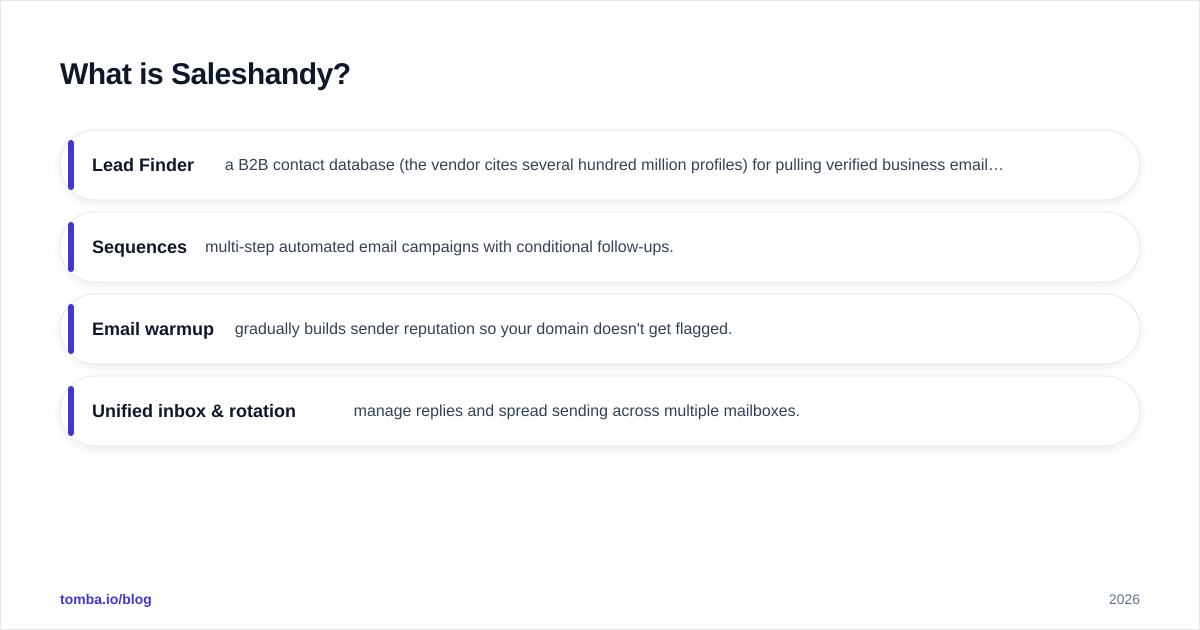
- Lead Finder — a B2B contact database (the vendor cites several hundred million profiles) for pulling verified business emails.
- Sequences — multi-step automated email campaigns with conditional follow-ups.
- Email warmup — gradually builds sender reputation so your domain doesn't get flagged.
- Unified inbox & rotation — manage replies and spread sending across multiple mailboxes.
If your motion is volume outbound — SDRs, agencies, founders doing their own prospecting — Saleshandy sits right in the center of the workflow. You can see how it stacks up against peers on G2's outreach category and on the vendor's own feature pages.
Aidentified vs Saleshandy: how do they compare?#
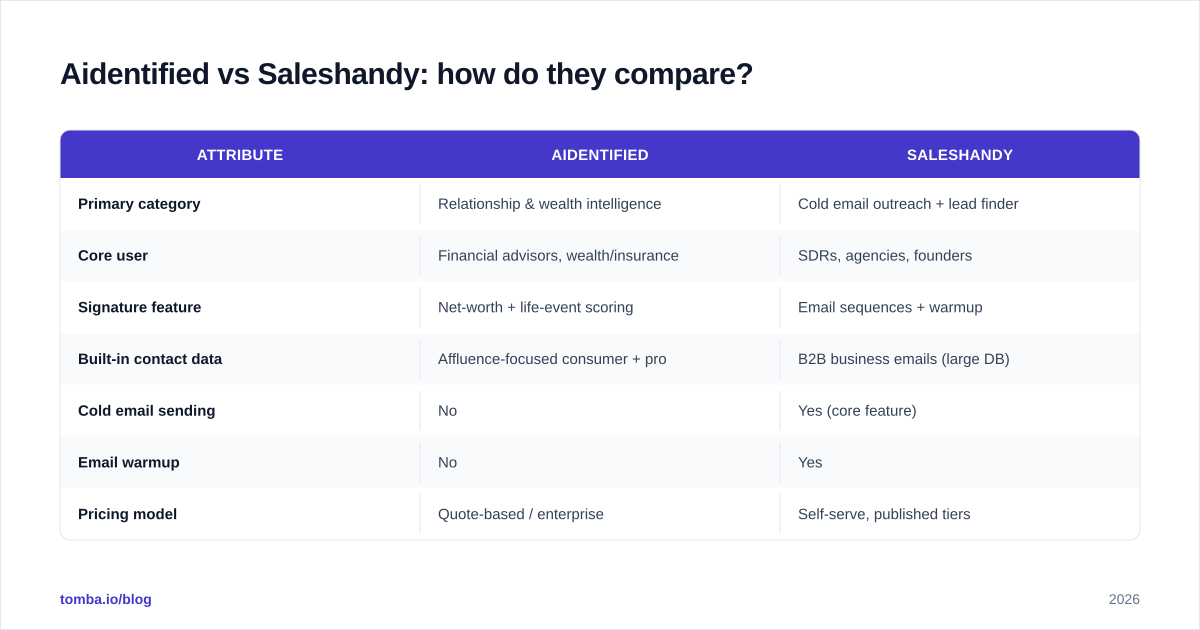
Here's the honest side-by-side. Note that several Aidentified figures are quote-based and not published publicly, so treat pricing as directional and confirm with the vendor.
| Attribute | Aidentified | Saleshandy |
|---|---|---|
| Primary category | Relationship & wealth intelligence | Cold email outreach + lead finder |
| Core user | Financial advisors, wealth/insurance | SDRs, agencies, founders |
| Signature feature | Net-worth + life-event scoring | Email sequences + warmup |
| Built-in contact data | Affluence-focused consumer + pro | B2B business emails (large DB) |
| Cold email sending | No | Yes (core feature) |
| Email warmup | No | Yes |
| Pricing model | Quote-based / enterprise | Self-serve, published tiers |
| Entry price | Custom (higher) | Low (~$25/mo range) |
| Free trial | Demo-gated | Yes, self-serve |
| Best for | Warm intros & referrals | Scaled outbound campaigns |
The table makes the split obvious: these tools overlap only in that both touch "prospecting data." Everything downstream — the workflow, the buyer, the price — diverges.
Is Aidentified better than Saleshandy?#
Neither is "better" — it depends entirely on how you sell. Use this quick decision filter:
- You sell financial services, wealth management, or insurance and win through referrals and timing → Aidentified. Its life-event triggers and network mapping are purpose-built for that.
- You run outbound email at volume and need deliverability, sequencing, and a lead database in one place → Saleshandy.
- You need raw email-finding accuracy and verification to feed any outreach tool → neither is your best primary source; use a dedicated email finder and pipe clean data in.
A common mistake is buying a relationship-intelligence platform expecting it to send campaigns, or buying an outreach tool expecting deep wealth signals. Match the tool to the motion, not to the louder marketing page.
What about data accuracy and coverage?#
This is where most buyers get burned, so be specific about what you're measuring.
Aidentified's strength is depth on affluent individuals — net worth modeling, asset signals, and relationship paths. Its weakness is that this depth is concentrated; it's not a general-purpose B2B contact engine for, say, finding the VP of Engineering at a mid-market SaaS company.
Saleshandy's Lead Finder is broader B2B but, like every bundled database, coverage and freshness vary by geography and seniority. Bundled databases are convenient, but they're rarely the most accurate option per record because the vendor's primary product is the sending engine, not the data.
That's why a lot of high-performing teams separate concerns:
- Source and verify contacts with a specialized tool.
- Push clean, verified records into the outreach or CRM platform.
If you go that route, run every address through an email verifier before it touches a sequence, and use domain search to pull every contact at a target account. A bounce rate under 3% protects the sender reputation that Saleshandy's warmup works so hard to build. Clean data in, more replies out — there's no warmup feature that fixes a list full of dead addresses.
How does pricing compare?#
Saleshandy is transparent; Aidentified is a sales conversation.
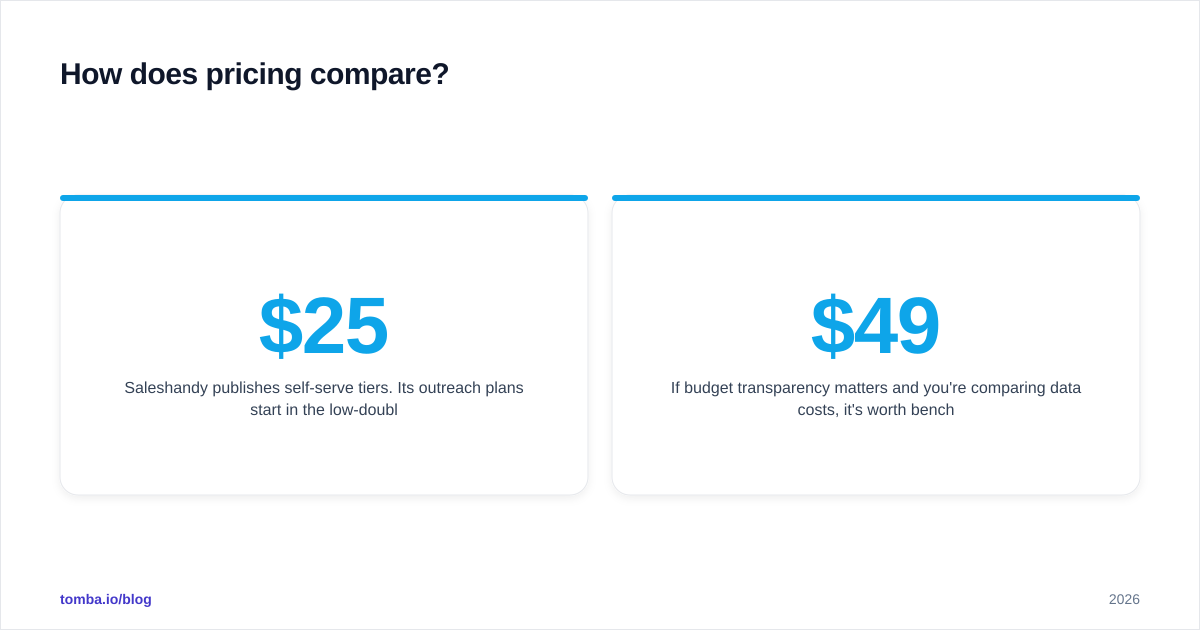
Saleshandy publishes self-serve tiers. Its outreach plans start in the low-double-digits per month (roughly $25/mo at entry, scaling with prospects and email accounts), and Lead Finder credits are sold in separate plans. You can start a trial without talking to anyone — see the live Saleshandy pricing page for current numbers.
Aidentified does not publish standard pricing. As a relationship- and wealth-data platform sold mostly to financial enterprises, it runs on demos and custom quotes, and the entry point is meaningfully higher than a self-serve outreach tool. That's normal for the category — you're paying for proprietary affluence modeling, not seats in a sequencer.
If budget transparency matters and you're comparing data costs, it's worth benchmarking both against a usage-priced option. For reference, Tomba pricing runs a Free tier (25 searches/mo), Starter at $49/mo, Growth at $99/mo, and Pro at $249/mo — predictable, self-serve, and built around finding and verifying contacts rather than sending campaigns or modeling net worth.
Which workflow does each tool fit?#
Picture two sellers.
The wealth advisor. She works a book of 200 clients and grows through referrals. Her best leads are people in her clients' orbit who just had a liquidity event. Aidentified surfaces those connections and ranks them by net worth and timing. A cold email blaster would be useless — and frankly off-brand — for her motion.
The SaaS SDR. He needs 50 qualified conversations a month from a cold start. He builds lists, writes a four-step sequence, warms up three inboxes, and measures reply rate. Saleshandy is his cockpit. Wealth scoring is irrelevant; what he needs is volume, deliverability, and verified emails.
Now the power move: the SDR's results live or die on data quality. He can lean on Saleshandy's bundled database, or he can enrich and verify externally for higher hit rates. If he's evaluating alternatives, our breakdown of Saleshandy alternatives and our notes on data enrichment lay out where a dedicated data layer beats a bundled one.
Can you use them together?#
Yes — and for some firms that's the smartest setup, because they don't overlap.
A wealth-management team could use Aidentified to identify and prioritize high-net-worth prospects and warm paths, then use a cold email tool like Saleshandy for the colder segments where no relationship exists. The two cover different temperatures of the funnel: Aidentified owns "warm and wealthy," Saleshandy owns "cold and scalable."
The connective tissue is clean contact data. Whichever platform you act in, you still need accurate emails and phone numbers to reach people. That's where a finder-and-verifier layer — pulling B2B phone numbers and verified emails — keeps both engines fed without the cost or lock-in of a single mega-suite.
What are the main pros and cons?#
Aidentified — pros: unmatched wealth and life-event signals; relationship mapping across a firm's network; purpose-built for financial services. Aidentified — cons: niche audience; no cold email sending or warmup; opaque, enterprise-level pricing; not a general B2B prospecting database.
Saleshandy — pros: affordable, transparent, self-serve; complete cold email stack (sequences, warmup, unified inbox); built-in lead finder; fast to start. Saleshandy — cons: not built for relationship or wealth intelligence; bundled database accuracy varies; volume outbound still depends on list quality you may want to source elsewhere.
The bottom line#
Choose by motion, not by marketing. Aidentified wins when your growth comes from warm, well-timed introductions to affluent people. Saleshandy wins when your growth comes from sending a lot of well-crafted cold email and keeping it out of spam. Comparing them directly is mostly a category mismatch — and recognizing that is the actual decision.
What both motions share is a dependency on accurate contact data, and that's the cheapest place to upgrade your results. Before you commit budget to either platform, make sure the emails feeding it are real. Start free with the Tomba Email Finder to find and verify professional emails by domain, name, or company — then plug that clean list into whichever engine, warm or cold, matches how you actually sell.
Ready to find emails that actually work?
Join 150,000+ professionals who stopped guessing and started sending. Free credits on signup — no credit card required.
Get the Tomba newsletter
Practical outbound tactics and product updates — once every two weeks.
About the author