Aidentified vs ZoomInfo: B2B Data Platforms Compared 2026
ZoomInfo sells scale and intent; Aidentified sells relationships and wealth signals. Here's which B2B data platform actually fits your go-to-market motion in 2026.
Choosing between Aidentified and ZoomInfo is not a "which is better" question. It is a "which problem are you solving" question. One is built to map who knows whom and how much they're worth. The other is built to hand you the largest professional contact database money can buy. Pick the wrong one and you'll either drown in records you can't action or pay a premium for relationship graphs your sales team will never use.
TL;DR#
- **
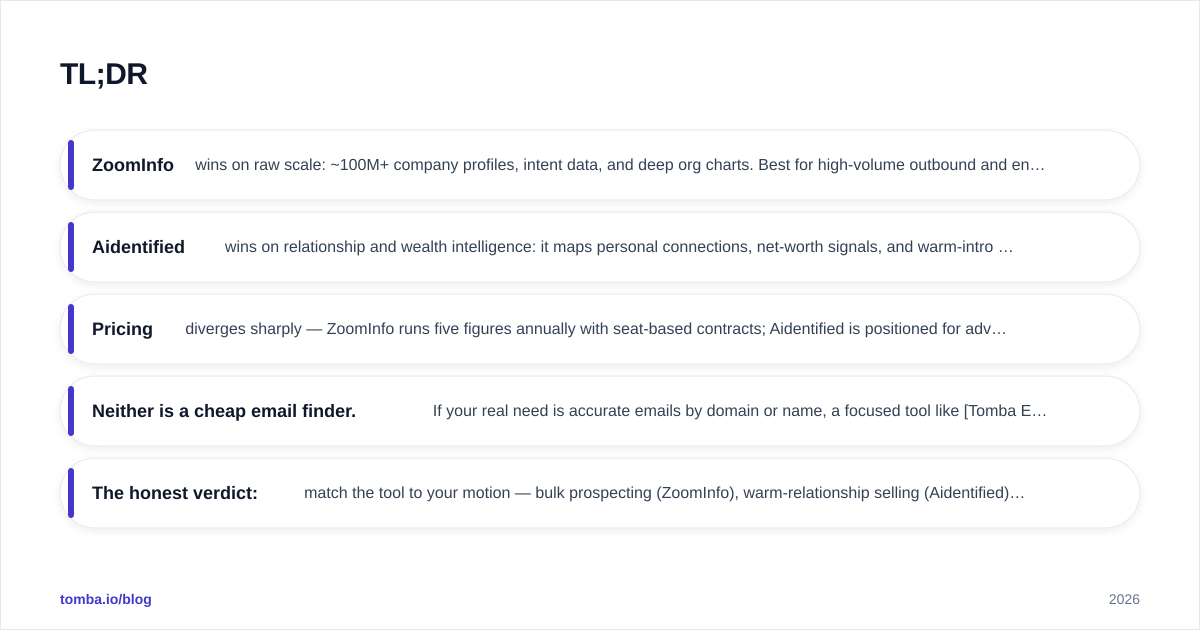
ZoomInfo** wins on raw scale: ~100M+ company profiles, intent data, and deep org charts. Best for high-volume outbound and enterprise RevOps.
- Aidentified wins on relationship and wealth intelligence: it maps personal connections, net-worth signals, and warm-intro paths. Best for wealth management, financial advisors, and high-ticket relationship selling.
- Pricing diverges sharply — ZoomInfo runs five figures annually with seat-based contracts; Aidentified is positioned for advisor teams with its own relationship-graph premium.
- Neither is a cheap email finder. If your real need is accurate emails by domain or name, a focused tool like Tomba Email Finder covers that at a fraction of the cost.
- The honest verdict: match the tool to your motion — bulk prospecting (ZoomInfo), warm-relationship selling (Aidentified), or surgical contact discovery (a dedicated email finder).
What is Aidentified?#
Aidentified is an AI-driven relationship and wealth intelligence platform. Its core promise is not "here are a million contacts" — it's "here is how you are connected to the person you want to reach, and here is what they're worth."
It ingests public and licensed data to build a graph of people, their professional and personal relationships, life events (job changes, liquidity events, board appointments), and estimated net worth. For a financial advisor trying to land a $5M client, knowing that your existing client went to college with the prospect is worth more than ten cold email addresses.
Aidentified's typical buyer is in wealth management, private banking, insurance, commercial real estate, or any field where deals are large, relationship-driven, and few. The platform leans into warm-intro pathing — surfacing the shortest trusted route into an account rather than a phone number you'll cold-dial.
What is ZoomInfo?#
ZoomInfo is the 800-pound gorilla of B2B data. It maintains one of the largest commercially available databases of companies and professionals, layered with firmographics, technographics, org charts, and buyer-intent signals scraped from across the web.
ZoomInfo's pitch is coverage and workflow. You can build a list of every VP of Engineering at SaaS companies with 200-1,000 employees using Snowflake, then push that list into your CRM and sequencing tool, enriched with direct dials and verified emails. Its intent data flags which of those accounts are actively researching your category.
The buyer here is RevOps, demand gen, and sales leadership at companies running volume-based outbound. ZoomInfo is a platform decision — it touches your CRM, your marketing automation, and your SDR workflow, and it's priced accordingly.
Aidentified vs ZoomInfo: how do they compare?#
The two platforms barely compete on the same axis.
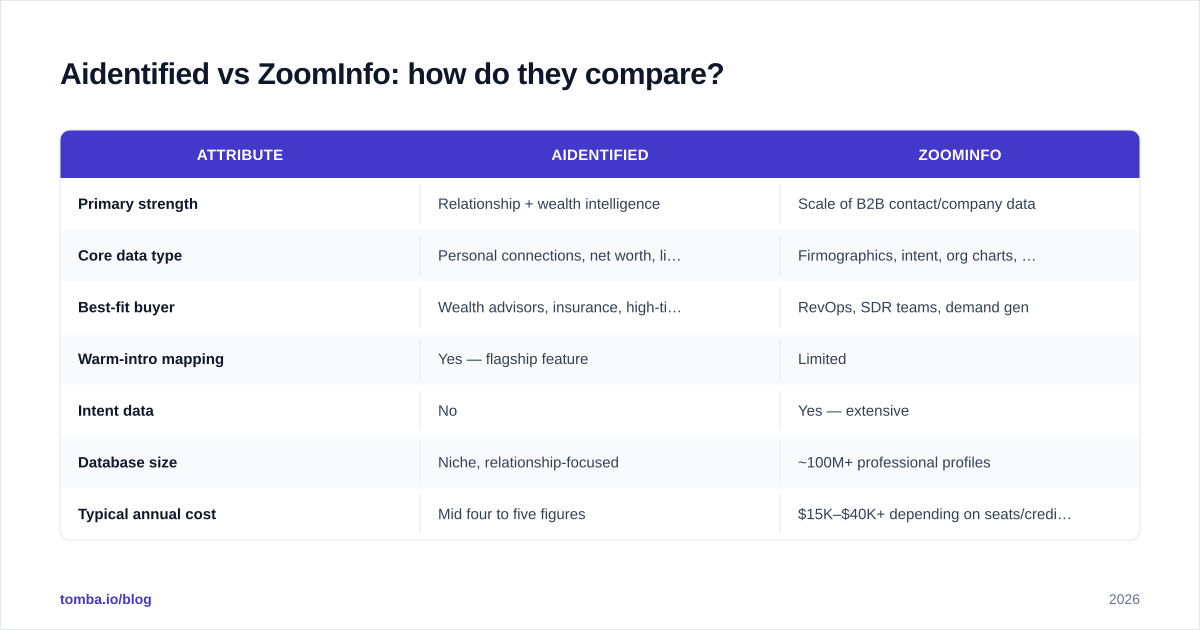
ZoomInfo optimizes for breadth and activation at scale; Aidentified optimizes for depth of relationship and signal quality on a smaller, higher-value set of targets.
Here's the head-to-head on the attributes that actually drive a buying decision:
| Attribute | Aidentified | ZoomInfo |
|---|---|---|
| Primary strength | Relationship + wealth intelligence | Scale of B2B contact/company data |
| Core data type | Personal connections, net worth, life events | Firmographics, intent, org charts, direct dials |
| Best-fit buyer | Wealth advisors, insurance, high-ticket sales | RevOps, SDR teams, demand gen |
| Warm-intro mapping | Yes — flagship feature | Limited |
| Intent data | No | Yes — extensive |
| Database size | Niche, relationship-focused | ~100M+ professional profiles |
| Typical annual cost | Mid four to five figures | $15K–$40K+ depending on seats/credits |
| Free tier | No | No (trial only) |
| CRM/workflow integrations | CRM sync, focused | Deep (Salesforce, HubSpot, Outreach, etc.) |
| Learning curve | Moderate | Steep (full platform) |
The pattern is clear: if your sales cycle hinges on who you know, Aidentified is purpose-built for it. If your cycle hinges on how many qualified accounts you can touch this quarter, ZoomInfo is the heavier machine.
Which one has better data?#
Neither — they have different data, and "better" depends entirely on your motion.
Think of it like maps. ZoomInfo is a satellite view of an entire continent: comprehensive, constantly updated, and great for planning routes across a huge territory. Aidentified is a detailed walking map of one neighborhood that also tells you which doors your friends can knock on for you. You wouldn't use a continent map to find your neighbor's back gate, and you wouldn't use a neighborhood map to plan a cross-country trip.
ZoomInfo's strength is volume and refresh. Its weakness is that scraped, scaled data inevitably carries decay — titles change, people leave, and direct dials go stale. That's why serious teams pair any large database with an email verifier before launching campaigns, regardless of vendor.
Aidentified's strength is signal: the relationship graph and wealth estimates are hard to replicate. Its weakness is narrow applicability — outside relationship-led, high-value selling, much of that intelligence is overkill.
If you want to understand how any provider sources and refreshes records, it's worth reading how data sources and verification actually work before trusting a vendor's coverage claims.
How much do they cost?#
This is where most evaluations end abruptly. Both platforms are annual-contract, sales-led purchases — neither publishes transparent self-serve pricing, and both typically require a demo before you see a quote.
- ZoomInfo commonly lands in the $15,000–$40,000+ per year range, scaling with seats, credits, and add-ons like intent and Engage (its sequencing layer). Enterprise deployments go far higher.
- Aidentified is priced for advisor and team deployments, generally in the mid-four to five-figure annual band, with the relationship-graph capability as the premium driver.
For a two-person startup that just needs verified emails to start outbound, both are dramatically over-scoped. That mismatch is the single most common reason teams churn off these platforms in year one — they bought a relationship graph or an intent engine when they actually needed contact discovery.

When should you choose Aidentified?#
Choose Aidentified when relationships are the product. Specifically:
- You're a financial advisor, wealth manager, or private banker and net-worth signals plus warm-intro paths directly drive revenue.
- Your deals are large and few — you'd rather have five perfect introductions than 5,000 cold contacts.
- Your team already has a referral-driven culture and wants to systematize it instead of relying on memory and luck.
- You sell high-ticket services (commercial real estate, insurance, M&A advisory) where trust and connection close deals.
In these worlds, the cost is easy to justify: a single relationship-sourced client can cover the annual contract many times over.
When should you choose ZoomInfo?#
Choose ZoomInfo when scale and workflow integration are the bottleneck:
- You run a volume outbound motion with SDRs who need fresh lists every week.
- RevOps needs enrichment at scale — auto-appending firmographics and intent to inbound leads and CRM records.
- You want buyer-intent data to prioritize accounts actively in-market.
- You need deep integrations with Salesforce, HubSpot, Outreach, and your existing stack — and the budget to support a platform decision.
ZoomInfo is a commitment. It rewards teams with the headcount and process maturity to actually operationalize that much data. For everyone else, it's an expensive address book.
Is there a better-fit alternative for most teams?#
For a large share of teams evaluating "Aidentified vs
ZoomInfo," the honest answer is: you may be over-buying.
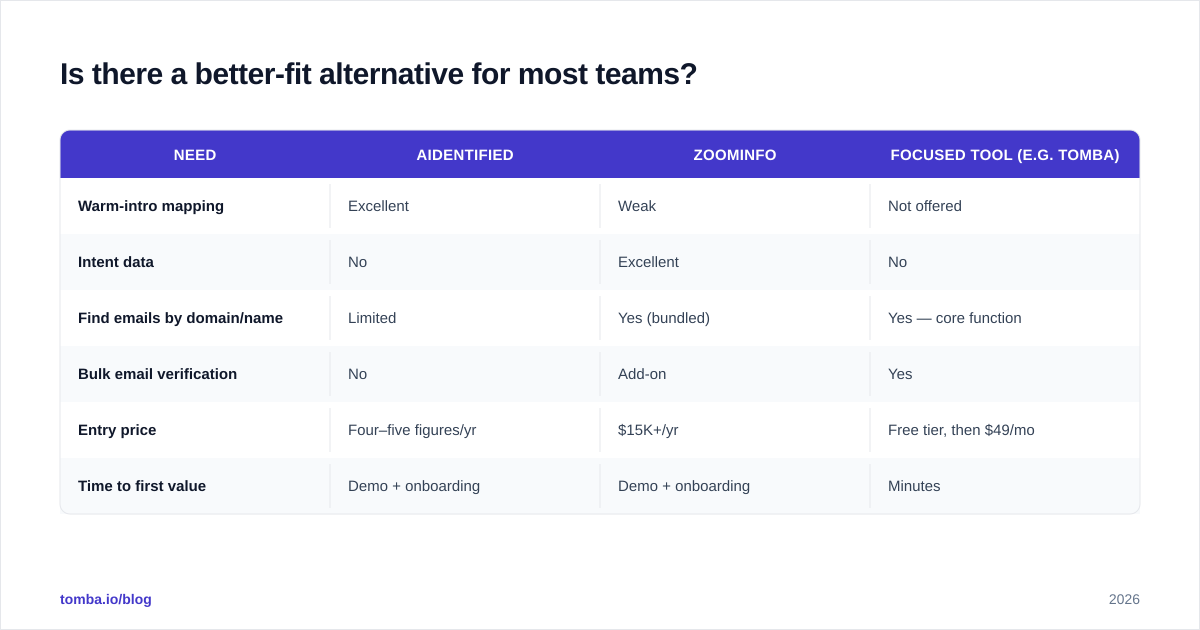
The relationship graph and the intent engine are powerful, but plenty of go-to-market teams really need three things — accurate emails, verified phone numbers, and clean enrichment — without a five-figure platform contract. That's the gap focused tools fill.
| Need | Aidentified | ZoomInfo | Focused tool (e.g. Tomba) |
|---|---|---|---|
| Warm-intro mapping | Excellent | Weak | Not offered |
| Intent data | No | Excellent | No |
| Find emails by domain/name | Limited | Yes (bundled) | Yes — core function |
| Bulk email verification | No | Add-on | Yes |
| Entry price | Four–five figures/yr | $15K+/yr | Free tier, then $49/mo |
| Time to first value | Demo + onboarding | Demo + onboarding | Minutes |
A pragmatic stack for most small and mid-market teams looks like this: use a dedicated email finder and domain search to build clean prospect lists, verify them, and enrich with contact enrichment — at a price point where the Tomba pricing starts free (25 searches/month) and runs $49/mo on Starter rather than $15K+/year.
That doesn't make ZoomInfo or Aidentified wrong. It means you should buy the relationship graph when you'll use the relationship graph, and buy the intent engine when you'll operationalize intent — not as a default because they're the names everyone recognizes.
How should you decide?#
Run your evaluation through three questions, in order:
- What closes your deals — connections, volume, or just reachable contacts? Connections point to Aidentified. Volume and intent point to ZoomInfo. Reachable contacts point to a focused email tool.
- What's your deal size and cadence? Few large deals justify relationship intelligence. Many smaller deals justify scale data. Early-stage outbound justifies a lean finder-plus-verifier.
- What can your team actually operationalize? A platform you don't fully use is the most expensive line item in your stack. Buy to your process maturity, not your ambition.
Match the tool to the motion and the decision makes itself. The mistake is treating these as interchangeable when they solve genuinely different problems.
The bottom line#
ZoomInfo is the right call when you need the biggest, most workflow-integrated B2B dataset and you have the volume motion and budget to use it. Aidentified is the right call when warm introductions and wealth signals are how you win, especially in financial services and high-ticket relationship selling.
But if you stepped into this comparison because you mostly need accurate, verified contact data to start reaching prospects this week — without signing a five-figure annual contract — start lean. Tomba Email Finder finds professional email addresses by domain, name, or company, pairs with built-in verification, and starts free at 25 searches a month before scaling to $49/mo. Validate your motion first, then graduate to a relationship graph or intent engine when you've proven you'll actually use it.
// get started
Find, verify and enrich your first contacts today
Start on the free plan with 25 searches a month, then scale when your team is ready.
Free plan · No credit card required · GDPR & CCPA
// about the author