Aircall vs CloudTalk 2026: Which Cloud Phone Wins?
Aircall vs CloudTalk compared on pricing, dialer power, integrations, and call quality so you pick the right cloud phone system for your sales team in 2026.
TL;DR
- Aircall wins on ecosystem depth and ease of setup — 100+ native integrations, a polished admin console, and reliability that mid-market RevOps teams trust.
- CloudTalk wins on dialer power per dollar — a stronger Smart/Power/Predictive dialer stack and call-center analytics at a lower entry seat price.
- Pricing is close: Aircall starts around $30/user/mo (3-seat minimum), CloudTalk around $25/user/mo. Both bill annually for the best rate.
- Pick Aircall if you live inside HubSpot/Salesforce and want set-it-and-forget-it. Pick CloudTalk if outbound call volume and dialer automation are your bottleneck.
- Neither tool finds numbers for you — pair whichever you choose with a dedicated phone finder so your reps dial verified contacts, not dead lines.
What are Aircall and CloudTalk?#
Both are cloud-based business phone systems (VoIP) built for sales and support teams that have outgrown a desk phone or a personal cell. Think of them like the difference between owning a landline and renting a fully-staffed call center that lives in your browser — you get numbers, routing, recording, analytics, and CRM sync without touching hardware.
Aircall launched in 2014 and positions itself as the integration-first phone for mid-market revenue teams. Its pitch is simplicity: spin up numbers in 100+ countries, drop a softphone on every rep's desktop, and pipe every call into your CRM automatically.
CloudTalk is the call-center-leaning challenger. It leads with dialer automation and granular analytics, targeting high-volume outbound teams and BPOs that measure success in dials-per-hour and connect rates.
The honest summary: these tools overlap on 80% of features. The 20% that differs — dialer sophistication, integration breadth, and per-seat economics — is where your decision actually lives.
Wait — that's the wrong frame. Let me show you the real one.
How do Aircall and CloudTalk compare on pricing?#
Pricing is the first place teams get tripped up because both vendors quote per-user, per-month figures that assume annual billing and a seat minimum. Here is the real-world shape as of 2026.
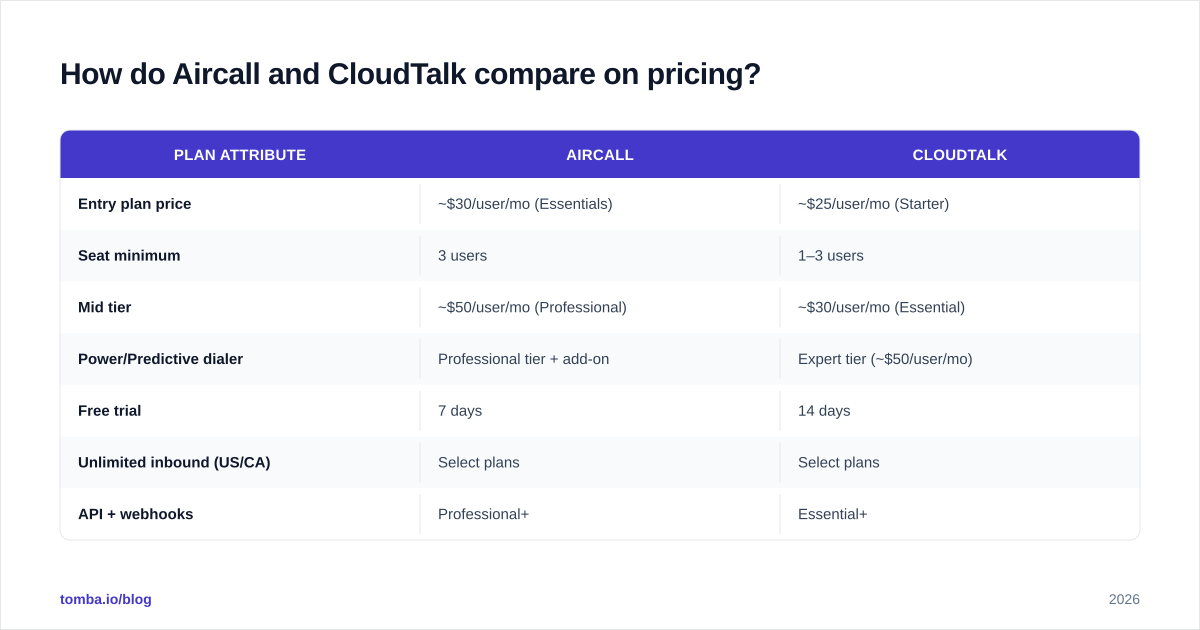
| Plan attribute | Aircall | CloudTalk |
|---|---|---|
| Entry plan price | ~$30/user/mo (Essentials) | ~$25/user/mo (Starter) |
| Seat minimum | 3 users | 1–3 users |
| Mid tier | ~$50/user/mo (Professional) | ~$30/user/mo (Essential) |
| Power/Predictive dialer | Professional tier + add-on | Expert tier (~$50/user/mo) |
| Free trial | 7 days | 14 days |
| Unlimited inbound (US/CA) | Select plans | Select plans |
| API + webhooks | Professional+ | Essential+ |
The takeaway: CloudTalk is cheaper at the entry rung and gives you a longer trial, while Aircall front-loads polish and integration access. If your team is small and dialer-hungry, CloudTalk's economics win. If you need Salesforce-grade workflows and you'll lean on the integration marketplace, Aircall's higher seat price buys you fewer headaches.
One caveat that bites everyone: international calling, number rental, and add-ons (extra numbers, advanced analytics, dialer credits) sit on top of the seat price. Budget 15–30% above the sticker for a realistic monthly figure.
Which has the better dialer for outbound sales?#
CloudTalk, decisively, on dialer depth. This is its home turf.
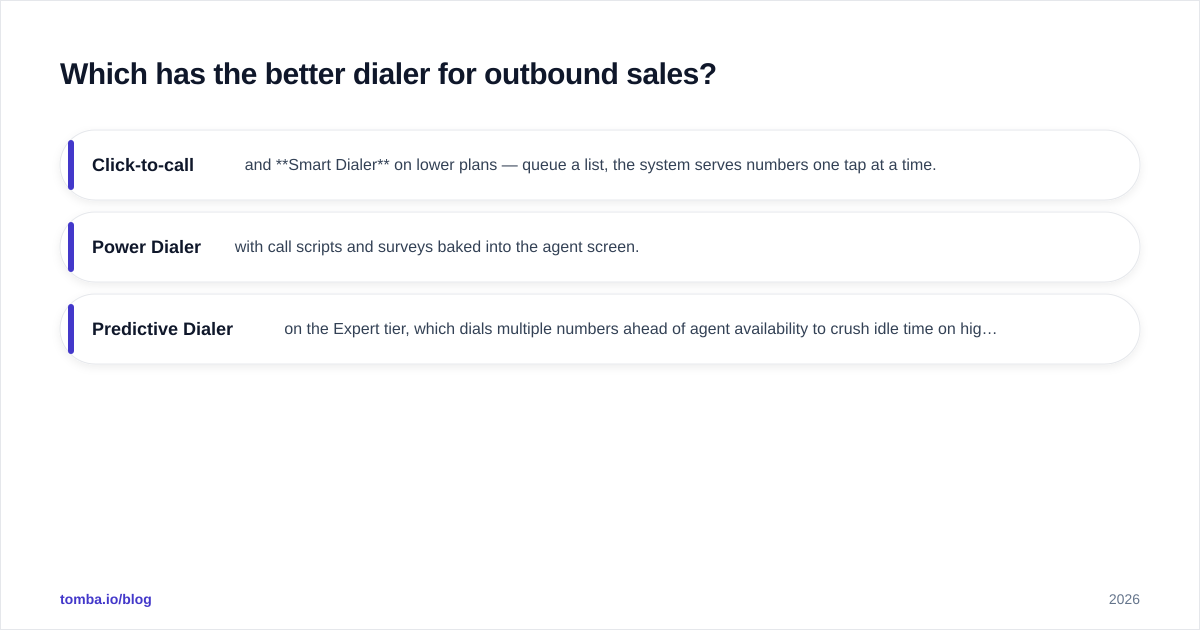
CloudTalk ships a tiered dialer stack:
- Click-to-call and Smart Dialer on lower plans — queue a list, the system serves numbers one tap at a time.
- Power Dialer with call scripts and surveys baked into the agent screen.
- Predictive Dialer on the Expert tier, which dials multiple numbers ahead of agent availability to crush idle time on high-volume campaigns.
Aircall offers a Power Dialer too, and it's genuinely good — it auto-queues numbers detected on a webpage and dials sequentially. But Aircall does not offer true predictive dialing, and its automation tooling is lighter. For a team grinding 150+ outbound dials per rep per day, that gap compounds into real lost selling hours.
A dialer is only as good as the list feeding it, though. Both platforms assume you arrive with clean, accurate phone numbers. If your CRM is full of stale or wrong numbers, even a predictive dialer just burns through bad data faster. This is where a validation step pays for itself — run your list through a phone validator before a campaign so your connect rate reflects real prospects, not disconnected lines.
Which integrates better with your CRM and stack?#
Aircall, by a clear margin. Integration breadth is its single strongest differentiator.
Aircall maintains 100+ one-click integrations covering HubSpot, Salesforce, Pipedrive,
Zendesk, Intercom, Gong, and most of the modern revenue stack. The syncs are deep — call logging, contact matching, click-to-dial from inside the CRM record, and automatic activity creation all work with minimal config.
CloudTalk integrates with the major players too — Salesforce, HubSpot, Pipedrive, Zendesk, Intercom — but the catalog is smaller (roughly 35+) and a few connectors are shallower, logging calls without the richer two-way contact sync Aircall offers.
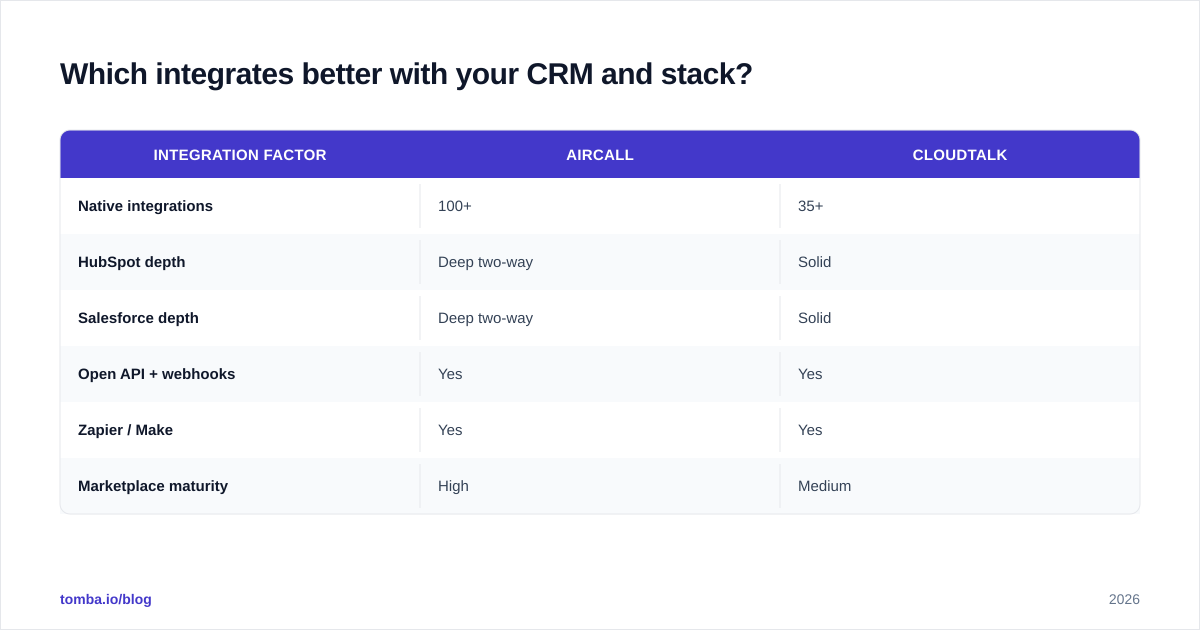
| Integration factor | Aircall | CloudTalk |
|---|---|---|
| Native integrations | 100+ | 35+ |
| HubSpot depth | Deep two-way | Solid |
| Salesforce depth | Deep two-way | Solid |
| Open API + webhooks | Yes | Yes |
| Zapier / Make | Yes | Yes |
| Marketplace maturity | High | Medium |
If your team runs on HubSpot or Salesforce and you want call data flowing into deals without engineering work, Aircall is the safer bet. CloudTalk closes the gap if you're willing to lean on its API or a Zapier integration for the long tail. And if you enrich contact records before dialing, a data enrichment step keeps both CRMs populated with current titles, companies, and direct lines.
Is call quality and reliability different?#
Both run on global carrier networks with redundancy, and in normal conditions you won't hear a difference — call quality on either is bound more by your reps' internet connection than the platform.
Where they diverge is at the edges:
- Aircall has a longer track record of mid-market uptime and a more mature status/monitoring setup. Larger teams tend to report fewer surprises.
- CloudTalk offers strong call quality and international number coverage (160+ countries), occasionally edging Aircall on specific regional routes.
For distributed teams making international calls, test both on your actual routes during the trial — CloudTalk's 14-day window is genuinely useful here. Don't take any vendor's quality claim on faith; dial your real prospect geographies and listen.
What about analytics and reporting?#
This one is closer than the dialer question, but CloudTalk leans more call-center-native while Aircall leans manager-friendly.
CloudTalk's analytics surface agent-level metrics — wait times, abandonment, dials-per-hour, service-level adherence — the way a contact-center supervisor expects. Wallboards and real-time dashboards are first-class.
Aircall's analytics are cleaner and more accessible for a sales manager who doesn't want to think like a call-center ops lead. You get call volume, missed-call rates, team activity, and tag-based reporting without a learning curve. Its higher tiers add Analytics+ for deeper drill-downs.
Rule of thumb: if a dedicated ops person will live in the dashboards, CloudTalk rewards them. If a sales manager wants a glance-and-go view, Aircall is friendlier.
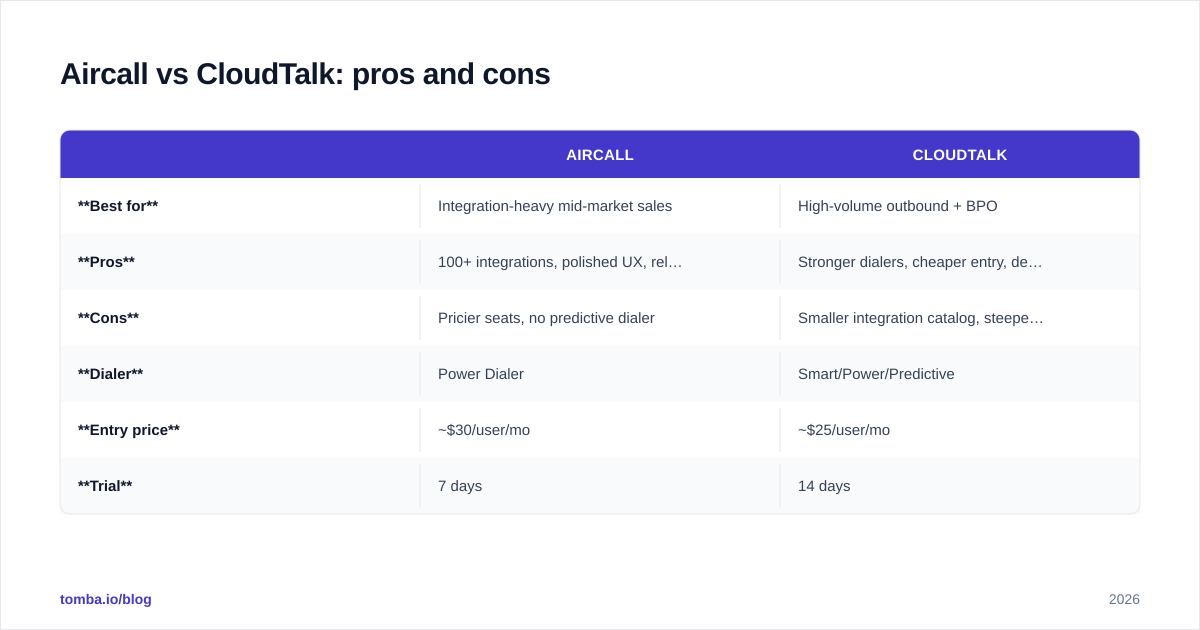
Aircall vs CloudTalk: pros and cons#
| Aircall | CloudTalk | |
|---|---|---|
| Best for | Integration-heavy mid-market sales | High-volume outbound + BPO |
| Pros | 100+ integrations, polished UX, reliable | Stronger dialers, cheaper entry, deep analytics |
| Cons | Pricier seats, no predictive dialer | Smaller integration catalog, steeper UI |
| Dialer | Power Dialer | Smart/Power/Predictive |
| Entry price | ~$30/user/mo | ~$25/user/mo |
| Trial | 7 days | 14 days |

How do you choose between them?#
Answer three questions in order:
- What's your bottleneck — connect volume or workflow? If reps can't dial fast enough, CloudTalk's predictive dialer is the lever. If reps drown in manual CRM logging, Aircall's integrations are the lever.
- What CRM do you live in? Deep HubSpot/Salesforce users lean Aircall. API-comfortable teams or budget-first teams lean CloudTalk.
- Who reads the reports? A call-center ops lead → CloudTalk. A sales manager who wants simplicity → Aircall.
Most teams that "can't decide" actually have a data problem, not a phone problem. A new dialer won't fix a contact list full of wrong numbers, missing direct lines, and outdated companies. Before you commit to either platform, get your prospect data right: use a phone finder to source verified B2B numbers, validate them, and only then turn the dialer loose. You can compare the full Tomba pricing tiers to see how data sourcing fits alongside whichever phone system you choose. For benchmarking your shortlist objectively, G2's category comparison is a useful neutral reference.
Frequently asked questions#
Is Aircall or CloudTalk cheaper? CloudTalk is cheaper at the entry tier (~$25 vs ~$30/user/mo) and offers a longer free trial. Total cost depends on dialer tier and add-ons.
Does CloudTalk have a predictive dialer? Yes, on its Expert tier. Aircall offers a Power Dialer but not true predictive dialing.
Which integrates better with HubSpot? Aircall, with deeper two-way sync and a larger integration catalog overall.
Can either tool find phone numbers? No. Both are phone systems, not data providers. You supply the numbers — source them with a dedicated tool and validate before dialing.
Final recommendation#
There's no universal winner — there's a winner for your bottleneck. Choose Aircall when integrations and reliability matter most and you want the lowest-friction rollout. Choose CloudTalk when raw outbound dialing throughput and call-center analytics drive your numbers.
Whichever you pick, the phone system is the megaphone — it's worthless without the right contacts on the other end. Start with accurate, verified data: use the Tomba Email Finder and phone finder to build a clean, enriched prospect list, then feed it into Aircall or CloudTalk with confidence. Better data in means better conversations out — and that's the only metric that closes deals.
Ready to find emails that actually work?
Join 150,000+ professionals who stopped guessing and started sending. Free credits on signup — no credit card required.
Get the Tomba newsletter
Practical outbound tactics and product updates — once every two weeks.
About the author