Aircall vs Five9 (2026): Which Call Center Tool Wins?
Aircall is the fast-to-deploy cloud phone for SMB sales teams; Five9 is the enterprise contact-center workhorse. Here's how they compare on price, dialer power, and integrations in 2026.
Choosing between Aircall and Five9 comes down to one question: are you running a lean sales team that wants to be dialing by tomorrow, or a high-volume contact center that needs predictive dialing, workforce management, and deep AI routing? Both are cloud telephony platforms, but they are built for different ends of the market.
This guide breaks down pricing, dialer capabilities, integrations, AI features, and support so you can pick the right one without a six-week sales cycle.
TL;DR — Aircall vs Five9 in one screen#
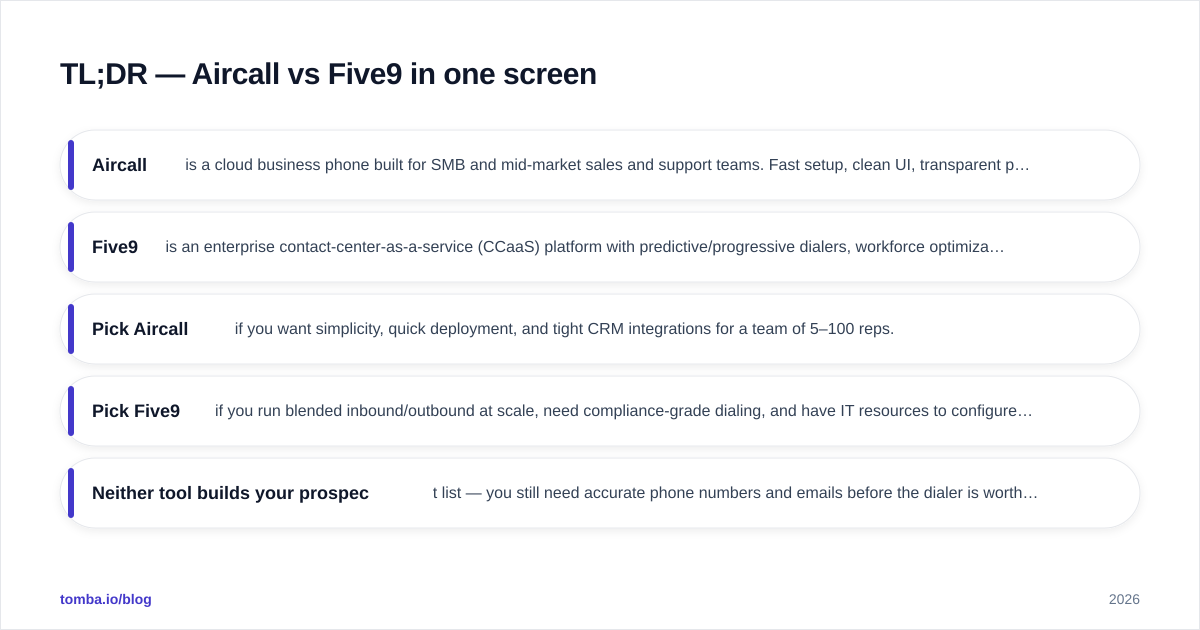
- Aircall is a cloud business phone built for SMB and mid-market sales and support teams. Fast setup, clean UI, transparent per-seat pricing starting around $30/user/month.
- Five9 is an enterprise contact-center-as-a-service (CCaaS) platform with predictive/progressive dialers, workforce optimization, and omnichannel routing. Pricing is quote-based and typically higher per seat.
- Pick Aircall if you want simplicity, quick deployment, and tight CRM integrations for a team of 5–100 reps.
- Pick Five9 if you run blended inbound/outbound at scale, need compliance-grade dialing, and have IT resources to configure it.
- Neither tool builds your prospect list — you still need accurate phone numbers and emails before the dialer is worth anything.
What is Aircall?#
Aircall is a cloud-based phone system (VoIP) aimed at sales and support teams that want call-center features without call-center complexity. You can spin up numbers in 100+ countries, route calls with an IVR, record and tag conversations, and push everything into your CRM.
Its reputation is built on speed and usability. Most teams are live within a day, and the admin dashboard is friendly enough that a sales ops generalist — not a dedicated telecom engineer — can manage it. Aircall integrates natively with HubSpot, Salesforce, Pipedrive, Intercom, Zendesk, and dozens of others.
The trade-off: Aircall is a power dialer and softphone, not a heavy predictive-dialing engine. For outbound teams burning through thousands of dials a day with strict compliance needs, it can feel light.
What is Five9?#
Five9 is a full contact-center-as-a-service platform. It's the tool you reach for when "phone system" undersells what you need: predictive and progressive dialers, automatic call distribution (ACD), skills-based routing, workforce management (WFM), quality monitoring, and omnichannel (voice, email, chat, SMS, social) in one console.
Five9 has been around since 2001 and serves large support and sales organizations — think hundreds or thousands of agents. Its AI layer (Five9 Intelligent CX) handles intent detection, real-time agent assist, and post-call summarization. The platform is deep, but that depth means longer implementation, professional services, and a steeper learning curve.
If Aircall is a well-designed sedan, Five9 is a freight system: more capacity, more controls, more setup.
Aircall vs Five9: feature and pricing comparison#
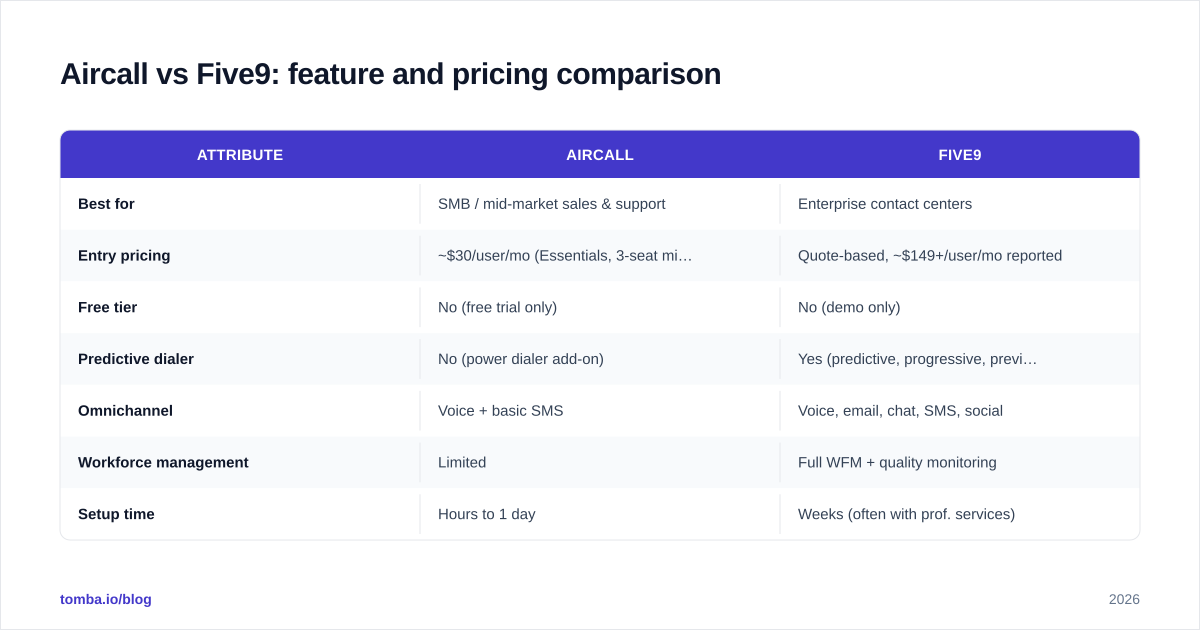
Here's the side-by-side. Aircall pricing is public and per-seat; Five9 pricing is quote-based, so the figures below reflect commonly reported ranges rather than a published rate card.
| Attribute | Aircall | Five9 |
|---|---|---|
| Best for | SMB / mid-market sales & support | Enterprise contact centers |
| Entry pricing | ~$30/user/mo (Essentials, 3-seat min) | Quote-based, ~$149+/user/mo reported |
| Free tier | No (free trial only) | No (demo only) |
| Predictive dialer | No (power dialer add-on) | Yes (predictive, progressive, preview) |
| Omnichannel | Voice + basic SMS | Voice, email, chat, SMS, social |
| Workforce management | Limited | Full WFM + quality monitoring |
| Setup time | Hours to 1 day | Weeks (often with prof. services) |
| Native CRM integrations | 100+ app marketplace | Salesforce, ServiceNow,Zendesk, MS Dynamics |
| AI features | Transcription, call summary | Intent detection, agent assist, IVA |
| Support model | Email/chat, phone on higher tiers | 24/7 + dedicated CSM at scale |
For Aircall's current published rates, check the Aircall pricing page directly; for Five9, you'll need to request a quote at five9.com. Third-party reviews on G2 are useful for seeing how each performs in your segment.

Is Aircall better than Five9 for outbound sales?#
For most SMB and mid-market outbound teams, yes — Aircall is the better fit. The power dialer, click-to-call from the CRM, and call tagging cover the core sales motion, and reps actually enjoy using it. You won't fight the interface.
But "better" flips at scale. If you're running blended campaigns with 50+ agents, need a predictive dialer to keep talk time high, or operate under TCPA-style compliance regimes, Five9's dialing engine and list management pull ahead. Five9 is engineered to maximize connected conversations per hour in a way Aircall's power dialer is not.
A simple rule of thumb:
- Under ~50 reps, relationship/consultative selling → Aircall
- High-volume, list-driven, compliance-heavy dialing → Five9
How do the integrations compare?#
Both connect to the tools your revenue team already runs, but the philosophy differs.
Aircall leans on a broad self-serve marketplace — over 100 one-click integrations across CRMs, helpdesks, and productivity apps. You toggle them on without engineering help. This is a big reason SMBs love it.
Five9 goes deeper on fewer, enterprise-grade connectors (Salesforce, ServiceNow, Microsoft Dynamics, Zendesk) with bidirectional sync, screen pops, and embedded agent desktops. It's less "plug and play," more "configured to your workflow by an implementation team."
If your stack is HubSpot or Pipedrive, Aircall wins on ease. If you live in Salesforce Service Cloud at enterprise scale, Five9's integration depth is the differentiator.
What about AI and call intelligence?#
This is where the 2026 gap narrows. Aircall now offers AI transcription, call summaries, and topic tagging across higher tiers — enough to feed coaching and CRM notes automatically. It's solid for the SMB use case.
Five9 plays a different game with Intelligent CX: real-time agent assist that surfaces answers mid-call, intent-based routing, virtual agents (IVA) that deflect calls before they reach a human, and analytics dashboards built for QA teams managing hundreds of agents. If AI-driven deflection and real-time guidance are core to your strategy, Five9 is the more complete platform.
For sales teams, the practical question is narrower: do you need accurate post-call summaries pushed to the CRM (Aircall handles this), or do you need AI actively shaping live conversations and routing (Five9's territory)?

The part both tools assume you've already solved#
Here's what neither Aircall nor Five9 does: build your list. A predictive dialer firing through bad numbers just burns reputation faster. Five9's compliance tooling and Aircall's clean UI are both wasted if the contact data feeding them is stale.
Before you commit to either platform, your real bottleneck is usually data quality. You need verified, direct-dial B2B phone numbers and decision-maker emails — not switchboard lines that route reps to a receptionist. That's the layer that determines whether your reps actually connect.
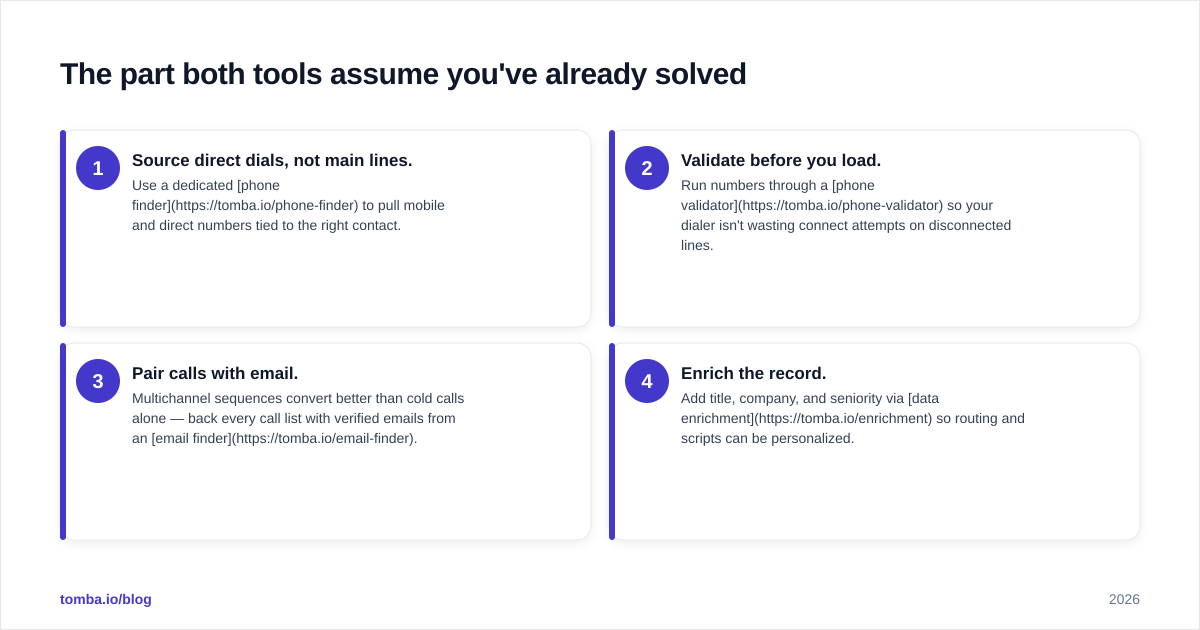
A practical pre-dialer checklist:
- Source direct dials, not main lines. Use a dedicated phone finder to pull mobile and direct numbers tied to the right contact.
- Validate before you load. Run numbers through a phone validator so your dialer isn't wasting connect attempts on disconnected lines.
- Pair calls with email. Multichannel sequences convert better than cold calls alone — back every call list with verified emails from an email finder.
- Enrich the record. Add title, company, and seniority via data enrichment so routing and scripts can be personalized.
Do this first, and either platform performs dramatically better. Skip it, and you'll blame the dialer for a data problem.
Which should you choose?#
Match the tool to your operation, not the other way around.
Choose Aircall if you:
- Run a sales or support team of roughly 5–100 people
- Want to be live in a day with minimal IT
- Value a clean rep experience and broad CRM integrations
- Have predictable, transparent per-seat budgeting in mind
Choose Five9 if you:
- Operate a contact center with high outbound volume or blended channels
- Need a predictive dialer, WFM, and quality monitoring
- Have compliance requirements around dialing
- Can invest in implementation and have a CSM relationship
For a large share of growing B2B sales teams, Aircall is the pragmatic pick — it removes telephony friction without forcing an enterprise procurement process. Five9 earns its keep once your volume, compliance, and agent count outgrow what a lightweight cloud phone can handle.
How does this fit your wider prospecting stack?#
Your dialer is the last mile. The number you dial and the email you send afterward decide whether outreach lands. If you want a deeper look at sourcing direct dials, see how a phone finder pulls verified numbers, and pair it with contact enrichment so every record your reps touch is complete.
Calling cold is also rarely a single-touch game — the strongest outbound motions combine calls with email and LinkedIn. Building that list accurately upfront is the highest-leverage thing you can do before paying for either Aircall or Five9.
The bottom line#
Aircall and Five9 solve the same problem at different scales. Aircall is the faster, friendlier cloud phone for SMB and mid-market teams. Five9 is the enterprise contact-center platform for high-volume, compliance-heavy, omnichannel operations. Decide based on your dial volume, agent count, and how much implementation effort you can absorb — not on a feature checklist alone.
Whichever you choose, the dialer is only as good as the data behind it. Start with accurate contacts: use the Tomba Email Finder to source verified decision-maker emails, layer in direct-dial numbers with the phone finder, and feed clean records into your call center. You can test it on the free tier (25 searches/month), then scale with the Starter plan at $49/month as your outbound ramps. Build the list right, and your call center platform — Aircall or Five9 — finally earns its price tag.
// get started
Find, verify and enrich your first contacts today
Start on the free plan with 25 searches a month, then scale when your team is ready.
Free plan · No credit card required · GDPR & CCPA
// about the author