Aircall vs Ringover (2026): Which Phone System Wins?
Aircall vs Ringover, compared head-to-head for 2026: pricing, calling features, integrations, and international coverage so you can pick the right cloud phone for your sales team.
Choosing a cloud phone system used to be a procurement footnote. Now it sits at the center of how sales and support teams move — every dial, every recording, every CRM log runs through it. Two names come up again and again on shortlists: Aircall and Ringover. Both are cloud-native, both plug into your CRM, and both promise to replace your aging desk phones. They are not the same product, though, and the gap shows up fastest in your monthly bill and your international call quality.
This guide breaks down Aircall vs Ringover the way a buyer actually evaluates them: price per seat, calling features, integrations, global coverage, and the trade-offs nobody puts on the pricing page.
TL;DR — Aircall vs Ringover at a glance#
- Ringover wins on price and inclusivity. Unlimited calls to 110+ destinations are bundled into its plans, while Aircall meters more and sells key features as add-ons.
- Aircall wins on ecosystem. Its app marketplace and integration depth (especially HubSpot and Salesforce) are broader and more mature than Ringover's.
- Both start around 3 users minimum. Aircall's entry plan lists higher per-seat pricing; Ringover's entry plan undercuts it and includes more out of the box.
- Ringover bundles calls, SMS, and video; Aircall leans on a tighter telephony core with paid AI and analytics layers on top.
- Pick on your stack and call volume: heavy CRM automation and a big app library favor Aircall; high international volume and predictable flat costs favor Ringover.
What are Aircall and Ringover?#
Aircall is a cloud-based phone system built for sales and support teams who live inside a CRM. Think of it as a phone that was designed CRM-first rather than dial-tone-first — the call is almost a side effect of logging activity, routing leads, and triggering workflows. It launched in 2014, is used by tens of thousands of companies, and is best known for its app marketplace and clean, opinionated interface. You can see the current feature set on the official Aircall site.
Ringover is a French-built cloud communications platform that bundles voice, SMS, and video into a single subscription. Its pitch is "all-in-one without the surprise invoice" — unlimited calling to a long list of countries is baked into the plans rather than billed per minute. It tends to appeal to teams with heavy outbound volume and international footprints. Details are on the official Ringover site.
Both are SaaS, browser-and-app based, and require no hardware. The real decision is about philosophy: Aircall is a telephony layer wrapped around your CRM and apps, while Ringover is a communications suite that tries to be self-contained.
How do Aircall and Ringover compare at a glance?#
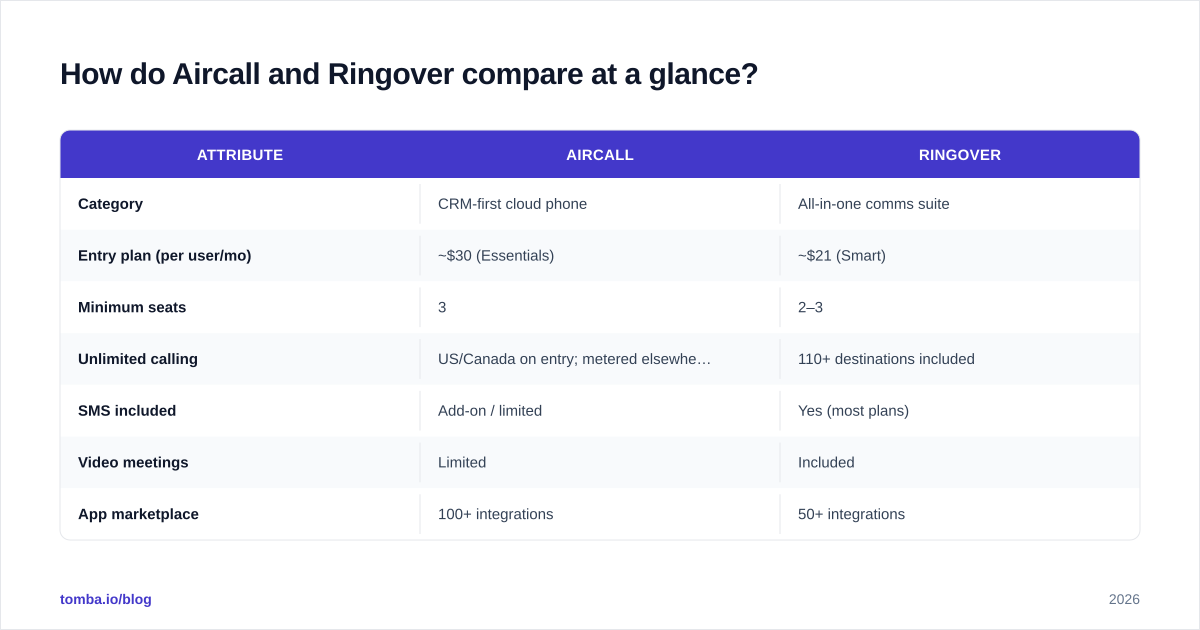
Here is the high-level comparison before we go deeper on each axis. Treat the pricing as directional — both vendors run promotions and annual discounts, so confirm on their pricing pages.
| Attribute | Aircall | Ringover |
|---|---|---|
| Category | CRM-first cloud phone | All-in-one comms suite |
| Entry plan (per user/mo) | ~$30 (Essentials) | ~$21 (Smart) |
| Minimum seats | 3 | 2–3 |
| Unlimited calling | US/Canada on entry; metered elsewhere | 110+ destinations included |
| SMS included | Add-on / limited | Yes (most plans) |
| Video meetings | Limited | Included |
| App marketplace | 100+ integrations | 50+ integrations |
| AI features | Paid add-on (Aircall AI) | Included on higher tiers (Empower) |
| Best for | CRM-heavy sales/support teams | High-volume + international outbound |
The headline: Ringover packs more into the base price, while Aircall asks you to pay for depth — but that depth is real if you live in HubSpot or Salesforce all day.
Is Aircall or Ringover better for pricing?#
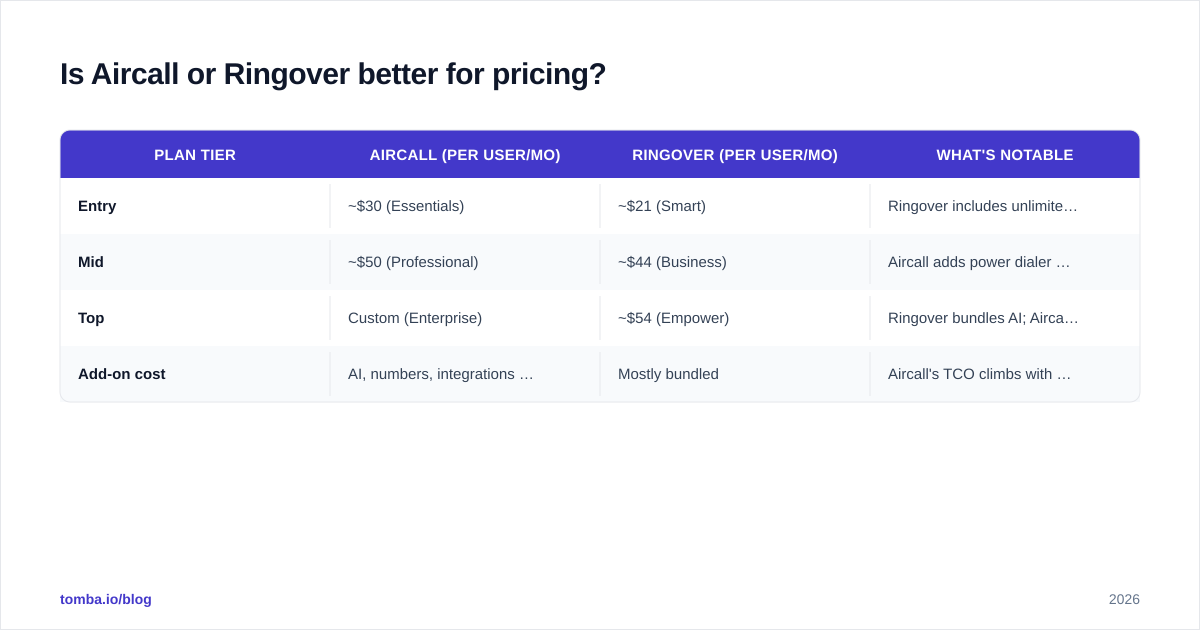
Ringover is the cheaper entry point and the more predictable bill. Aircall is the more expensive entry point but the more extensible platform.
Aircall publishes three main tiers — Essentials, Professional, and a custom Enterprise plan — with a three-seat minimum. The catch is that several things buyers assume are standard (advanced analytics, the power dialer, AI transcription) live on the Professional tier or as paid add-ons. So the "real" cost for an outbound sales team is usually the Professional plan, not the entry one.
Ringover's tiers — Smart, Business, and Empower — bundle more by default. Unlimited calls to 110+ destinations, SMS, and call recording show up earlier in the lineup, and the AI layer (Empower) is a plan rather than an à la carte surcharge.
| Plan tier | Aircall (per user/mo) | Ringover (per user/mo) | What's notable |
|---|---|---|---|
| Entry | ~$30 (Essentials) | ~$21 (Smart) | Ringover includes unlimited intl. calling |
| Mid | ~$50 (Professional) | ~$44 (Business) | Aircall adds power dialer + analytics here |
| Top | Custom (Enterprise) | ~$54 (Empower) | Ringover bundles AI; Aircall AI is add-on |
| Add-on cost | AI, numbers, integrations billed extra | Mostly bundled | Aircall's TCO climbs with add-ons |
If your evaluation is purely line-item cost for a team making lots of international calls, Ringover almost always comes out lower. If your team is small, domestic, and CRM-obsessed, the gap narrows and Aircall's ecosystem can justify the premium.
)
Which has better calling features?#
This one is closer than the pricing gap suggests, and it splits by use case.
Aircall's strengths are routing, collaboration, and the "shared inbox for phones" experience. Call whispering, warm transfers, shared contacts, tags, and assignment make it strong for support teams and SDR pods that hand calls around. The Professional plan's power dialer is genuinely good for outbound reps working a list.
Ringover's strengths are volume tooling and built-in versatility. Its power dialer, click-to-call, local presence dialing, and voicemail drop are designed for reps grinding through hundreds of dials a day. Because SMS and video are included, a rep can move from a cold call to a text follow-up to a screen-share without bolting on another tool.
For raw cold-calling throughput, both deliver a competent power dialer, but Ringover's is available lower in the lineup. For nuanced routing and team collaboration on inbound, Aircall has the edge. If your motion is heavy phone prospecting, pair whichever dialer you choose with a disciplined cadence — our breakdown of cold calling and phone sales tactics pairs naturally with either platform.
A practical note: a dialer is only as good as the numbers you feed it. Both tools assume you already have accurate, dialable B2B phone numbers — neither sources them for you.
How do the integrations compare?#
Aircall wins on breadth and depth of integrations; Ringover covers the essentials well but with a smaller catalog.
Aircall's app marketplace lists 100+ integrations, and the CRM connectors are deep — two-way sync, automatic call logging, click-to-dial inside the record, and workflow triggers. If your team runs on HubSpot or Salesforce, Aircall's native experience is one of its biggest selling points. You can wire either phone system into your broader stack the same way you would connect an email tool through a HubSpot integration or Salesforce integration.
Ringover integrates with the major CRMs and helpdesks too — HubSpot, Salesforce, Pipedrive,
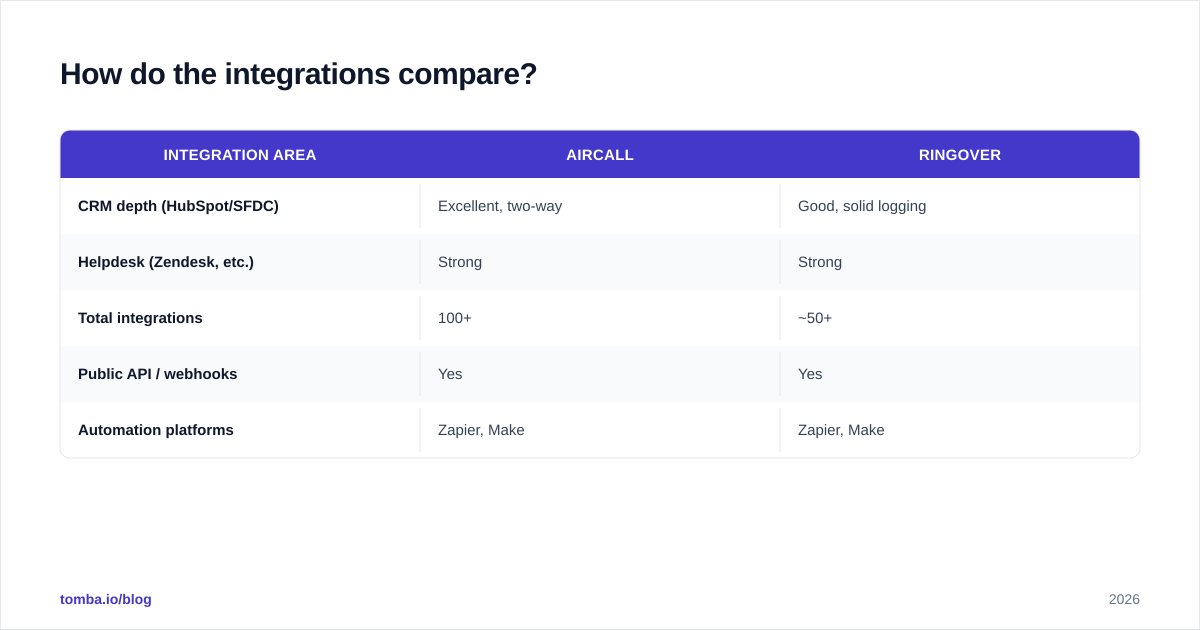
Zoho, and others — plus an API and webhooks for custom builds. The library is smaller (roughly 50+), but it covers what most sales teams actually use. If your stack is mainstream, you likely won't notice the catalog gap.
| Integration area | Aircall | Ringover |
|---|---|---|
| CRM depth (HubSpot/SFDC) | Excellent, two-way | Good, solid logging |
| Helpdesk (Zendesk, etc.) | Strong | Strong |
| Total integrations | 100+ | ~50+ |
| Public API / webhooks | Yes | Yes |
| Automation platforms | Zapier, Make | Zapier, Make |
The tie-breaker: if you depend on a niche tool, check both marketplaces before committing — that single missing connector is often what decides the deal. You can validate integration claims through third-party reviews on G2 rather than the vendor sites alone.
Which is better for international calling?#
Ringover, clearly — international coverage is its signature advantage.
Ringover bundles unlimited outbound calls to 110+ destinations into its plans and offers local numbers across a wide range of countries, which makes it a favorite for teams selling across Europe, North America, and beyond. The flat-rate model means a rep calling London, Paris, and New York in one afternoon does not generate a per-minute scare on the invoice.
Aircall supports international numbers and calling too, but more of it is metered or tiered, and unlimited calling is concentrated on US/Canada at the entry level. For a domestic team this is irrelevant; for a globally distributed outbound team it can mean a materially higher bill.
If international expansion is on your roadmap, model your call volume by destination before deciding. The difference between "unlimited included" and "metered per minute" compounds fast at scale.
Aircall vs Ringover: pros and cons#
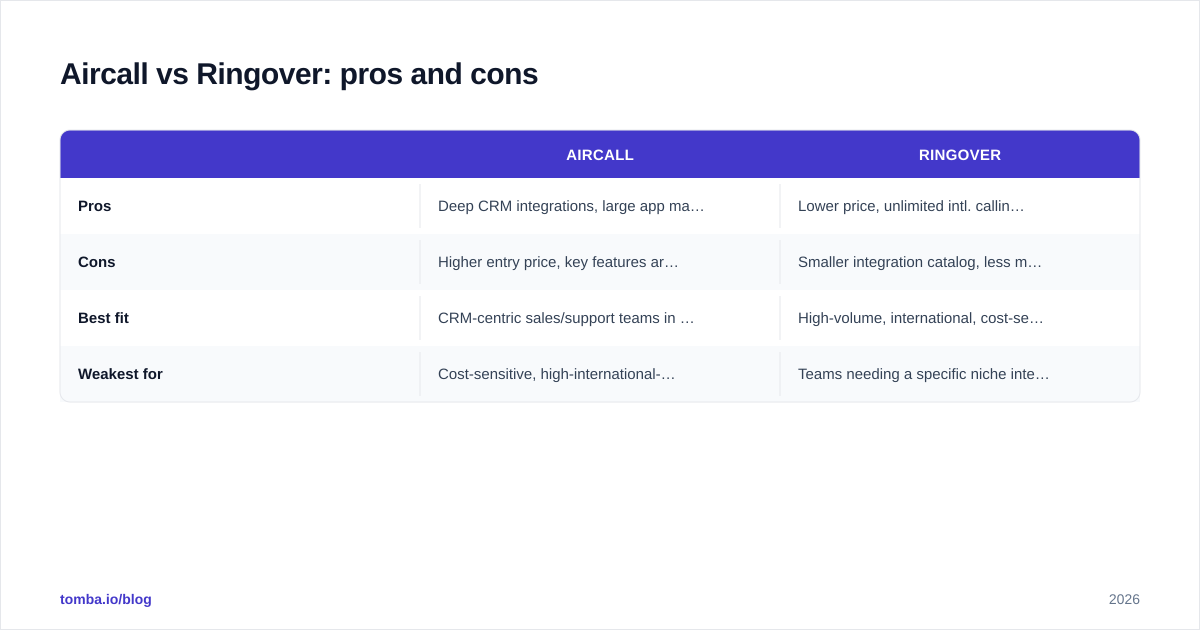
| Aircall | Ringover | |
|---|---|---|
| Pros | Deep CRM integrations, large app marketplace, strong routing/collaboration, polished UX | Lower price, unlimited intl. calling, SMS + video included, predictable billing |
| Cons | Higher entry price, key features are add-ons, intl. calling can get pricey | Smaller integration catalog, less mature ecosystem, fewer advanced routing options |
| Best fit | CRM-centric sales/support teams in the US who value the app ecosystem | High-volume, international, cost-sensitive outbound teams |
| Weakest for | Cost-sensitive, high-international-volume teams | Teams needing a specific niche integration or advanced routing |
Which should you choose — Aircall or Ringover?#
Decide with a simple framework instead of a feature checklist. Score your situation on three axes: integration dependency, international volume, and budget sensitivity.
- Choose Aircall if your team practically lives in HubSpot or Salesforce, you rely on a broad app ecosystem, your routing/collaboration needs are sophisticated, and most of your calling is domestic. You're paying a premium for depth — and getting it.
- Choose Ringover if you make high volumes of international calls, you want SMS and video bundled, you prefer a predictable flat bill, and your integration needs are mainstream. You're trading some ecosystem breadth for lower, simpler costs.
For most outbound-heavy, internationally distributed teams, Ringover is the value pick. For CRM-anchored teams in North America that treat the phone as an extension of their CRM, Aircall earns its higher price.
)
How do you keep either dialer full of the right numbers?#
Here's the part both vendors quietly assume: a cloud phone routes and records calls, but it does not find the people you should be calling. Garbage numbers waste your reps' most expensive hours, and no dialer fixes a bad list.
That's the gap to close before you commit to Aircall or Ringover. You need accurate, current B2B contact data flowing into your CRM, which then flows into your phone system. A reliable phone finder surfaces direct dials, a phone validator screens out dead lines before a rep ever wastes a dial, and data enrichment fills in titles, companies, and the email addresses you'll use for multichannel follow-up. Plug that pipeline into the same CRM you connect your phone to, and the dialer stops idling on bad data.
This is also where a phone system alone falls short on multichannel motions. Top reps don't only call — they sequence calls with email and LinkedIn touches. Having verified emails alongside dialable numbers is what turns a single cold call into a cadence.
Frequently asked questions#
Is Ringover cheaper than Aircall? Generally yes. Ringover's entry plan undercuts Aircall's and includes unlimited international calling, SMS, and recording that Aircall often bills as add-ons or reserves for higher tiers. Confirm current rates on each vendor's pricing page, since both run promotions.
Does Aircall integrate with more tools than Ringover? Yes. Aircall's marketplace lists 100+ integrations with deeper CRM sync, while Ringover offers a smaller but solid catalog covering the major CRMs and helpdesks. If you need a niche connector, check both marketplaces first.
Which is better for international calling? Ringover, by a wide margin for cost. It bundles unlimited calls to 110+ destinations, while Aircall meters more international calling outside the US and Canada.
Can I use either with HubSpot or Salesforce? Both integrate with HubSpot and Salesforce. Aircall's connectors are deeper (two-way sync, in-record dialing, workflow triggers); Ringover handles the core logging and click-to-call reliably.
Do Aircall or Ringover provide phone numbers to call? No — they provide the phone system, not the contact data. You source dialable B2B numbers separately with a tool like a phone finder and verify them before importing into your CRM.
The bottom line#
Aircall and Ringover solve the same problem from opposite directions. Aircall is the CRM-native, ecosystem-rich choice you pay a premium for; Ringover is the all-in-one, international-friendly choice that keeps the invoice flat. Map your stack, your call destinations, and your budget against the framework above, and the answer usually picks itself.
Whichever phone system you land on, it's only as effective as the list behind it. Before you migrate a single seat, build a clean pipeline of verified contacts: use Tomba's Phone Finder to surface direct dials, layer in the Tomba Email Finder for multichannel follow-up, and enrich everything so your reps spend their day talking to real prospects instead of dead numbers. Start free with 25 searches a month, and check Tomba pricing when you're ready to scale your outbound data alongside your new phone system.
Ready to find emails that actually work?
Join 150,000+ professionals who stopped guessing and started sending. Free credits on signup — no credit card required.
Get the Tomba newsletter
Practical outbound tactics and product updates — once every two weeks.
About the author