Aircall vs Talkdesk 2026: Which Call Center Tool Wins?
Aircall vs Talkdesk, compared head-to-head for 2026: pricing, dialer power, AI features, call quality, and integrations so you pick the right cloud phone system the first time.
Aircall vs Talkdesk: Which Cloud Phone System Should Your Team Buy in 2026?
Choosing a business phone system is one of those decisions that feels reversible until you're six months in, three integrations deep, and quoting your rep count to a renewals manager. Aircall and Talkdesk both promise the same headline — a cloud contact center that plugs into your CRM — but they aim at different buyers. This guide breaks down where each one actually wins.
TL;DR#
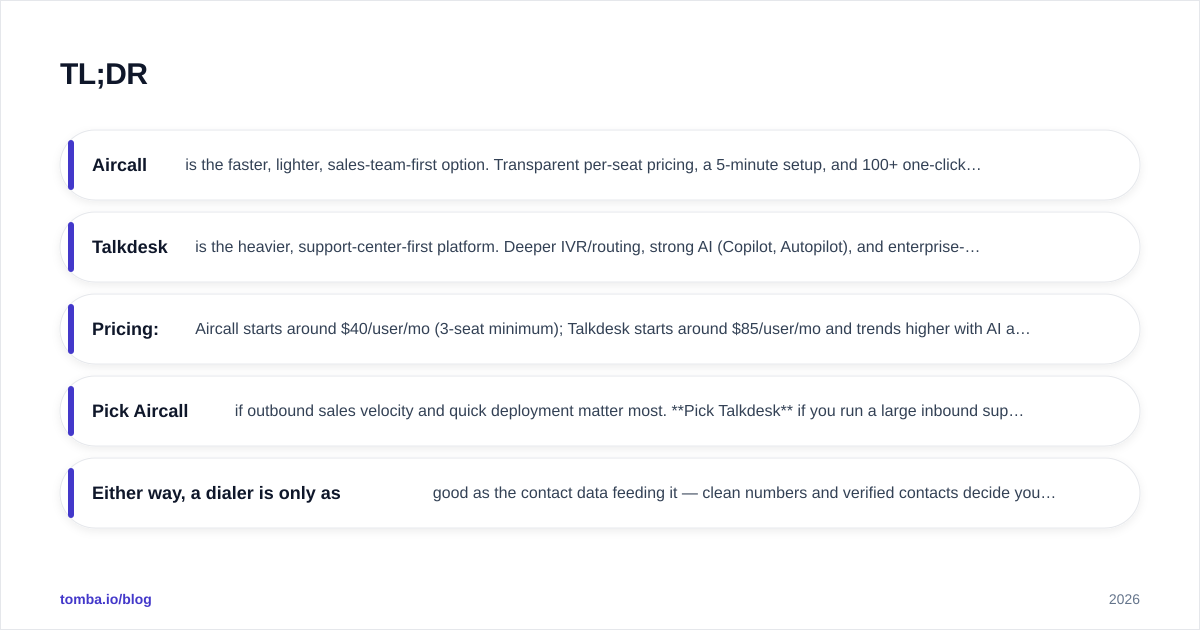
- Aircall is the faster, lighter, sales-team-first option. Transparent per-seat pricing, a 5-minute setup, and 100+ one-click integrations. Best for SMBs and mid-market revenue teams.
- Talkdesk is the heavier, support-center-first platform. Deeper IVR/routing, strong AI (Copilot, Autopilot), and enterprise-grade reporting — but pricing is quote-only and onboarding is a project.
- Pricing: Aircall starts around $40/user/mo (3-seat minimum); Talkdesk starts around $85/user/mo and trends higher with AI add-ons.
- Pick Aircall if outbound sales velocity and quick deployment matter most. Pick Talkdesk if you run a large inbound support operation with complex routing and compliance needs.
- Either way, a dialer is only as good as the contact data feeding it — clean numbers and verified contacts decide your connect rate, not the brand on the softphone.
What Are Aircall and Talkdesk?#
Both are cloud-based phone systems (VoIP/CCaaS — Contact Center as a Service). Instead of physical PBX hardware, calls route over the internet, and your reps work from a softphone on desktop or mobile.
Aircall launched as a sales- and support-friendly cloud phone built around speed and integrations. It's the tool a 20-person SaaS company spins up in an afternoon to give every rep a real business line, shared inbox, and CRM call logging.
Talkdesk is a full contact center platform. It targets larger support organizations that need omnichannel routing (voice, chat, SMS, email), workforce management, and AI agents that can deflect or assist on thousands of daily interactions.
The short version: Aircall optimizes for the outbound and blended sales team; Talkdesk optimizes for the inbound, high-volume support center. The overlap is real, which is why they end up on the same shortlist — but the center of gravity is different.
How Do Aircall and Talkdesk Compare at a Glance?#
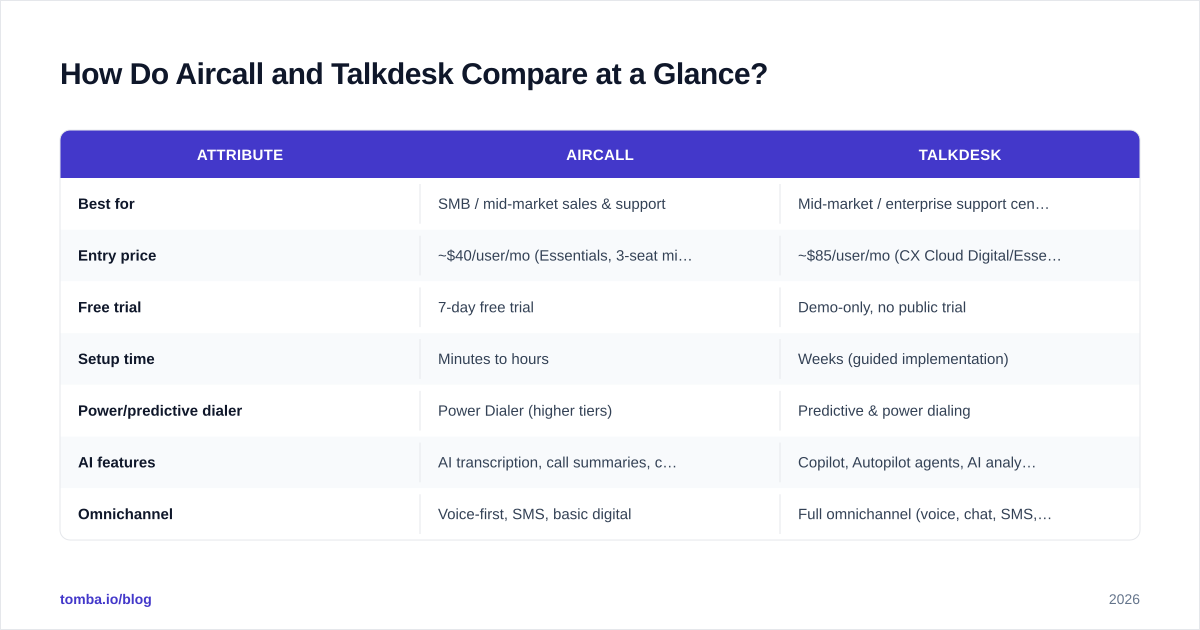
Here's the head-to-head on the attributes most teams actually evaluate.
| Attribute | Aircall | Talkdesk |
|---|---|---|
| Best for | SMB / mid-market sales & support | Mid-market / enterprise support centers |
| Entry price | ~$40/user/mo (Essentials, 3-seat min) | ~$85/user/mo (CX Cloud Digital/Essentials) |
| Free trial | 7-day free trial | Demo-only, no public trial |
| Setup time | Minutes to hours | Weeks (guided implementation) |
| Power/predictive dialer | Power Dialer (higher tiers) | Predictive & power dialing |
| AI features | AI transcription, call summaries, coaching | Copilot, Autopilot agents, AI analytics |
| Omnichannel | Voice-first, SMS, basic digital | Full omnichannel (voice, chat, SMS, social) |
| Integrations | 100+ one-click (HubSpot, Salesforce, etc.) | 80+ plus deep CRM/WFM and APIs |
| Reporting | Solid call analytics dashboards | Advanced, customizable, real-time |
| Contract | Monthly or annual, self-serve | Annual, sales-led, quote-based |
Treat the prices as directional — both vendors move list pricing and gate features behind tiers. Always confirm current numbers on their sites and on a review aggregator like G2.
Is Aircall or Talkdesk Better for Pricing?#
Aircall wins on transparency; Talkdesk wins on enterprise flexibility.
Aircall publishes per-seat pricing with a clear three-tier structure (Essentials, Professional, and a custom Enterprise plan), a three-license minimum, and a self-serve signup. You know roughly what a 10-rep team costs before you talk to anyone. That predictability is a big reason SMB sales leaders favor it.
Talkdesk is quote-only. You'll go through a sales motion, get a bundle tailored to your seat count and feature mix, and the per-seat number climbs as you add AI (Copilot, Autopilot), workforce engagement, and advanced analytics. For a 200-seat support center that needs all of it, the bundled approach can make sense. For a 12-rep outbound team, it's overkill you'll pay for.
A quick mental model: Aircall is priced like a SaaS tool you buy with a credit card. Talkdesk is priced like an enterprise platform you buy with a procurement team. Neither is "cheaper" in the abstract — it depends entirely on whether you need the depth.
Which Has the Better Dialer for Outbound Sales?#
Aircall for simplicity and speed; Talkdesk for raw volume and predictive pacing.
If your team is running outbound cadences, the dialer is the heartbeat of the operation. Here's how they differ:
- Aircall Power Dialer queues numbers from a webpage or CRM list and dials them sequentially, logging each call automatically. It's clean, fast to learn, and tightly coupled to your CRM. It does not do predictive (multi-line) dialing.
- Talkdesk supports both power and predictive dialing, the latter dialing multiple numbers at once and connecting answered calls to free agents. For a 50-seat outbound floor chasing connect efficiency, predictive dialing materially lifts talk time.
But here's the part most comparisons skip: dialer mode is downstream of data quality. A predictive dialer pointed at a list of stale, unverified numbers just burns through bad records faster and tanks your reputation with carriers. Before you optimize pacing, optimize the list. Use a phone validator to strip disconnected and invalid numbers, and enrich thin records with a phone finder so reps dial real direct lines instead of switchboards.
A 35% connect rate on clean data beats a 12% connect rate on a bigger, dirtier list every time — regardless of which dialer fired the call.
How Do the AI Features Compare?#
Talkdesk is ahead on AI breadth; Aircall covers the essentials cleanly.
This is where the two have diverged most in the last two years.
Talkdesk has leaned hard into AI: Copilot assists live agents with suggested responses and real-time knowledge surfacing, Autopilot handles automated voice/chat resolution, and its analytics layer scores sentiment and topics across every interaction. For a support org drowning in ticket volume, deflection and assist features can pay for the platform on their own.
Aircall offers AI transcription, automated call summaries, talk-ratio analytics, and coaching tools — genuinely useful for sales managers reviewing reps, but scoped to the sales/support workflow rather than full autonomous resolution.
If "AI agent that resolves tier-1 tickets without a human" is on your requirements list, that's a Talkdesk conversation. If "transcribe and summarize every sales call so managers can coach" is the goal, Aircall delivers that without the enterprise price tag.
Which Integrates Better With Your Stack?#
Roughly even, with different philosophies.
Aircall built its reputation on a one-click integration marketplace — 100+ apps including HubSpot, Salesforce, Pipedrive, Zendesk, Intercom, and Slack. Setup is genuinely a few clicks, which matches its "live in an afternoon" promise. If you run HubSpot or Salesforce, call logging and click-to-dial just work.
Talkdesk integrates with the major CRMs and adds deeper workforce management, quality management, and API/SDK extensibility for teams that need to build custom routing or embed telephony into proprietary apps. The integrations are more powerful and more involved to configure.
Rule of thumb: Aircall integrations are plug-and-play; Talkdesk integrations are build-and-configure. The right answer depends on whether you have engineering time to invest.
What About Call Quality and Reliability?#
Both run on global cloud infrastructure with strong uptime track records, and both let you provision local numbers across dozens of countries. In practice, call quality complaints for either platform trace back to the customer's own network conditions far more often than the platform itself — bandwidth, jitter, and headset hardware matter more than the logo.
Talkdesk publishes a 100% uptime SLA on higher tiers, which is a meaningful procurement checkbox for enterprise support centers where downtime is measured in lost revenue per minute. Aircall's reliability is strong for its segment but it markets less aggressively on contractual SLAs.
If five-nines-with-penalties is a contractual requirement, that favors Talkdesk. For most SMB and mid-market teams, both are reliable enough that this won't be the deciding factor.
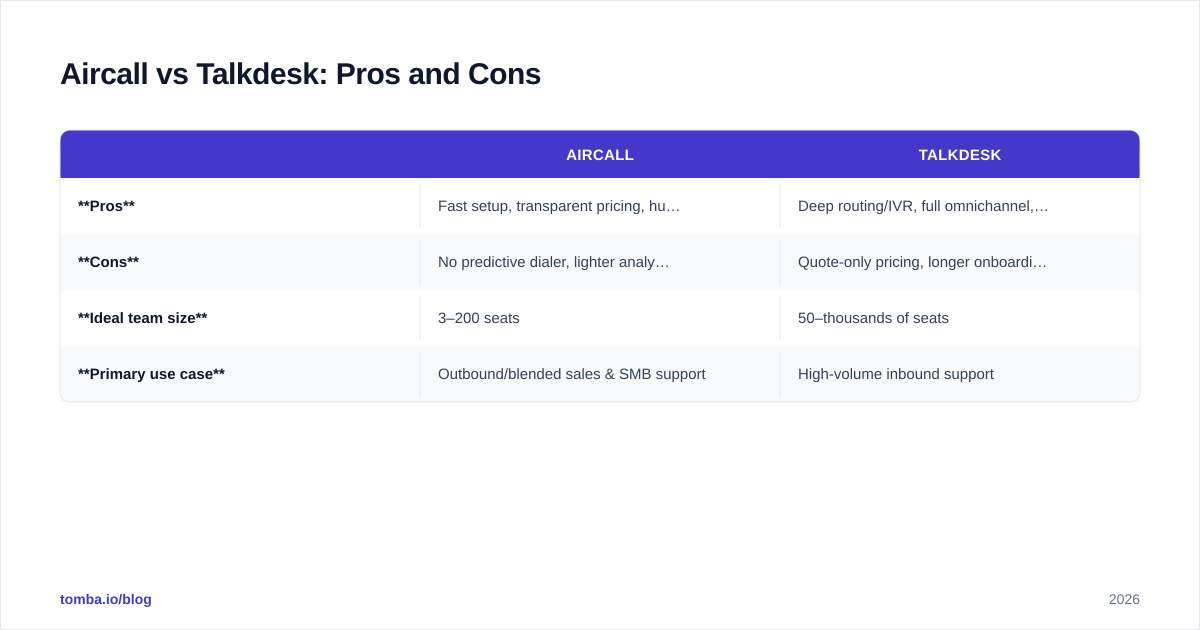
Aircall vs Talkdesk: Pros and Cons#
| Aircall | Talkdesk | |
|---|---|---|
| Pros | Fast setup, transparent pricing, huge one-click integration library, sales-friendly UX | Deep routing/IVR, full omnichannel, leading AI agents, enterprise SLA & reporting |
| Cons | No predictive dialer, lighter analytics, fewer enterprise controls | Quote-only pricing, longer onboarding, overkill for small teams |
| Ideal team size | 3–200 seats | 50–thousands of seats |
| Primary use case | Outbound/blended sales & SMB support | High-volume inbound support |
So, Which One Should You Choose?#
Choose Aircall if: you're a sales-led SMB or mid-market team, you want to be live this week, you value predictable per-seat pricing, and your integration list is mainstream CRMs. It's the pragmatic choice for revenue teams that want a great business phone without running a procurement marathon.
Choose Talkdesk if: you run a large inbound support operation, you need sophisticated routing and omnichannel, AI-driven deflection moves the needle on your cost-to-serve, and you have the budget and implementation bandwidth to do it right.
A useful gut-check: count how much of your call volume is outbound prospecting versus inbound support. Heavy outbound and blended → Aircall. Heavy inbound at scale → Talkdesk. If you're genuinely split down the middle and growing fast, demo both with your own data and your own reps before signing.
For more context on dialing strategy itself, our breakdown of response rate benchmarks pairs well with whichever platform you pick.
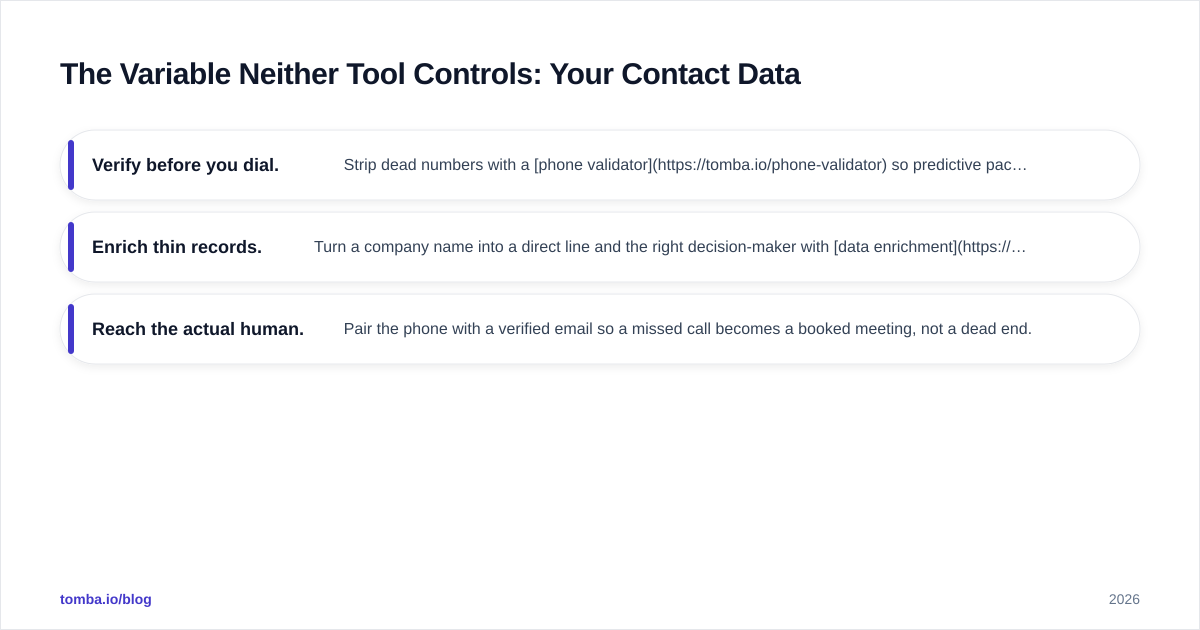
The Variable Neither Tool Controls: Your Contact Data#
Here's the uncomfortable truth that gets lost in feature-by-feature comparisons. The platform decides how you call. Your data decides whether anyone picks up.
Both Aircall and Talkdesk will happily dial a list of wrong numbers, disconnected lines, and gatekeeper switchboards all day long. The phone system isn't responsible for your connect rate — your data is. Teams that obsess over dialer modes while feeding the machine garbage lists consistently underperform teams running a "worse" dialer on clean, enriched, verified contacts.
That's the layer to get right before you swipe the card on either subscription:
- Verify before you dial. Strip dead numbers with a phone validator so predictive pacing doesn't waste cycles.
- Enrich thin records. Turn a company name into a direct line and the right decision-maker with data enrichment.
- Reach the actual human. Pair the phone with a verified email so a missed call becomes a booked meeting, not a dead end.
The Bottom Line#
Aircall and Talkdesk are both strong — they just solve different problems. Aircall is the fast, transparent, sales-team cloud phone. Talkdesk is the deep, AI-forward, enterprise support center. Match the tool to the shape of your call volume and you'll be happy with either.
But before you spend a dollar on seats, fix the input. A dialer with empty or wrong numbers is an expensive way to listen to busy tones. Start by building a clean, verified contact list with Tomba's Email Finder — find and verify the right decision-makers by name, company, or domain, enrich them with direct phone numbers, and feed your new phone system contacts that actually answer. Check the Tomba pricing plans (a free tier with 25 searches/month, Starter at $49/mo) and turn your shiny new dialer into booked meetings instead of voicemail. Your connect rate will thank you.
// get started
Find, verify and enrich your first contacts today
Start on the free plan with 25 searches a month, then scale when your team is ready.
Free plan · No credit card required · GDPR & CCPA
Get the Tomba newsletter
Product and data updates
// about the author