Aircall vs Vonage 2026: Which Business Phone System Wins?
Aircall vs Vonage compared on pricing, call features, integrations, and sales fit. See which cloud phone system actually suits your outbound team in 2026.
Choosing between Aircall and Vonage usually comes down to one question: are you buying a phone system for a sales team that lives in a CRM all day, or a flexible business communications suite for a whole company? Both are mature cloud phone platforms, but they aim at different buyers. This guide breaks down where each one wins so you can pick without a three-week trial marathon.
TL;DR: Aircall vs Vonage at a glance#
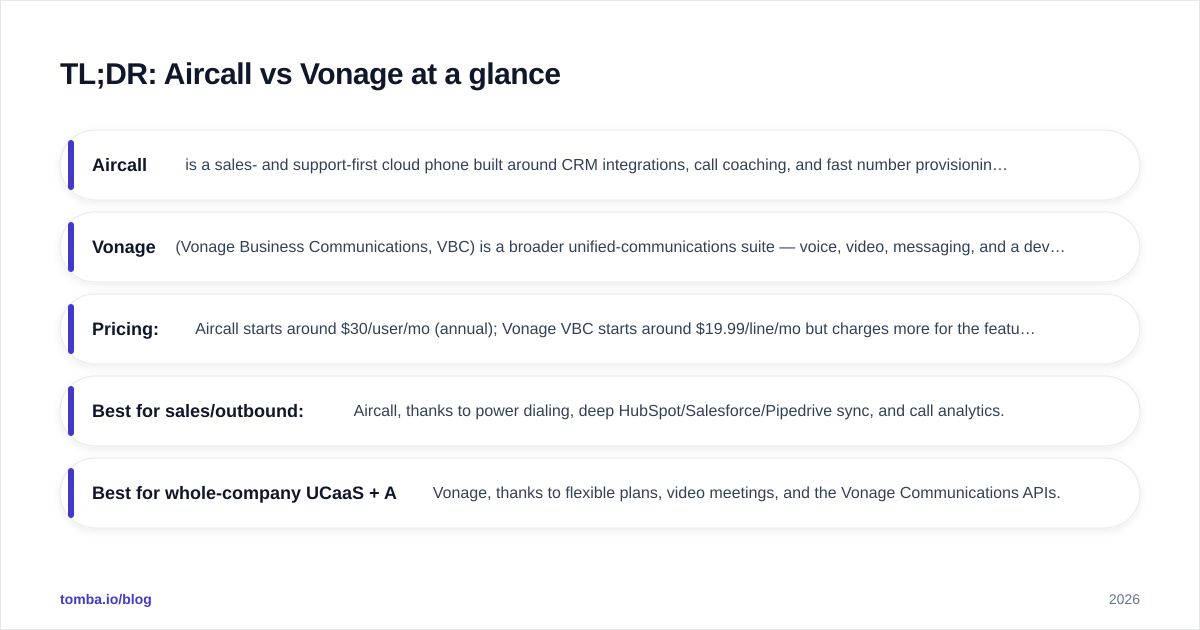
- Aircall is a sales- and support-first cloud phone built around CRM integrations, call coaching, and fast number provisioning. It bills per user on flat seats.
- Vonage (Vonage Business Communications, VBC) is a broader unified-communications suite — voice, video, messaging, and a developer API platform — aimed at general business telephony.
- Pricing: Aircall starts around $30/user/mo (annual); Vonage VBC starts around $19.99/line/mo but charges more for the features sales teams actually need.
- Best for sales/outbound: Aircall, thanks to power dialing, deep HubSpot/Salesforce/Pipedrive sync, and call analytics.
- Best for whole-company UCaaS + APIs: Vonage, thanks to flexible plans, video meetings, and the Vonage Communications APIs.
What is Aircall and who is it for?#
Aircall is a cloud-based phone system designed for sales and customer support teams that work inside a CRM. Think of it less as a "phone line" and more as a call layer that sits on top of your existing sales stack. When a prospect calls, the contact card pops; when a rep dials, the call is logged automatically; when a manager wants to coach, they can whisper or barge into a live call.
Its sweet spot is teams of 5 to a few hundred reps who need to provision numbers in dozens of countries, route inbound calls intelligently, and measure activity. Features like the power dialer, shared call inbox, call tagging, and live monitoring are built for high-volume calling — the daily reality of cold calling and phone sales.
The trade-off: Aircall is voice-centric. It added some messaging and analytics depth, but it is not trying to be your video-conferencing or contact-center-as-a-service backbone. You bolt it onto tools you already use rather than replacing them.
What is Vonage and who is it for?#
Vonage is a unified communications provider with two distinct sides. Vonage Business Communications (VBC) is the UCaaS product most buyers compare against Aircall — voice, team messaging, and video meetings in one app, sold per line. The second side is Vonage Communications APIs (formerly Nexmo), a developer platform for embedding SMS, voice, verification, and video into your own software.
That dual nature is the headline difference. If you want one vendor for company-wide phones and the ability to programmatically send a verification SMS from your app, Vonage covers both. For a general business that needs reliable telephony across departments — not just a sales floor — VBC is a sensible, flexible pick.
The catch for sales teams is that the features they care about (call recording, advanced analytics, CRM integration depth) often sit in higher tiers or cost extra add-ons, so the low entry price climbs quickly once you configure a real outbound setup.
Aircall vs Vonage: full comparison table#
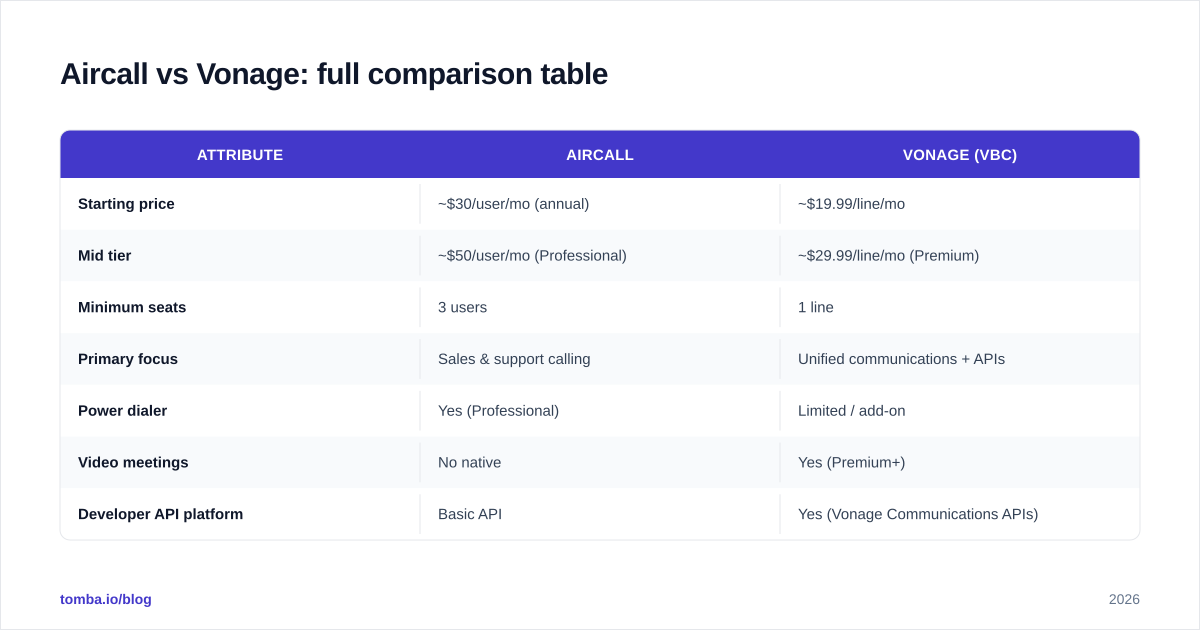
The fastest way to see the gap is side by side. Prices below are published list figures for 2026 and shift with promotions and contract terms — always confirm current numbers on each vendor's site before you sign.
| Attribute | Aircall | Vonage (VBC) |
|---|---|---|
| Starting price | ~$30/user/mo (annual) | ~$19.99/line/mo |
| Mid tier | ~$50/user/mo (Professional) | ~$29.99/line/mo (Premium) |
| Minimum seats | 3 users | 1 line |
| Primary focus | Sales & support calling | Unified communications + APIs |
| Power dialer | Yes (Professional) | Limited / add-on |
| Video meetings | No native | Yes (Premium+) |
| Developer API platform | Basic API | Yes (Vonage Communications APIs) |
| CRM integration depth | Deep (HubSpot, Salesforce, Pipedrive) | Moderate, tier-dependent |
| Call analytics & coaching | Strong (whisper, barge, monitoring) | Available in higher tiers |
| Best fit | Outbound/inbound sales teams | Whole-company telephony + dev needs |
Is Aircall better than Vonage for sales teams?#
For a dedicated outbound or inbound sales team, Aircall is usually the better fit. The reasons are concrete, not marketing gloss:
- CRM sync that actually saves time. Aircall logs calls, recordings, and notes into HubSpot, Salesforce, or Pipedrive automatically. Reps stop copy-pasting. That matters when each rep makes 60+ dials a day.
- Coaching tools built in. Call whispering (manager talks to rep, prospect can't hear), barge, and live monitoring help ramp new reps faster — a direct lever on your team's win rate.
- Power dialing. Queue a list, and Aircall dials through it with screen pops, cutting the dead time between calls.
Vonage can do sales telephony, but you assemble it from a broader toolkit and lean on higher tiers. If telephony is one of ten things your company needs from a comms vendor, that breadth is a plus. If calling is the job, Aircall's focus shows.
Use the framework above as a quick filter: route by primary use case first (pure sales calling vs. mixed company comms), then by integration requirements, then by budget. The use-case axis decides more than price does.

How do Aircall and Vonage pricing models differ?#
The pricing philosophies are different enough that a raw per-seat comparison misleads.
Aircall charges flat per-user seats with most sales features included at the Professional tier. You know your monthly cost: seats × price. Calling minutes within covered regions are bundled, with fair-use limits. This predictability is friendly to sales ops planning headcount.
Vonage prices per line, and the headline rate is for the entry Mobile plan. To match what a sales team expects — call recording, CRM integration, analytics — you move to Premium or Advanced, and some capabilities are paid add-ons. The Communications APIs are billed separately on usage (per SMS, per minute, per verification).
A rough rule: Aircall's quoted price is closer to your real all-in cost, while Vonage's entry price is a floor you'll build on. Model your actual feature list before comparing. For a 15-rep outbound team that needs recording and CRM sync, the two often land closer than the sticker prices suggest — sometimes with Vonage ahead, sometimes Aircall, depending on which add-ons you trigger.

Which integrates better with your sales stack?#
Integrations are where most buyers actually decide, because a phone system that doesn't sync is just a fancy dial pad.
- Aircall maintains a large marketplace with deep, native two-way sync for HubSpot, Salesforce, Pipedrive, Zendesk, Intercom, and Slack. Click-to-dial, auto-logging, and contact insights work out of the box.
- Vonage integrates with major CRMs too, but depth and availability vary by plan, and some connectors are lighter. Its developer APIs let engineering build custom flows — powerful, but that's a project, not a toggle.
Whichever you choose, the phone system is only as good as the contact data feeding it. A dialer with stale or missing numbers wastes rep hours. This is where a dedicated phone finder and phone validator earn their keep — you want verified, reachable B2B numbers in the CRM before Aircall or Vonage ever rings. Pairing accurate data with either platform via their integrations beats paying for premium calling features that dial dead lines.
What are the main pros and cons of each?#
Aircall — pros
- Sales/support-first feature set (power dialer, coaching, shared inbox)
- Deep, native CRM integrations with auto-logging
- Predictable flat-seat pricing
- Fast multi-country number provisioning
Aircall — cons
- No native video conferencing
- 3-seat minimum; pricier entry than Vonage's floor
- Voice-centric — not a full UCaaS replacement
Vonage — pros
- True unified communications: voice, video, messaging in one app
- Powerful developer API platform (SMS, voice, verify, video)
- Flexible per-line plans, low entry price
- Good fit for whole-company telephony
Vonage — cons
- Sales-critical features gated to higher tiers or add-ons
- Integration depth varies by plan
- Real cost climbs above the advertised starting price
When should you pick Vonage over Aircall?#
Pick Vonage when telephony is one need among several. Specific scenarios where it wins:
- You want one vendor for the whole company — sales, support, ops, and execs — with video and messaging bundled, not just a sales dialer.
- You have developers who need to embed communications (programmatic SMS, two-factor verification, in-app voice) into your own product via the Vonage Communications APIs.
- You're cost-sensitive at the low end and your calling needs are modest enough that the entry tier genuinely covers them.
- Video meetings matter and you'd rather not run a separate
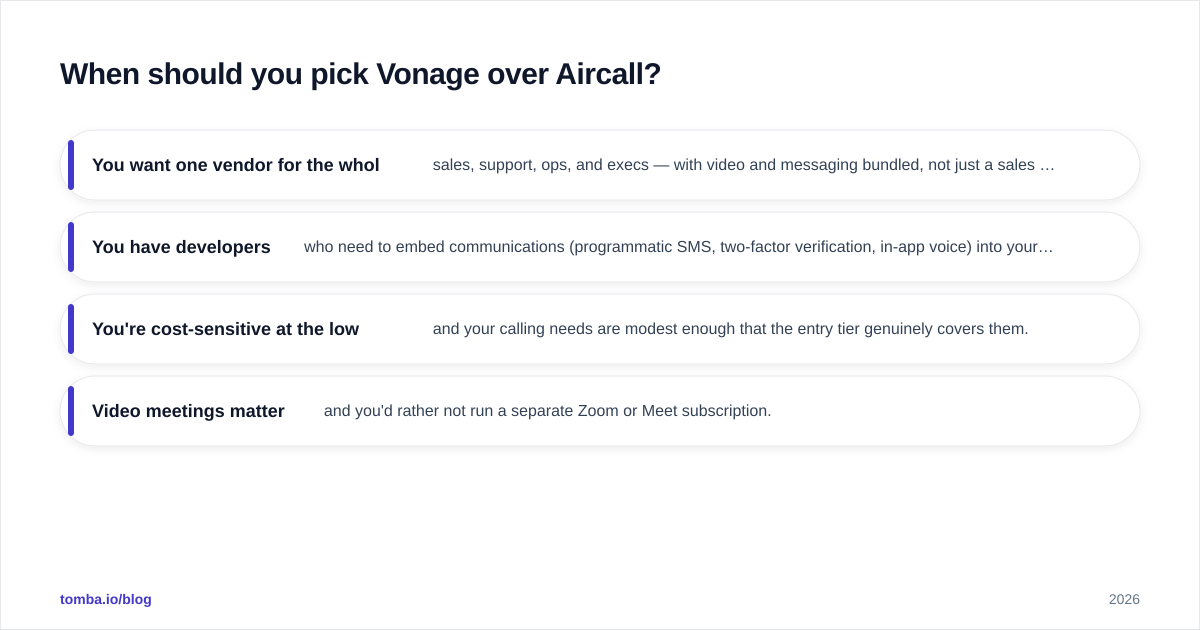
Zoom or Meet subscription.
If none of those apply and your team's day is dialing prospects, Aircall's focus will serve you better. For teams weighing other tools entirely, it's worth scanning the broader market of sales automation platforms before committing — the right answer sometimes isn't either of these two.
How do you actually decide between Aircall and Vonage?#
Run this three-step test instead of a feature-by-feature spreadsheet:
- Name the primary user. A sales floor? Aircall. The whole company plus a product team? Vonage. Mixed but sales-led? Trial both, but bias to Aircall.
- List your must-have integrations and confirm the tier. Don't assume a connector exists at the price you saw. Get it in writing for the plan you'd buy.
- Model all-in cost, not sticker price. Add the recording, analytics, and CRM add-ons each vendor needs to reach feature parity, then compare. Multiply by realistic seat count and your contract term.
Both platforms are reputable and well-reviewed. You can read verified user feedback on G2 and confirm current capabilities on the Aircall and Vonage sites. The "wrong" choice here is rarely a bad product — it's a mismatch between the tool's focus and your team's daily work.
The bottom line#
Aircall is the sharper tool for sales teams that live in a CRM and measure dials, talk time, and coaching. Vonage is the more flexible suite for companies that want voice, video, messaging, and developer APIs from one vendor. Match the platform to your primary user and your real all-in cost, and the decision makes itself.
Whichever phone system you land on, its performance depends entirely on the numbers you feed it. Before you scale either Aircall or Vonage, fill your pipeline with verified, accurate contacts: use the Tomba phone finder to source direct B2B numbers and pair them with email finder data so every rep dials and emails real, reachable prospects — not dead ends. Start free with 25 searches a month, then scale on a plan that fits, and let your new phone system ring people who actually pick up.
Ready to find emails that actually work?
Join 150,000+ professionals who stopped guessing and started sending. Free credits on signup — no credit card required.
Get the Tomba newsletter
Practical outbound tactics and product updates — once every two weeks.
About the author