AIScraper Pricing, Reviews, Pros and Cons (2026 Breakdown)
An honest look at AIScraper in 2026 — real pricing tiers, what reviewers actually say, where it shines, where it stalls, and the alternatives worth testing before you commit budget.
TL;DR
- AIScraper is an AI-assisted web scraping tool that turns "describe the data you want" prompts into structured exports, aimed at non-engineers who used to live in copy-paste hell.
- Pricing scales by credits/pages, not seats — a free tier exists for trials, but production-volume scraping pushes most buyers into the mid or top plans fast.
- Reviewers love the no-code setup and AI field detection; the recurring complaints are credit burn on retries, brittle results on JavaScript-heavy sites, and thin support on lower tiers.
- It is a collection tool, not a contact-data provider — you still need verification and enrichment before anything you scrape touches a CRM or an inbox.
- If your real goal is finding and validating B2B emails, a purpose-built finder beats a general scraper on accuracy and compliance. More on that below.
What is AIScraper and who is it for?#
AIScraper is a no-code web scraping platform that uses AI to identify and extract structured data from web pages. Instead of writing CSS selectors or XPath, you point it at a URL, describe the fields you want ("product name, price, review count"), and it returns a table you can export to CSV, JSON, or push through an API.
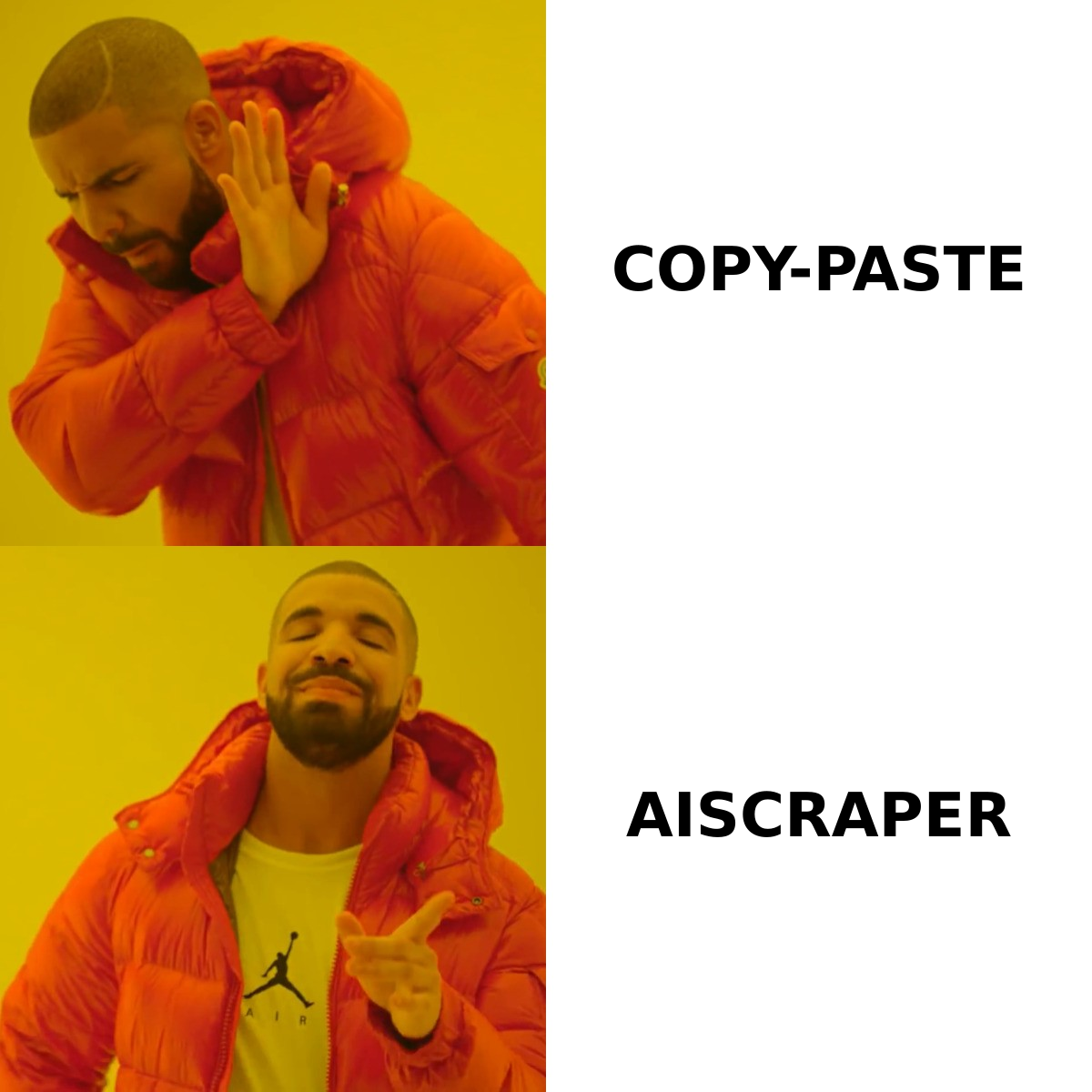
Think of it like hiring a very fast intern who never gets bored: you say "go through these 4,000 pages and copy the same five fields off each one," and it does that overnight. The "AI" part is mostly field detection and layout adaptation — it tries to keep working when a page's HTML shifts slightly, where a hard-coded selector would break.
The typical buyer is a growth marketer, analyst, founder, or ops person who needs data off the web but does not want to maintain a scraping codebase. Engineers tend to reach for frameworks like Scrapy or a managed runner instead; AIScraper's pitch is squarely at the people who would otherwise be pasting cells into a spreadsheet by hand.
How much does AIScraper cost in 2026?#
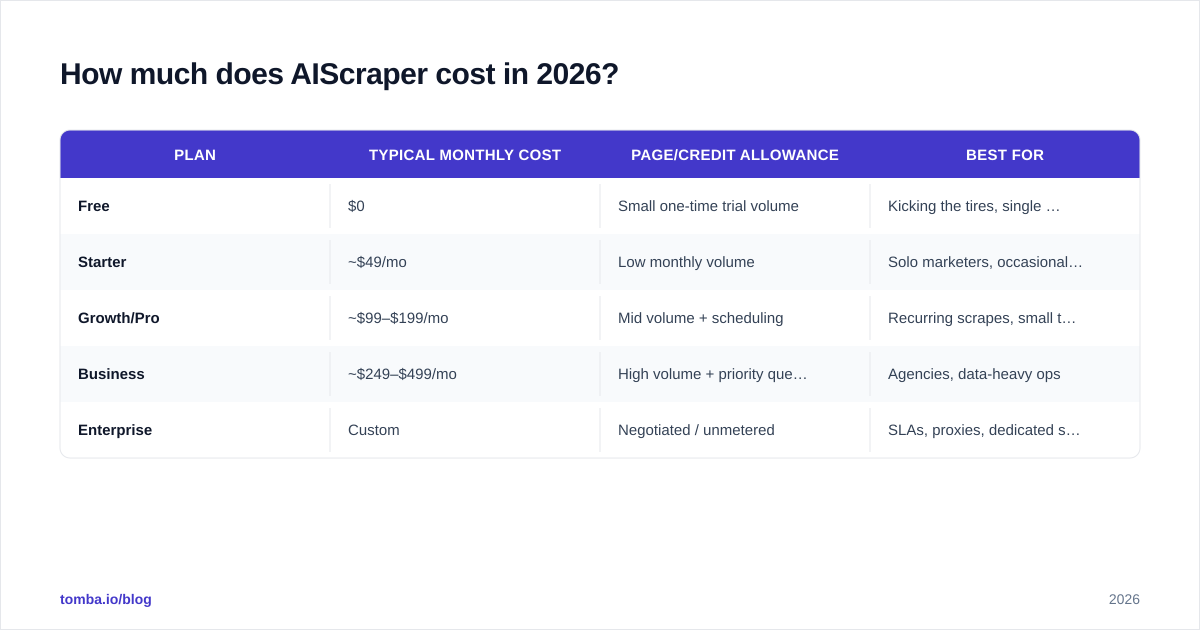
AIScraper prices on consumption — credits or page-fetches per month — rather than per user. That matters: a "cheap" plan can evaporate the moment you run a large job with retries, because every failed fetch and every re-run can still draw down credits.
Plans and limits change, so treat the table below as a representative shape rather than a contract — always confirm the current numbers on the vendor's own pricing page before you buy. The structure (free trial → volume tiers → custom enterprise) is consistent with how this category prices.
| Plan | Typical monthly cost | Page/credit allowance | Best for |
|---|---|---|---|
| Free | $0 | Small one-time trial volume | Kicking the tires, single small scrape |
| Starter | ~$49/mo | Low monthly volume | Solo marketers, occasional jobs |
| Growth/Pro | ~$99–$199/mo | Mid volume + scheduling | Recurring scrapes, small teams |
| Business | ~$249–$499/mo | High volume + priority queue | Agencies, data-heavy ops |
| Enterprise | Custom | Negotiated / unmetered | SLAs, proxies, dedicated support |
A few cost realities reviewers flag repeatedly:
- Retries cost credits. Anti-bot pages, timeouts, and CAPTCHAs trigger re-attempts that quietly eat your allowance.
- JavaScript rendering is heavier. Sites that load content client-side cost more per page than static HTML.
- Overage pricing stings. Going over your monthly bucket is usually more expensive per unit than just sizing up a tier.
If you are comparing this against tools you already evaluate for outbound, it is worth keeping vendor pricing pages side by side — the way you'd weigh Tomba pricing against a contact-data competitor. Scraping credits and email-finder credits are not the same currency, and conflating them is how budgets blow up.
What do AIScraper reviews actually say?#
Aggregate sentiment on review platforms like G2 and Capterra tends to cluster around a few consistent themes. Pulling the signal out of the noise:
What reviewers praise
- Speed to first result. People who have never written a scraper get usable data in minutes. That "wow" moment drives most of the five-star reviews.
- AI field detection. Describing fields in plain language beats hunting for selectors, especially on unfamiliar sites.
- Export flexibility. CSV/JSON plus an API and common integrations means data does not get trapped in the tool.
What reviewers criticize
- Reliability on hard sites. Heavily protected or single-page-app sites produce partial or empty results, and the AI sometimes "hallucinates" a field mapping that looks right but is subtly wrong.
- Credit anxiety. The most common complaint is not the headline price — it is unpredictability. Users want a clearer estimate of cost before a big run.
- Support depth on low tiers. Fast help is often gated behind higher plans; free and starter users report slow responses.
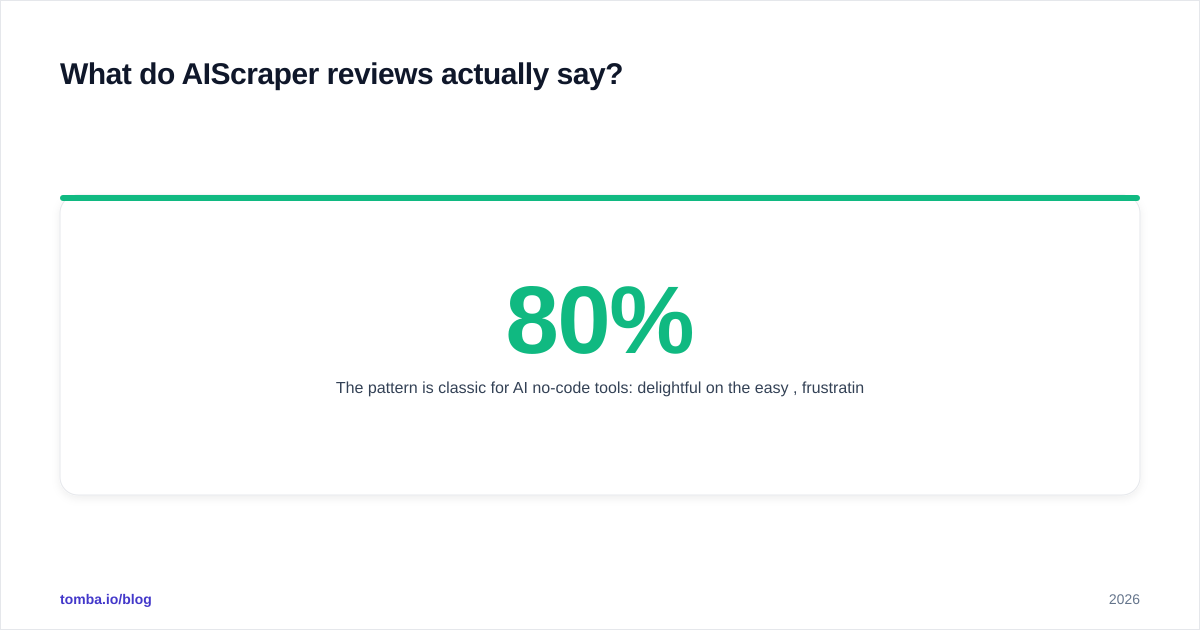
The pattern is classic for AI no-code tools: delightful on the easy 80%, frustrating on the hard 20% — and the hard 20% is usually exactly the data you most wanted.
What are the pros and cons of AIScraper?#
Here is the honest ledger.
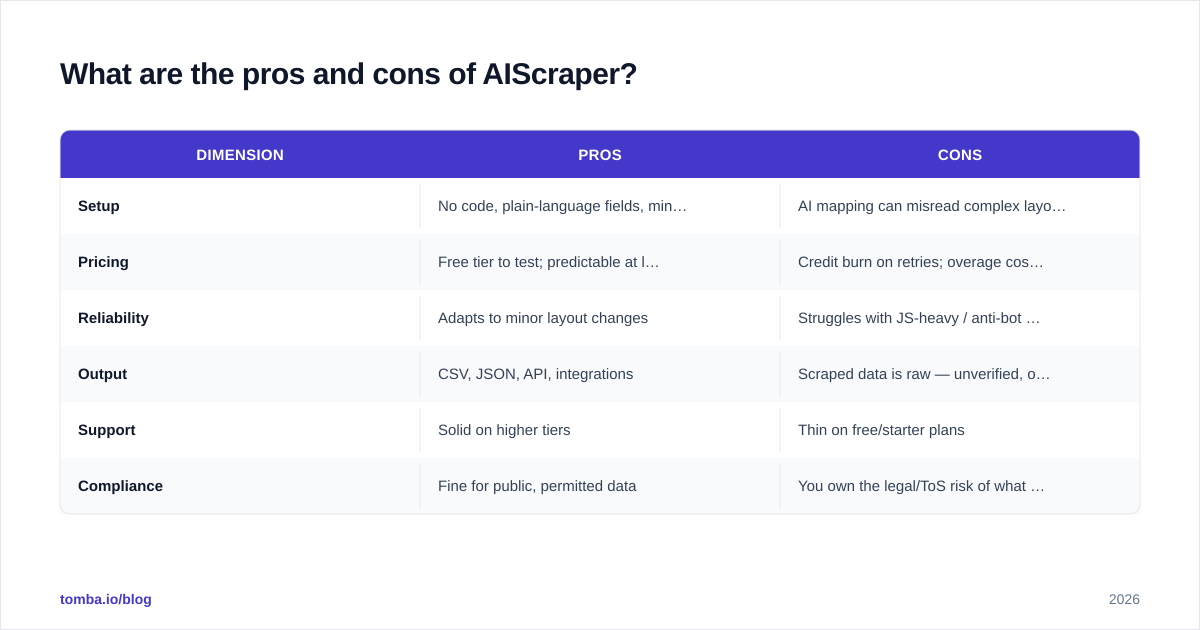
| Dimension | Pros | Cons |
|---|---|---|
| Setup | No code, plain-language fields, minutes to first run | AI mapping can misread complex layouts |
| Pricing | Free tier to test; predictable at low volume | Credit burn on retries; overage costs add up |
| Reliability | Adapts to minor layout changes | Struggles with JS-heavy / anti-bot sites |
| Output | CSV, JSON, API, integrations | Scraped data is raw — unverified, often messy |
| Support | Solid on higher tiers | Thin on free/starter plans |
| Compliance | Fine for public, permitted data | You own the legal/ToS risk of what you scrape |
The single most important "con" is conceptual, not technical: a scraper gives you raw collected data, not validated business contacts. A list of email-looking strings pulled off a directory page is not the same as a deliverable, verified inbox. Sending to it can torch your sender reputation and your domain's deliverability.

How does AIScraper fit into a data workflow?#
A scraper is one stage in a pipeline, never the whole thing. The mistake teams make is treating "scraped" as "ready." It is not. Raw web data is dirty: duplicates, formatting noise, stale records, and — if you scraped contact info — a high share of invalid or risky addresses.
A sane flow looks like this:
- Collect — use AIScraper (or any scraper) to pull raw rows from permitted, public sources.
- Clean & dedupe — strip noise, normalize fields, remove duplicates before anything downstream multiplies the mess.
- Verify — run any email field through an email verifier so you are not sending into the void or onto a spam trap.
- Enrich — fill gaps (titles, company, firmographics) with proper data enrichment instead of whatever the page happened to expose.
- Activate — only now push clean, verified contacts into your CRM or sequencing tool.
Skipping steps 2–4 is how a "great scrape" becomes a bounced campaign two weeks later. If contact data is the goal, you can often shortcut steps 1–4 entirely with a tool built for it — pulling verified business emails by company with a domain search is both more accurate and far less legally fraught than scraping a site's HTML and hoping the addresses are real.
Is AIScraper the right tool for finding B2B emails?#
Short answer: no — not on its own, and not as your primary method.
General-purpose scrapers are excellent at structured public data: prices, listings, reviews, catalog fields. They are mediocre at contact data, for three reasons:
- Accuracy. Emails scraped off pages are unverified by definition. You inherit every typo, role-based catch-all, and abandoned mailbox on the site.
- Coverage. The best contact for a prospect is rarely published on a public page. Email-finder tools infer and validate patterns across many sources; a scraper only sees what is rendered.
- Compliance. Scraping personal data carries ToS and privacy exposure. Purpose-built finders draw on permitted, sourced data and document where their data comes from.
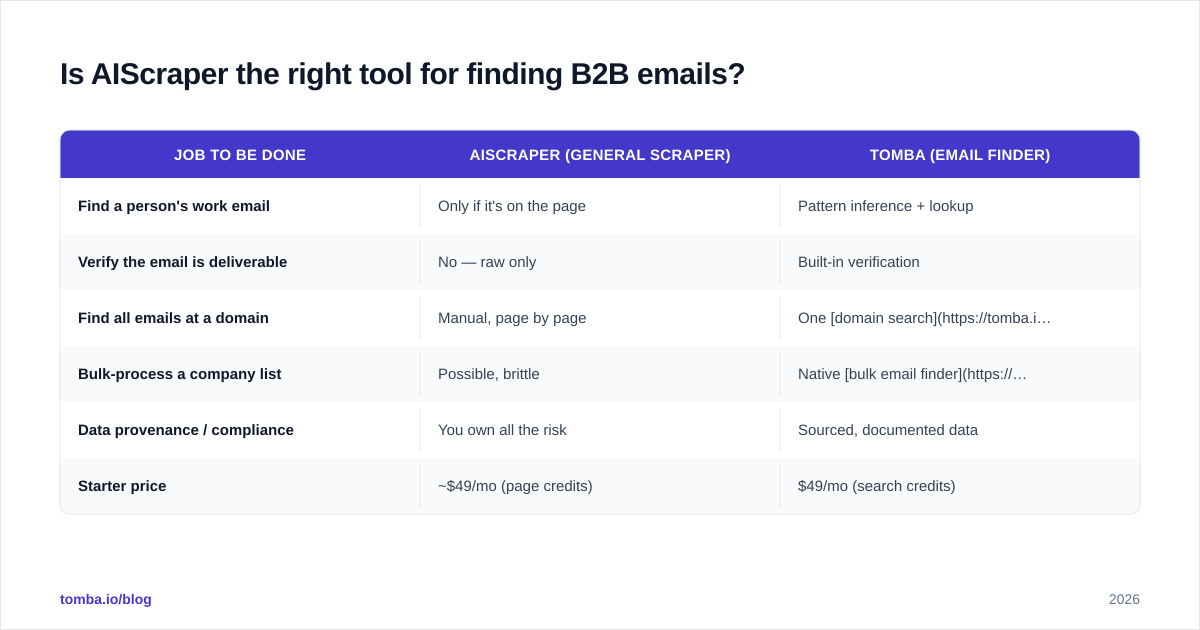
This is where a dedicated finder beats a scraper outright. Here is the head-to-head for the email-specific job:
| Job to be done | AIScraper (general scraper) | Tomba (email finder) |
|---|---|---|
| Find a person's work email | Only if it's on the page | Pattern inference + lookup |
| Verify the email is deliverable | No — raw only | Built-in verification |
| Find all emails at a domain | Manual, page by page | One domain search |
| Bulk-process a company list | Possible, brittle | Native bulk email finder |
| Data provenance / compliance | You own all the risk | Sourced, documented data |
| Starter price | ~$49/mo (page credits) | $49/mo (search credits) |
If you genuinely need both — scrape a marketplace for company names, then find and verify the right contacts — use each tool for what it is best at. Scrape the firmographics, then hand the company list to a bulk email finder and a verifier. Do not ask the scraper to be your data-quality layer.
What are the best AIScraper alternatives?#
Depending on which job you are actually solving, the alternative differs:
- For developer-grade, large-scale scraping: a managed runner like Apify or an open framework like Scrapy gives you more control and proxy management. If you want that data flowing straight into your stack, Tomba's Apify integration and the Tomba API bridge collection and contact enrichment.
- For spreadsheet-native users: pulling data directly inside Google Sheets or Excel avoids a separate tool entirely for lighter jobs.
- For B2B contact data specifically: skip the scraper and go straight to an email finder with verification and a B2B database behind it. You will get cleaner results with less legal exposure and no credit-burn surprises.
The honest framing: AIScraper is a fine general scraper for public, structured data and a poor substitute for a contact-data platform. Match the tool to the job and you will not overpay for either.
Final verdict — should you buy AIScraper?#
Buy AIScraper if your work is genuinely about collecting structured public data — prices, listings, reviews, research datasets — and you want a no-code tool that gets you there without an engineering ticket. Start on the free tier, run your hardest real-world page through it before you pay, and size your plan to your actual monthly volume plus a buffer for retries. Watch credit burn like a hawk.
Do not buy it expecting a B2B contact engine. Scraped emails are unverified, incomplete, and a compliance liability — exactly the wrong foundation for outbound.
If finding and validating real business emails is the job, use the right tool. Tomba's Email Finder locates professional email addresses by name, company, or domain, validates them before they ever reach your sequencer, and ships with verification, domain search, and enrichment in one place — starting free at 25 searches a month and $49/mo on Starter. Let a scraper scrape, and let a finder find. Your bounce rate, your deliverability, and your budget will all thank you.
Ready to find emails that actually work?
Join 150,000+ professionals who stopped guessing and started sending. Free credits on signup — no credit card required.
Get the Tomba newsletter
Practical outbound tactics and product updates — once every two weeks.
About the author