8 Best AiSDR Alternatives in 2026 (Ranked & Compared)
AiSDR automates AI-driven outreach, but it isn't the only option. Here are 8 AiSDR alternatives compared on data quality, autonomy, pricing, and fit.
AiSDR built a name by promising a fully autonomous AI sales rep that researches prospects, writes emails, and books meetings while you sleep. It's a compelling pitch. But "autonomous" only works when the data underneath it is clean, the personalization is real, and the price scales with results instead of with hype. For a lot of teams, AiSDR is either too expensive, too opaque about where its contacts come from, or too eager to send before a human signs off.
This guide breaks down the eight strongest AiSDR alternatives for 2026, what each one is actually good at, and how to pick based on your motion rather than the loudest demo.
TL;DR#
- AiSDR is a solid all-in-one AI SDR, but the data quality and per-seat cost push many teams to look elsewhere.
- If your bottleneck is accurate contact data, fix that first — a great AI writer on bad emails just bounces faster.
- Tomba is the best pick when you want verified emails and enrichment feeding your own outreach stack instead of a black-box sender.
- Instantly and Saleshandy win on deliverability-at-scale; Apollo and Clay win on data-plus-workflow depth.
- Match the tool to your motion: founder-led, SDR-augmented, or fully automated. There is no single "best."
What is AiSDR and why look for alternatives?#
AiSDR is an AI sales development platform that strings together prospecting, research, copywriting, and email/SMS sending into one autonomous loop. You point it at an ICP, connect a mailbox, and it drafts and sends personalized sequences, then replies to inbound responses on its own.
The appeal is obvious: it compresses a whole SDR workflow into one subscription. The reasons teams shop around are just as concrete.
- Data provenance is fuzzy. Autonomous sending is only as good as the email list behind it. When you can't see how contacts were sourced or verified, bounce rates and spam complaints become your problem, not the vendor's.
- Pricing scales steeply. Per-rep AI pricing can run into four figures monthly once you add volume, which is hard to justify before you've proven the channel.
- Limited control. Fully automated send loops make some teams nervous — especially regulated industries or founder-led motions where every email reflects the brand.
- Lock-in. An all-in-one tool owns your data, your sequences, and your reputation. Splitting the stack keeps you portable.
The core decision isn't "which AI writes better emails." It's how much autonomy you want to hand over, and how much you trust the data layer underneath it. Hold that thought through the comparison.
How do the top AiSDR alternatives compare?#
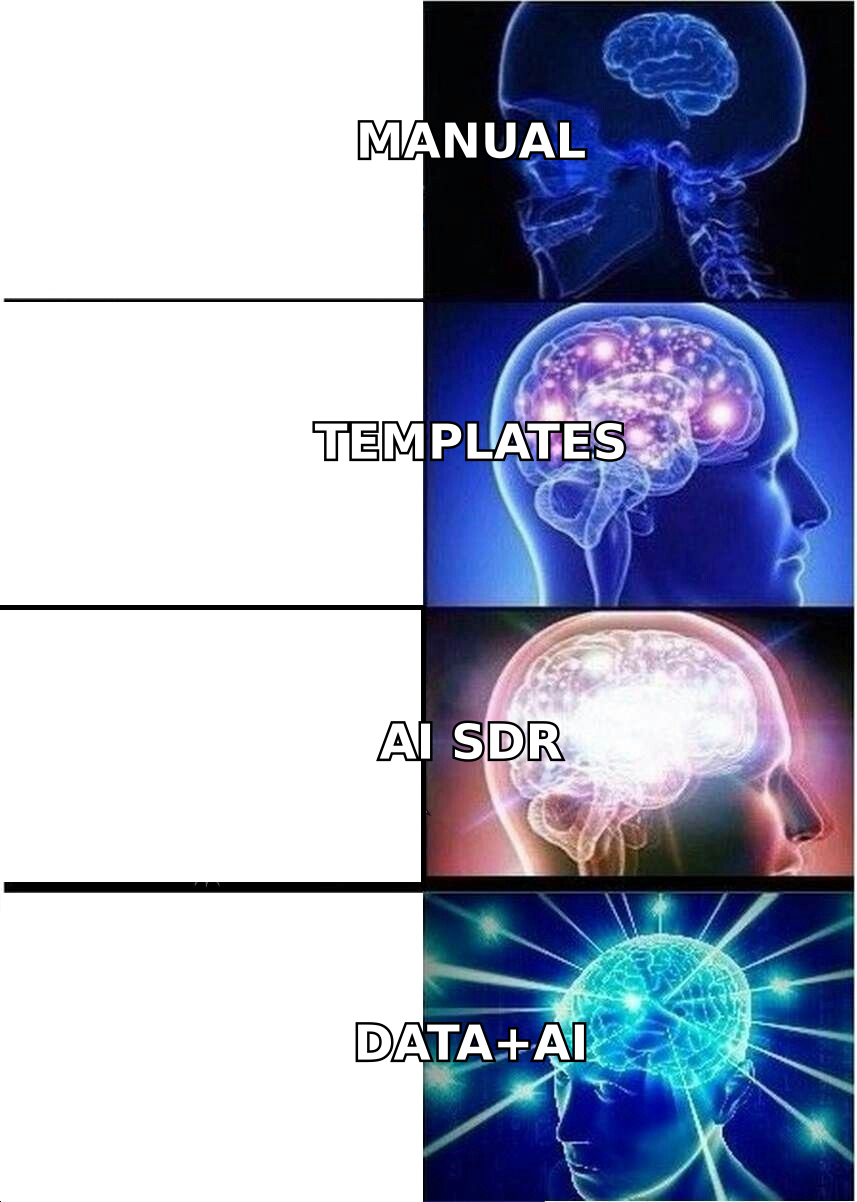
Here's the shortlist at a glance. Prices are entry tiers as published by each vendor in 2026 and change often — confirm before you buy.
| Tool | Best for | Core strength | Entry price | Autonomy level |
|---|---|---|---|---|
| AiSDR | All-in-one AI rep | End-to-end automation | ~$900/mo | Full auto |
| Tomba | Data + outreach control | Verified emails & enrichment | Free, then $49/mo | You stay in control |
| Apollo | Data + sequencing | 275M+ contact DB | $49/mo | Semi-auto |
| Clay | RevOps & enrichment | Waterfall enrichment | $149/mo | Workflow-driven |
| Instantly | Cold email at scale | Deliverability & inboxes | $37/mo | Semi-auto |
| Saleshandy | SMB cold outreach | Sequences + verification | $36/mo | Semi-auto |
| Reply.io | Multichannel AI SDR | Email + LinkedIn + AI | $59/mo | Semi to full auto |
| Lemlist | Personalized outreach | Images/video personalization | $69/mo | Semi-auto |
No single row wins every column. A founder testing a new channel and a 20-rep outbound team have opposite right answers.
Which AiSDR alternative is best for accurate data?#
Tomba — when the data layer is your real bottleneck.
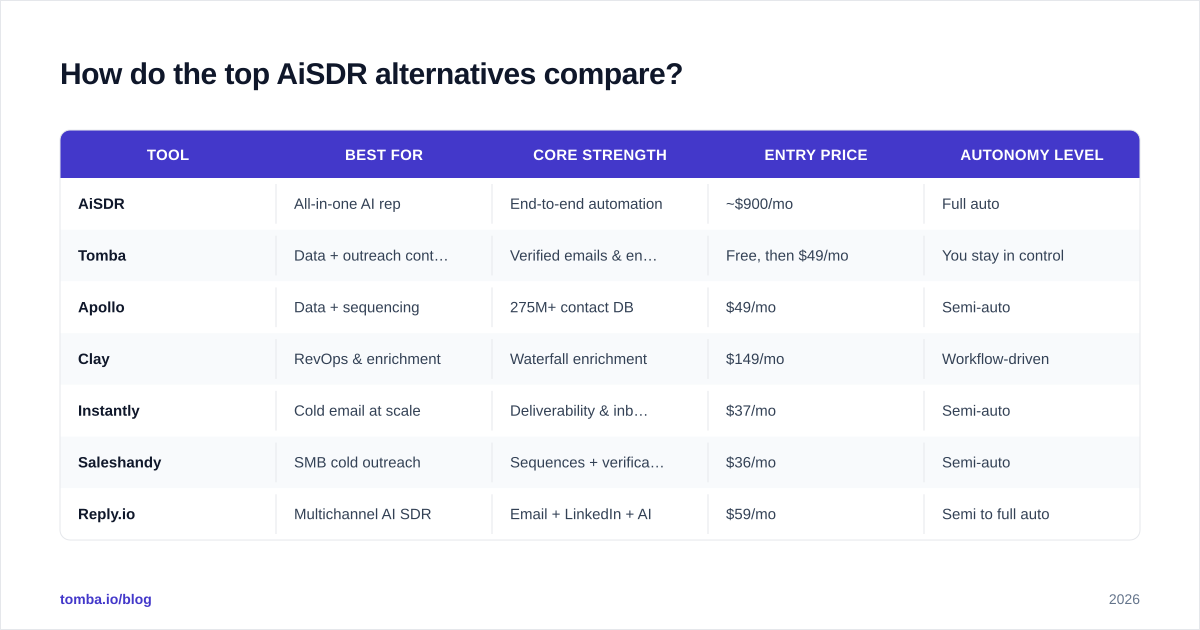
Most "AI SDR" failures trace back to one thing: the emails were wrong. An autonomous tool that sends to 30% invalid addresses torches your domain reputation in a week. The fix is to own a clean, verified data layer and feed it into whatever sender you like.
That's where Tomba's email finder fits. Instead of a black box that sources and sends in one opaque motion, Tomba gives you transparent, verifiable building blocks:
- Find professional emails by name, company, or domain search with confidence scores.
- Verify every address with the email verifier before it ever hits a sequence, including catch-all verification.
- Enrich thin lists into full profiles with data enrichment, then push them to your CRM or sender.
You see exactly where each contact came from via Tomba's data sources, which matters when deliverability — and compliance — is on you. The trade-off is honest: Tomba is not a fully autonomous "books meetings while you sleep" agent. It's the accuracy engine you point your outreach tool at. If you're tired of guessing why AiSDR's open rates dropped, this is usually the missing piece.
Pricing is straightforward: a free tier with 25 searches a month, then Starter at $49/mo, Growth at $99/mo, and Pro at $249/mo — see full Tomba pricing for credit limits. That's a fraction of a full AI-SDR seat, and you keep the contacts.
Which alternative is best for an all-in-one data + sequencing tool?#
Apollo — the database-and-sender hybrid.
Apollo.io bundles a 275M+ contact database with sequencing, dialer, and AI writing assists. If you want one login for sourcing and sending and you're comfortable with database-grade (not always razor-accurate) data, it's a strong middle ground. Teams replacing AiSDR with Apollo usually do it to cut cost while keeping a single workflow. The catch: Apollo's email accuracy varies by region and seniority, so layer in verification before high-volume sends. If you like Apollo's breadth but want cleaner records, an Apollo alternative stack pairs its database with a dedicated verifier.
Which alternative is best for RevOps and deep enrichment?#
Clay — programmable enrichment for technical teams.
Clay's waterfall enrichment hits multiple data providers in sequence and keeps the first valid result, which produces unusually complete records. It's the favorite of revenue operations teams that want to build custom signals — funding rounds, tech stack, headcount — and trigger outreach off them. It rewards people who think in tables and formulas. If "I want to script my GTM data" sounds exciting, Clay fits. If it sounds like a second job, look at the simpler options.
Which alternatives are best for cold email at scale?#
Instantly and Saleshandy — deliverability-first senders.
When volume and inbox placement matter more than a built-in AI brain, these two win.
- Instantly specializes in running many inboxes with rotation and warmup so you can scale sends without nuking sender reputation. It's the go-to for agencies and high-volume outbound. Compare the trade-offs in this Instantly alternative breakdown.
- Saleshandy leans SMB-friendly with sequences, built-in verification, and a gentler learning curve. A practical Saleshandy alternative comparison shows where each tier draws the line.
Both expect you to bring clean data — which loops back to pairing them with a verifier. Neither will research and write fully autonomously the way AiSDR does, but that's the point: you trade autonomy for control and deliverability.

Which alternatives are best for multichannel and personalization?#
Reply.io and Lemlist — for touch beyond the inbox.
- Reply.io is the closest like-for-like AiSDR competitor: AI SDR agents that handle email, LinkedIn, and calls with autonomous reply handling. If you want AiSDR's automation but more channel flexibility, start your evaluation at this Reply.io alternative overview.
- Lemlist is built around standout personalization — dynamic images, custom landing pages, and video — which lifts reply rates on smaller, high-value lists. It shines for social selling plays where a templated blast won't cut it.
Both support semi- to fully-automated sequences, so you choose how much the human stays in the loop.
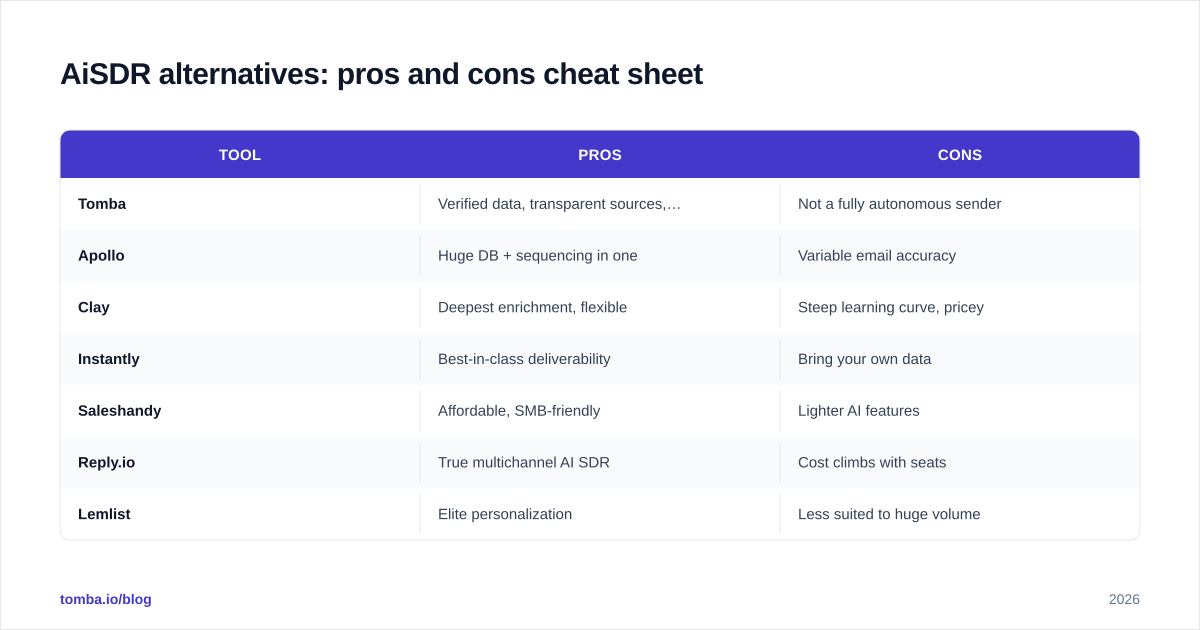
AiSDR alternatives: pros and cons cheat sheet#
| Tool | Pros | Cons |
|---|---|---|
| Tomba | Verified data, transparent sources, cheap entry, API-first | Not a fully autonomous sender |
| Apollo | Huge DB + sequencing in one | Variable email accuracy |
| Clay | Deepest enrichment, flexible | Steep learning curve, pricey |
| Instantly | Best-in-class deliverability | Bring your own data |
| Saleshandy | Affordable, SMB-friendly | Lighter AI features |
| Reply.io | True multichannel AI SDR | Cost climbs with seats |
| Lemlist | Elite personalization | Less suited to huge volume |
How do you choose the right AiSDR alternative?#
Conclusion first: pick by motion, not by feature count. Work through three questions.
Where does your funnel actually leak? If meetings are fine but emails bounce, you have a data problem — start with a finder and email verification, not a new AI writer. If you can't find enough qualified contacts, start with a database like Apollo or Clay. If you find and verify fine but can't scale sends, start with Instantly or Saleshandy.
How much autonomy do you actually want? Founder-led and regulated teams should keep a human on the send button — favor modular tools (Tomba + a sender you control). Teams drowning in volume and comfortable with automation can lean toward Reply.io or AiSDR itself.
What's your budget reality? A full AI-SDR seat near $900/mo only pays off after you've proven the channel converts. Proving it on a $49/mo data tool plus a $37/mo sender de-risks the whole experiment. You can always graduate to full autonomy once the unit economics are clear.
A common, durable stack in 2026 looks like this: Tomba for finding and verifying contacts → enrichment to add context → a deliverability-focused sender → your CRM for tracking. It costs less than one autonomous seat, keeps your data portable, and you can swap any layer without rebuilding everything. For teams that prefer one vendor and full automation, AiSDR or Reply.io remain reasonable — just verify the data feeding them.
The bottom line#
AiSDR is a capable autonomous AI SDR, but autonomy is only worth paying for when the data underneath is trustworthy and the price matches the results. Most teams that "replace AiSDR" are really fixing the data layer first — and discovering they need less automation than the demo suggested.
If accurate, verified contact data is your real constraint, start there. The Tomba Email Finder finds professional emails by name, company, or domain, verifies them before they ever reach a sequence, and enriches them into full profiles — with a free tier so you can test it against your current list today. Get the data right, and whichever sender you choose suddenly performs the way the AI SDR pitch promised.
// get started
Find, verify and enrich your first contacts today
Start on the free plan with 25 searches a month, then scale when your team is ready.
Free plan · No credit card required · GDPR & CCPA
// about the author