AI SDR Pros and Cons: Is the Hype Worth It in 2026?
AI SDRs promise 24/7 pipeline at a fraction of headcount cost. Here's an honest breakdown of where they win, where they break, and when a human still beats the bot.
TL;DR
- An AI SDR is software that automates prospecting tasks a junior sales rep would do: research, list building, personalized outreach, and follow-up at machine scale.
- The biggest pros are cost (a fraction of a loaded headcount), tireless volume, and instant CRM logging. The biggest cons are shallow personalization, deliverability risk, and brittle handling of real conversations.
- AI SDRs work best for top-of-funnel volume on well-defined ICPs; they struggle with complex, multi-stakeholder, or relationship-led deals.
- The hidden dependency nobody markets: an AI SDR is only as good as the contact data feeding it. Garbage emails sink even the best AI copy.
- The smart 2026 play is hybrid — let AI handle research and first-touch sequencing, keep humans on qualification and objection handling.
What is an AI SDR?#
An AI SDR (sales development representative) is a software agent that does the repetitive top-of-funnel work a human SDR normally handles: finding accounts, researching contacts, drafting outreach, sending sequences, and booking the meeting. Think of it like cruise control for prospecting — it holds the speed and lane on a straight highway, but you still want hands on the wheel for traffic and exits.
Under the hood, most AI SDR products chain three things together: a data layer (who to contact), a large language model (what to say), and an automation layer (when and how to send). The pitch is seductive — a rep that never sleeps, never gets discouraged after 40 rejections, and costs less than a single human salary.
But "AI SDR" is a marketing label stretched across very different products. Some are glorified mail-merge tools with a GPT wrapper. Others genuinely research each prospect and adapt messaging. Before you weigh the AI SDR pros and cons, you need to know which kind you're actually evaluating.
How does an AI SDR actually work?#
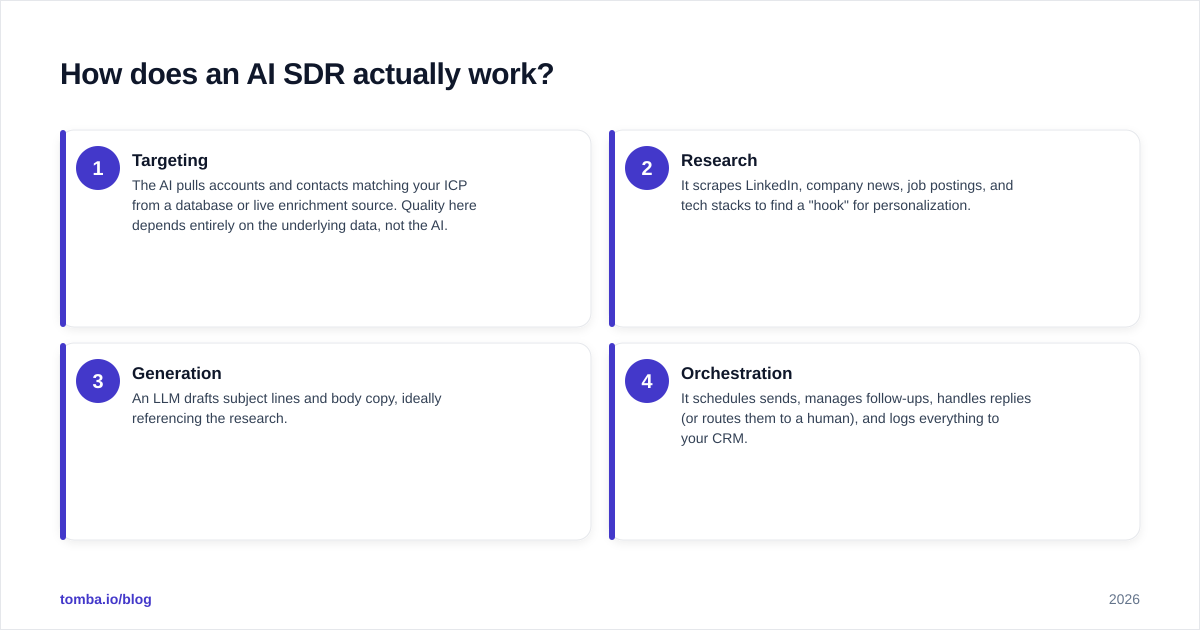
The workflow breaks into four stages, and each is a place where the technology can shine or fall over:
- Targeting — The AI pulls accounts and contacts matching your ICP from a database or live enrichment source. Quality here depends entirely on the underlying data, not the AI.
- Research — It scrapes LinkedIn, company news, job postings, and tech stacks to find a "hook" for personalization.
- Generation — An LLM drafts subject lines and body copy, ideally referencing the research.
- Orchestration — It schedules sends, manages follow-ups, handles replies (or routes them to a human), and logs everything to your CRM.
The dirty secret is stage one. If the email address is wrong, stale, or a catch-all that silently bounces, stages two through four are wasted compute. This is why teams running AI SDRs lean hard on a dedicated email verifier and a reliable email finder before a single message goes out. The AI can write Shakespeare; it can't fix a bounced send.
What are the pros of an AI SDR?#
Here's where AI SDRs earn their keep.
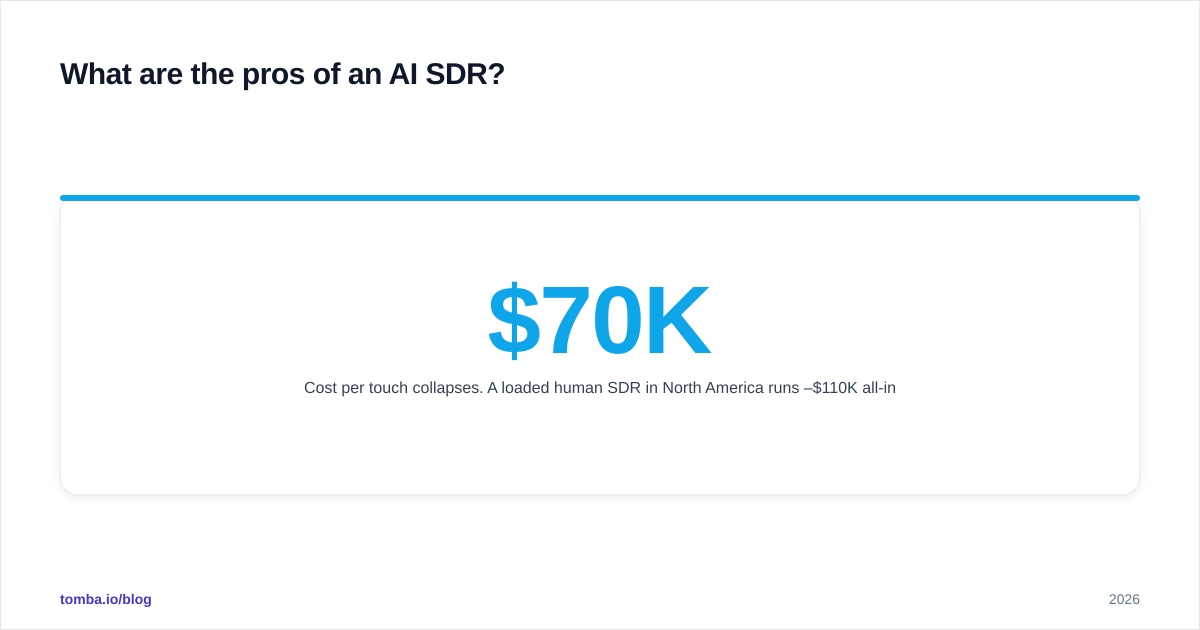
Cost per touch collapses. A loaded human SDR in North America runs $70K–$110K all-in. An AI SDR subscription is typically $1K–$5K/month and never asks for PTO. For high-volume, low-ACV motions, the unit economics are hard to argue with.
Volume and consistency. An AI SDR can research and personalize 500 prospects in the time a human does 30. It never has a bad Monday, never forgets the follow-up, and never lets a hot lead go cold because it was buried in a busy inbox.
Speed to first touch. Inbound lead response time is a known revenue lever — contacting a lead within five minutes massively outperforms an hour later. AI SDRs respond instantly, 24/7, across time zones.
Always-on CRM hygiene. Every touch, reply, and status change is logged automatically. No more reps "forgetting" to update the CRM. RevOps teams love this part.
Cheap experimentation. Want to test 12 subject-line variants across 3 personas? An AI SDR runs that matrix overnight. A human team would need a week and a spreadsheet argument.
What are the cons of an AI SDR?#
Now the honest other half.
Personalization is often shallow. "Saw you went to State University, congrats on 5 years at Acme!" reads as automated because it is. Buyers in 2026 have pattern-matched the AI-generated opener. Surface-level research produces surface-level relevance, and reply rates suffer.
Deliverability risk scales with volume. This is the big one. Blasting AI-generated cold email at volume from cold domains tanks your sender reputation fast. One misconfigured campaign can land your primary domain on a blacklist. AI makes it trivially easy to send too much, too fast — which is exactly how you destroy email deliverability.
It breaks on real conversations. AI handles a clean "yes, book a time" reply well. It fumbles "we're mid-migration off Salesforce, talk to me in Q3 but loop in our VP first." Nuanced, multi-threaded, objection-heavy exchanges still need a human.
Data dependency is a single point of failure. The AI is downstream of your contact data. Bad data means bounces, spam complaints, and wasted send reputation — see the deliverability point above.
Brand risk. An AI SDR that hallucinates a fake mutual connection or sends a tone-deaf message at scale damages your brand at scale. Mistakes don't stay small.
Compliance exposure. GDPR, CAN-SPAM, and CCPA obligations don't disappear because a bot pressed send. You own the consequences.
AI SDR vs human SDR: how do they compare?#
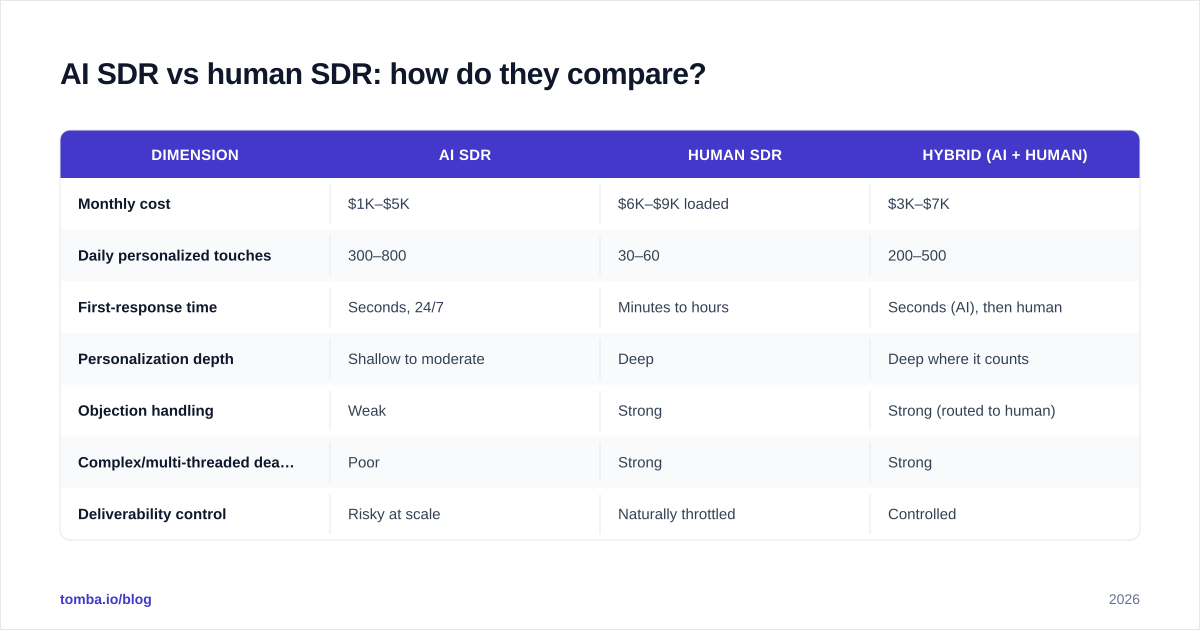
Neither wins outright. They win at different jobs. Here's a concrete breakdown.
| Dimension | AI SDR | Human SDR | Hybrid (AI + Human) |
|---|---|---|---|
| Monthly cost | $1K–$5K | $6K–$9K loaded | $3K–$7K |
| Daily personalized touches | 300–800 | 30–60 | 200–500 |
| First-response time | Seconds, 24/7 | Minutes to hours | Seconds (AI), then human |
| Personalization depth | Shallow to moderate | Deep | Deep where it counts |
| Objection handling | Weak | Strong | Strong (routed to human) |
| Complex/multi-threaded deals | Poor | Strong | Strong |
| Deliverability control | Risky at scale | Naturally throttled | Controlled |
| CRM logging | Automatic | Inconsistent | Automatic |
| Ramp time | Days | 1–3 months | Days to weeks |
The pattern is clear: AI wins on cost, speed, and volume; humans win on depth, judgment, and complex deals. The hybrid column is where most high-performing 2026 teams actually live.
When should you use an AI SDR (and when not)?#
Use an AI SDR when:
- Your ICP is well-defined and your TAM is large (thousands of similar accounts).
- Average contract value is low-to-mid, so volume matters more than white-glove touch.
- You have clean, verified contact data and a warmed-up sending infrastructure.
- You're testing new segments or messaging and want cheap, fast signal.
Lean human when:
- Deals are six figures, multi-stakeholder, and relationship-driven.
- Your buyers are senior executives who detect and resent automation.
- You're in a small, finite market where every prospect is precious and a bad first touch is unrecoverable.
- Compliance or brand sensitivity is high.
A good gut check: if a misfire would cost you a logo, keep a human on it. If a misfire just means one of 5,000 prospects ignores you, AI is fine.
What does an AI SDR cost in 2026?#
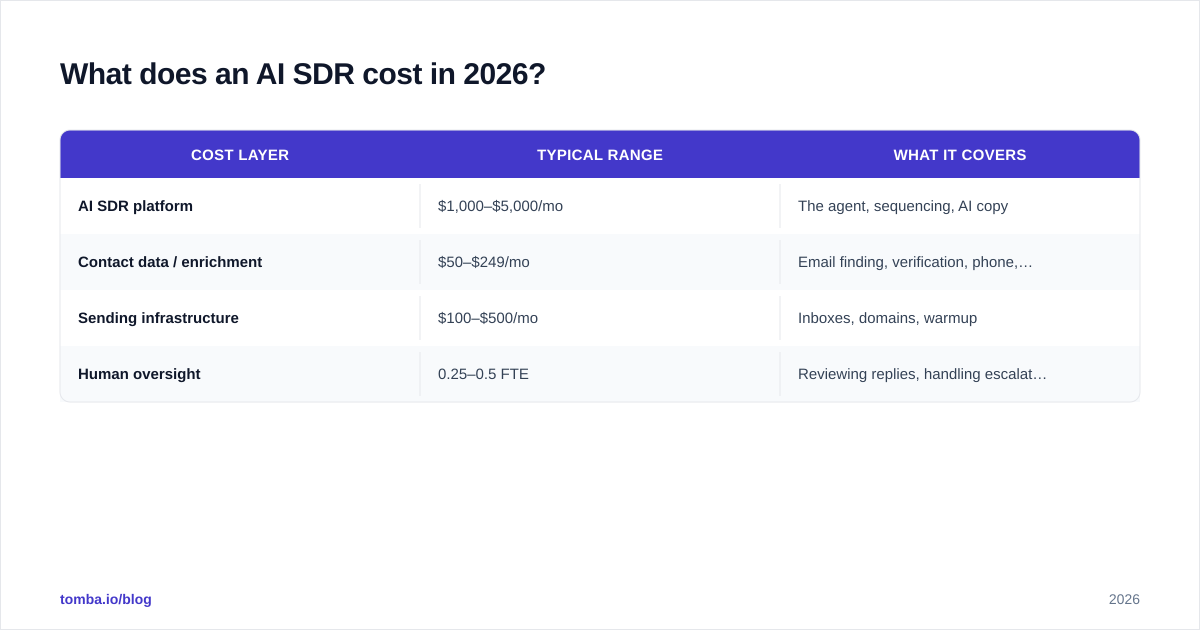
Pricing splits into three buckets, and the sticker price is rarely the real price.
| Cost layer | Typical range | What it covers |
|---|---|---|
| AI SDR platform | $1,000–$5,000/mo | The agent, sequencing, AI copy |
| Contact data / enrichment | $50–$249/mo | Email finding, verification, phone, enrichment |
| Sending infrastructure | $100–$500/mo | Inboxes, domains, warmup |
| Human oversight | 0.25–0.5 FTE | Reviewing replies, handling escalations |
That data layer line is where teams overpay or underbuild. You don't need an all-in-one platform's marked-up data if you pair a focused AI SDR with a precise email finder and verifier. For reference, Tomba pricing runs a free tier at 25 searches/month, Starter at $49/month, Growth at $99/month, and Pro at $249/month — meaningfully cheaper than bundling data into a premium platform you don't control.
The takeaway: budget for all four layers. Teams that buy only the shiny AI platform and skimp on data and infrastructure are the ones posting "AI SDRs don't work" six months later.
How do you make an AI SDR actually perform?#
If you deploy one, these are the moves that separate the teams who win from the teams who churn:
- Verify before you send. Run every address through an email verifier and screen catch-all domains. Bounces above 2–3% are a reputation death spiral.
- Warm up and segment domains. Never send AI volume from your primary domain. Use dedicated sending domains, warm them gradually, and cap daily volume.
- Keep research deep. Configure the AI to pull real, specific signals (funding, hiring, product launches) — not just "company name + title." Shallow inputs produce ignorable outputs.
- Route, don't automate, the hard replies. Let AI handle scheduling and simple positive replies; escalate anything nuanced to a human within minutes.
- Measure reply quality, not send volume. A dashboard bragging about 10,000 sends and 0.1% positive replies is a liability, not a win. Track response rate and meetings booked.
For broader context on what to look for in tooling, G2's sales engagement category and HubSpot's research on sales benchmarks are useful neutral references when you're building your evaluation criteria.
Is an AI SDR worth it in 2026?#
The honest answer: yes, for the right motion, deployed correctly — and a waste of money otherwise.
An AI SDR is not a replacement for a sales team. It's a force multiplier for the top of your funnel, and a fragile one if you ignore the data and deliverability fundamentals underneath it. The companies disappointed by AI SDRs almost always made the same mistake: they bought the AI and treated contact data as an afterthought. The companies thrilled with them built the data foundation first and let the AI do what it's genuinely good at — research and first-touch at scale.
Weigh the AI SDR pros and cons against your specific motion, not the demo. If you sell a high-volume, well-defined product and you've got your sending hygiene sorted, an AI SDR can be the cheapest pipeline you'll ever buy. If you sell complex enterprise deals to skeptical executives, keep your humans — and maybe let AI just build their lists.
Where Tomba fits#
Whatever AI SDR you choose, it will only ever be as accurate as the email addresses you feed it. That's the layer Tomba owns. The Tomba Email Finder gives your AI SDR verified, professional email addresses by name, domain, or company — so your sequences land in real inboxes instead of bouncing and burning your sender reputation. Pair it with our verifier and catch-all screening, start free with 25 searches a month, and build the data foundation your AI SDR actually needs before you scale a single send. Find the emails first; let the AI do the rest.
Ready to find emails that actually work?
Join 150,000+ professionals who stopped guessing and started sending. Free credits on signup — no credit card required.
Get the Tomba newsletter
Practical outbound tactics and product updates — once every two weeks.
About the author