Albacross Pricing, Reviews, Pros and Cons (2026 Guide)
A no-fluff breakdown of Albacross pricing, real user reviews, and the honest pros and cons of using it for website visitor identification in 2026.
Albacross promises to turn anonymous website traffic into named B2B accounts you can actually sell to. The pitch is appealing, but the pricing is opaque, the reviews are mixed, and the tool solves only half of the lead-generation equation. This guide breaks down what you actually pay, what real users say, and where Albacross fits — or doesn't — in a 2026 outbound stack.
TL;DR#
- Albacross is a website visitor identification and intent platform — it reveals the companies browsing your site, not individual contact details.
- Pricing is quote-based. Public plans start around a free tier with hard limits; paid plans are billed annually and scale by identified companies and seats, often landing in the $1,000–$15,000+/year range.
- Strengths: strong European (GDPR-focused) company data, clean dashboard, native CRM and ad-platform integrations.
- Weaknesses: no individual email/phone data, company-level only, annual contracts, and accuracy that drops outside the EU.
- Best paired with an email finder like Tomba Email Finder to turn an identified company into a real person you can email.
What is Albacross and what does it actually do?#
Albacross is a website visitor identification tool. When a company visits your website, Albacross matches the visitor's IP address against its B2B database and tells you which organization it was — company name, size, industry, and sometimes the pages they viewed and how long they stayed.
Think of it like a doorman who recognizes the company logo on a visitor's jacket but never catches their name. You learn that Acme Corp spent four minutes on your pricing page. You do not learn that Jane Okafor, VP of Operations was the human behind that session. That distinction matters enormously, and we'll come back to it.
Albacross sits in the same category as tools like Leadfeeder, Clearbit Reveal, and RB2B. Its differentiator is a heavier focus on European company data and GDPR-conscious processing, which makes it popular with EU-based SaaS and agency teams.
)
If your growth motion depends on knowing which accounts are warming up — classic account-based marketing — visitor ID is genuinely useful. If you need to email a specific person tomorrow, visitor ID alone leaves you stranded at the company gate.
How much does Albacross cost in 2026?#
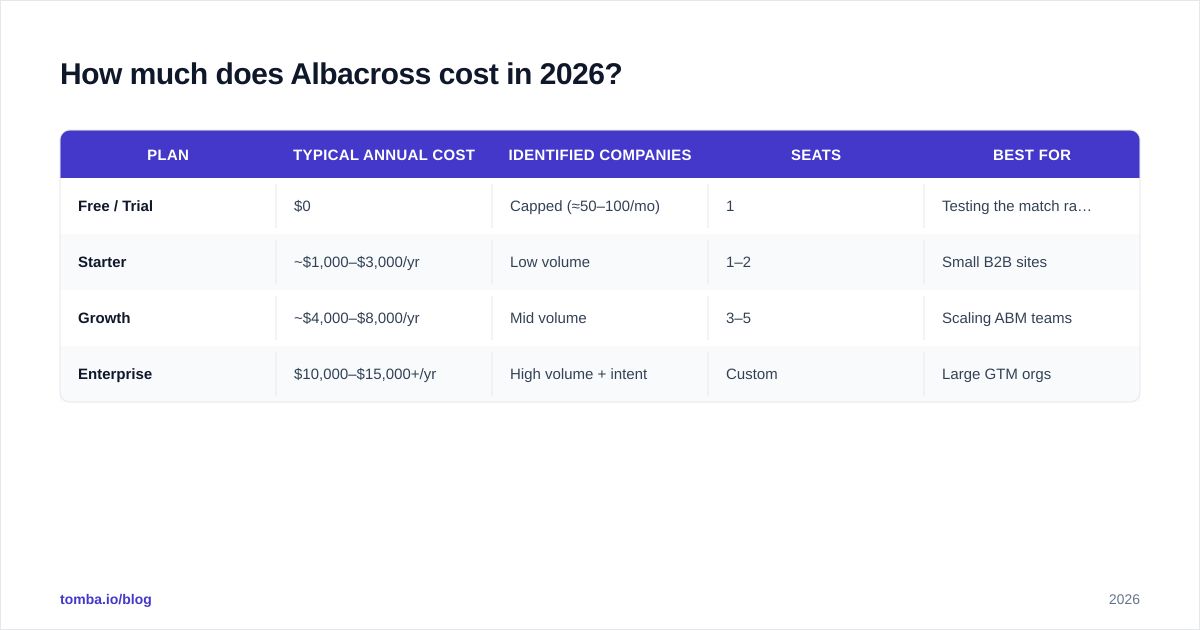
Albacross does not publish a fully transparent pricing table the way self-serve tools do. Most paid plans are quote-based, billed annually, and scale on two axes: the number of identified companies per month and the number of user seats. Below is a representative breakdown based on publicly reported plan structures and user-reported quotes. Treat the dollar figures as directional — your quote depends on traffic volume and region.
| Plan | Typical annual cost | Identified companies | Seats | Best for |
|---|---|---|---|---|
| Free / Trial | $0 | Capped (≈50–100/mo) | 1 | Testing the match rate |
| Starter | ~$1,000–$3,000/yr | Low volume | 1–2 | Small B2B sites |
| Growth | ~$4,000–$8,000/yr | Mid volume | 3–5 | Scaling ABM teams |
| Enterprise | $10,000–$15,000+/yr | High volume + intent | Custom | Large GTM orgs |
A few things to know before you sign:
- Annual billing is the norm. Month-to-month is rarely offered, so you're committing for a year.
- Pricing scales with traffic. High-traffic sites pay more because more sessions get matched.
- Intent data and integrations (the genuinely valuable features) usually sit in higher tiers.
- Overage handling varies — confirm what happens when you exceed your identified-company cap.
For comparison, a tool like Tomba pricing is fully transparent and self-serve: a Free tier with 25 searches/month, Starter at $49/month, Growth at $99/month, and Pro at $249/month — no sales call required. Different product, but a useful benchmark for how opaque visitor-ID pricing can feel.
What do real Albacross reviews say?#
Aggregating public reviews from G2 and Capterra, Albacross generally lands in the 4.0–4.3 out of 5 range. The sentiment is consistent enough to summarize cleanly.
What reviewers praise:
- Clean, intuitive dashboard — easy to see which companies visited and what they did.
- Strong European company data — match rates are notably better for EU traffic.
- Solid integrations — native connections to HubSpot, Salesforce, Pipedrive, Slack, and ad platforms for retargeting.
- Responsive support during onboarding.
What reviewers criticize:
- Match rate drops outside Europe, especially for US small-business and remote-worker traffic.
- Company-level only — repeated complaints that you can't get the actual person.
- Annual contracts and unclear pricing create friction for smaller teams.
- Data freshness — some firmographic details lag, particularly for fast-moving startups.
The recurring theme: people love the visibility and wish the actionability went one layer deeper. Knowing Acme Corp visited is step one. Knowing who to contact and how to reach them is the step Albacross deliberately doesn't take — largely for GDPR reasons in its core European market.
What are the pros and cons of Albacross?#
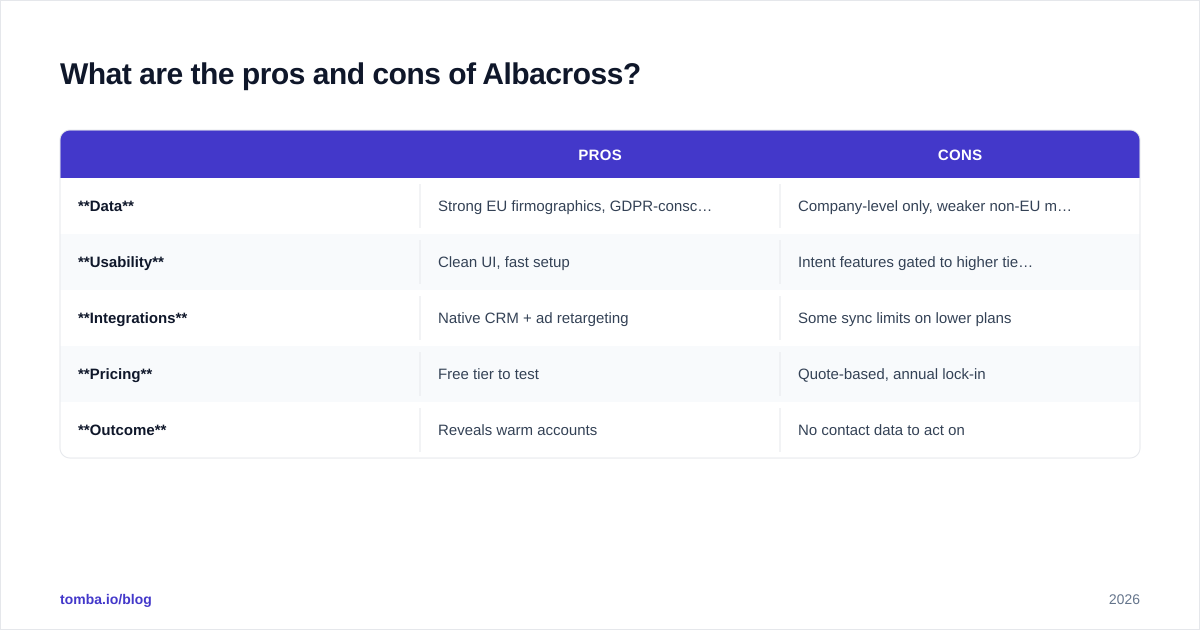
Here's the honest ledger.
| Pros | Cons | |
|---|---|---|
| Data | Strong EU firmographics, GDPR-conscious | Company-level only, weaker non-EU match |
| Usability | Clean UI, fast setup | Intent features gated to higher tiers |
| Integrations | Native CRM + ad retargeting | Some sync limits on lower plans |
| Pricing | Free tier to test | Quote-based, annual lock-in |
| Outcome | Reveals warm accounts | No contact data to act on |
The single biggest limitation is structural, not a bug: Albacross identifies organizations, not people. That's a deliberate design choice, and it means Albacross is the first tool in a workflow, never the last. You still need a way to go from "company name" to "a verified email in your sequence."
)
How does Albacross compare to alternatives?#
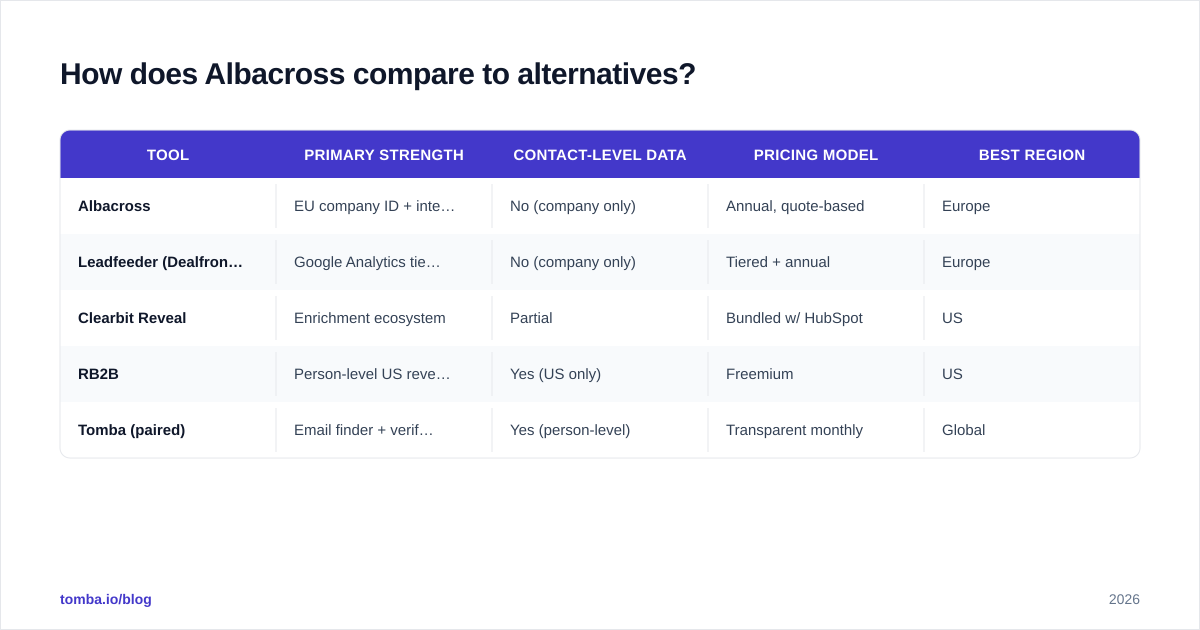
Visitor ID is a crowded space. Here's how Albacross stacks up against the common alternatives teams evaluate alongside it.
| Tool | Primary strength | Contact-level data | Pricing model | Best region |
|---|---|---|---|---|
| Albacross | EU company ID + intent | No (company only) | Annual, quote-based | Europe |
| Leadfeeder (Dealfront) | Google Analytics tie-in | No (company only) | Tiered + annual | Europe |
| Clearbit Reveal | Enrichment ecosystem | Partial | Bundled w/ HubSpot | US |
| RB2B | Person-level US reveal | Yes (US only) | Freemium | US |
| Tomba (paired) | Email finder + verifier | Yes (person-level) | Transparent monthly | Global |
If your traffic is primarily European and you care about account-level intent for ABM, Albacross is a reasonable pick. If your traffic is US-heavy and you need person-level reveal, RB2B is closer to what you want. And if you're shopping specifically because Albacross feels too rigid, the Albacross alternative breakdown walks through how a finder-plus-reveal stack can replace it.
For teams that want the reveal layer and a path to contact data in one place, pairing a website visitor reveal capability with an email finder closes the loop that Albacross leaves open.
How do you turn an Albacross visit into a real lead?#
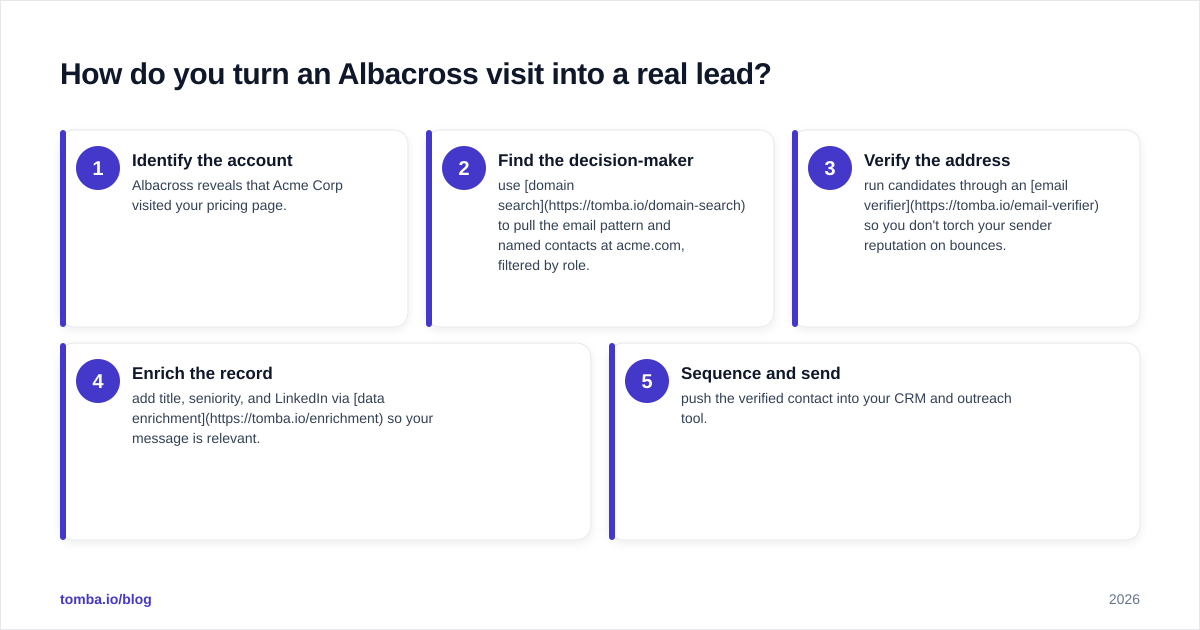
This is where most Albacross workflows quietly stall. Identification is not outreach. Here's the practical chain from anonymous session to booked meeting.
- Identify the account — Albacross reveals that Acme Corp visited your pricing page.
- Find the decision-maker — use domain search to pull the email pattern and named contacts at acme.com, filtered by role.
- Verify the address — run candidates through an email verifier so you don't torch your sender reputation on bounces.
- Enrich the record — add title, seniority, and LinkedIn via data enrichment so your message is relevant.
- Sequence and send — push the verified contact into your CRM and outreach tool.
Albacross owns step 1. Steps 2–5 require contact-level tooling it simply doesn't provide. This is why the most effective teams treat visitor ID as a trigger, not a destination — the visit fires the signal, and a separate finder-and-verify layer converts that signal into a person you can actually talk to.
Who should use Albacross — and who shouldn't?#
Albacross is a good fit if you:
- Run account-based marketing with a defined target list.
- Have meaningful European website traffic.
- Want to retarget identified companies with ads.
- Already have a contact-sourcing layer to act on the accounts.
Look elsewhere if you:
- Need individual emails and phone numbers, not company names.
- Have mostly US or non-EU traffic where match rates dip.
- Want transparent, month-to-month pricing without a sales call.
- Are a small team that can't justify a four-figure annual commitment.
The deciding question is simple: do you already have a way to contact the people inside the companies Albacross surfaces? If yes, Albacross adds a useful intent signal. If no, you'll buy it, get excited about the dashboard, and then realize you still can't email anyone — the exact complaint that shows up across its reviews.
The verdict on Albacross pricing, reviews, pros and cons#
Albacross is a competent, GDPR-friendly visitor identification tool with a clean interface and strong European data — and its 4.0–4.3 review average reflects that. The pros are real: account-level intent, good integrations, easy setup. The cons are equally real: opaque annual pricing, company-only data, and weaker accuracy outside the EU.
But the core takeaway isn't about Albacross's flaws. It's about scope. Visitor ID tells you which door is warm. It never hands you the key. To convert those signals into pipeline, you need a reliable way to find and verify the humans behind the accounts.
That's exactly where Tomba fits. Use Albacross (or any reveal tool) to surface warm accounts, then run them through the Tomba Email Finder to get verified, deliverable email addresses for the right decision-makers — with a free tier to start and transparent pricing as you scale. Identify the account, find the person, and actually start the conversation. Start free at tomba.io/email-finder.
// get started
Find, verify and enrich your first contacts today
Start on the free plan with 25 searches a month, then scale when your team is ready.
Free plan · No credit card required · GDPR & CCPA
// about the author