Albacross vs Leadfeeder 2026: Visitor Identification Compared
Albacross vs Leadfeeder, compared on data accuracy, pricing, integrations, and GDPR. See which website visitor identification tool fits your 2026 pipeline.
Most of your website traffic leaves without filling out a form. Visitor identification tools try to fix that by matching anonymous IP and device signals to real companies, so your sales team can follow up before the lead goes cold. Albacross and Leadfeeder (now part of Dealfront) are two of the biggest names in that category — and they make very different trade-offs.
This is a neutral, side-by-side breakdown to help you pick the right one in 2026.
TL;DR — Albacross vs Leadfeeder at a glance#
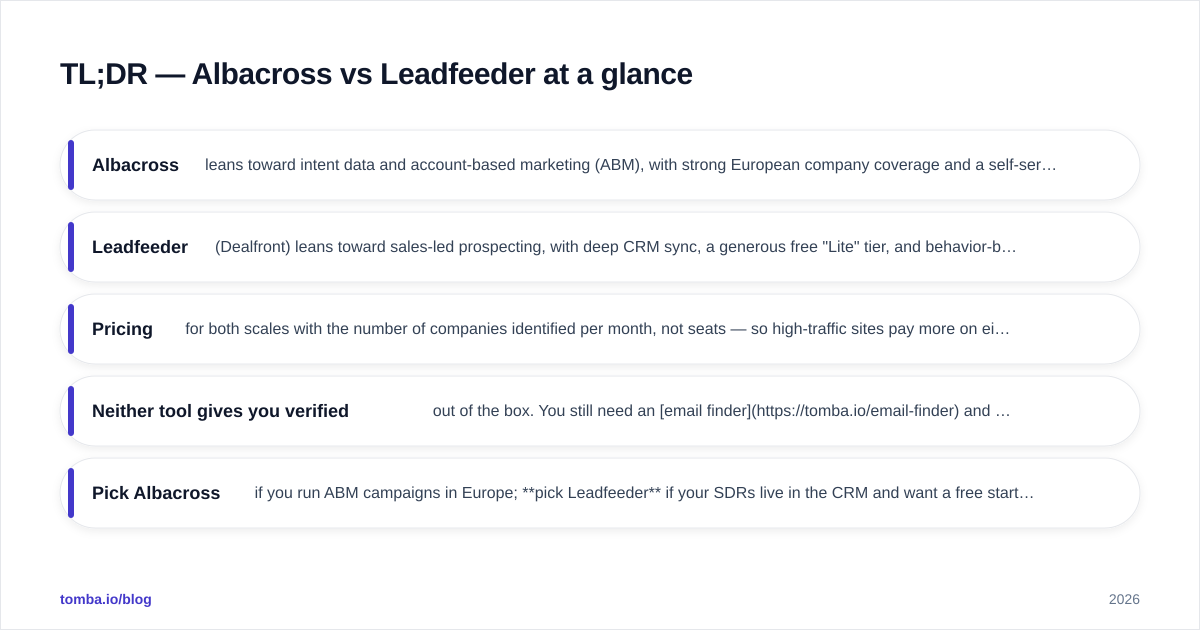
- Albacross leans toward intent data and account-based marketing (ABM), with strong European company coverage and a self-serve, marketing-led workflow.
- Leadfeeder (Dealfront) leans toward sales-led prospecting, with deep CRM sync, a generous free "Lite" tier, and behavior-based lead scoring.
- Pricing for both scales with the number of companies identified per month, not seats — so high-traffic sites pay more on either platform.
- Neither tool gives you verified contact emails out of the box. You still need an email finder and an email verifier to turn an identified company into a reachable person.
- Pick Albacross if you run ABM campaigns in Europe; pick Leadfeeder if your SDRs live in the CRM and want a free starting point.

What do Albacross and Leadfeeder actually do?#
Both tools answer the same question: which companies visited my website, and what did they look at?
Think of your website like a physical showroom with no reception desk. People walk in, browse, and walk out — and you never learn their names. Visitor identification is the security camera plus the license-plate lookup: it can't always tell you who walked in, but it can often tell you which company the car belongs to.
Technically, both platforms drop a tracking script on your site, capture each visitor's IP address and firmographic signals, and reverse-match that against a database of company IP ranges and ISP data. The output is a feed of company names, the pages they viewed, time on site, and a rough "fit" or intent score.
The key thing to understand: company-level identification is the product, person-level contact data is not. Match rates depend heavily on traffic geography, B2B vs B2C mix, and how many of your visitors browse from corporate networks versus home Wi-Fi. Expect anywhere from 10% to 40% of B2B traffic to be identifiable — vendors quoting higher numbers are usually counting bot and ISP noise.
How do Albacross and Leadfeeder compare on features and pricing?#
Here's the head-to-head on the attributes that actually change your buying decision.
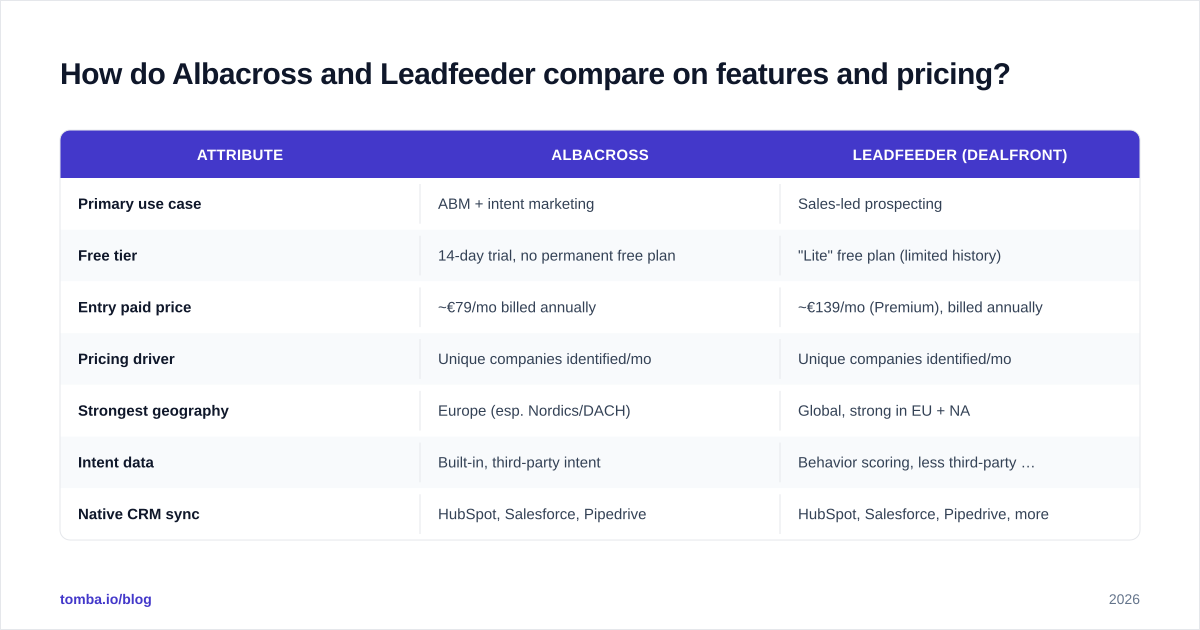
| Attribute | Albacross | Leadfeeder (Dealfront) |
|---|---|---|
| Primary use case | ABM + intent marketing | Sales-led prospecting |
| Free tier | 14-day trial, no permanent free plan | "Lite" free plan (limited history) |
| Entry paid price | ~€79/mo billed annually | ~€139/mo (Premium), billed annually |
| Pricing driver | Unique companies identified/mo | Unique companies identified/mo |
| Strongest geography | Europe (esp. Nordics/DACH) | Global, strong in EU + NA |
| Intent data | Built-in, third-party intent | Behavior scoring, less third-party intent |
| Native CRM sync | HubSpot, Salesforce, Pipedrive | HubSpot, Salesforce, Pipedrive, more |
| Contact emails included | No (company-level) | No (company-level) |
| GDPR posture | EU-based, GDPR-first | EU-based (Dealfront), GDPR-first |
| Best for | Marketers running account campaigns | SDRs working a CRM-driven pipeline |
Prices shift over time and by contract; confirm current numbers on the Albacross and Leadfeeder sites before you commit. The structural point holds: you pay for volume of identified companies, so a spike in traffic raises your bill on both.

Is Albacross better than Leadfeeder for ABM?#
Yes — if account-based marketing is your core motion, Albacross is the more natural fit.
Albacross was built around the marketer's workflow. It surfaces intent signals, lets you build target account lists, and pushes audiences into ad platforms for retargeting. If your team thinks in terms of "tier-1 accounts" and "buying committees" rather than "today's hot leads," that framing maps cleanly onto how Albacross presents data.
Albacross also has a reputation for strong European company coverage, particularly in the Nordics and DACH regions where it originated. For a B2B company selling into those markets, that regional density can mean a meaningfully higher match rate than a US-centric tool.
Where Albacross is weaker: the sales hand-off. The data is excellent for building campaigns, but turning an identified account into an SDR's call list takes more manual work than Leadfeeder's CRM-first design.
Is Leadfeeder better than Albacross for sales teams?#
For SDR-driven outbound, Leadfeeder usually wins — and the free tier makes it easy to try.
Leadfeeder's whole design assumes a salesperson living inside HubSpot or Pipedrive. Its behavior-based lead scoring, custom feeds ("show me companies that viewed pricing twice this week"), and automatic CRM creation are tuned for working leads, not just analyzing accounts. Reps can filter to high-intent visitors and start outreach the same day.
The free "Lite" plan is the other big draw. You get a capped, short-history view of identified companies at no cost — enough to prove the concept before paying. Albacross has a trial, but no permanent free plan, so Leadfeeder lowers the barrier to entry for budget-conscious teams.
Since the Dealfront merger, Leadfeeder also benefits from a larger European B2B database, narrowing Albacross's old geographic advantage. If you want a deeper look at competing options, our Leadfeeder alternative and visitor-reveal resources cover the broader landscape.
The trade-off: Leadfeeder's ABM and third-party intent features are thinner than Albacross's. It tells you who's hot right now better than it tells you which accounts to build a quarter-long campaign around.
What neither tool solves: turning companies into contacts#
Here's the gap nobody puts on the pricing page. Both Albacross and Leadfeeder identify companies, not people.
You'll learn that "Acme GmbH visited your pricing page four times." You will not get the name and verified email of the procurement lead who actually needs your product. That last mile — from company to decision-maker — is where most visitor-ID workflows stall.
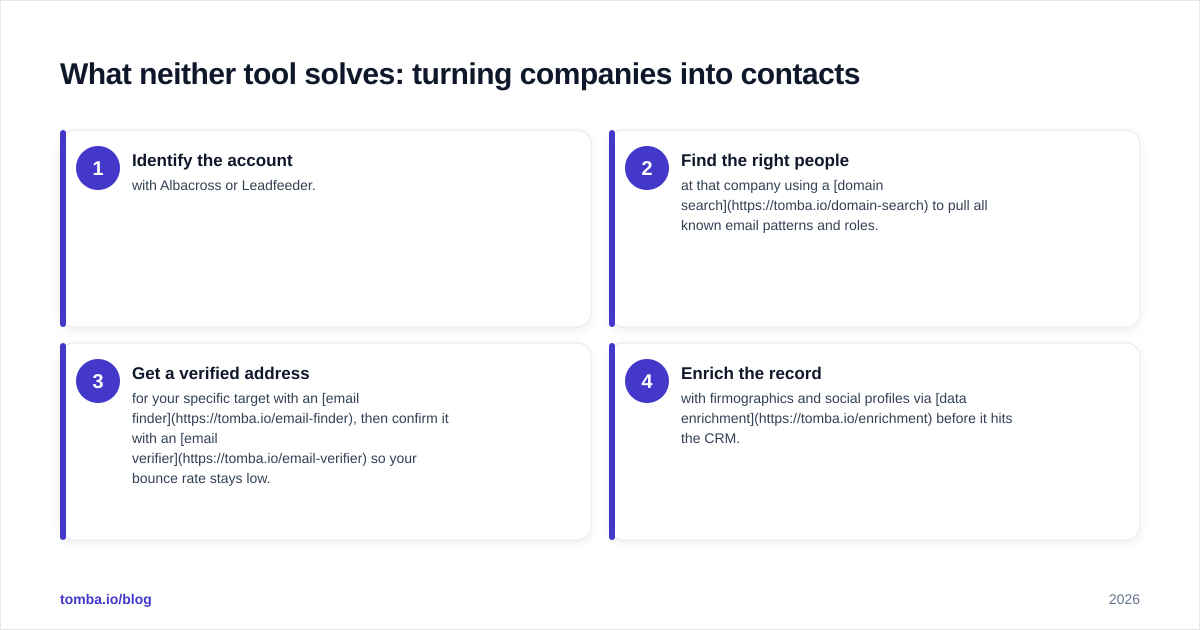
This is why mature teams pair a visitor identification tool with a contact-data stack:
- Identify the account with Albacross or Leadfeeder.
- Find the right people at that company using a domain search to pull all known email patterns and roles.
- Get a verified address for your specific target with an email finder, then confirm it with an email verifier so your bounce rate stays low.
- Enrich the record with firmographics and social profiles via data enrichment before it hits the CRM.
Without that pipeline, an identified-company feed is just a list of logos. Skipping verification is the most common reason cold outreach to "warm" accounts still bounces — sending to unverified guesses tanks your sender reputation and hurts deliverability for every other email you send.
How do Albacross and Leadfeeder handle GDPR?#
Both are built with GDPR in mind, which matters because you're processing visitor data — but the responsibility is shared, not outsourced.
Because both vendors are European (Leadfeeder via Dealfront), they design around EU privacy norms and identify at the company level rather than profiling named individuals, which keeps most use cases on safer legal footing. You should still:
- Disclose the tracking in your privacy policy.
- Confirm your data processing agreement (DPA) with the vendor.
- Check that your consent management platform doesn't block the script in a way that breaks tracking — or, conversely, that it respects opt-outs.
Don't treat "the vendor is GDPR-compliant" as the end of the conversation. Your use of the data — especially when you enrich a company into named contacts and start emailing them — is where your own compliance obligations kick in. Lawful-basis and suppression-list hygiene are on you.
Which should you choose in 2026?#
Here's the decision in one table.
| If you... | Choose |
|---|---|
| Run ABM campaigns and think in target accounts | Albacross |
| Sell primarily into the Nordics/DACH | Albacross |
| Want third-party intent data baked in | Albacross |
| Live inside HubSpot/Pipedrive as an SDR | Leadfeeder |
| Need a free tier to prove value first | Leadfeeder |
| Want behavior-based "hot right now" scoring | Leadfeeder |
| Need verified contact emails, not just companies | Neither — add an email finder |
A practical recommendation: if you're early-stage and budget-sensitive, start on Leadfeeder's free Lite plan, validate that your traffic is identifiable enough to matter, and only then decide whether Albacross's ABM depth justifies the switch or a parallel subscription. Check independent reviews on G2 for current user sentiment, since both products iterate fast.
Whichever you pick, budget for the contact-data layer from day one. The visitor tool is the top of the funnel; the email finder and verifier are what make it convert.
The bottom line#
Albacross and Leadfeeder are both solid at the same core job — telling you which companies browse your site — and they differentiate on philosophy more than raw capability. Albacross is the marketer's ABM-and-intent platform with strong European coverage. Leadfeeder is the SDR's CRM-native prospecting feed with a free on-ramp. Neither hands you a verified inbox to email.
That's the piece Tomba fills. Once Albacross or Leadfeeder names the account, run it through the Tomba Email Finder to get the decision-maker's professional email, verify it before you send, and push a clean, enriched record into your CRM. Start free with 25 searches a month, and see full Tomba pricing when you're ready to scale your outbound. Identify the company with a visitor tool — then actually reach the human with Tomba.
// get started
Find, verify and enrich your first contacts today
Start on the free plan with 25 searches a month, then scale when your team is ready.
Free plan · No credit card required · GDPR & CCPA
// about the author