Alesco Data Pricing, Reviews, Pros and Cons (2026 Guide)
A straight-talking breakdown of Alesco Data's pricing model, real-world reviews, and the pros and cons every marketer should weigh before signing a data contract in 2026.
Alesco Data is one of the largest consumer and B2B data compilers in the United States. But its pricing is quote-only, and the buying experience is built for direct marketers, not modern sales teams. This guide to Alesco Data pricing reviews pros and cons gives you the numbers people actually pay. You also get the reviews that matter and a clear verdict. By the end, you can decide whether Alesco belongs in your stack in 2026.
TL;DR#
- Alesco Data sells compiled consumer and business lists — automotive, mortgage, homeowner, and B2B firmographic data. It is priced by record, by license, and by usage, almost always behind a custom quote.
- Typical list pricing runs from roughly $0.03–$0.15 per record for consumer data, and higher for specialty or modeled audiences. Minimum orders push real spend into the $1,000s.
- Reviews are thin and split: praise for raw scale and niche automotive and mortgage data, but criticism for stale records, opaque pricing, and weak self-serve tools.
- Biggest con for outbound teams: list data decays fast. Alesco does not give you live email verification, so you carry the bounce risk.
- The fix most teams land on: pair compiled data (or skip it) with a real-time verification and enrichment layer like Tomba's data enrichment to keep deliverability high.
What is Alesco Data?#
Alesco Data is a Jacksonville, Florida-based data compiler and list provider. It pulls consumer and business records from public records, surveys, self-reported sources, transactional feeds, and third-party partners. Think of it as a giant warehouse of pre-built audiences. Instead of finding contacts one at a time, you tell Alesco "homeowners in Texas with a mortgage over $300k who bought a truck in the last 18 months," and they hand you a matching list.
Their best-known strengths are vertical consumer datasets. These include automotive (vehicle make, model, year, in-market signals), mortgage and property, homeowner and renter status, and demographic and lifestyle attributes. They also sell B2B firmographic data — company size, industry, and contacts — though that is not their flagship.
The model is classic direct marketing. You license a list for a defined use (one-time mailing, multi-use, or unlimited), Alesco delivers a file, and you run your campaign. That works well for a postal mail house. It works less well for a sales team that wants verified, deduplicated, CRM-ready contacts on demand.
How much does Alesco Data pricing cost?#
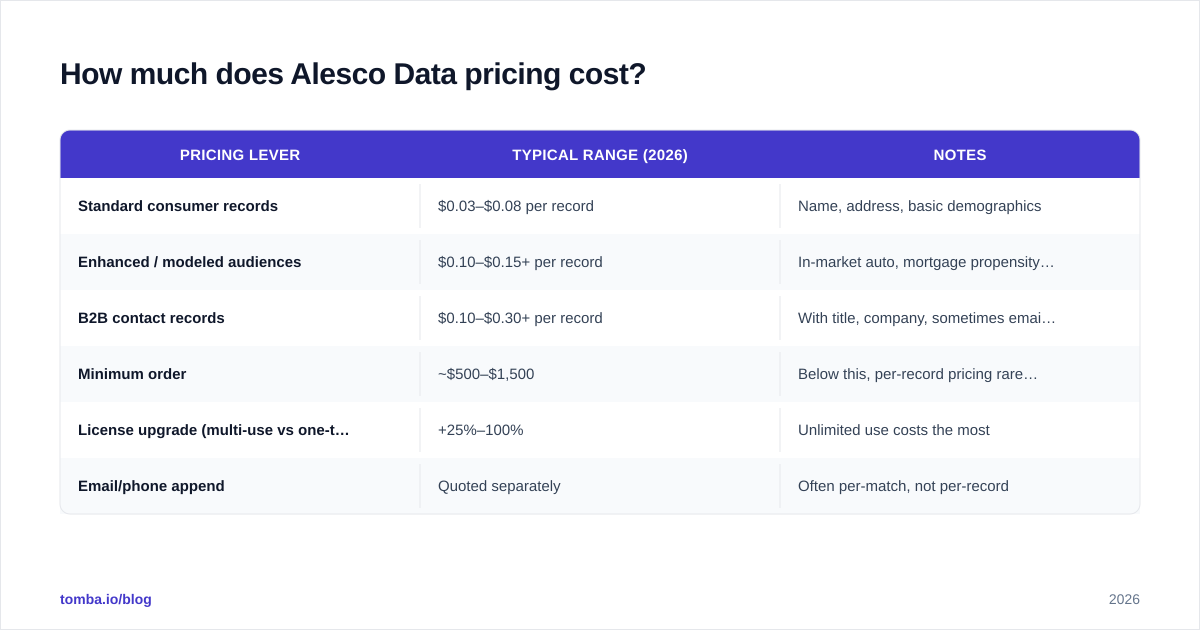
There is no public price list — Alesco Data pricing is quote-only. The final number depends on four levers: record volume, data type, license terms, and any modeling or appends you add. That opacity is the most common complaint in Alesco reviews, so here is a grounded estimate of what buyers actually encounter.
| Pricing lever | Typical range (2026) | Notes |
|---|---|---|
| Standard consumer records | $0.03–$0.08 per record | Name, address, basic demographics |
| Enhanced / modeled audiences | $0.10–$0.15+ per record | In-market auto, mortgage propensity, lifestyle |
| B2B contact records | $0.10–$0.30+ per record | With title, company, sometimes email/phone |
| Minimum order | ~$500–$1,500 | Below this, per-record pricing rarely applies |
| License upgrade (multi-use vs one-time) | +25%–100% | Unlimited use costs the most |
| Email/phone append | Quoted separately | Often per-match, not per-record |
A realistic first order is a modeled audience of 25,000–50,000 records for a mid-market team. That lands somewhere between $2,000 and $7,500, before appends. Specialty automotive in-market data and exclusive licenses push that higher. Unlike a SaaS tool with a published pricing page, you cannot self-serve. You also cannot easily compare tiers — you negotiate.
That negotiation is where two things bite. First, list licenses are time- and use-bound. A "one-time use" license means you cannot legally re-mail the list or load it into your CRM for an ongoing campaign. Second, the per-record cost says nothing about how many records are still accurate. That brings us to the reviews.

What do Alesco Data reviews say?#
Alesco Data reviews are sparse and split down the middle. Buyers who need raw scale in a specific vertical tend to be happy. Buyers who expected modern, verified, sales-ready data tend to be frustrated. Alesco sells mostly through direct relationships and brokers, so it has a much smaller public review footprint than self-serve SaaS tools. Weigh each data point carefully.
Common themes show up across public listings on G2 and Capterra, broker forums, and direct-marketing communities.
What reviewers like:
- Depth in automotive and mortgage data — niche attributes you cannot easily get elsewhere.
- Scale — hundreds of millions of consumer records, useful for large postal and modeling programs.
- Responsive account and broker support during the sales process.
- Flexible audience building — you can layer many selects to target tightly.
What reviewers criticize:
- Data freshness — records (especially emails and phones) go stale, driving bounces and wrong numbers.
- Opaque pricing — no transparency, lots of back-and-forth, surprise license fees.
- Weak self-serve tooling — no clean dashboard, API-first workflow, or live verification.
- Deliverability risk — you inherit the bounce problem, and there is no built-in safety net.
The pattern fits how compiled data ages. Industry studies put B2B data decay at roughly 2–3% per month. That means about a quarter of a list goes bad every year. People change jobs, companies rebrand, and inboxes get shut off. A list that was 90% accurate at delivery can fall well under 80% within a few months. This is not unique to Alesco. It is the nature of buying a static file instead of querying live data.
Alesco Data pricing reviews pros and cons: the honest verdict#
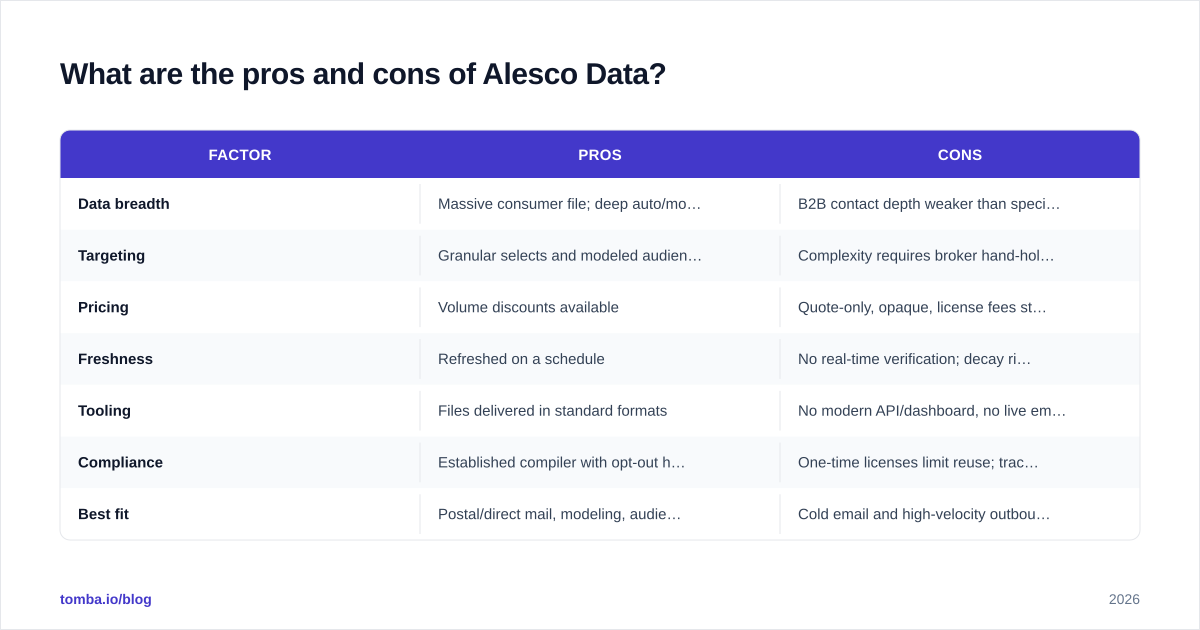
The pros and cons of Alesco Data come down to one trade-off: unmatched vertical scale versus stale, license-bound, unverified records. Here is the head-to-head.
| Factor | Pros | Cons |
|---|---|---|
| Data breadth | Massive consumer file; deep auto/mortgage/property | B2B contact depth weaker than specialists |
| Targeting | Granular selects and modeled audiences | Complexity requires broker hand-holding |
| Pricing | Volume discounts available | Quote-only, opaque, license fees stack up |
| Freshness | Refreshed on a schedule | No real-time verification; decay risk on you |
| Tooling | Files delivered in standard formats | No modern API/dashboard, no live email verifier |
| Compliance | Established compiler with opt-out handling | One-time licenses limit reuse; track carefully |
| Best fit | Postal/direct mail, modeling, audience analytics | Cold email and high-velocity outbound |
The short version is simple. If you run large-scale direct mail or build lookalike models, Alesco's scale is a genuine asset. If you run cold email or build a sales pipeline, the math flips. The lack of verification and the license limits make raw compiled lists a liability. You pay per record and still eat the bounce rate.
Is Alesco Data good for cold email and outbound sales?#
For cold email, raw compiled lists from any broker — Alesco included — are risky. Deliverability lives and dies on list hygiene, not list size. Mailbox providers like Google and Microsoft watch your bounce rate and spam complaints. Send to a purchased list with a 10–20% bad-address rate, and you can wreck your sender reputation in a single campaign. That drags down even your legitimate mail.
This is where the workflow matters more than the source. A defensible outbound stack looks like this.
- Source contacts — from a compiler, a discovery tool, or your own research.
- Verify every email in real time — drop invalids, risky catch-alls, and role accounts before they hit your sequencer. Tomba's email verifier does this at the moment of send, not on a monthly refresh schedule.
- Enrich the survivors — add title, company, and direct contact details so you can personalize.
- Sync clean records to your CRM with deduplication.
Notice that step 2 is exactly the layer a static Alesco file does not give you. Even a perfectly sourced list needs verification before outbound. Verification reflects the inbox's state today, not the day the file was compiled. Want to know why provenance matters? Tomba documents its data sources openly — the kind of transparency that compiled-list buyers rarely get.
What are the best Alesco Data alternatives in 2026?#
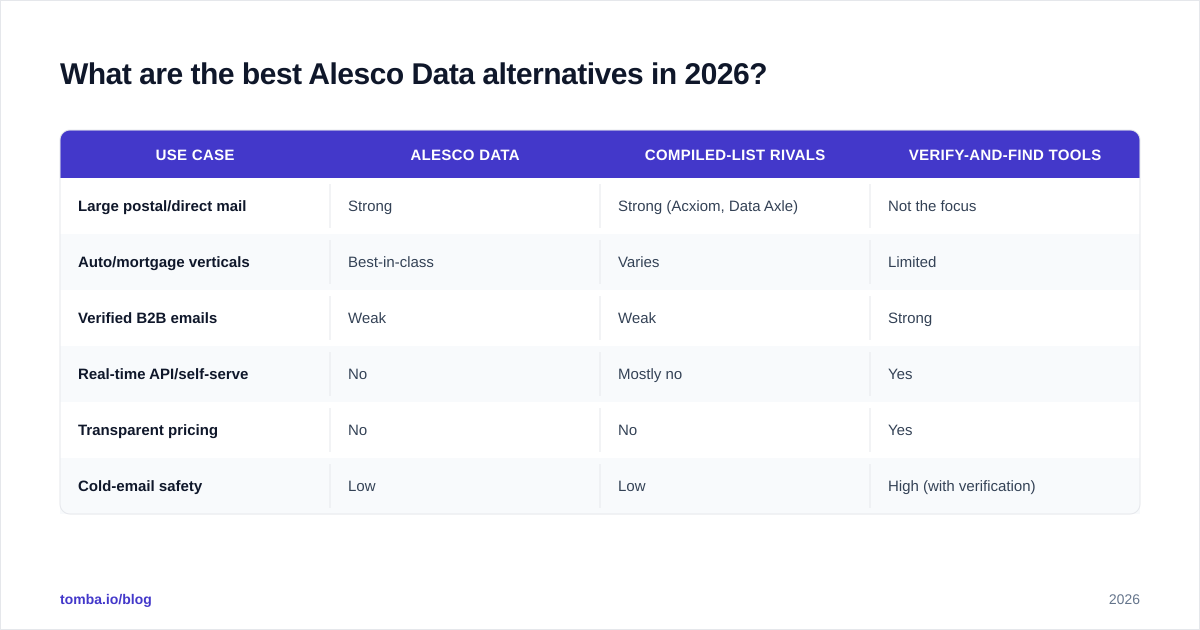
The best alternative depends on whether you need bulk audiences or precise, verified B2B contacts. They are different jobs. Alesco competes with consumer compilers (Experian, Acxiom, Data Axle) on the audience side. On the sales side, it competes with B2B contact platforms. For sales and outbound teams, the more useful comparison is against tools that find and verify contacts on demand rather than selling you a file.
| Use case | Alesco Data | Compiled-list rivals | Verify-and-find tools |
|---|---|---|---|
| Large postal/direct mail | Strong | Strong (Acxiom, Data Axle) | Not the focus |
| Auto/mortgage verticals | Best-in-class | Varies | Limited |
| Verified B2B emails | Weak | Weak | Strong |
| Real-time API/self-serve | No | Mostly no | Yes |
| Transparent pricing | No | No | Yes |
| Cold-email safety | Low | Low | High (with verification) |
Say your problem is "I need clean, verified business emails for outbound." A verify-and-find approach wins on cost-per-usable-contact, even when the per-record price looks higher. You pay only for contacts you can actually reach. You can also build a deduplicated B2B database over time, instead of licensing a static file you can use once. For teams that just need to confirm an address before sending, a quick check with a free email checker prevents the worst bounces at zero cost.
How do you decide if Alesco Data is worth it?#
Buy Alesco if your campaign is volume-and-vertical driven. Skip it if your campaign is precision-and-deliverability driven. Run your situation through these questions before you sign anything.
- What channel? Postal mail and modeling favor Alesco. Cold email and dialing favor verified, on-demand data.
- How often will you use the list? One-and-done mailings fit a one-time license. Ongoing outbound does not, so you will re-buy or breach the terms.
- Who owns the bounce risk? With a static file, you do. With real-time verification, you de-risk every send.
- Can you tolerate quote-only pricing? If procurement needs predictable costs, opaque per-record quotes become a friction point.
- Do you need an API? Modern revenue teams automate enrichment. A file-delivery vendor adds manual steps.
Did you answer "email/outbound," "ongoing," "I own the risk," "I need transparency," and "yes to API"? Then a compiled list is the wrong tool for the job — no matter how good Alesco's automotive data is.
Frequently asked questions#
How much does Alesco Data cost per record? Most consumer records fall in the $0.03–$0.15 range, depending on how enhanced or modeled the audience is. B2B contacts cost more. Exact pricing is quote-only and gated by minimum orders, usually in the hundreds to low thousands of dollars.
Does Alesco Data verify emails? Alesco refreshes its data on a schedule, but it does not provide real-time, per-send email verification. For outbound, verify every address yourself before sending to protect deliverability.
Is Alesco Data good for B2B sales? It can supply B2B firmographic and contact data, but it is strongest in consumer verticals like automotive and mortgage. For verified B2B emails and self-serve workflows, dedicated contact tools fit better.
What licenses does Alesco Data offer? Typically one-time use, multi-use, and unlimited-use licenses. A one-time license legally restricts you from re-mailing the list or permanently loading it into your CRM, so read the terms carefully.
The bottom line and your next step#
Alesco Data is a legitimate, large-scale compiler with real depth in automotive, mortgage, and consumer verticals. But its pricing and tooling are built for an older direct-marketing world. The pros are real — scale and niche selects. So are the cons: opaque quotes, license limits, stale records, and zero live verification. For postal and modeling work, it can earn its keep. For cold email and modern outbound, raw compiled lists are a deliverability hazard you don't need to take on.
If your goal is reaching real people in the inbox, start from verification, not from a file. Use the Tomba Email Finder to find and validate professional email addresses by name, company, or domain in real time. Then every contact you pay for is one you can actually reach. Pair it with verification and enrichment, and you replace a static, decaying list with a living pipeline that protects your sender reputation and your budget.
Ready to find emails that actually work?
Join 150,000+ professionals who stopped guessing and started sending. Free credits on signup — no credit card required.
Get the Tomba newsletter
Practical outbound tactics and product updates — once every two weeks.
About the author