Aligned Alternatives: 6 Best Digital Sales Rooms for 2026
Aligned is a solid digital sales room, but it isn't the only one. Here are six Aligned alternatives compared on pricing, features, and best-fit use case for 2026.
TL;DR
- Aligned is a well-built digital sales room (DSR) and buyer enablement platform, but pricing, mutual action plan depth, and integrations push many teams to look at alternatives.
- The strongest Aligned alternatives in 2026 are Dock, GetAccept, Trumpet, Journey, Recapped, and DealHub — each wins on a different axis (price, e-signature, onboarding, simplicity).
- Pick by job-to-be-done: cheapest entry (Dock), signing built in (GetAccept), fastest setup (Trumpet), post-sale onboarding (Recapped), full CPQ workflow (DealHub).
- A digital sales room is only as good as the buyers inside it. Accurate contact data is the upstream input that decides whether your DSR ever gets opened.
- Use this guide's comparison table and decision framework to shortlist in under ten minutes.
What is Aligned and why look for alternatives?#
Aligned is a digital sales room platform — a shared workspace where a seller and a buying committee collaborate on a single link instead of trading 40 email threads. Inside one room you get a mutual action plan, content, pricing, stakeholder tracking, and engagement analytics. It's a genuinely good product, which is why it shows up on most shortlists.
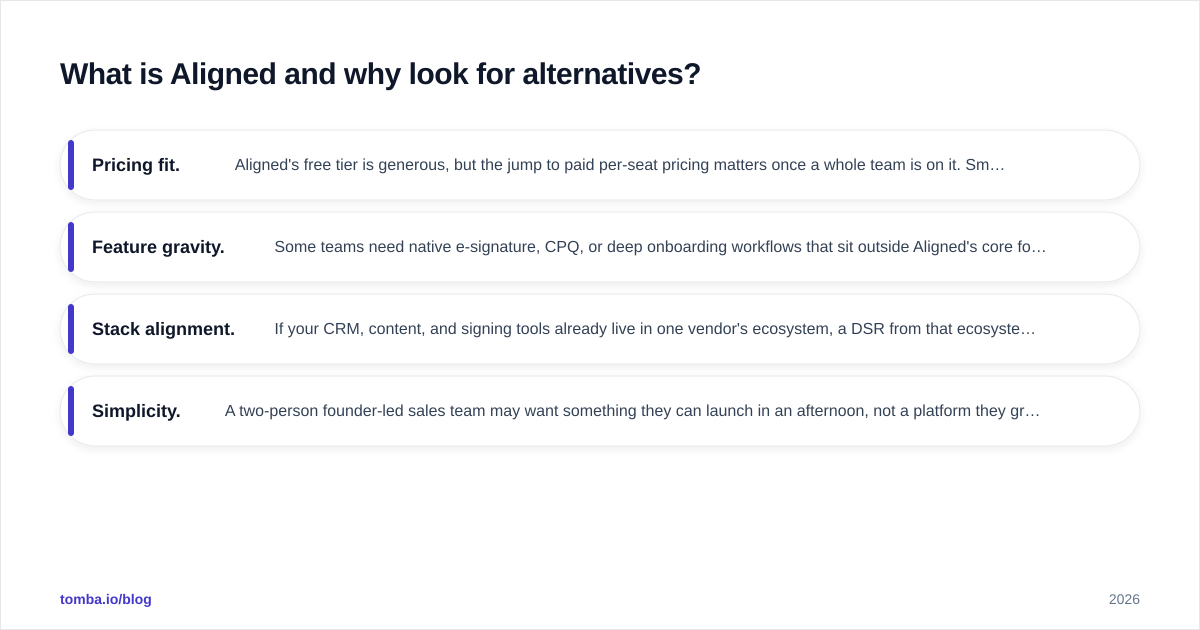
So why shop around? A few honest reasons:
- Pricing fit. Aligned's free tier is generous, but the jump to paid per-seat pricing matters once a whole team is on it. Smaller teams sometimes want a flatter or cheaper plan.
- Feature gravity. Some teams need native e-signature, CPQ, or deep onboarding workflows that sit outside Aligned's core focus on the active deal.
- Stack alignment. If your CRM, content, and signing tools already live in one vendor's ecosystem, a DSR from that ecosystem can reduce integration overhead.
- Simplicity. A two-person founder-led sales team may want something they can launch in an afternoon, not a platform they grow into.
None of this makes Aligned a bad choice. It just means the "best" DSR is the one that matches your deal motion, team size, and budget. Let's define that before naming tools.
What should you look for in an Aligned alternative?#
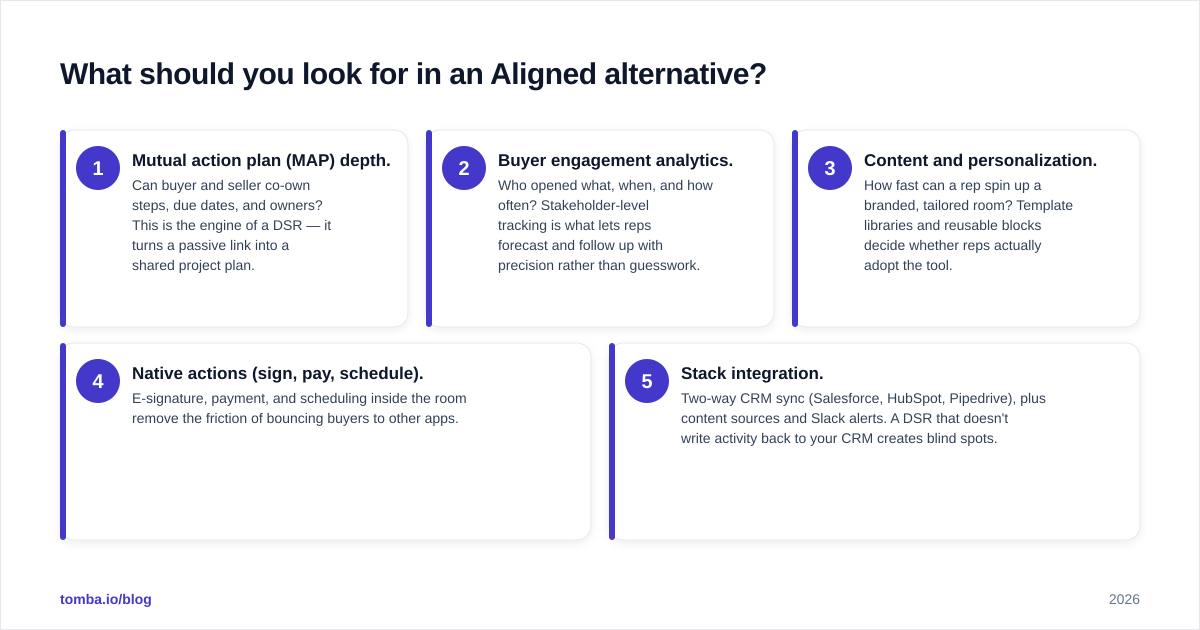
Conclusion first: judge an Aligned alternative on five dimensions, not on feature-count. A longer feature list rarely wins deals; the right five capabilities for your motion do.
- Mutual action plan (MAP) depth. Can buyer and seller co-own steps, due dates, and owners? This is the engine of a DSR — it turns a passive link into a shared project plan.
- Buyer engagement analytics. Who opened what, when, and how often? Stakeholder-level tracking is what lets reps forecast and follow up with precision rather than guesswork.
- Content and personalization. How fast can a rep spin up a branded, tailored room? Template libraries and reusable blocks decide whether reps actually adopt the tool.
- Native actions (sign, pay, schedule). E-signature, payment, and scheduling inside the room remove the friction of bouncing buyers to other apps.
- Stack integration. Two-way CRM sync (Salesforce, HubSpot, Pipedrive), plus content sources and Slack alerts. A DSR that doesn't write activity back to your CRM creates blind spots.
A practical scoring approach: weight these by your deal size. Enterprise teams with 6+ stakeholders should weight MAP depth and analytics heavily. SMB or PLG motions should weight speed-to-launch and price. For more on how this fits the wider funnel, see how a strong sales automation layer connects prospecting to closing.
What are the 6 best Aligned alternatives in 2026?#
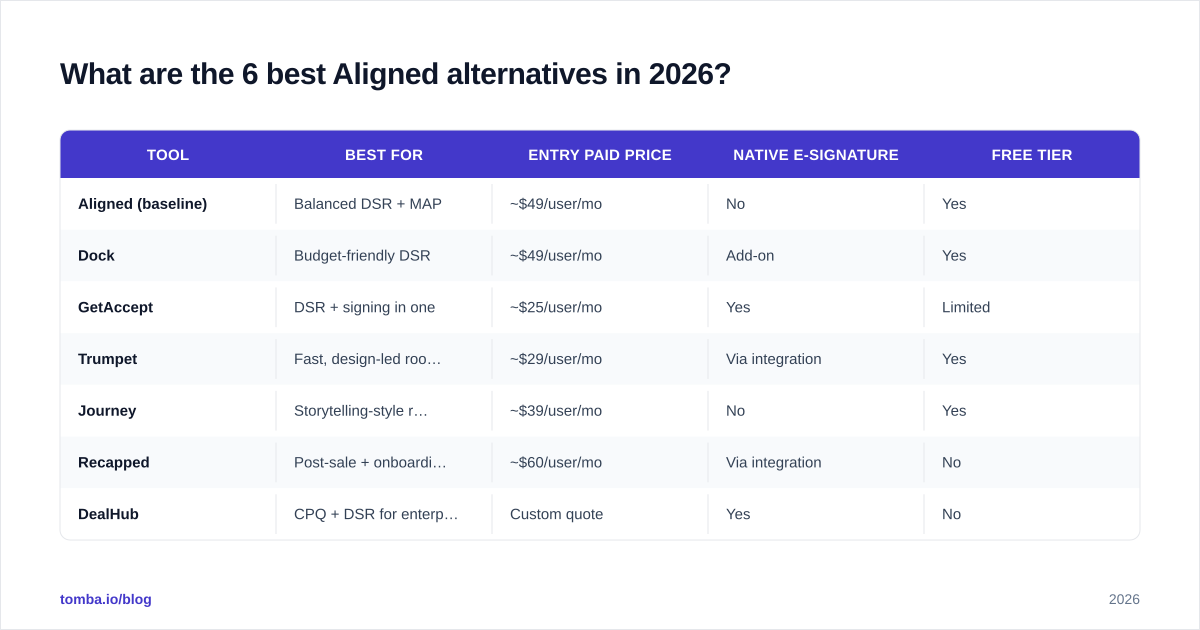
Here's the shortlist, compared on the attributes that actually move a buying decision. Prices are entry paid tiers as commonly published; confirm current numbers on each vendor's site before you buy.
| Tool | Best for | Entry paid price | Native e-signature | Free tier |
|---|---|---|---|---|
| Aligned (baseline) | Balanced DSR + MAP | ~$49/user/mo | No | Yes |
| Dock | Budget-friendly DSR | ~$49/user/mo | Add-on | Yes |
| GetAccept | DSR + signing in one | ~$25/user/mo | Yes | Limited |
| Trumpet | Fast, design-led rooms | ~$29/user/mo | Via integration | Yes |
| Journey | Storytelling-style rooms | ~$39/user/mo | No | Yes |
| Recapped | Post-sale + onboarding | ~$60/user/mo | Via integration | No |
| DealHub | CPQ + DSR for enterprise | Custom quote | Yes | No |
A quick read of the table: GetAccept and Trumpet anchor the low end and bundle the most into the base price, Recapped and DealHub sit at the top for teams that need workflow depth, and Dock is the closest like-for-like swap if you mainly want a cleaner, cheaper Aligned. You can cross-check live user sentiment on G2's digital sales room category before committing.
Dock#
Dock is the most direct Aligned competitor — a clean DSR with mutual action plans, content rooms, and order forms. It leans into being approachable for revenue teams that want structure without a heavy rollout. If you like Aligned's concept but want a slightly different UI and pricing posture, Dock is the first demo to book.
- Strengths: Intuitive room builder, solid MAP, order forms, security review portals.
- Watch for: E-signature and some advanced analytics depend on plan tier.
GetAccept#
GetAccept blends a digital sales room with a full e-signature and document workflow engine. For teams whose deals end in a contract — which is most of them — having the room and the signature in one place is a real workflow win. It's also one of the more affordable entry points.
- Strengths: Native e-signature, video in rooms, strong CRM sync.
- Watch for: The breadth can feel like two products bolted together until you configure it.
Trumpet#
Trumpet ("pods") is design-led and fast. Reps can clone a polished, branded room in minutes, which drives the one thing that kills most DSR rollouts: low rep adoption. If your blocker is "reps won't build rooms," Trumpet's speed is the answer.
- Strengths: Beautiful templates, quick cloning, good engagement tracking.
- Watch for: Deepest workflow automations are on higher tiers.
Journey#
Journey focuses on narrative — turning a sales room into a scrollable story rather than a folder of links. It's a fit for teams selling a vision (early-stage, category-creation, design-conscious buyers) where the experience of the room matters as much as the MAP.
- Strengths: Strong storytelling layout, embeds, clean buyer experience.
- Watch for: Lighter on heavy CPQ/signature workflows.
Recapped#
Recapped specializes in mutual action plans and post-sale onboarding. It shines when your deals are long, multi-threaded, and need to carry momentum into implementation. Customer success and onboarding teams often adopt it alongside sales.
- Strengths: Best-in-class MAP, onboarding workflows, accountability nudges.
- Watch for: Pricing sits higher; overkill for short transactional deals.
DealHub#
DealHub is the enterprise option — a DealRoom that sits on top of full CPQ, contract management, and billing. If your real problem is quoting complexity and you want the room as a layer over that, DealHub consolidates the stack. Read independent analyst context on the broader CPQ space from Gartner before scoping it.
- Strengths: CPQ + DSR + e-signature in one, deep configurability.
- Watch for: Custom pricing and a longer implementation; not a quick swap.
How do Aligned alternatives compare on pricing?#
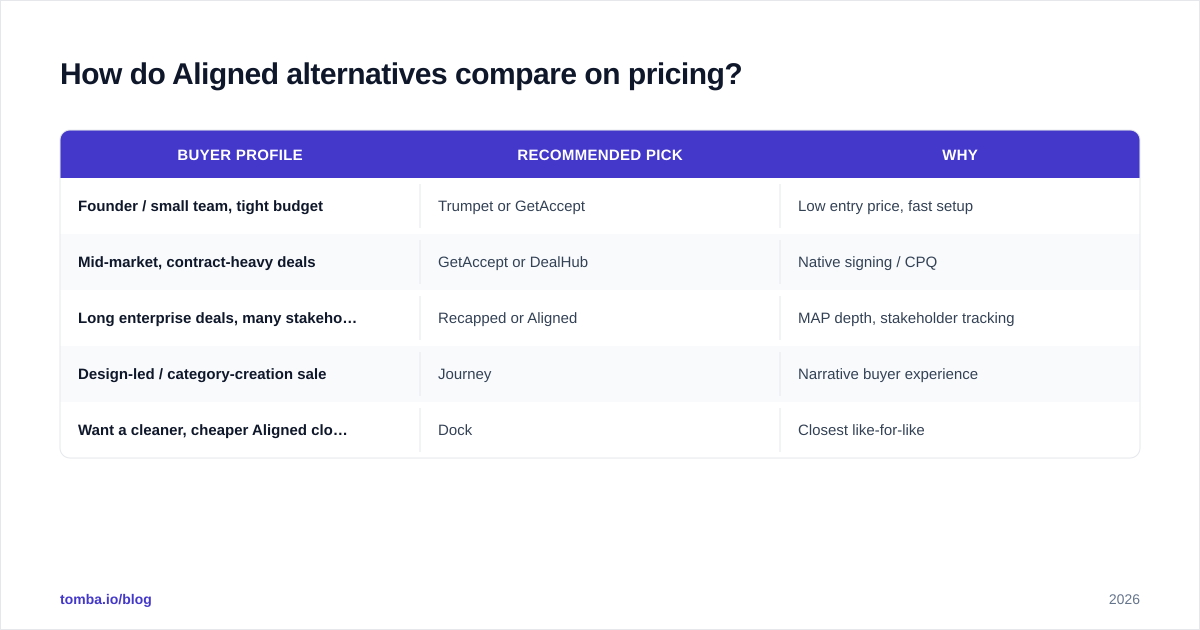
Conclusion first: for a 5-rep team, GetAccept and Trumpet are usually the lowest total cost, while Recapped and DealHub cost more but absorb tools you'd otherwise buy separately (signing, onboarding, CPQ).
A useful way to think about cost: don't compare per-seat price in isolation. Compare replaced tools. If a DSR removes a separate e-signature subscription and a scheduling tool, a higher sticker price can be net cheaper. Map your current stack first, then subtract what each alternative absorbs.
| Buyer profile | Recommended pick | Why |
|---|---|---|
| Founder / small team, tight budget | Trumpet or GetAccept | Low entry price, fast setup |
| Mid-market, contract-heavy deals | GetAccept or DealHub | Native signing / CPQ |
| Long enterprise deals, many stakeholders | Recapped or Aligned | MAP depth, stakeholder tracking |
| Design-led / category-creation sale | Journey | Narrative buyer experience |
| Want a cleaner, cheaper Aligned clone | Dock | Closest like-for-like |
If you're consolidating tools, also confirm two-way sync with your system of record — a DSR that doesn't update your CRM leaves activity stranded outside your forecast.

Do digital sales rooms actually improve win rates?#
Short answer: they improve the measurable parts of a deal, which tends to lift win rates indirectly. DSRs don't cast a spell on buyers — they reduce friction and surface intent.
The mechanism is straightforward:
- Fewer dropped threads. One link beats a buried email chain, so deals stall less between meetings.
- Better multithreading. When the economic buyer forwards the room internally, you see who else engaged — and can sell to the committee, not just your champion.
- Sharper follow-up. Engagement analytics tell a rep when interest spikes, so outreach lands at the right moment instead of on a generic cadence.
- Cleaner handoffs. A shared MAP carries context from sales into onboarding without a 30-minute internal sync.
The catch: a DSR amplifies a good process and exposes a bad one. If your discovery is weak or you're in the room with the wrong people, prettier rooms won't save the deal. Which leads to the part most DSR comparisons skip entirely.
How do you fill your digital sales room with the right people?#
Here's the uncomfortable truth a tool comparison won't tell you: the best digital sales room in the world is worthless if you've invited the wrong contacts — or can't reach the decision-maker at all.
A DSR is a closing and multithreading tool. It assumes you already have:
- The right account.
- The right stakeholders within that account.
- A verified, working email for each so the invite actually arrives.
That third point quietly breaks more deals than any feature gap. If the VP of Operations never gets your room link because you used a guessed or stale email address, none of the engagement analytics matter. This is where your top-of-funnel data quality directly determines bottom-of-funnel DSR performance.
That's the upstream job Tomba handles. Before a deal ever reaches a sales room, you can:
- Use the email finder to get verified professional emails for the exact stakeholders you want in the room.
- Run a domain search to map every relevant contact at a target account — so you multithread on purpose, not by luck.
- Verify emails before sending invites, keeping your sender reputation clean and your room invites out of spam.
Think of it like a dinner party: the venue (your DSR) can be flawless, but if the invitations go to wrong addresses, you're hosting an empty room. Get the guest list right first.
Frequently asked questions#
Is there a free Aligned alternative? Yes. Dock, Trumpet, and Journey all offer free tiers suitable for testing or low-volume use. GetAccept offers limited free access. Recapped and DealHub are paid-only.
What's the closest tool to Aligned? Dock is the most like-for-like swap — a focused DSR with mutual action plans and content rooms. GetAccept is the closest if you also want native e-signature.
Do I need a digital sales room if I already use a CRM? They solve different problems. A CRM is your internal system of record; a DSR is the buyer-facing collaboration layer. The best setups sync the two so room activity flows back into the CRM automatically.
How much should I budget per rep? Entry paid plans cluster around $25–$60 per user per month, with enterprise CPQ-based tools like DealHub quoted custom. Compare on tools replaced, not sticker price alone.
Can a DSR fix a low response rate? Not by itself. Response rate is set upstream by targeting, deliverability, and data accuracy. Fix those first — see how response rate is actually driven — then a DSR compounds the gains.
The bottom line#
Aligned is a strong digital sales room, and for many teams it's the right answer. But "best" is a function of your deal motion: Dock for a cleaner clone, GetAccept for built-in signing, Trumpet for speed, Journey for storytelling, Recapped for onboarding depth, and DealHub for CPQ-heavy enterprise sales. Shortlist two, run a live deal through each, and let win rate decide.
Whichever room you choose, remember it's the last mile — not the first. The deals that close in a beautiful DSR started with reaching the right stakeholders at the right accounts. Start that upstream work with the Tomba Email Finder: find verified, decision-maker emails by name, company, or domain, then drop those contacts straight into the sales room you just picked. Spin up a free account (25 searches a month, no card), and see the Tomba pricing tiers — Starter at $49/mo — when you're ready to scale your pipeline. Fill the room with the right people, and the room does the rest.
// get started
Find, verify and enrich your first contacts today
Start on the free plan with 25 searches a month, then scale when your team is ready.
Free plan · No credit card required · GDPR & CCPA
// about the author