Allego vs Seismic 2026: Sales Enablement Platform Compared
Allego vs Seismic, broken down by features, pricing, content management, and AI coaching so you can pick the right sales enablement platform in 2026.
TL;DR
- Seismic is the enterprise heavyweight for content management, governance, and analytics — best when you have thousands of assets, strict compliance, and a large rep org to keep on-message.
- Allego leads on learning, video coaching, and conversation intelligence — best when ramp speed, rep skill, and just-in-time enablement matter more than a sprawling content library.
- Pricing for both is quote-only and lands in the enterprise range; expect $30–$60+ per user per month with annual contracts and implementation fees.
- Pick Seismic for content scale and marketing-to-sales alignment; pick Allego for coaching, onboarding, and a video-first sales force.
- Neither tool finds or verifies contact data — pair whichever you choose with a dedicated prospecting stack to keep your pipeline full.
Choosing between Allego and Seismic usually comes down to one question: is your bottleneck content or skill? Both call themselves sales enablement platforms, both carry strong analyst ratings, and both will quote you an enterprise price. But they were built around different centers of gravity, and that difference decides which one your reps actually use.
This guide breaks down the two platforms on capability, pricing, and fit so you can make the call with evidence instead of a demo-day gut feeling.
What is sales enablement software?#
Sales enablement software is the shared toolkit that gets reps the right content, training, and coaching at the moment they need it — then measures whether any of it moved a deal. Think of it like a pit crew for your sellers: the rep drives the deal, but the platform makes sure the right tires, fuel, and instructions are ready before the car rolls back out.
In practice these platforms cluster around four jobs:
- Content management — store, govern, and surface decks, one-pagers, case studies, and pricing sheets so reps stop rebuilding assets from scratch.
- Buyer engagement — digital sales rooms, content links, and tracking that show when a prospect opens or shares what you sent.
- Learning and coaching — onboarding paths, certifications, and video role-plays that build and verify rep skill.
- Analytics — usage, content performance, and rep-activity data that tie enablement back to revenue.
Seismic and Allego both touch all four, but each leans hard into a different pair. Understanding that lean is the whole comparison.
What is Seismic?#
Seismic is the market-share leader in sales enablement, positioned as an end-to-end enablement and content automation platform for mid-market and enterprise revenue teams. Its core strength is managing content at scale: large libraries, granular permissions, automated personalization, and deep analytics on what actually gets used in deals.
Where Seismic shines:
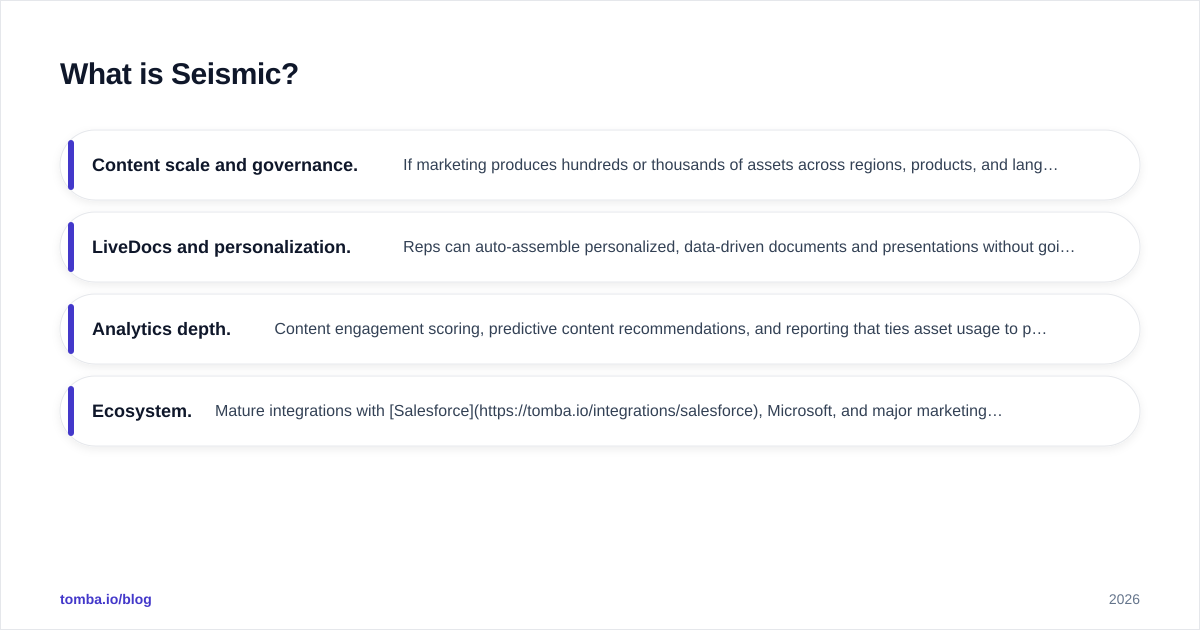
- Content scale and governance. If marketing produces hundreds or thousands of assets across regions, products, and languages, Seismic's tagging, version control, and compliance workflows keep the library clean and on-brand.
- LiveDocs and personalization. Reps can auto-assemble personalized, data-driven documents and presentations without going off-template.
- Analytics depth. Content engagement scoring, predictive content recommendations, and reporting that ties asset usage to pipeline.
- Ecosystem. Mature integrations with Salesforce, Microsoft, and major marketing stacks.
The trade-off is weight. Seismic is powerful but can feel heavy to administer, and smaller teams often pay for capabilities they never fully switch on. You can read more about the platform on the official Seismic site.
What is Allego?#
Allego started as a sales learning and readiness platform and grew outward into content and engagement. Its DNA is video: peer-to-peer knowledge sharing, AI-scored practice role-plays, and conversation intelligence that captures and analyzes real sales calls.
Where Allego shines:
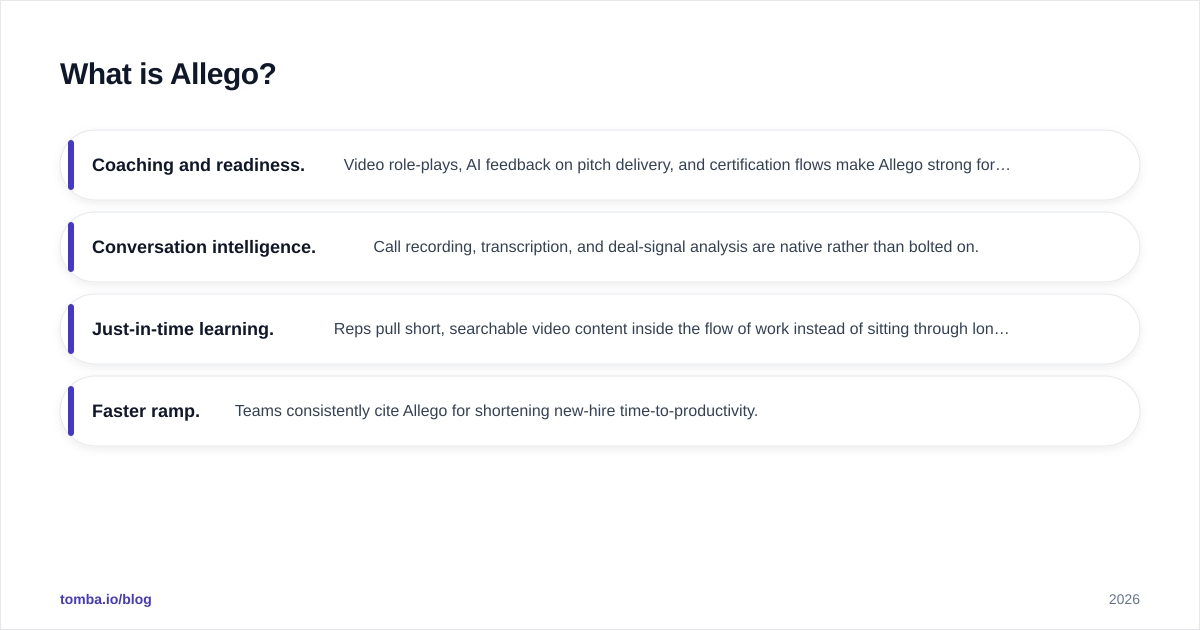
- Coaching and readiness. Video role-plays, AI feedback on pitch delivery, and certification flows make Allego strong for onboarding and ongoing skill-building.
- Conversation intelligence. Call recording, transcription, and deal-signal analysis are native rather than bolted on.
- Just-in-time learning. Reps pull short, searchable video content inside the flow of work instead of sitting through long courses.
- Faster ramp. Teams consistently cite Allego for shortening new-hire time-to-productivity.
The trade-off: Allego's content management and document automation, while capable, are not as deep or as governance-heavy as Seismic's. If your primary pain is a chaotic 5,000-asset library, Allego is the lighter side of that scale. See the official Allego site for current modules.
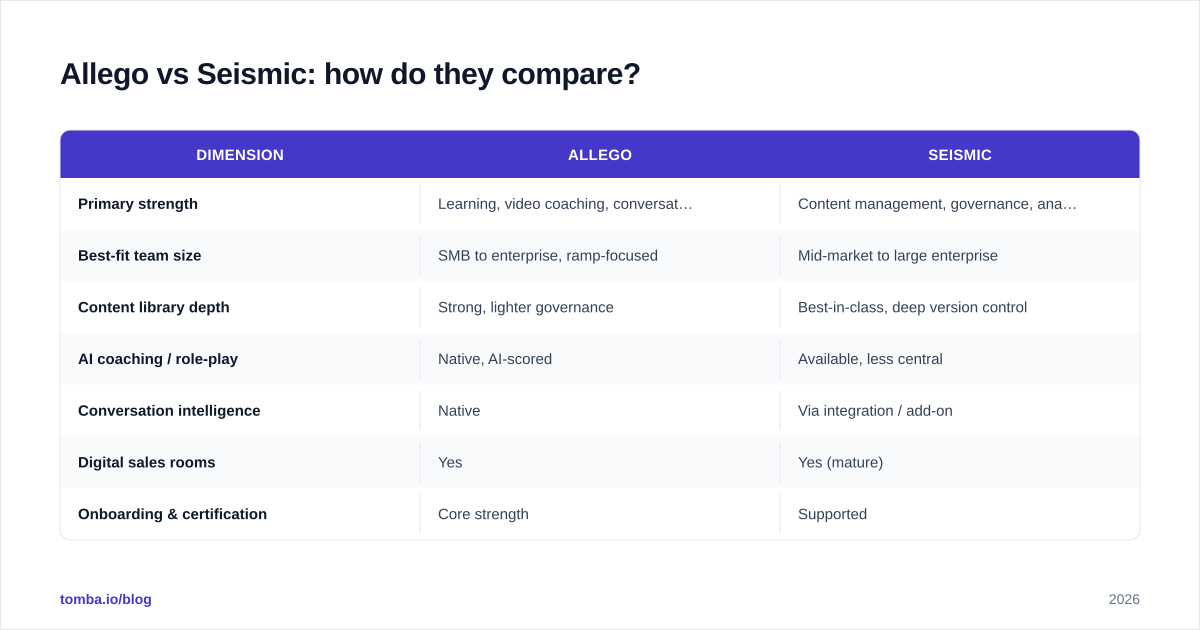
Allego vs Seismic: how do they compare?#
Here is the head-to-head on the dimensions that actually drive a buying decision.
| Dimension | Allego | Seismic |
|---|---|---|
| Primary strength | Learning, video coaching, conversation intelligence | Content management, governance, analytics at scale |
| Best-fit team size | SMB to enterprise, ramp-focused | Mid-market to large enterprise |
| Content library depth | Strong, lighter governance | Best-in-class, deep version control |
| AI coaching / role-play | Native, AI-scored | Available, less central |
| Conversation intelligence | Native | Via integration / add-on |
| Digital sales rooms | Yes | Yes (mature) |
| Onboarding & certification | Core strength | Supported |
| Analytics depth | Solid, engagement-focused | Deep, predictive content scoring |
| Implementation effort | Lighter, faster | Heavier, longer rollout |
| Pricing model | Quote-only, per user/year | Quote-only, per user/year |
The pattern is consistent: Allego optimizes for the rep, and Seismic optimizes for the content operation. A 40-person SaaS sales team trying to cut ramp from six months to three will feel Allego's value faster. A 600-rep enterprise with regulated content and a large product marketing team will get more out of Seismic's governance and automation.
Is Allego better than Seismic for coaching?#
Yes — for coaching specifically, Allego is the stronger pick. Its video role-play and AI scoring were built first and are deeply woven into the product, not added as a module. Reps record practice pitches, get AI feedback on pacing and keyword coverage, and managers review at scale. Seismic offers coaching, but it sits alongside its content engine rather than at the heart of it.
Is Seismic better than Allego for content?#
Yes — for large-scale content management, Seismic leads. Version control, automated compliance, regional and language variants, and LiveDocs personalization handle complexity that would strain a learning-first tool. If product marketing is your most active enablement stakeholder, Seismic gives them more control.
How much do Allego and Seismic cost in 2026?#
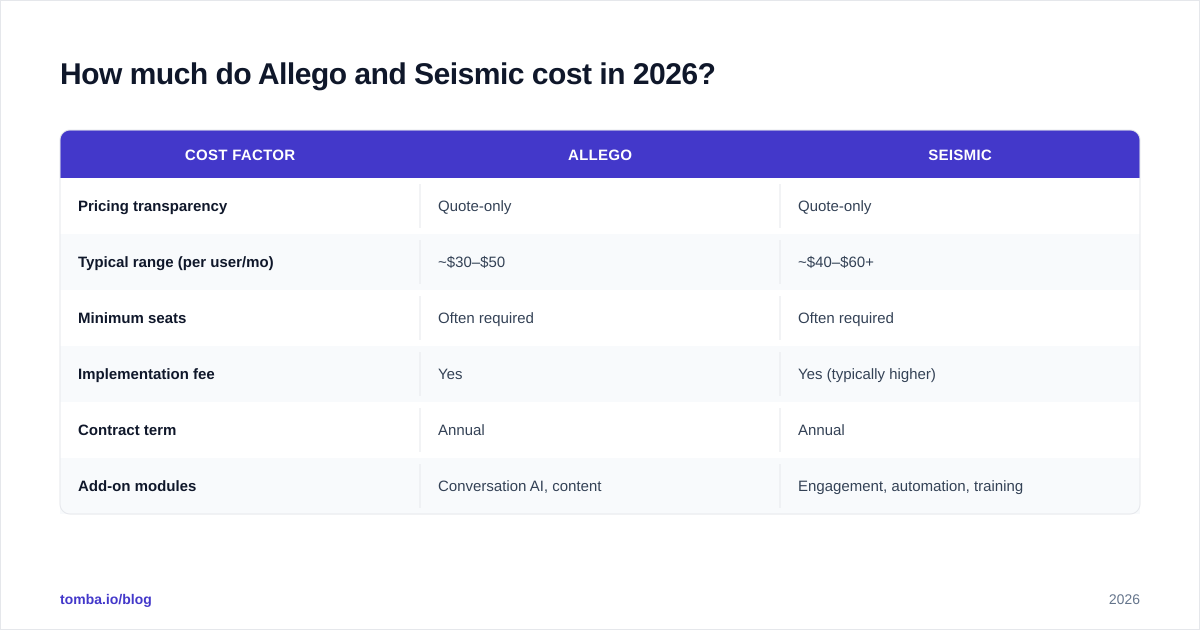
Both vendors keep pricing behind a sales conversation, so there is no public price card to quote with precision. Based on market reporting and buyer reviews on platforms like G2, both land in the enterprise tier — commonly $30 to $60+ per user per month, billed annually, with separate implementation and onboarding fees.
| Cost factor | Allego | Seismic |
|---|---|---|
| Pricing transparency | Quote-only | Quote-only |
| Typical range (per user/mo) | ~$30–$50 | ~$40–$60+ |
| Minimum seats | Often required | Often required |
| Implementation fee | Yes | Yes (typically higher) |
| Contract term | Annual | Annual |
| Add-on modules | Conversation AI, content | Engagement, automation, training |
A few realities worth budgeting for:
- Total cost is not the per-seat number. Implementation, admin time, and content migration drive real spend, and Seismic's enterprise rollouts tend to be the heavier of the two.
- Module creep. Both platforms sell capabilities as tiers or add-ons. Confirm whether conversation intelligence, digital sales rooms, and advanced analytics are included or extra.
- Right-sizing matters. If you only need a third of Seismic's capability, you are likely overpaying versus a focused Allego deployment — and vice versa.
For context on how usage-based and per-seat tooling stacks up across the wider sales stack, our breakdown of Tomba pricing shows what transparent, published tiers look like by comparison.
Which sales enablement platform should you choose?#
Match the tool to your bottleneck, not to the analyst quadrant. Here is a simple decision path.
Choose Seismic if:
- You manage a large, fast-changing content library across products, regions, or languages.
- Compliance and brand governance are non-negotiable (financial services, healthcare, regulated industries).
- Product marketing is a primary enablement driver and needs control over assets.
- You want predictive content analytics tied tightly to CRM pipeline.
Choose Allego if:
- Ramp speed and rep skill are your biggest revenue levers.
- You want native conversation intelligence without stitching together a separate tool.
- Your sellers learn best from short, searchable video in the flow of work.
- You need a lighter, faster implementation than a full enterprise content platform.
Consider neither (yet) if: your team is under ~15 reps and your real problem is pipeline volume, not enablement. At that stage a lighter content-sharing tool plus disciplined CRM hygiene usually beats a six-figure platform. Brush up on the fundamentals in our CRM glossary entry before committing budget.
For independent validation, check current positioning from analysts like Gartner and verified user reviews — both platforms shift feature sets each year, and the 2024 comparison is not the 2026 one.
What about conversation intelligence specifically?#
If conversation intelligence is a top-three requirement, Allego has the edge because it is native. With Seismic you will often integrate a dedicated call-recording tool, which adds a vendor and a data-sync to manage. Weigh whether one consolidated platform or best-of-breed integration fits your team's appetite for tool sprawl.
Where enablement ends and data begins#
Here is the gap neither Allego nor Seismic fills: they make reps better at working the contacts you already have — they don't find new ones. A coaching role-play and a perfectly governed deck are worthless against an empty pipeline or a list full of bounced addresses.
That is the layer that sits underneath enablement. Before a rep ever opens a digital sales room, someone has to identify the right account, find the decision-maker's email, verify it, and enrich the record. Skip that and your shiny enablement platform is coaching reps to sell into a void.
This is where a prospecting and data stack earns its keep:
- Use an email finder to source verified, professional addresses by name, company, or domain.
- Run new contacts through an email verifier so your outreach lands instead of bouncing and dragging down sender reputation.
- Layer in data enrichment to fill out titles, company size, and other fields your enablement analytics depend on.
Get the data foundation right and your Allego or Seismic investment compounds. Get it wrong and you are paying enterprise prices to enable reps against garbage.
The bottom line#
Allego wins on skill; Seismic wins on scale. If your revenue is capped by how fast reps ramp and how well they sell, Allego's coaching-first design pays back faster. If your revenue is capped by content chaos and compliance across a large org, Seismic's governance and automation are worth the heavier lift. Both are legitimate enterprise choices — the wrong one is simply the one that solves a bottleneck you don't have.
Whatever platform you land on, the deals it helps close still start with finding the right person and a working email address. Tomba's Email Finder gives your reps verified, accurate contact data to feed the top of the funnel — so the content and coaching downstream actually have someone to reach. Start free with 25 searches a month, then scale up as your pipeline grows.
// get started
Find, verify and enrich your first contacts today
Start on the free plan with 25 searches a month, then scale when your team is ready.
Free plan · No credit card required · GDPR & CCPA
// about the author