Allegrow Pricing, Reviews, Pros and Cons (2026 Guide)
A neutral 2026 breakdown of Allegrow's pricing model, real user reviews, and the honest pros and cons before you trust it with your inbox placement.

Allegrow sells one promise: keep your cold emails out of spam and in the primary inbox. Whether that promise is worth its price depends on how you send, how much you send, and what you're comparing it against. This guide breaks down Allegrow pricing, reviews, pros and cons with no marketing gloss — so you can decide before the sales call, not during it.
TL;DR#
- Allegrow is a deliverability-optimization layer, not an email finder or a sending tool. It monitors sender reputation, automates inbox placement actions, and tries to move messages out of spam and promotions tabs.
- Pricing is quote-based, not a public self-serve menu. Expect to talk to sales and to be priced by seats, mailboxes, and send volume — which makes it feel enterprise-leaning versus self-serve warmup tools.
- Reviews are generally positive on placement gains and account management, with the common complaints being cost opacity and a setup learning curve.
- It works best for established sales teams sending real volume who already have clean data and just need the last-mile inbox lift.
- It does not solve bad data or bad targeting. Deliverability tooling amplifies a working list; it can't rescue a list full of invalid addresses.
What is Allegrow and what does it actually do?#
Allegrow is a sender-reputation and inbox-placement platform. Think of it like a personal trainer for your sending domain: it doesn't write your emails or find your prospects, it watches your form (reputation signals) and pushes you toward habits that land messages in the primary inbox instead of spam or the promotions tab.
Concretely, the platform centers on a few jobs:
- Reputation scoring — a continuously updated view of how mailbox providers likely perceive your sending identity.
- Inbox placement automation — actions that nudge messages toward the primary inbox and away from spam folders.
- Deliverability monitoring — alerts when a domain or mailbox starts trending the wrong way, before a campaign tanks.
- Team-level controls — reputation management across many reps and many mailboxes, which is where it separates from single-user warmup apps.
If you want the textbook version of the problem it attacks, the email deliverability and sender reputation entries in our glossary cover the underlying mechanics. Allegrow's pitch is that it operationalizes those concepts so you don't have to babysit them manually.
How does Allegrow pricing work in 2026?#
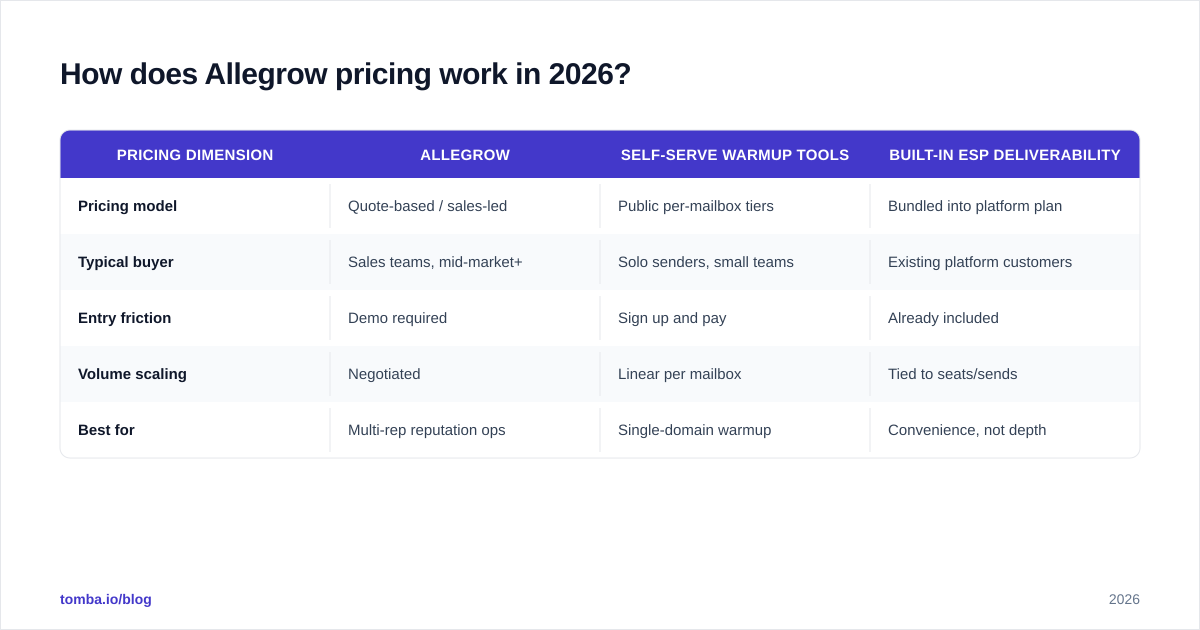
Short answer: Allegrow uses quote-based pricing, not a published self-serve price list. Unlike consumer warmup tools that show $X/mailbox/month on the homepage, Allegrow routes you through a demo and prices by your specific setup. That's normal for tools aimed at sales teams rather than solo senders, but it has consequences you should plan for.
The cost drivers you'll be quoted on typically include:
- Number of users/seats in your sales org
- Number of connected mailboxes under management
- Monthly send volume across those mailboxes
- Contract length — annual commitments usually discount the effective monthly rate
Because the number isn't public, treat any specific figure you read on a third-party blog with suspicion — it changes by deal and by year. The honest move is to get a written quote scoped to your exact mailbox count and volume, then compare the per-mailbox effective cost against the alternatives below.
Practical tip: ask for the price as "cost per mailbox per month at my volume," not a bundled total. That single normalization makes Allegrow comparable to warmup tools and to the deliverability features bundled into sending platforms.
Where Allegrow sits on the cost spectrum#
| Pricing dimension | Allegrow | Self-serve warmup tools | Built-in ESP deliverability |
|---|---|---|---|
| Pricing model | Quote-based / sales-led | Public per-mailbox tiers | Bundled into platform plan |
| Typical buyer | Sales teams, mid-market+ | Solo senders, small teams | Existing platform customers |
| Entry friction | Demo required | Sign up and pay | Already included |
| Volume scaling | Negotiated | Linear per mailbox | Tied to seats/sends |
| Best for | Multi-rep reputation ops | Single-domain warmup | Convenience, not depth |

Is Allegrow worth the price? (Reviews summary)#
The consensus across public reviews: teams that send real volume tend to be satisfied with placement improvements and support; the friction is cost transparency and onboarding effort. You can scan the current sentiment on G2 and Capterra to see the live distribution, but the recurring themes are consistent.
What reviewers praise:
- Measurable inbox-placement lift after the platform has data to work with. Teams report fewer messages buried in spam and promotions.
- Hands-on account management — onboarding help and deliverability guidance, not just a dashboard you're left alone with.
- Visibility — knowing which mailboxes are degrading before a launch instead of after replies dry up.
What reviewers criticize:
- Opaque pricing — the demo-first model frustrates buyers who want to self-serve and compare numbers fast.
- Learning curve — the reputation concepts and recommended actions take time to internalize.
- Overkill for tiny senders — a solo founder with one mailbox often doesn't need this depth and won't hit ROI.
A fair reading: the tool delivers on placement when you give it volume and clean inputs. It underdelivers when buyers expect a cheap, plug-and-play fix for a fundamentally broken list or a brand-new domain with zero history.
What are the pros and cons of Allegrow?#
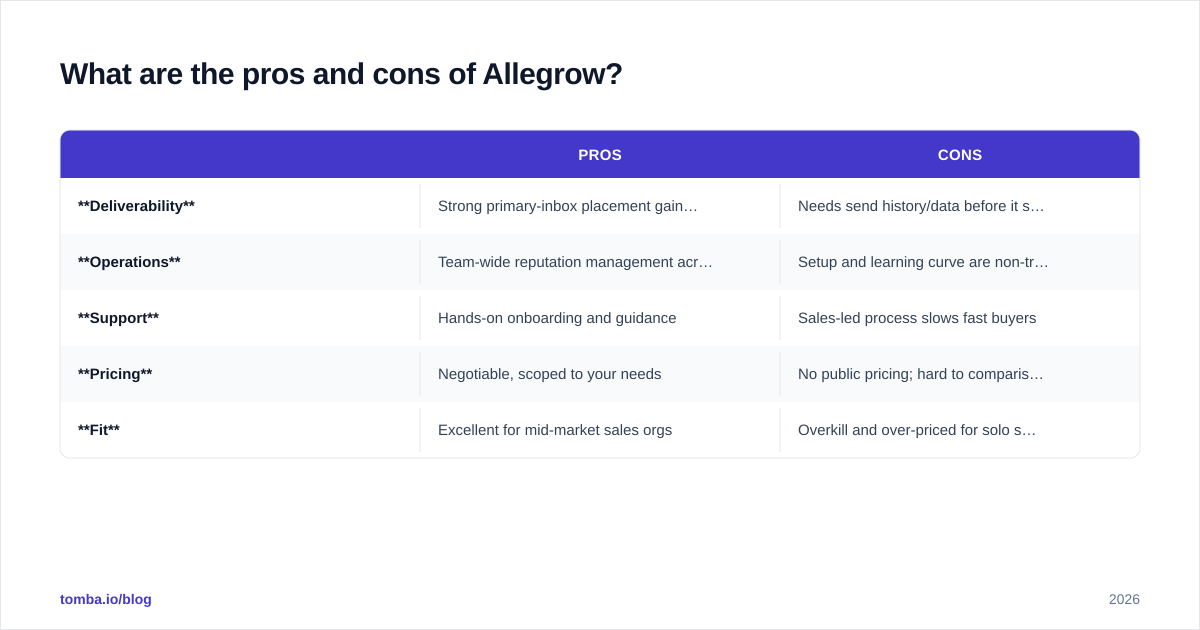
Here's the balanced ledger, written for a buyer who has to defend the line item.
| Pros | Cons | |
|---|---|---|
| Deliverability | Strong primary-inbox placement gains at volume | Needs send history/data before it shines |
| Operations | Team-wide reputation management across many mailboxes | Setup and learning curve are non-trivial |
| Support | Hands-on onboarding and guidance | Sales-led process slows fast buyers |
| Pricing | Negotiable, scoped to your needs | No public pricing; hard to comparison-shop |
| Fit | Excellent for mid-market sales orgs | Overkill and over-priced for solo senders |
The honest caveat most reviews skip#
Deliverability tooling is a multiplier, not a foundation. If 20% of your list is invalid, every send hammers your sender reputation with bounces — and no inbox-placement layer fully outruns that. The sequence that actually works is: clean data first, then deliverability optimization on top. Spending on Allegrow before you've verified your list is like supercharging an engine with sand in the fuel line.
That's why teams that get the most from a tool like Allegrow usually pair it with rigorous list hygiene — finding accurate addresses with an email finder and removing the dead ones with an email verifier before a single campaign goes out.

How does Allegrow compare to the alternatives?#
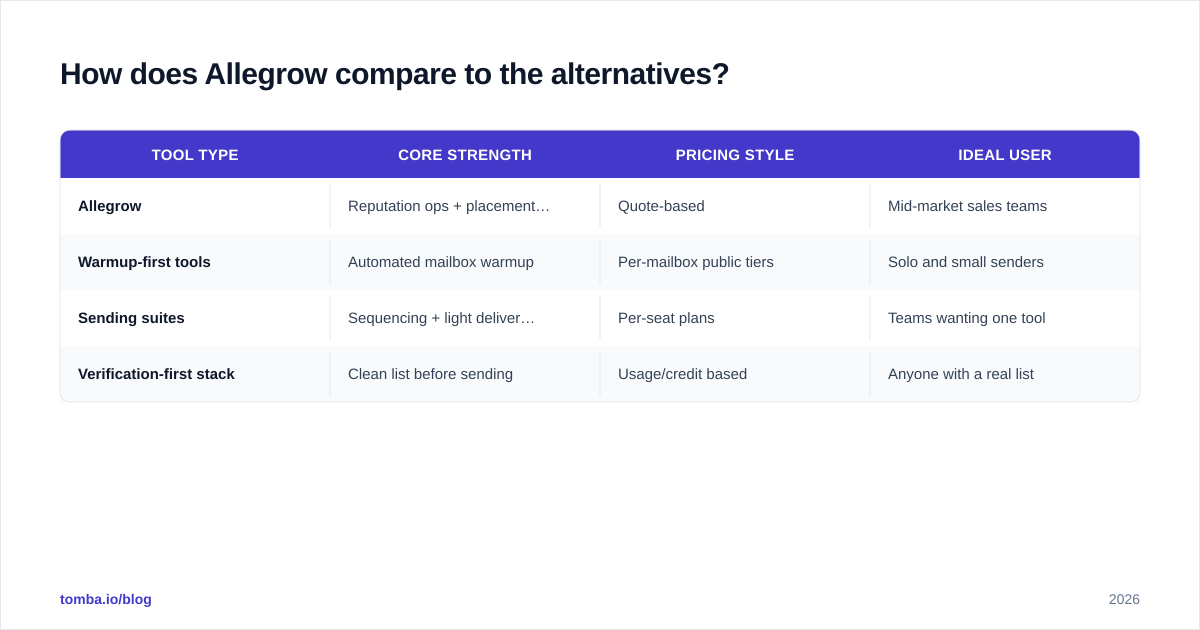
There are three buckets you're really choosing between, and Allegrow only lives in one of them.
- Deliverability-optimization platforms (Allegrow's category) — focused on inbox placement and reputation ops for teams.
- Warmup-first tools — automate inbox interactions to build domain reputation, usually self-serve and per-mailbox priced.
- All-in-one sending suites — sequencing plus bundled deliverability features, where placement is one feature among many.
| Tool type | Core strength | Pricing style | Ideal user |
|---|---|---|---|
| Allegrow | Reputation ops + placement at team scale | Quote-based | Mid-market sales teams |
| Warmup-first tools | Automated mailbox warmup | Per-mailbox public tiers | Solo and small senders |
| Sending suites | Sequencing + light deliverability | Per-seat plans | Teams wanting one tool |
| Verification-first stack | Clean list before sending | Usage/credit based | Anyone with a real list |
If you're weighing platforms in adjacent categories, our breakdowns of an Instantly alternative and a Saleshandy alternative walk through where warmup and sending features overlap with what Allegrow does — useful context so you don't pay twice for the same capability.
When Allegrow is the right call#
- You run a multi-rep team with many mailboxes and need reputation visibility across all of them.
- You already send meaningful volume and have the history a reputation model needs.
- You've cleaned your data and the remaining problem is genuinely placement, not list quality.
- You can absorb a sales-led purchase and value hands-on onboarding.
When to skip it#
- You're a solo sender with one or two mailboxes — a self-serve warmup tool is cheaper and sufficient.
- You're pre-product-market-fit on your messaging and just need to start, not optimize the last 5%.
- Your bounce rate is high — fix the list first; deliverability tooling can't paper over bad data.
What should you do before buying any deliverability tool?#
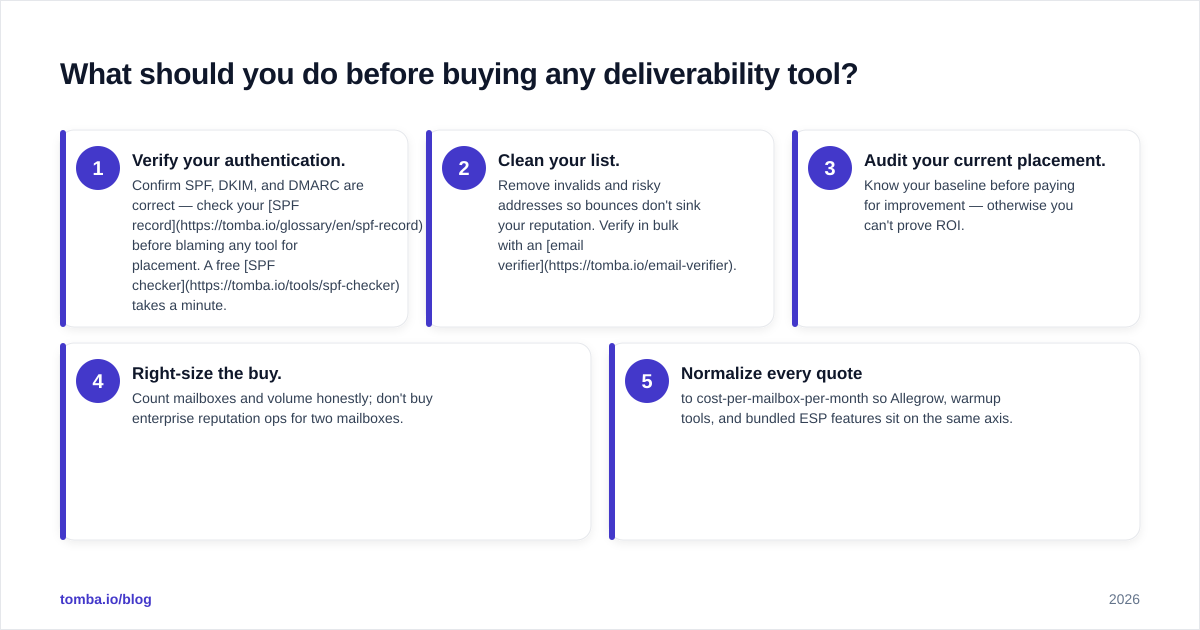
Run this five-step pre-purchase checklist. It saves money whether or not Allegrow ends up being the pick.
- Verify your authentication. Confirm SPF, DKIM, and DMARC are correct — check your SPF record before blaming any tool for placement. A free SPF checker takes a minute.
- Clean your list. Remove invalids and risky addresses so bounces don't sink your reputation. Verify in bulk with an email verifier.
- Audit your current placement. Know your baseline before paying for improvement — otherwise you can't prove ROI.
- Right-size the buy. Count mailboxes and volume honestly; don't buy enterprise reputation ops for two mailboxes.
- Normalize every quote to cost-per-mailbox-per-month so Allegrow, warmup tools, and bundled ESP features sit on the same axis.
You can read the deliverability fundamentals behind these steps in the official guidance from inbox providers — Google's sender guidelines are the canonical reference and cost nothing to apply.
What is the final verdict on Allegrow?#
Allegrow is a legitimate, well-reviewed deliverability platform that earns its keep for mid-market sales teams sending real volume — and is usually overkill for solo senders. Its biggest friction isn't the product; it's the quote-based pricing that forces you into a demo before you can compare. Go in with a normalized per-mailbox cost target and a clean list, and you'll either get a sharp ROI or a fast "not yet."
The thing every honest deliverability review eventually admits: the tool can only optimize what you already have. Inbox placement is the last mile. The first mile — reaching the right person at a valid address — is where most cold outreach actually breaks. No reputation engine fixes a list of guesses.
That's the part to nail before you spend a dollar on optimization. Tomba's Email Finder gives you accurate, verifiable professional emails by name, company, or domain, with a built-in verifier so your list is clean before it ever touches a deliverability layer. Start free with 25 searches a month, scale on the Starter plan at $49/mo, and let tools like Allegrow optimize a foundation that's actually solid. Build on clean data first — then make the inbox-placement investment with confidence.
// get started
Find, verify and enrich your first contacts today
Start on the free plan with 25 searches a month, then scale when your team is ready.
Free plan · No credit card required · GDPR & CCPA
// about the author