Allegrow vs Clodura.ai 2026: Deliverability or Data?
Allegrow optimizes inbox placement; Clodura.ai builds prospecting lists. They solve opposite halves of cold outreach. Here is which one your team actually needs in 2026 — and where they overlap.
Most "Allegrow vs Clodura.ai" searches start from a wrong assumption: that these two tools do the same job and you must pick one. They don't. Allegrow is an email deliverability and inbox-placement optimizer. Clodura.ai is a B2B prospecting and sales-intelligence database. One gets your email seen; the other gives you someone to email. Understanding that split is the whole decision.
This guide breaks down what each tool actually does, where the (small) overlap lives, how pricing compares, and which one belongs in your outbound stack first.
TL;DR#
- Allegrow = deliverability layer. It monitors inbox placement, spam-folder rates, and sender reputation, then nudges your sending behavior to keep you out of Promotions and Spam.
- Clodura.ai = prospecting layer. It's a contact database (~600M+ contacts by its own claims) with intent data, org charts, and a built-in sequencer.
- They are complementary, not competitors. A complete outbound motion needs accurate data and strong deliverability — plus verification in between.
- If forced to prioritize: fix data accuracy first (bad addresses wreck deliverability), then layer in placement optimization.
- Neither tool is a true email finder. Pair either with a dedicated email finder and email verifier for clean, deliverable lists.
What is Allegrow?#
Allegrow is a deliverability optimization platform. Instead of finding contacts, it watches what happens after you hit send. It tracks where your emails land — Primary inbox, Promotions tab, or Spam — across seed accounts, and scores your sender reputation over time.
Its core jobs:
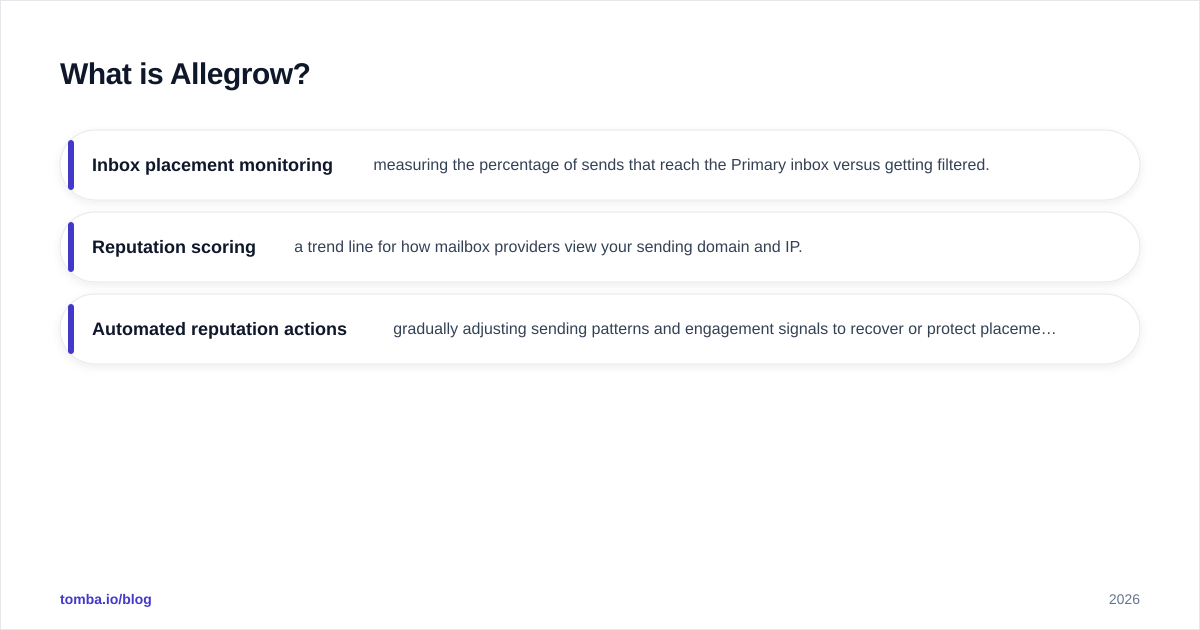
- Inbox placement monitoring — measuring the percentage of sends that reach the Primary inbox versus getting filtered.
- Reputation scoring — a trend line for how mailbox providers view your sending domain and IP.
- Automated reputation actions — gradually adjusting sending patterns and engagement signals to recover or protect placement.
Allegrow plugs into your existing sequencer (think Outreach, Salesloft, or similar) and acts as the quality-control layer. It assumes you already have a list and a sending tool. Its value shows up when reply rates quietly collapse because half your mail is landing in Spam and nobody noticed.
If you've never measured your spam-folder rate, that number is usually worse than you'd guess. For background on the underlying mechanics, see this primer on email deliverability and sender reputation.
What is Clodura.ai?#
Clodura.ai sits at the opposite end of the funnel. It's a sales-intelligence and prospecting platform built around a large contact database with direct dials, verified emails, org charts, and buying-intent signals. On top of the data, it bundles a sequencer so you can prospect and send from one place.
Its core jobs:
- Contact discovery — search a B2B database by title, industry, geography, tech stack, and company size.
- Intent & trigger data — surface accounts showing buying signals or hiring/funding triggers.
- Org charts & direct dials — map decision-makers and pull phone numbers.
- Built-in cadence — send sequences without exporting to a separate tool.
Where Allegrow assumes you have a list, Clodura.ai is where the list comes from. It competes more directly with Apollo, ZoomInfo, and Lusha than with anything Allegrow does. If you're weighing those, our Apollo alternative breakdown covers the same data-quality questions.

Allegrow vs Clodura.ai: how do they actually compare?#
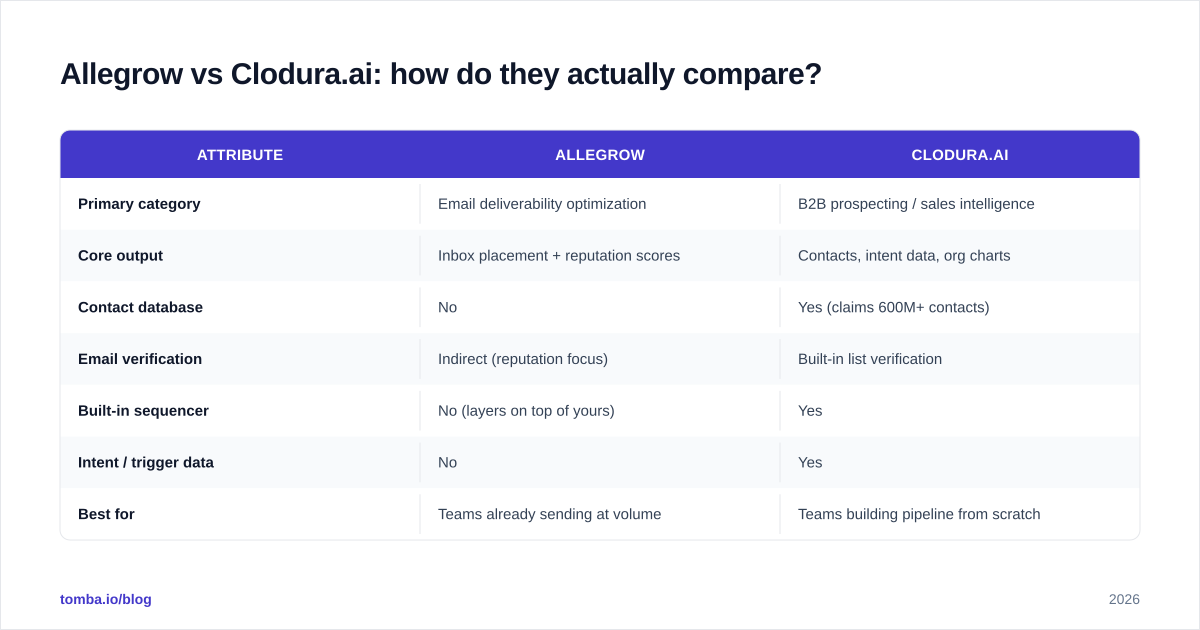
Because the two tools occupy different layers, a head-to-head feature table looks lopsided — and that's the point. The table makes the "you probably need both" conclusion obvious.
| Attribute | Allegrow | Clodura.ai |
|---|---|---|
| Primary category | Email deliverability optimization | B2B prospecting / sales intelligence |
| Core output | Inbox placement + reputation scores | Contacts, intent data, org charts |
| Contact database | No | Yes (claims 600M+ contacts) |
| Email verification | Indirect (reputation focus) | Built-in list verification |
| Built-in sequencer | No (layers on top of yours) | Yes |
| Intent / trigger data | No | Yes |
| Best for | Teams already sending at volume | Teams building pipeline from scratch |
| Replaces an email finder? | No | Partially |
The decision framework below maps each tool to the stage of outbound it strengthens. Most teams discover they have a gap on both ends — weak data going in, and no visibility into placement coming out.
Where do they overlap?#
The overlap is thin but real: data hygiene affects deliverability. Clodura.ai's verification step keeps invalid addresses out of your sends, which protects the bounce rate that Allegrow is trying to optimize. In other words, Clodura's data quality is an input to the outcome Allegrow measures.
But Clodura's built-in verification is a convenience feature, not a specialized one. If list accuracy is the lever that most affects deliverability — and it is — you want a dedicated email verification pass before sending, regardless of which platform sourced the contacts.
Which one improves cold email results more?#
Conclusion first: for most teams, accurate data moves the needle before placement optimization does. Here's the logic.
Deliverability problems are downstream of three things, roughly in order of impact:
- List quality — invalid addresses cause hard bounces, and bounce rate is the single fastest way to torch a sending domain's reputation.
- Sending behavior — volume ramps, engagement, content, and authentication (SPF/DKIM/DMARC).
- Placement tuning — the marginal optimization Allegrow specializes in.
Allegrow is excellent at #2 and #3. But if your list is full of guessed or stale addresses, no amount of placement tuning saves you — you'll bounce your way into the spam folder faster than Allegrow can recover you. That's why list hygiene is the prerequisite.
Clodura.ai helps with #1 by giving you verified contacts at the source. The catch: any single database has coverage gaps, and "verified" timestamps go stale. Re-verifying right before send — and finding the addresses a database simply doesn't have — is where a standalone finder-plus-verifier stack earns its keep.
A practical sequencing rule#
Think of it like cooking. Clodura.ai is your grocery run — it determines whether you even have ingredients. A standalone verifier is washing and checking those ingredients before they go in the pan. Allegrow is plating and timing so the dish actually reaches the table hot. Skip the groceries and the fancy plating is irrelevant.
So the order of operations for a team building from zero:
- Source contacts (Clodura.ai, or a finder + database).
- Verify every address before it enters a sequence.
- Warm up domains and authenticate properly.
- Then add Allegrow to protect and optimize placement at scale.
How does pricing compare?#
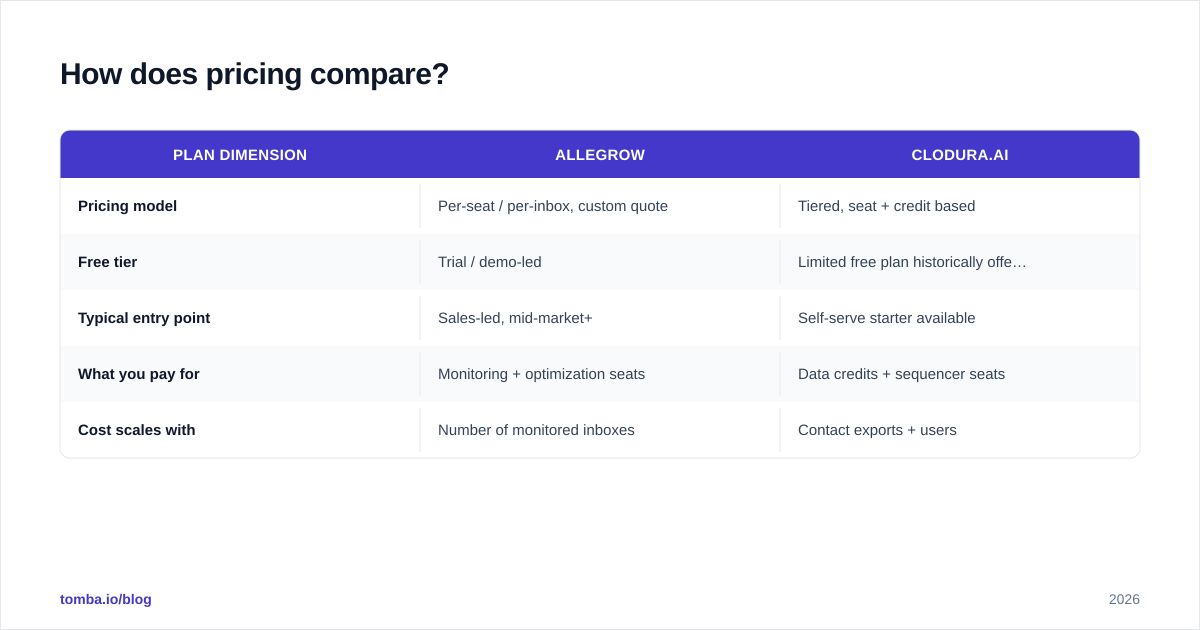
Both vendors quote custom or tiered pricing that shifts often, so treat any number as directional and confirm on their own sites. The structural difference matters more than the exact figure.
| Plan dimension | Allegrow | Clodura.ai |
|---|---|---|
| Pricing model | Per-seat / per-inbox, custom quote | Tiered, seat + credit based |
| Free tier | Trial / demo-led | Limited free plan historically offered |
| Typical entry point | Sales-led, mid-market+ | Self-serve starter available |
| What you pay for | Monitoring + optimization seats | Data credits + sequencer seats |
| Cost scales with | Number of monitored inboxes | Contact exports + users |
Check Allegrow's site and Clodura.ai's site for current numbers, and cross-reference reviews on G2 before committing — pricing pages and real invoices often diverge for sales-led tools.
For comparison, a dedicated data tool like Tomba pricing runs a free tier (25 searches/month), Starter at $49/mo, Growth at $99/mo, and Pro at $249/mo — credit-based and self-serve, which is a different cost shape than a bundled prospecting suite.
What's missing from both? The verification gap#
Here's the uncomfortable part for anyone trying to pick just one of these tools: neither is a best-in-class email finder, and neither is a dedicated verifier.
- Allegrow never touches contact discovery. It optimizes what you already send.
- Clodura.ai finds contacts but ships verification as a bundled feature, optimized for breadth over precision, and its coverage has the same blind spots every single-source database has.
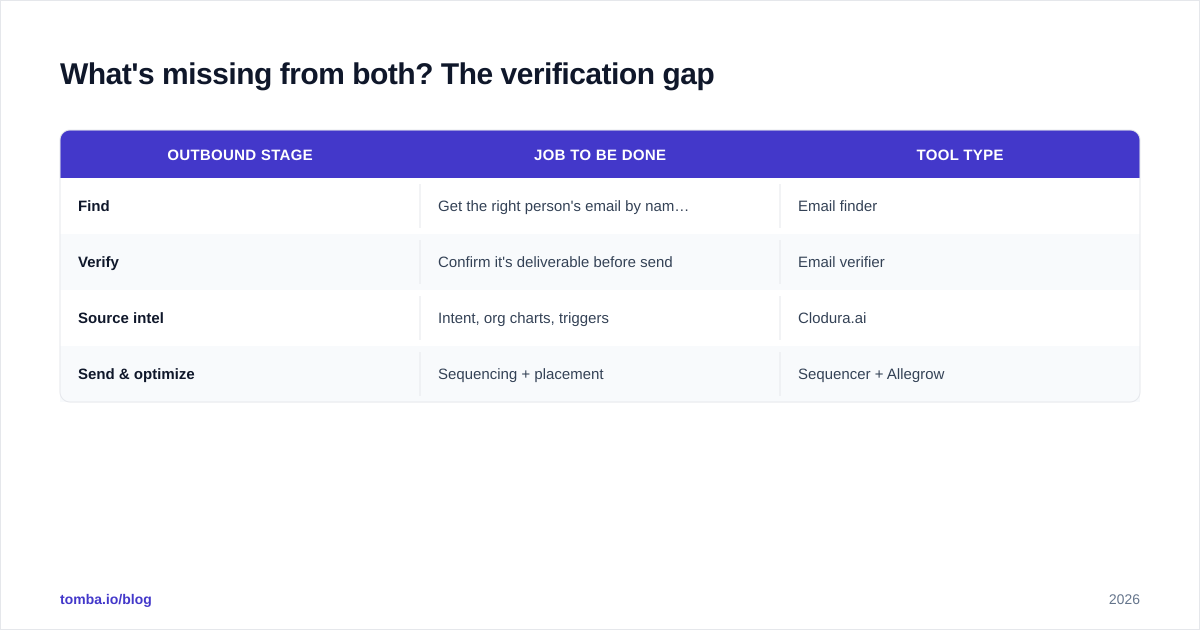
The reliable pattern is a layered stack where each tool does one job well:
| Outbound stage | Job to be done | Tool type |
|---|---|---|
| Find | Get the right person's email by name/domain | Email finder |
| Verify | Confirm it's deliverable before send | Email verifier |
| Source intel | Intent, org charts, triggers | Clodura.ai |
| Send & optimize | Sequencing + placement | Sequencer + Allegrow |
This is exactly where a focused tool fits. Tomba's domain search pulls every public address pattern for a company, the email finder resolves a specific person, and the email verifier re-checks deliverability right before you load a sequence. Run that pass on Clodura.ai exports too — re-verifying third-party data is one of the cheapest ways to protect the deliverability Allegrow is paid to optimize.
For high volume, the bulk email finder handles whole lists at once, and the email finder API wires verification directly into your CRM or sending tool so no unverified address ever reaches a mailbox.
Who should choose which?#
Choose Allegrow if: you already have solid data and a working sequencer, you're sending meaningful volume, and your reply rates dropped without an obvious cause. Allegrow is the diagnostic-and-fix layer for placement. It's overkill for a team still assembling its first 500 prospects.
Choose Clodura.ai if: you need a pipeline-building engine — a searchable database plus intent signals plus a place to send from — and you want it bundled. It's a reasonable all-in-one for SMB and mid-market teams that prefer one login over a best-of-breed stack. Validate its coverage in your niche during the trial; database fit varies wildly by industry and region.
Choose both (most scaled teams) if: you're running outbound seriously. Clodura.ai (or a finder + database) fills the top of the funnel, and Allegrow guards the bottom. Add a dedicated verifier between them and you've closed the gap each tool leaves open.
Choose neither — yet — if: you haven't nailed list accuracy. Spending on placement optimization before your data is clean is paying for a better plate while serving spoiled ingredients.
Frequently asked questions#
Is Allegrow a competitor to Clodura.ai? Not really. Allegrow optimizes deliverability; Clodura.ai sources prospecting data and sends sequences. They address opposite ends of the outbound funnel and are often used together.
Does Clodura.ai improve deliverability? Indirectly. Cleaner data means fewer bounces, which protects sender reputation. But its bundled verification isn't a substitute for a dedicated verifier or a placement tool like Allegrow.
Can one tool replace both? No single tool does best-in-class prospecting and deliverability optimization and verification. The durable approach is a layered stack: find, verify, source intel, send, optimize.
What about the email-finding step neither covers well? That's the gap a dedicated finder fills. Use it to locate the exact contacts a database misses and to verify everything before send.
The bottom line#
Stop framing this as Allegrow versus Clodura.ai. They're different layers of the same machine: Clodura.ai (or a finder plus database) builds the list, and Allegrow protects how that list lands. The piece both leave exposed is rigorous email finding and verification — and that's the layer that most directly determines whether your outbound bounces or books meetings.
Start where the leverage is highest: clean, deliverable data. Use the Tomba Email Finder to source accurate, verified addresses by name or domain, run them through the email verifier before they hit a sequence, and let your prospecting and deliverability tools do what they each do best. Spin up the free tier (25 searches/month) and test the accuracy on your own target accounts before you spend a dollar on placement optimization.
Ready to find emails that actually work?
Join 150,000+ professionals who stopped guessing and started sending. Free credits on signup — no credit card required.
Get the Tomba newsletter
Practical outbound tactics and product updates — once every two weeks.
About the author