Allegrow vs Hunter 2026: Deliverability vs Email Finding
Allegrow optimizes inbox placement; Hunter finds and verifies emails. They solve different problems. Here's how to tell which one your outreach stack actually needs in 2026.
TL;DR
- They are not the same category. Allegrow is a deliverability and inbox-placement optimization platform. Hunter is an email-finding and verification tool. Comparing them head-to-head is like comparing a water filter to a well — both touch "water," but they do opposite jobs.
- Pick Hunter (or a finder) first. You cannot optimize the delivery of emails you do not have. Sourcing and verifying valid addresses is step one.
- Add Allegrow when volume and reputation become the bottleneck. Once you are sending hundreds of cold emails a day and landing in spam, an inbox-placement tool earns its price.
- Most teams need both layers, plus a verifier in between. The cheapest mistake is buying one and assuming it covers the other.
- Budget reality: Hunter starts around $34/mo, Allegrow is a higher-tier deliverability spend, and a finder-plus-verifier like Tomba starts at $49/mo on the Tomba pricing page.
What problem does each tool actually solve?#
Here is the conclusion first: Hunter helps you build a list of real, reachable email addresses; Allegrow helps the emails you send to that list reach the inbox instead of spam. They sit at opposite ends of the same outbound pipeline.
If your campaign were a delivery service, Hunter is the part that finds correct street addresses for your packages. Allegrow is the part that makes sure the truck is allowed through the gate and the package gets placed on the doorstep rather than dumped in the alley. Neither replaces the other.
That distinction matters because "Allegrow vs Hunter" is a search a lot of cold-email operators run when they are really asking a deeper question: which gap in my outreach is costing me replies right now? Answer that, and the tool choice becomes obvious.

What is Hunter?#
Hunter (hunter.io) is one of the best-known email finder tools on the market. Its core jobs are:
- Domain Search — enter a company domain and get the email addresses associated with it, plus the detected pattern (for example,
first.last@company.com). - Email Finder — give it a name and a company, and it returns the most likely address with a confidence score.
- Email Verifier — check whether an address is deliverable before you send.
- Campaigns — a lightweight cold-email sender bolted on top of the data.
Hunter's strength is breadth of awareness and a clean, beginner-friendly interface. Its data comes largely from crawling public web sources, so coverage is strong for companies with a visible web footprint and thinner for stealthy or smaller firms. Accuracy is solid but not infallible, which is why pairing any finder with a dedicated email verifier is standard practice.
In short: Hunter is a data-acquisition tool. It answers "who do I email and what is their address?"
What is Allegrow?#
Allegrow is a deliverability optimization platform. It does not find leads. Instead, it focuses on the second half of the outbound problem: making sure the messages you send actually land in the primary inbox.
Allegrow's feature set centers on:
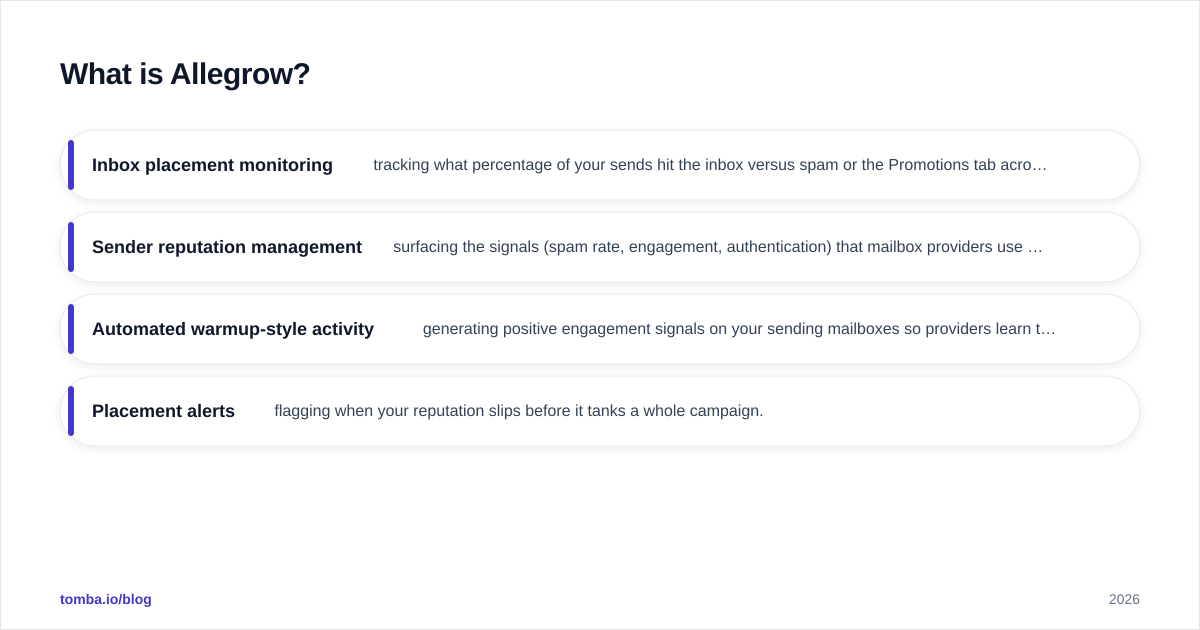
- Inbox placement monitoring — tracking what percentage of your sends hit the inbox versus spam or the Promotions tab across major providers.
- Sender reputation management — surfacing the signals (spam rate, engagement, authentication) that mailbox providers use to score you.
- Automated warmup-style activity — generating positive engagement signals on your sending mailboxes so providers learn to trust them.
- Placement alerts — flagging when your reputation slips before it tanks a whole campaign.
If you want a primer on the underlying concept, Tomba's glossary entry on email deliverability covers the mechanics. You can compare Allegrow's positioning against peers on review sites like G2, where deliverability tools are categorized separately from email-finding tools — a useful signal that these products are not direct substitutes.
In short: Allegrow is an inbox-placement tool. It answers "will the email I send actually be seen?"
Allegrow vs Hunter: how do they compare?#
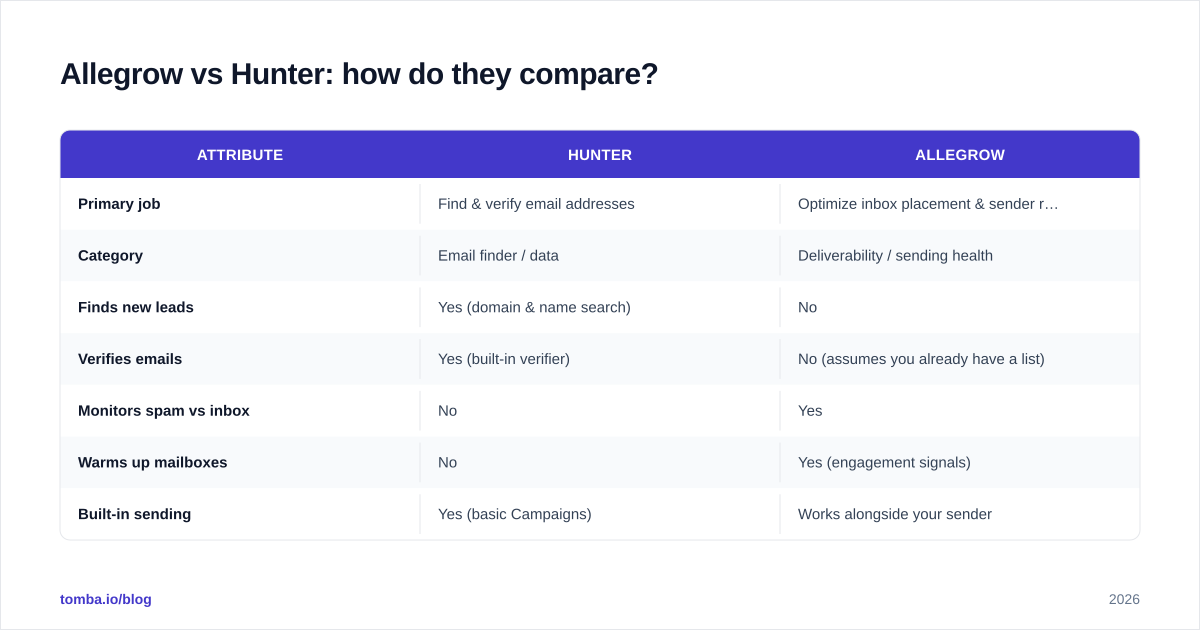
Because they live in different categories, a feature-by-feature table is less about "who wins" and more about "what each one even attempts." Here is the honest layout:
| Attribute | Hunter | Allegrow |
|---|---|---|
| Primary job | Find & verify email addresses | Optimize inbox placement & sender reputation |
| Category | Email finder / data | Deliverability / sending health |
| Finds new leads | Yes (domain & name search) | No |
| Verifies emails | Yes (built-in verifier) | No (assumes you already have a list) |
| Monitors spam vs inbox | No | Yes |
| Warms up mailboxes | No | Yes (engagement signals) |
| Built-in sending | Yes (basic Campaigns) | Works alongside your sender |
| Best for | Building a contact list | Protecting an existing sending operation |
| Entry price | ~$34/mo | Higher-tier deliverability pricing |
| Free tier | Yes (limited monthly searches) | Trial-based |
The takeaway: if you ask "Allegrow vs Hunter, which should I buy?" and you do not yet have a verified list, the answer is almost always Hunter first. You cannot improve the placement of campaigns that do not exist.
How do they fit into one outbound pipeline?#
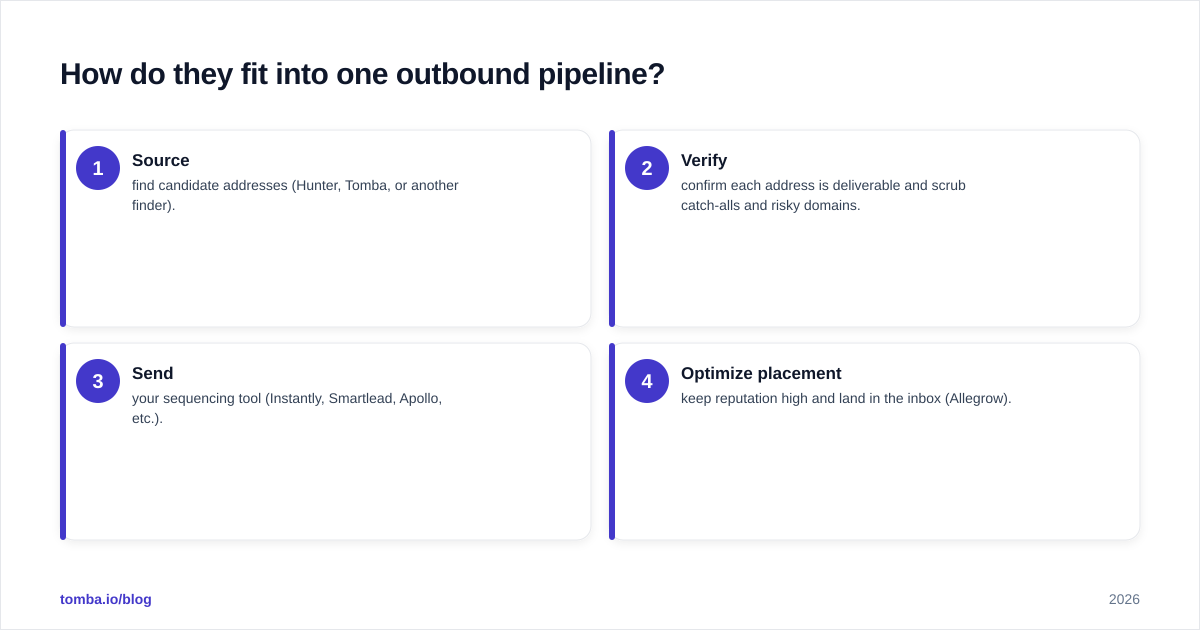
Stop thinking "or" and start thinking "stages." A healthy cold-email pipeline runs in four layers, and Hunter and Allegrow occupy different ones:
- Source — find candidate addresses (Hunter, Tomba, or another finder).
- Verify — confirm each address is deliverable and scrub catch-alls and risky domains.
- Send — your sequencing tool (Instantly, Smartlead, Apollo, etc.).
- Optimize placement — keep reputation high and land in the inbox (Allegrow).
Skipping any layer breaks the chain. Great deliverability on a list full of bad addresses still produces bounces — and bounces wreck the very reputation Allegrow is trying to protect. That is why verification sits between sourcing and sending, and why teams that run both finders and deliverability tools see compounding gains. If you want to model the warmup ramp before you commit to a sending volume, run the numbers through Tomba's email warmup calculator.
Is Allegrow better than Hunter?#
Neither is "better" — they are not competing for the same job. But you can rank them for your situation:
Choose Hunter (or another finder) if:
- You are starting cold and need contacts.
- Your reply rates are low because your list is small or stale, not because of spam folders.
- You want a verifier and a finder in one familiar interface.
Choose Allegrow if:
- You already source and verify leads reliably.
- You send meaningful volume (hundreds of emails per day per inbox).
- Your open and reply rates dropped suddenly, suggesting a placement problem rather than a copy or list problem.
- You manage multiple sending domains and need to protect sender reputation at scale.
Choose both if:
- You run outbound as a real revenue channel and want each layer handled by a specialist tool.
A quick diagnostic: if your bounce rate is high, that is a data problem — fix it with a finder and verifier. If your bounce rate is fine but opens cratered, that is a placement problem — that is Allegrow's territory.

How does pricing compare?#
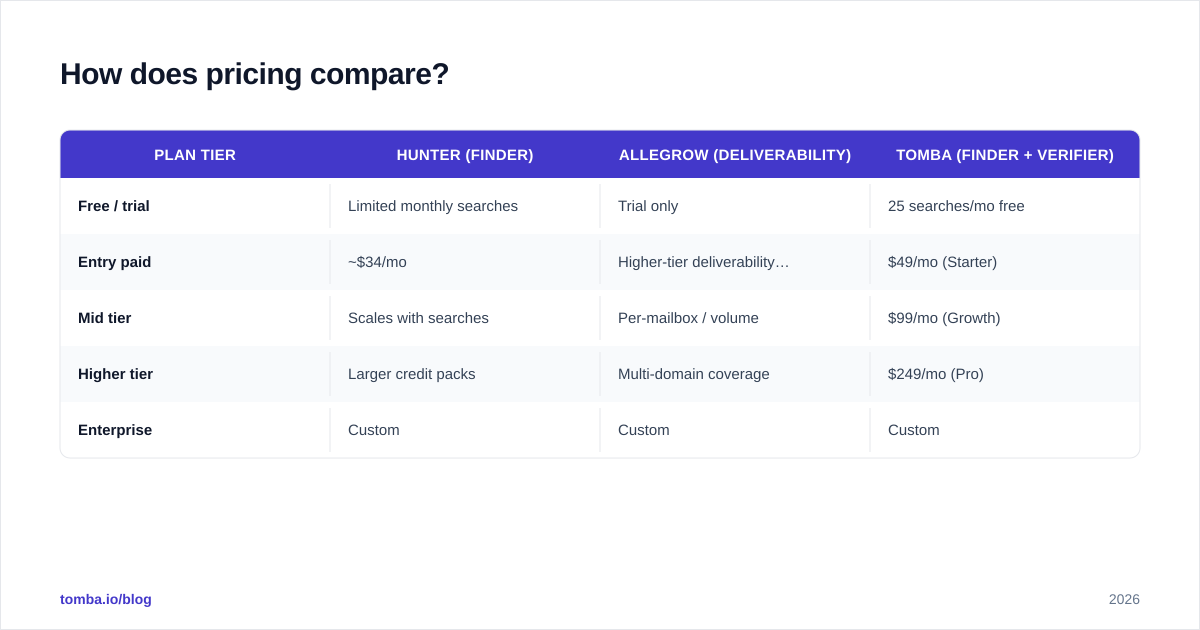
Pricing reflects the category gap. Email finders sell credits or monthly searches; deliverability tools sell monitored mailboxes and placement coverage.
| Plan tier | Hunter (finder) | Allegrow (deliverability) | Tomba (finder + verifier) |
|---|---|---|---|
| Free / trial | Limited monthly searches | Trial only | 25 searches/mo free |
| Entry paid | ~$34/mo | Higher-tier deliverability spend | $49/mo (Starter) |
| Mid tier | Scales with searches | Per-mailbox / volume | $99/mo (Growth) |
| Higher tier | Larger credit packs | Multi-domain coverage | $249/mo (Pro) |
| Enterprise | Custom | Custom | Custom |
Two notes. First, Allegrow's pricing model is built around monitored inboxes and sending volume rather than lookups, so it is not directly comparable line-for-line with a finder. Second, if your core need is sourcing plus verification in one place, a finder with a strong built-in verifier is the more cost-efficient starting point than buying a deliverability suite you are not yet ready to use.
Where does Tomba fit in this comparison?#
Honestly: Tomba competes with Hunter, not with Allegrow. Both Tomba and Hunter are email finders with built-in verification, so if you are evaluating "Allegrow vs Hunter" and lean toward needing the finder layer, Tomba is the natural third option to put on the table.
Where Tomba tends to stand out against Hunter:
- Verification depth. Beyond standard checks, Tomba includes a catch-all verifier for the catch-all domains that defeat most finders' confidence scores.
- Breadth of search. Domain search, LinkedIn-based lookups, bulk processing, and an email finder API sit under one roof.
- Transparent pricing. The Free tier gives 25 searches a month, and paid plans start at $49/mo — laid out plainly on the Tomba pricing page.
What Tomba does not do is replace a dedicated deliverability platform like Allegrow. If your sole problem is inbox placement on an already-clean list, a finder is the wrong tool. Use the right layer for the right job — and use clean data as the foundation, because even the best deliverability tool cannot rescue a list full of invalid addresses.
Frequently asked questions#
Is Allegrow a competitor to Hunter? Not really. Allegrow is a deliverability and inbox-placement tool; Hunter is an email finder and verifier. They sit in different stages of the outbound pipeline and are often used together.
Do I need both Allegrow and Hunter? If you run cold email at volume, the layers they cover — sourcing/verification and deliverability — are both important. Start with the finder layer, add deliverability monitoring once placement becomes your bottleneck.
Can Hunter improve my deliverability? Indirectly. By giving you verified addresses, Hunter (or any solid finder plus verifier) reduces bounces, and lower bounce rates protect sender reputation. But it does not monitor inbox placement or warm up mailboxes the way Allegrow does.
What is the cheapest way to start? Begin with a finder that includes verification so you are not paying for two tools at once. A free tier — like Tomba's 25 monthly searches or Hunter's limited free plan — lets you test data quality before committing budget.
The bottom line#
"Allegrow vs Hunter" is the wrong framing for most teams, because the two tools answer different questions. Hunter builds and verifies your list. Allegrow protects the delivery of campaigns sent to that list. The order matters: source and verify first, optimize placement second.
If your immediate gap is getting accurate contact data — the layer Hunter occupies — start there, and compare finders on accuracy and verification rather than on features you will not use. Try the Tomba Email Finder free for 25 searches a month, pair it with built-in verification to keep your bounce rate low, and let your deliverability tool do its job on a list that is actually clean. Get the foundation right, and every layer above it works harder for you.
// get started
Find, verify and enrich your first contacts today
Start on the free plan with 25 searches a month, then scale when your team is ready.
Free plan · No credit card required · GDPR & CCPA
// about the author