Allegrow vs SignalHire 2026: Deliverability vs Contact Data
Allegrow optimizes inbox placement; SignalHire finds contacts. Here's why most outbound teams don't actually choose between them — and what they really need.
If you typed "Allegrow vs SignalHire" into a search bar expecting a head-to-head between two interchangeable tools, here's the twist: they barely compete. One keeps your emails out of spam. The other finds the people you email. Picking between them is like asking whether you need tires or fuel.
This post breaks down what each tool actually does, where they overlap (a little), where they don't (a lot), and how to decide which one — or which combination — belongs in your 2026 outbound stack.
TL;DR#
- Allegrow is a deliverability optimization platform. It improves sender reputation, monitors inbox placement, and pushes more of your cold email into the primary inbox instead of spam or the Promotions tab.
- SignalHire is a contact-data tool. It finds verified emails and phone numbers for prospects and candidates, with a Chrome extension and bulk lookup.
- They solve different problems. Most teams that compare them end up needing both a data source and a deliverability layer — not one instead of the other.
- The shared dependency is data quality. Neither tool fixes a list full of invalid addresses; that's the job of an email verifier.
- If your real gap is finding and verifying contacts, a dedicated finder like Tomba Email Finder is the closer comparison to SignalHire than Allegrow is.
What is Allegrow?#
Allegrow is a sender reputation and deliverability optimization tool. It sits on top of your existing sending infrastructure (Gmail, Outlook, or a dedicated sending tool) and works to land more of your messages in the primary inbox.
Its core jobs:
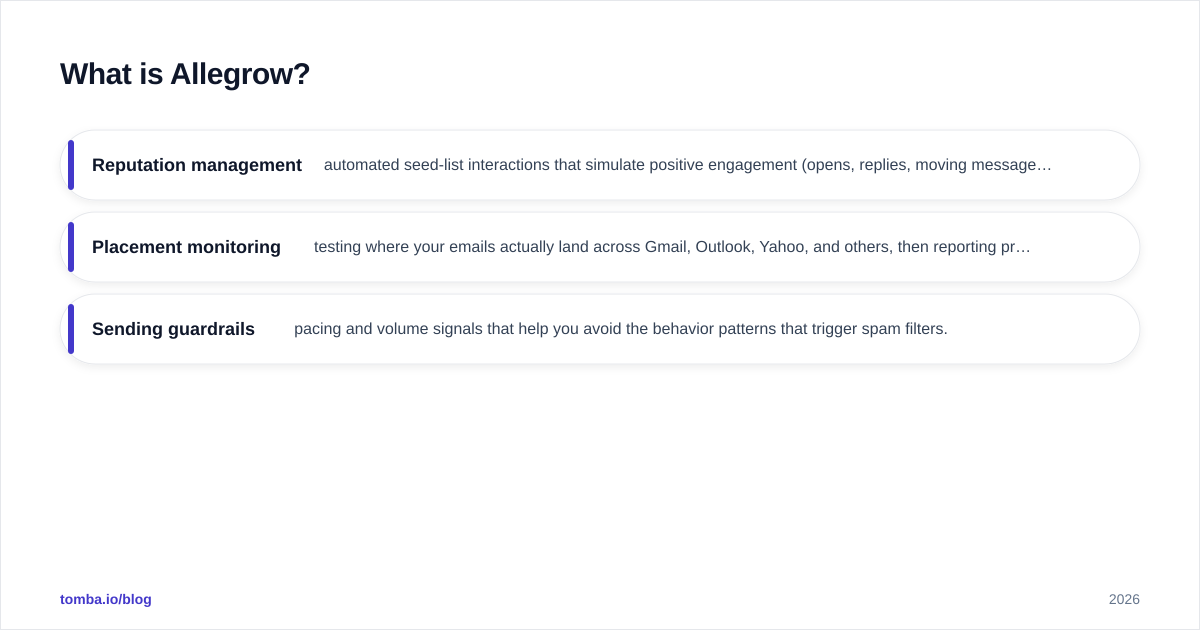
- Reputation management — automated seed-list interactions that simulate positive engagement (opens, replies, moving messages out of spam) to train mailbox providers that your sender is trustworthy.
- Placement monitoring — testing where your emails actually land across Gmail, Outlook, Yahoo, and others, then reporting primary vs. Promotions vs. spam rates.
- Sending guardrails — pacing and volume signals that help you avoid the behavior patterns that trigger spam filters.
Allegrow does not find you contacts. It assumes you already have a list and a sending tool, and its entire value is making sure the emails you send are actually seen. If you don't understand why that matters, read up on email deliverability first — it's the single most underrated lever in cold outreach.
What is SignalHire?#
SignalHire is a contact-finding platform built for recruiters and sales teams. You give it a name, a LinkedIn profile, or a company, and it returns professional emails and phone numbers.
Its core jobs:
- Contact lookup — emails and direct-dial / mobile numbers for individual prospects.
- Chrome extension — pull contact details directly from LinkedIn and other profiles while you browse.
- Bulk search and lists — process many profiles at once and export to CSV or an ATS/CRM.
- Candidate sourcing — SignalHire leans heavily into recruiting use cases, with pipeline and team features.
SignalHire does not manage your sender reputation or tell you whether your emails land in spam. It hands you the raw material — verified contact details — and stops there. Once you've got the addresses, deliverability is your problem to solve.
)
Allegrow vs SignalHire: do they even compete?#
Mostly no. They occupy different rows in the outbound stack.
Think of a cold email campaign as a relay race:
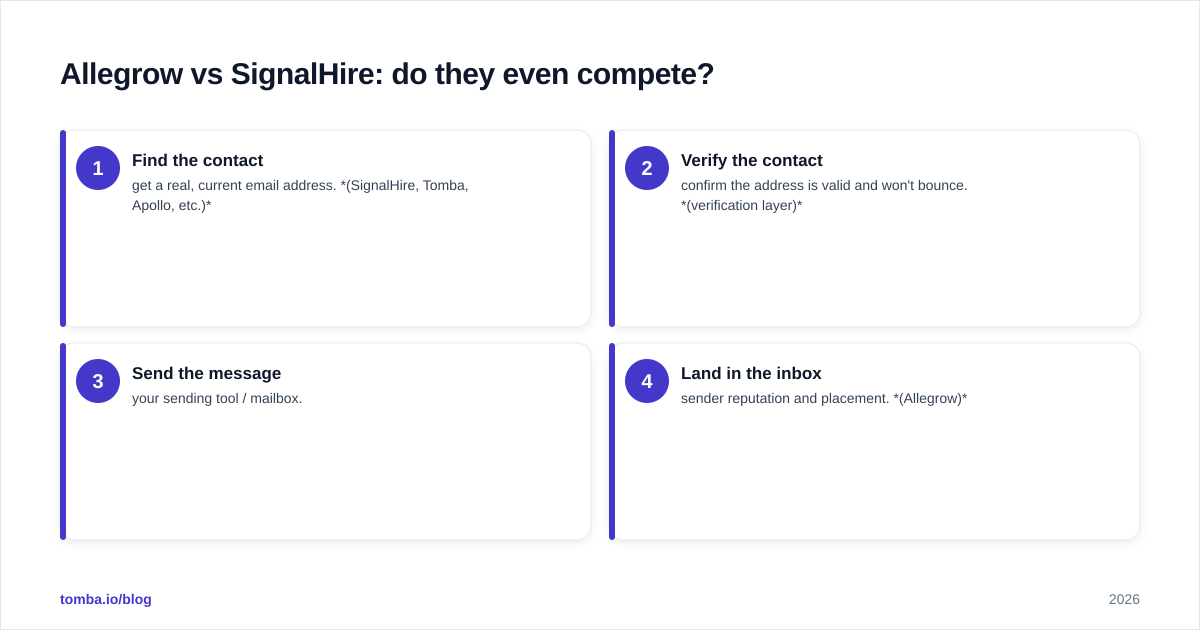
- Find the contact — get a real, current email address. (SignalHire, Tomba, Apollo, etc.)
- Verify the contact — confirm the address is valid and won't bounce. (verification layer)
- Send the message — your sending tool / mailbox.
- Land in the inbox — sender reputation and placement. (Allegrow)
SignalHire owns step 1. Allegrow owns step 4. Putting them in a cage match misunderstands the race — they run different legs.
The reason people still type "Allegrow vs SignalHire" is budget. When you're capping spend on outbound tooling, you compare line items even when they aren't substitutes. Fair enough — so let's compare them honestly, then explain what you'd actually pair with each.
How do Allegrow and SignalHire compare feature by feature?#
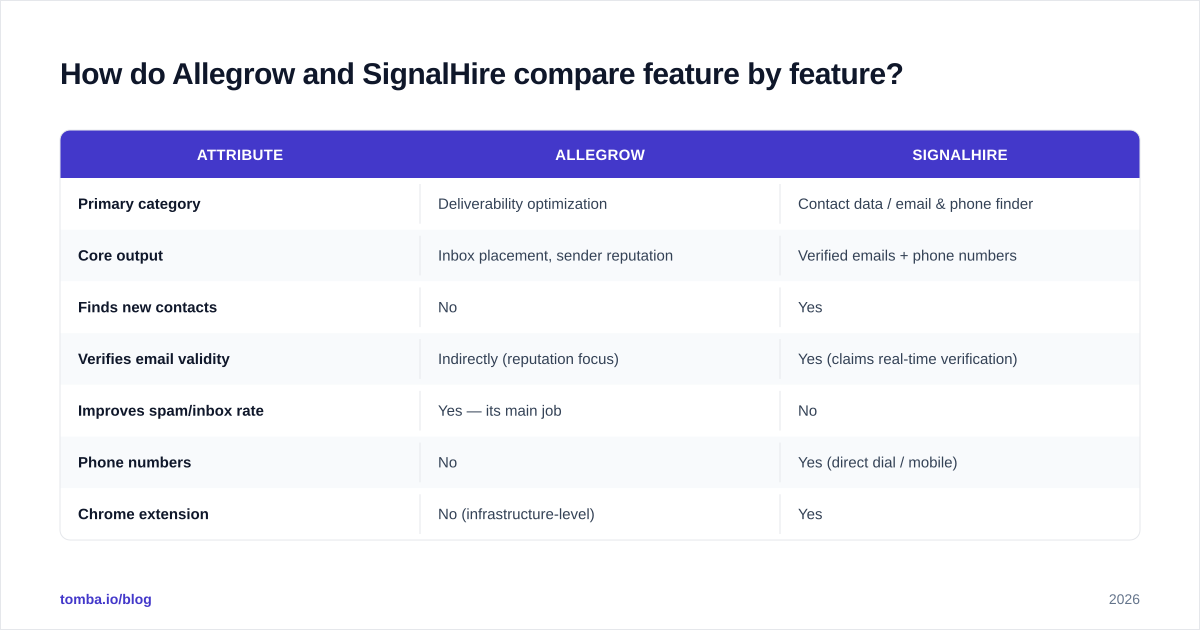
| Attribute | Allegrow | SignalHire |
|---|---|---|
| Primary category | Deliverability optimization | Contact data / email & phone finder |
| Core output | Inbox placement, sender reputation | Verified emails + phone numbers |
| Finds new contacts | No | Yes |
| Verifies email validity | Indirectly (reputation focus) | Yes (claims real-time verification) |
| Improves spam/inbox rate | Yes — its main job | No |
| Phone numbers | No | Yes (direct dial / mobile) |
| Chrome extension | No (infrastructure-level) | Yes |
| Best-fit user | Teams already sending volume | Recruiters & SDRs sourcing leads |
| Recruiting use case | Minimal | Strong |
| Works without the other | Needs a data source | Needs deliverability hygiene |
The pattern is clear: the "winner" column flips depending on which problem is bleeding money today. Low reply rates because messages hit spam? That's an Allegrow-shaped problem. Empty pipeline because you have no one to email? That's a SignalHire-shaped problem.
What does Allegrow do best?#
Allegrow earns its keep when you already have volume and a list, but your numbers are quietly broken by spam filtering. Classic symptoms:
- Open rates that crashed after a strong start (a reputation death-spiral).
- High send volume, near-zero replies.
- Emails landing in Promotions or spam when you test them yourself.
Allegrow's automated reputation work and placement monitoring give you visibility and a corrective mechanism most sending tools don't offer natively. If you run cold email at scale across many mailboxes, that's real value.
What it won't do: build your pipeline, enrich your CRM, or fix a list stuffed with role-based and invalid addresses. In fact, a dirty list actively sabotages the reputation Allegrow is trying to build — every bounce is a strike against you. Garbage in, spam folder out.
What does SignalHire do best?#
SignalHire shines when finding and reaching people is the bottleneck — especially in recruiting. Its phone-number coverage and LinkedIn extension make it a genuine sourcing workhorse, and the candidate-pipeline features set it apart from pure sales finders.
For SDR teams, it's a serviceable email-and-phone source. But this is exactly where it stops being a unique category and starts competing with every other contact-data vendor — Apollo, RocketReach, Lusha, and dedicated finders like Tomba. On that battlefield, the questions become coverage, accuracy, price per credit, and how clean the verification really is.
If you want to see how those finders stack up on the metric that matters — bounce rate — independent review sites like G2 are a better gut-check than any single vendor's marketing page.
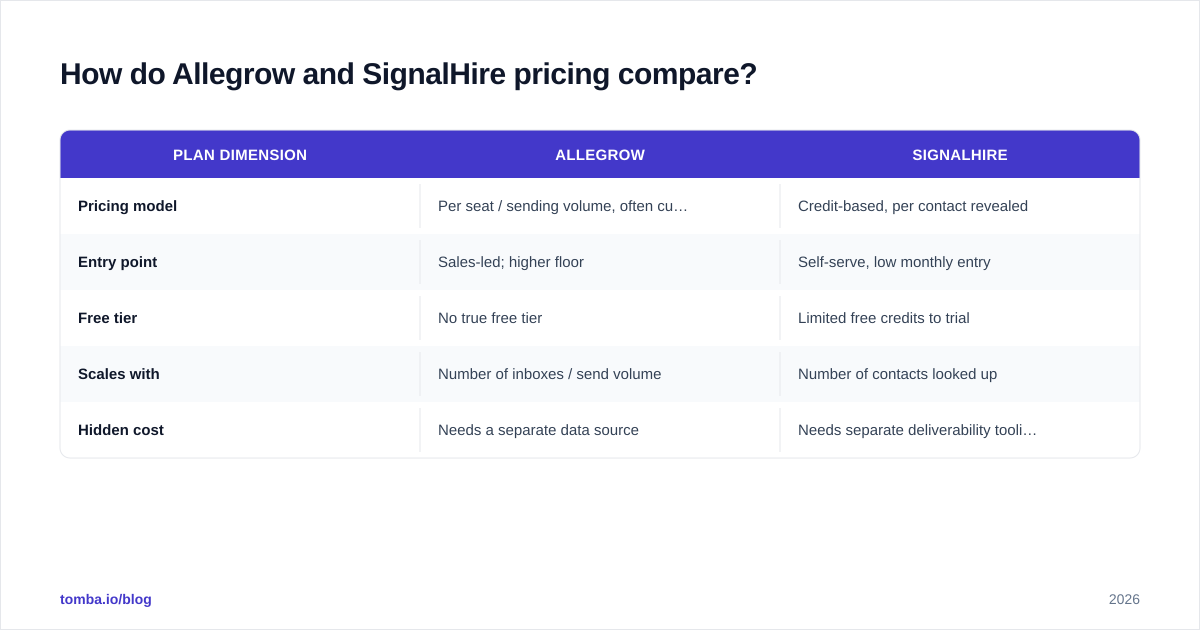
How do Allegrow and SignalHire pricing compare?#
Pricing for both shifts over time and skews toward custom quotes, so treat these as directional and confirm on the vendors' own sites before you buy.
| Plan dimension | Allegrow | SignalHire |
|---|---|---|
| Pricing model | Per seat / sending volume, often custom | Credit-based, per contact revealed |
| Entry point | Sales-led; higher floor | Self-serve, low monthly entry |
| Free tier | No true free tier | Limited free credits to trial |
| Scales with | Number of inboxes / send volume | Number of contacts looked up |
| Hidden cost | Needs a separate data source | Needs separate deliverability tooling |
The "hidden cost" row is the one buyers miss. Whichever you choose, you're signing up for a second category of spend to complete the stack. Budget for the relay, not just one leg of it.
)
Which one do you actually need in 2026?#
Use this quick diagnostic. Find the symptom that hurts most right now:
- "My emails go to spam." → Deliverability problem → Allegrow (plus list hygiene).
- "I have no one to email." → Data problem → SignalHire or another finder.
- "I have contacts but half of them bounce." → Verification problem → a finder with built-in verification.
- "All three are broken." → You need a data + verification layer first, then deliverability. Fix the inputs before optimizing the channel.
Order matters. Optimizing deliverability on top of bad data is like tuning an engine that has no fuel. Get accurate, verified contacts in the door first — then worry about placement. A deliverability tool can't save a campaign aimed at addresses that don't exist.
Where does verification fit — and where does Tomba come in?#
Here's the connective tissue both categories depend on: list quality. SignalHire claims real-time verification; Allegrow's reputation work collapses the moment your bounce rate spikes. Both bet on clean data, but neither is built as a dedicated verification-first finder.
That's the gap a tool like Tomba fills. The Tomba Email Finder returns professional addresses by name, company, or domain, and pairs with a built-in verifier so you're not exporting guesses into your sending tool. For teams that found SignalHire's coverage thin or its per-credit cost steep, it's a direct, finder-to-finder comparison — and you can check the Tomba pricing against SignalHire's credit model line by line.
Tomba doesn't replace Allegrow. Nothing in the finder category does — deliverability optimization is its own discipline, and if spam placement is your wound, you still want a reputation tool. What Tomba replaces is the guesswork feeding the top of your funnel, which is what makes everything downstream — including any deliverability investment — actually pay off. Even the best inbox-placement engine, per general email marketing benchmarks from HubSpot, can't rescue a campaign built on invalid addresses.
Frequently asked questions#
Is Allegrow a SignalHire competitor? Not really. Allegrow is a deliverability tool; SignalHire is a contact-data tool. They're complementary, not interchangeable. SignalHire's true competitors are other finders like Apollo, RocketReach, and Tomba.
Can I use Allegrow and SignalHire together? Yes, and many teams effectively do — SignalHire (or another finder) supplies contacts, your sending tool delivers, and Allegrow optimizes placement. They sit in different layers of the same stack.
Which is better for recruiters? SignalHire, clearly. Its phone-number coverage and candidate-sourcing features are built for recruiting. Allegrow is irrelevant to sourcing — it only matters once you're sending email at volume.
Do I need a separate email verifier? If your finder doesn't verify well, yes. Bounces wreck sender reputation, which undermines any deliverability investment. A finder with integrated verification, or a standalone email verifier, protects everything downstream.
What's the cheapest way to start? Start with the problem that's costing you the most. If it's empty pipeline, begin with a finder that has a free tier so you can test data quality before committing budget — then layer in deliverability tooling once volume justifies it.
The bottom line#
"Allegrow vs SignalHire" is the wrong frame. Allegrow makes sure your emails land; SignalHire helps you find people to email. Choosing between them depends entirely on which leg of the relay is dropping the baton — and plenty of teams need help with both.
But before you spend on either, fix the input that feeds them: accurate, verified contact data. If your real problem is finding the right people and trusting the addresses you export, start with the Tomba Email Finder. Find professional emails by name, company, or domain, verify them on the spot, and feed your outbound stack — deliverability tool included — with data that won't bounce. There's a free tier to test coverage before you commit a cent.
Ready to find emails that actually work?
Join 150,000+ professionals who stopped guessing and started sending. Free credits on signup — no credit card required.
Get the Tomba newsletter
Practical outbound tactics and product updates — once every two weeks.
About the author