Allegrow vs Tomba (2026): Deliverability or Email Finder?
Allegrow optimizes inbox placement; Tomba finds and verifies the emails you send to. Here's how the two tools differ and when you actually need each one.
Most "Allegrow vs Tomba" searches start from a wrong assumption: that these are two tools doing the same job. They aren't. Allegrow lives at the delivery end of your outbound funnel — making sure the emails you send land in the inbox. Tomba lives at the targeting end — finding and verifying the addresses you send to in the first place.
That distinction changes the whole comparison. So before you put them on a spreadsheet and pick the cheaper one, read this.
What's the quick verdict (TL;DR)?#
- Allegrow is an inbox-placement and sender-reputation platform. It monitors where your emails land, automates seed-list testing, and nudges messages out of spam folders.
- Tomba is an email-finder and verification platform. It finds professional email addresses by name, domain, or company, then verifies them before you send.
- They solve different problems at different funnel stages — finding good addresses vs. landing in the inbox. Comparing them head-to-head is like comparing a GPS to a fuel pump.
- If your bounce rate is high and your lists are stale, you need Tomba. If your verified emails still hit spam, you need a deliverability layer like Allegrow.
- Best setup for most teams: verify and target with Tomba, then protect deliverability with warmup/monitoring. One feeds the other.
What is Allegrow?#
Allegrow is a deliverability optimization tool. Think of it as the air-traffic control tower for your outbound email — it doesn't pack the plane, it makes sure the plane lands at the right gate instead of being diverted to the spam runway.
Concretely, Allegrow focuses on three things:
- Inbox placement monitoring — it uses seed lists (test inboxes across Gmail, Outlook, and other providers) to measure whether your campaigns land in Primary, Promotions, or Spam.
- Sender reputation scoring — it tracks signals that mailbox providers use to judge you and surfaces a reputation score over time.
- Spam-folder remediation — automated interactions that aim to train mailbox-provider filters to treat your domain as trusted.
Allegrow is built for teams already running volume — SDR orgs, agencies, and revenue teams whose problem isn't finding people, it's reaching them. It plugs into sending tools rather than replacing them. Pricing is quote-based and not publicly listed, which is common for deliverability platforms aimed at mid-market and enterprise.
What Allegrow is not: it is not a database, not an email finder, and not a verification engine for arbitrary prospect lists. It assumes you already have addresses to send to.
What is Tomba?#
Tomba is a B2B email-finder and data platform. If Allegrow is the control tower, Tomba is the crew that builds the passenger manifest — it tells you who to contact and confirms their address is real before you ever hit send.
Tomba's core capabilities:
- Email finder — find a professional email from a name plus company domain.
- Domain search — pull every discoverable email pattern and contact for a company.
- Email verifier — validate deliverability (syntax, MX, SMTP, catch-all) before sending so you protect your bounce rate.
- Enrichment, phone finder, and bulk processing for scaling list-building.
Tomba publishes transparent pricing: a Free tier with 25 searches/month, Starter at $49/mo, Growth at $99/mo, Pro at $249/mo, and custom Enterprise. The verification piece matters here — clean lists are the foundation of good deliverability, which is exactly the metric Allegrow tries to improve downstream.

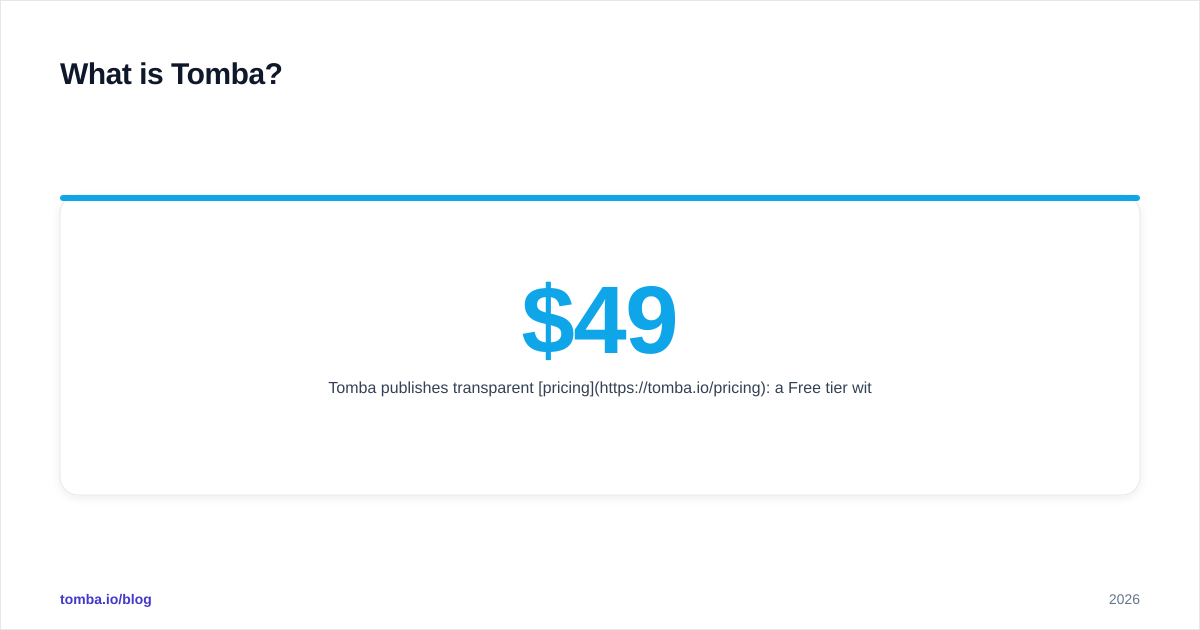
Allegrow vs Tomba: how do they actually differ?#
The cleanest way to see it: one tool affects the quality of your list, the other affects the fate of your send. Here's the side-by-side.
| Attribute | Tomba | Allegrow |
|---|---|---|
| Primary job | Find & verify email addresses | Optimize inbox placement |
| Funnel stage | Top — targeting & list-building | Bottom — delivery & reputation |
| Core outputs | Verified emails, domains, contacts | Placement score, reputation score |
| Free tier | Yes — 25 searches/mo | Not publicly listed |
| Entry price | $49/mo (Starter) | Quote-based |
| Bounce-rate impact | Direct (verify before send) | Indirect (reputation effect) |
| Spam-folder fix | Prevents via clean data | Active remediation/seeding |
| Replaces your sender? | No | No |
| Best for | Teams building cold lists | Teams already sending at volume |
| API access | Yes (Tomba API) | Yes |
The takeaway: there's almost no feature overlap. A high bounce rate caused by guessed addresses is a Tomba problem. A 3% bounce rate that still lands in spam is an Allegrow problem. You can have both at once — which is the case for a lot of teams who never diagnosed which is which.
Is Allegrow better than Tomba?#
Wrong question. The right question is: which problem is killing your campaign right now?
Run this quick diagnosis:
- Are your bounce rates above 3-5%? That's a data problem. You're emailing addresses that don't exist or were never verified. Fix this first — bounces wreck sender reputation faster than almost anything, so no amount of deliverability tooling saves you. This is Tomba's lane.
- Are bounces low but opens mysteriously flat? Your mail may be landing in spam or Promotions. That's a placement problem — Allegrow's lane.
- Are you not even sure who to email yet? You're at the list-building stage. Allegrow has nothing to do here; you need an email finder and a B2B database.
Most teams chasing a deliverability tool because "our emails go to spam" discover the real cause is dirty data inflating their bounce and complaint rates. Mailbox providers like Google read those signals directly — high bounces and spam complaints tank your reputation no matter how clever your seeding strategy is. Clean targeting is upstream of deliverability, not parallel to it.
When should you choose Tomba?#
Pick Tomba when your bottleneck is who and whether the address is real:
- You're building cold outbound lists from scratch. Tomba's domain search and email finder turn a company name into verified contacts.
- Your bounce rate is hurting you. Running addresses through the email verifier before sending is the single highest-leverage move for protecting sender reputation.
- You want predictable, transparent costs. The Free tier and $49/mo Starter let you test without a sales call.
- You need data inside your existing stack. Tomba pushes into HubSpot, Google Sheets, and more, plus a clean API and CLI.
In short: Tomba is for the part of the job that happens before you press send. Get this wrong and every downstream tool — including a deliverability platform — is fighting a fire you started.
When should you choose Allegrow?#
Pick Allegrow (or a deliverability platform like it) when your data is already clean and the problem is purely placement:
- You send real volume — hundreds or thousands of cold emails a week — and need ongoing reputation monitoring.
- Your bounce rate is already low (because you verify), but inbox placement is still inconsistent across Gmail and Outlook.
- You run an agency or large SDR team where a fraction of a percent in placement translates to real revenue.
- You want seed-list testing to know before a campaign goes out where it's likely to land.
Allegrow is a specialist tool for a specialist problem. If you don't yet have verified lists and steady sending volume, you're paying for a solution to a problem you don't have yet.
Can you use Allegrow and Tomba together?#
Yes — and for serious outbound teams, that's the point. They sit at opposite ends of the same pipeline, so they complement rather than compete.
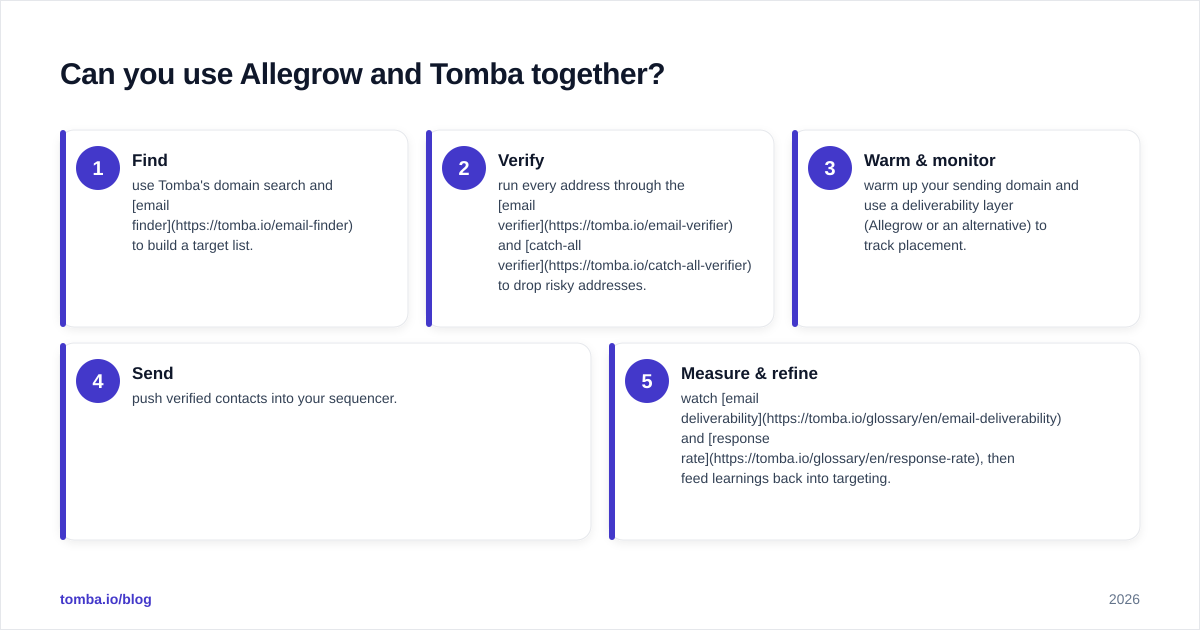
A healthy outbound stack looks like this:
- Find — use Tomba's domain search and email finder to build a target list.
- Verify — run every address through the email verifier and catch-all verifier to drop risky addresses.
- Warm & monitor — warm up your sending domain and use a deliverability layer (Allegrow or an alternative) to track placement.
- Send — push verified contacts into your sequencer.
- Measure & refine — watch email deliverability and response rate, then feed learnings back into targeting.
Steps 1-2 are Tomba. Step 3's monitoring is Allegrow's territory. Skipping step 2 is the most common mistake — and it's the one that makes step 3 feel like an uphill battle.
How does pricing compare?#
This is where the two diverge most clearly, and it reflects who each tool is built for.
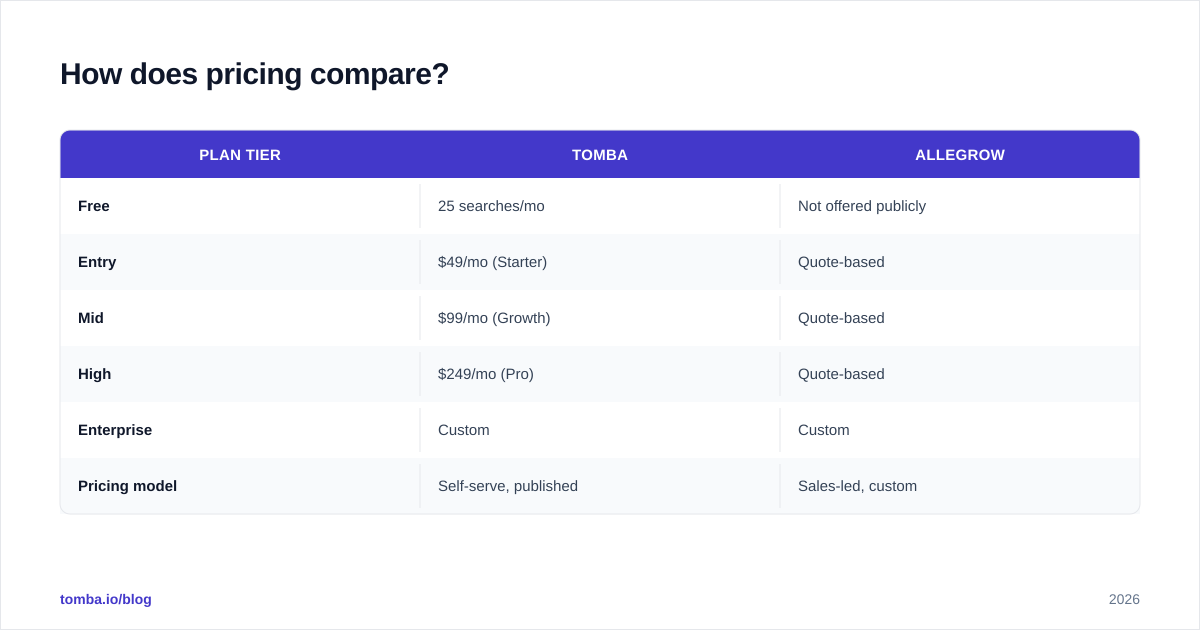
| Plan tier | Tomba | Allegrow |
|---|---|---|
| Free | 25 searches/mo | Not offered publicly |
| Entry | $49/mo (Starter) | Quote-based |
| Mid | $99/mo (Growth) | Quote-based |
| High | $249/mo (Pro) | Quote-based |
| Enterprise | Custom | Custom |
| Pricing model | Self-serve, published | Sales-led, custom |
Tomba is self-serve and transparent — you can start free and scale by usage. Allegrow follows the enterprise deliverability playbook: custom quotes, usually after a demo. Neither model is "better"; they signal different buyers. If you want to start today without talking to sales, Tomba's structure fits. If you're a large org budgeting for a managed deliverability program, Allegrow's model is normal for that segment. (Cross-check current details on a directory like G2 before committing, since deliverability pricing shifts often.)
What about the alternatives?#
Because these tools occupy different categories, their real competitors are within their own lane:
- Tomba's competitors are other email finders and verifiers — Hunter, Apollo, RocketReach, ZeroBounce. If you're comparing finders, see how Tomba stacks up as an Apollo alternative or RocketReach alternative.
- Allegrow's competitors are deliverability and warmup platforms — Instantly, Warmup Inbox, Folderly, MailReach.
If you landed on "Allegrow vs Tomba" expecting a clean winner, the honest answer is that you were likely comparing across categories. Decide which problem you have, then compare within that category.
Frequently asked questions#
Is Tomba a deliverability tool like Allegrow? No. Tomba is an email finder and verifier. It improves deliverability indirectly by keeping bounce rates low through verification, but it doesn't monitor inbox placement or remediate spam-folder issues the way Allegrow does.
Does Allegrow find email addresses? No. Allegrow assumes you already have addresses. It focuses on whether those emails reach the inbox. To build and verify lists, you need a tool like Tomba.
Which should I buy first? Almost always Tomba first. Clean, verified data is the foundation of deliverability. There's little value in optimizing placement for a list full of invalid addresses that will bounce and damage your reputation anyway.
Can I just use one tool? If you're early-stage and building lists, Tomba alone covers finding and verification. Once you're sending at high volume and bounces are already controlled, adding a deliverability layer makes sense.
Is there a free way to test Tomba? Yes — the Free tier includes 25 searches per month with no credit card. See full Tomba pricing for paid tiers.
The bottom line#
Allegrow and Tomba aren't rivals — they're neighbors in the same outbound pipeline. Allegrow protects the delivery of your email; Tomba ensures the addresses are real and worth sending to. Get the data right first, because deliverability tooling can't rescue a list built on guessed addresses.
If your real bottleneck is finding verified, accurate contacts — and for most teams chasing a "deliverability problem," it quietly is — start with the Tomba Email Finder. Find professional emails by domain, name, or company, verify them before you send, and stop feeding bad data into the rest of your stack. You can begin free with 25 searches a month and scale from a transparent $49/mo when you're ready.
Ready to find emails that actually work?
Join 150,000+ professionals who stopped guessing and started sending. Free credits on signup — no credit card required.
Get the Tomba newsletter
Practical outbound tactics and product updates — once every two weeks.
About the author