9 Best AlphaSense Alternatives for Market Intelligence (2026)
AlphaSense is powerful but priced for enterprises. Here are 8 AlphaSense alternatives for market intelligence, financial research, and B2B data — compared on depth, price, and fit.
AlphaSense is one of the most recognized names in market intelligence — but it is built and priced for large research teams, and it is not the only way to get fast answers out of filings, transcripts, and broker research. If the seat cost, the contract structure, or the feature focus does not match how your team actually works, there are strong alternatives worth a serious look.
This guide breaks down eight AlphaSense alternatives, what each one is genuinely good at, and how to decide which fits your workflow and budget in 2026.
TL;DR#
- AlphaSense excels at AI-powered search across SEC filings, earnings transcripts, broker research, and expert calls — but pricing is enterprise-only and quoted per seat.
- Best for real-time markets: Bloomberg Terminal and S&P Capital IQ Pro. Best value: Koyfin and Fiscal.ai. Best for private markets: PitchBook and CB Insights. Best AI research assistant: Brightwave.
- Pick based on three things: the data you actually need (public vs. private, real-time vs. document), your budget per seat, and whether you want AI summarization or raw data access.
- No single tool covers everything. Many teams pair a research platform with a contact data layer to turn company intelligence into actual conversations.
- If your end goal is outbound — reaching the decision-makers you just researched — a market intelligence tool is only half the stack. You still need verified contact data.
What is AlphaSense and why look for alternatives?#
AlphaSense is an AI-driven market intelligence platform. Its core value is search: instead of opening 40 PDFs, you query a corpus of SEC filings, earnings call transcripts, broker (sell-side) research, news, and — since its acquisitions of Sentieo and Tegus — expert interview transcripts. The platform surfaces relevant passages, tracks sentiment, and increasingly summarizes findings with generative AI. You can read more about the product on the official AlphaSense site.
So why shop around? A few recurring reasons:
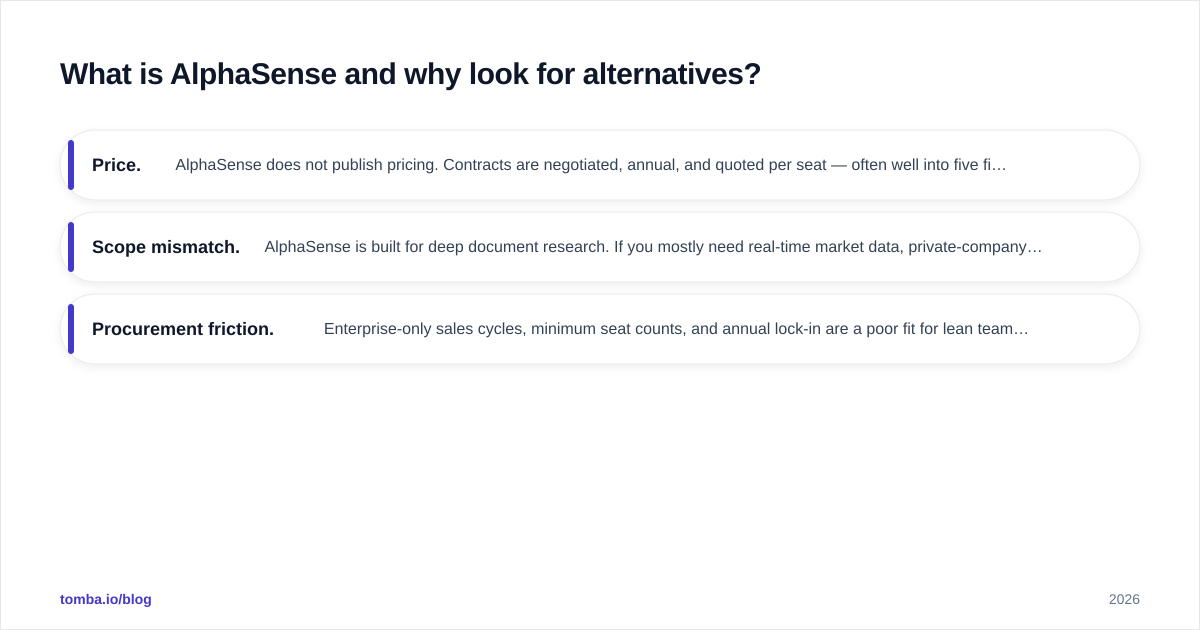
- Price. AlphaSense does not publish pricing. Contracts are negotiated, annual, and quoted per seat — often well into five figures for a team. That is hard to justify for a two-person research function or a sales team that only needs occasional company context.
- Scope mismatch. AlphaSense is built for deep document research. If you mostly need real-time market data, private-company funding history, or a lightweight charting tool, you are paying for capabilities you will not touch.
- Procurement friction. Enterprise-only sales cycles, minimum seat counts, and annual lock-in are a poor fit for lean teams that want to start small.
If any of those describe you, the alternatives below cover the spectrum — from Bloomberg-grade terminals to sub-$50/month tools.
What should you look for in an AlphaSense alternative?#
Before comparing logos, get clear on what you are actually buying. Most "AlphaSense vs. X" debates collapse once you map tools to needs. Use this framework.
1. Data type. Are you researching public companies (filings, transcripts, market data) or private ones (funding, cap tables, M&A)? AlphaSense leans public-document-heavy; PitchBook and CB Insights lead on private markets.
2. Depth vs. speed. Some tools give you raw, exhaustive data you interpret yourself (Bloomberg, Capital IQ). Others give you fast AI summaries you trust at a glance (Brightwave, AlphaSense's Generative Search). Decide how much you want the tool to "do the thinking."
3. Price model. Public, self-serve pricing (Koyfin, Fiscal.ai) lets you start in minutes. Custom enterprise pricing (most of the rest) means a sales call and an annual commitment.
4. Workflow fit. A research analyst, a corporate strategy team, and a B2B sales rep need very different things. The "best" tool is the one that matches the job, not the one with the most data.
5. The contact gap. Market intelligence tells you which companies and trends matter. It rarely tells you how to reach the right person there. If your research feeds outbound, plan for a contact-data layer separately — more on that below.
What are the best AlphaSense alternatives in 2026?#
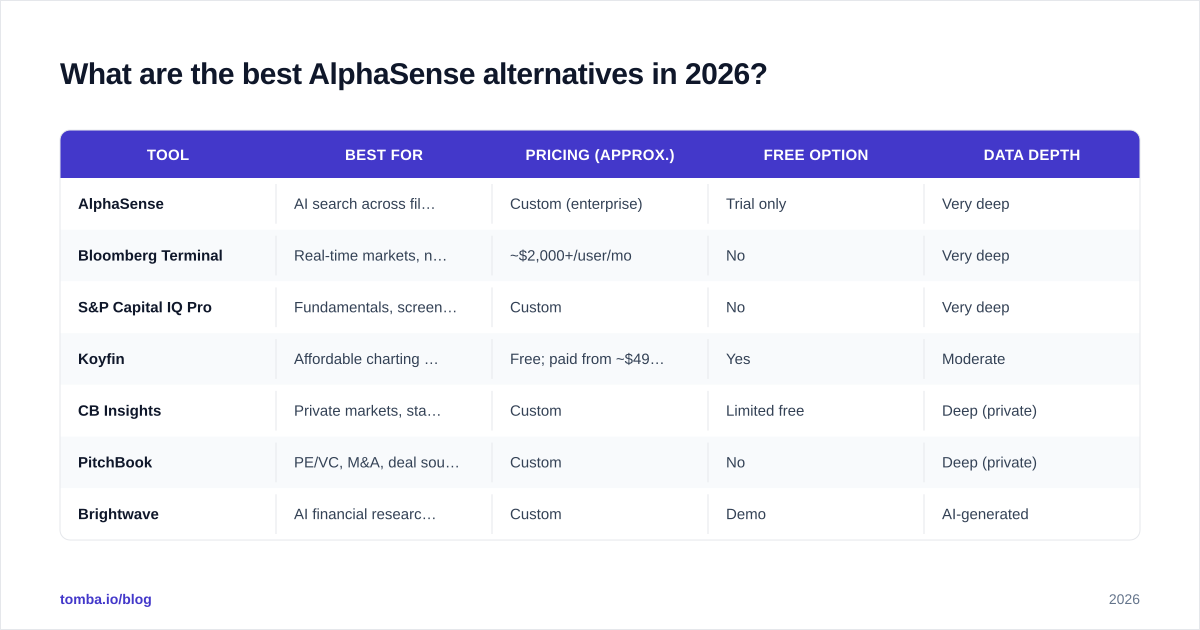
Here is a side-by-side comparison, followed by a closer look at each tool. Pricing reflects publicly available information as of 2026; "Custom" means enterprise-quoted and not published.
| Tool | Best for | Pricing (approx.) | Free option | Data depth |
|---|---|---|---|---|
| AlphaSense | AI search across filings, transcripts, broker research | Custom (enterprise) | Trial only | Very deep |
| Bloomberg Terminal | Real-time markets, news, trading | ~$2,000+/user/mo | No | Very deep |
| S&P Capital IQ Pro | Fundamentals, screening, modeling | Custom | No | Very deep |
| Koyfin | Affordable charting + fundamentals | Free; paid from ~$49/mo | Yes | Moderate |
| CB Insights | Private markets, startups, tech trends | Custom | Limited free | Deep (private) |
| PitchBook | PE/VC, M&A, deal sourcing | Custom | No | Deep (private) |
| Brightwave | AI financial research assistant | Custom | Demo | AI-generated |
| Fiscal.ai (FinChat) | AI-driven equity research | Free; paid from ~$50/mo | Yes | Moderate |
1. Bloomberg Terminal#
The institutional standard. Bloomberg combines real-time market data, news, analytics, messaging, and trading in one (famously dense) interface. If your work touches live markets, fixed income, or trading desks, nothing matches its breadth. The trade-offs are obvious: a steep learning curve and a price tag around $2,000+ per user per month. It is not a document-search tool the way AlphaSense is — it is a markets terminal. Choose it when real-time data and the Bloomberg network matter more than AI summarization.
2. S&P Capital IQ Pro#
Capital IQ is the workhorse for fundamental analysts in banking, PE, and corporate development. Deep company financials, screening, comps, transcripts, and Excel modeling plug-ins are its strengths. Like AlphaSense, pricing is custom and enterprise-oriented. Pick Capital IQ when your job is building models and pulling clean fundamentals at scale, rather than running natural-language search across a research corpus.
3. Koyfin#
Koyfin is the value champion for public-markets research. It delivers institutional-feeling dashboards, charts, fundamentals, and watchlists at a fraction of terminal pricing — a free tier plus paid plans starting around $49/month. It will not replace AlphaSense's transcript-and-research search, but for analysts, RIAs, and serious individual investors who mostly need market data and visualization, it is a remarkable value. You can review current tiers and user feedback on G2.
4. CB Insights#
If your questions are about emerging tech, startups, and private-company trajectories, CB Insights is purpose-built. It tracks funding rounds, market maps, patents, and trend signals across private markets — territory where filing-based tools go dark. Pricing is custom. Choose it for venture, corporate innovation, and competitive-intelligence work focused on the private and emerging-tech landscape.
5. PitchBook#
PitchBook is the deal-data standard for private equity and venture capital: funding history, cap tables, investor relationships, M&A comps, and limited-partner data. For deal sourcing and private-market diligence, it is hard to beat. Pricing is custom and seat-based. See the official PitchBook site for product detail. Pick it over AlphaSense when the work is private-market deal flow rather than public-document research.
6. Brightwave#
Brightwave represents the newer wave of AI-native research assistants. Rather than returning search results, it generates analyst-style narratives and syntheses across documents you feed it or connect. It competes directly with AlphaSense's generative features and appeals to teams that want the AI to draft the first pass of analysis. Pricing is custom. Treat its output the way you would any AI summary: a fast first draft to verify, not a final source of truth.
7. Fiscal.ai (formerly FinChat)#
Fiscal.ai blends a conversational AI interface with structured financial data — ask a question, get charts and figures with sourcing. With a free tier and paid plans starting around $50/month, it is one of the most accessible AI-research options for public equities. It does not carry AlphaSense's depth of broker research or expert transcripts, but for fast fundamental answers at an individual or small-team price point, it punches above its weight.
8. The "build-your-own" stack#
A growing number of lean teams skip the all-in-one platform and assemble a stack: a low-cost data tool (Koyfin or Fiscal.ai), free public sources (SEC EDGAR, investor relations pages), an AI assistant for synthesis, and a dedicated B2B database for the contact and company layer. It takes more setup, but it can deliver 80% of the value at 20% of the cost — and it is far more flexible.

Is any AlphaSense alternative actually better?#
"Better" depends entirely on the job. Here is the honest breakdown:
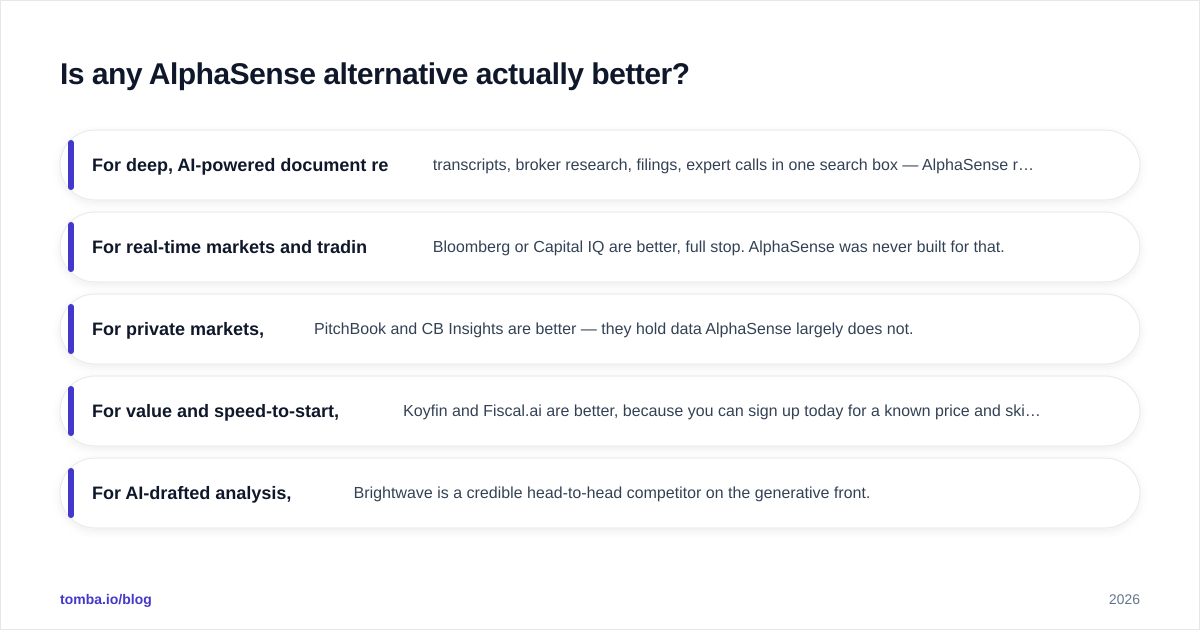
- For deep, AI-powered document research — transcripts, broker research, filings, expert calls in one search box — AlphaSense remains best in class, and most alternatives only cover a slice of that. If that workflow is your core need and budget is available, the incumbent is hard to beat.
- For real-time markets and trading, Bloomberg or Capital IQ are better, full stop. AlphaSense was never built for that.
- For private markets, PitchBook and CB Insights are better — they hold data AlphaSense largely does not.
- For value and speed-to-start, Koyfin and Fiscal.ai are better, because you can sign up today for a known price and skip the enterprise sales cycle.
- For AI-drafted analysis, Brightwave is a credible head-to-head competitor on the generative front.
So the right framing is not "what beats AlphaSense" but "what matches my use case at my budget." For many teams — especially those whose research ultimately fuels sales and outreach — the answer is a combination, not a single replacement.
How does market intelligence fit into a GTM data stack?#
Here is the gap nobody mentions in tool comparisons: market intelligence platforms are research tools, not go-to-market tools. They tell you which companies are growing, which trends matter, and what a target's filings reveal. They do not hand you the verified email of the VP you now want to talk to.
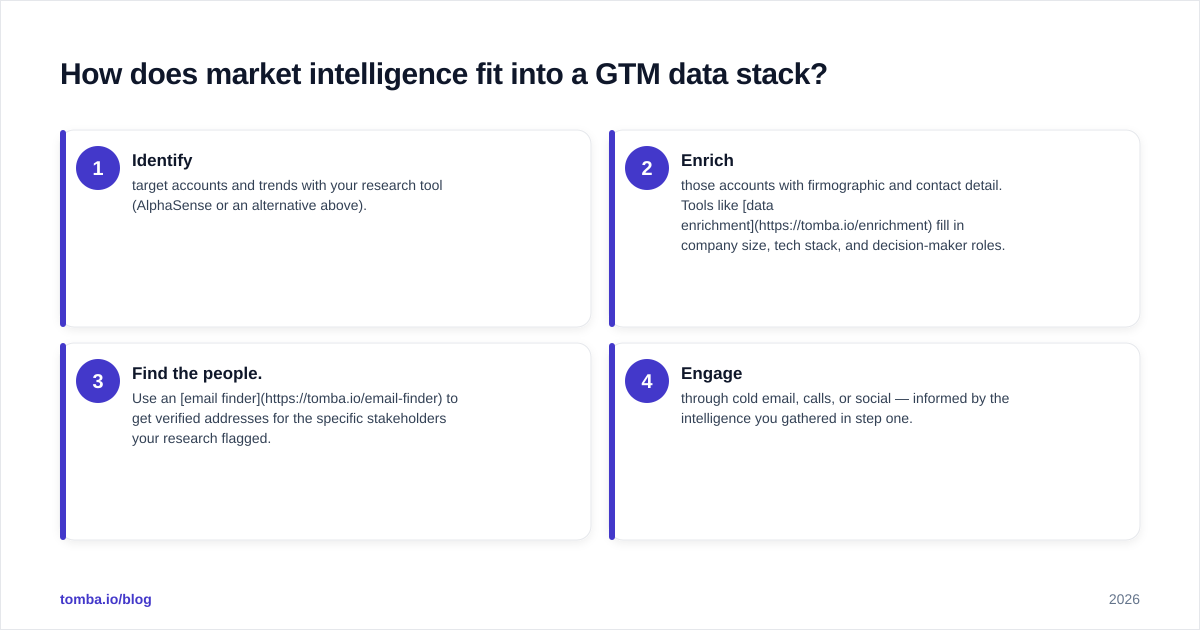
That last mile — turning a researched account into a real conversation — runs on contact data, not market data. The typical flow looks like this:
- Identify target accounts and trends with your research tool (AlphaSense or an alternative above).
- Enrich those accounts with firmographic and contact detail. Tools like data enrichment fill in company size, tech stack, and decision-maker roles.
- Find the people. Use an email finder to get verified addresses for the specific stakeholders your research flagged.
- Engage through cold email, calls, or social — informed by the intelligence you gathered in step one.
This is why pairing a research platform with a contact-data provider is so common. The intelligence tool answers "who and why"; the contact layer answers "how do I reach them." If you are building automated pipelines, both layers expose APIs — including the Tomba API — so account research and contact enrichment can run as a single workflow rather than two disconnected manual steps.
Treating these as one stack, rather than competing line items, is what separates teams that research efficiently from teams that research and act.
How to choose the right AlphaSense alternative#
Run through this short checklist before you commit:
- Define the core job. Public-document research, real-time markets, private deals, or AI summaries? Pick the category first, the tool second.
- Set a per-seat budget. If it is under a few hundred dollars a month, focus on Koyfin and Fiscal.ai. If enterprise budget exists, shortlist by data type.
- Trial before you sign. Every tool here offers a demo or free tier. Test it against three real questions you ask weekly.
- Map the contact gap. Decide now how researched accounts become outreach. Adding a contact-data layer after the fact is harder than planning for it.
- Avoid over-buying. The most common mistake is paying for an enterprise research platform to do a job a $49/month tool handles fine.
The bottom line#
AlphaSense is excellent at what it was designed for — AI-powered search across a vast research corpus — but it is enterprise-priced and narrow in focus. The best alternative depends on your actual need: Bloomberg or Capital IQ for markets, PitchBook or CB Insights for private deals, Koyfin or Fiscal.ai for affordable public-equity research, and Brightwave for AI-drafted analysis. Most growing teams end up with a stack rather than a single tool.
And whichever research platform you land on, remember that intelligence only pays off when it turns into conversations. Once you have identified the accounts and people who matter, Tomba's Email Finder gets you verified, deliverable email addresses for those decision-makers — so your market research actually reaches the inbox. Start free with 25 searches a month, and check the full Tomba pricing when you are ready to scale your outreach alongside your research.
Ready to find emails that actually work?
Join 150,000+ professionals who stopped guessing and started sending. Free credits on signup — no credit card required.
Get the Tomba newsletter
Practical outbound tactics and product updates — once every two weeks.
About the author