AlphaSense Pricing, Reviews, Pros and Cons (2026 Guide)
AlphaSense sells AI market intelligence on custom quotes that often start near five figures. Here's what it really costs, who it's for, and where it falls short.
AlphaSense is one of the most talked-about AI market intelligence platforms in finance and corporate strategy — and one of the most opaque when it comes to price. If you're evaluating it in 2026, you've probably already hit the wall: there's no public price list, the sales cycle is long, and the contract lands somewhere between "expensive" and "enterprise budget review required." This AlphaSense pricing review cuts through that.
TL;DR#
- AlphaSense uses custom, quote-only pricing. Public data points and user reports put most seats in the $10,000–$40,000+ per user, per year range, scaling with content add-ons and seat count.
- It's strong at what it does: AI search across earnings calls, broker research, filings, and expert transcripts, with genuinely useful summarization and sentiment tools.
- It's overkill for most sales and GTM teams. If you mainly need contact data, firmographics, or prospecting fuel, you're paying research-desk prices for the wrong job.
- Ratings are solid but not flawless — roughly 4.4–4.6 stars on major review sites, with cost and learning curve the most common complaints.
- Cheaper, more focused tools win for prospecting. Pair a research tool with a dedicated email finder instead of stretching one expensive platform across both jobs.
What is AlphaSense and who is it for?#
AlphaSense is an AI-powered market intelligence and search platform. Think of it as a research analyst's Google: instead of crawling the open web, it indexes a curated universe of financial and business content — earnings call transcripts, SEC filings, broker/sell-side research, news, trade journals, and a large library of expert-call transcripts (boosted by its acquisition of Tegus).
The core value is search and synthesis. You type a question — "What are semiconductor firms saying about 2026 capex?" — and it surfaces relevant snippets across thousands of documents, with AI summaries, sentiment scoring, and document-level highlights. For an equity analyst, corporate strategy team, or consultant, that compresses days of reading into minutes.
The typical buyers are:
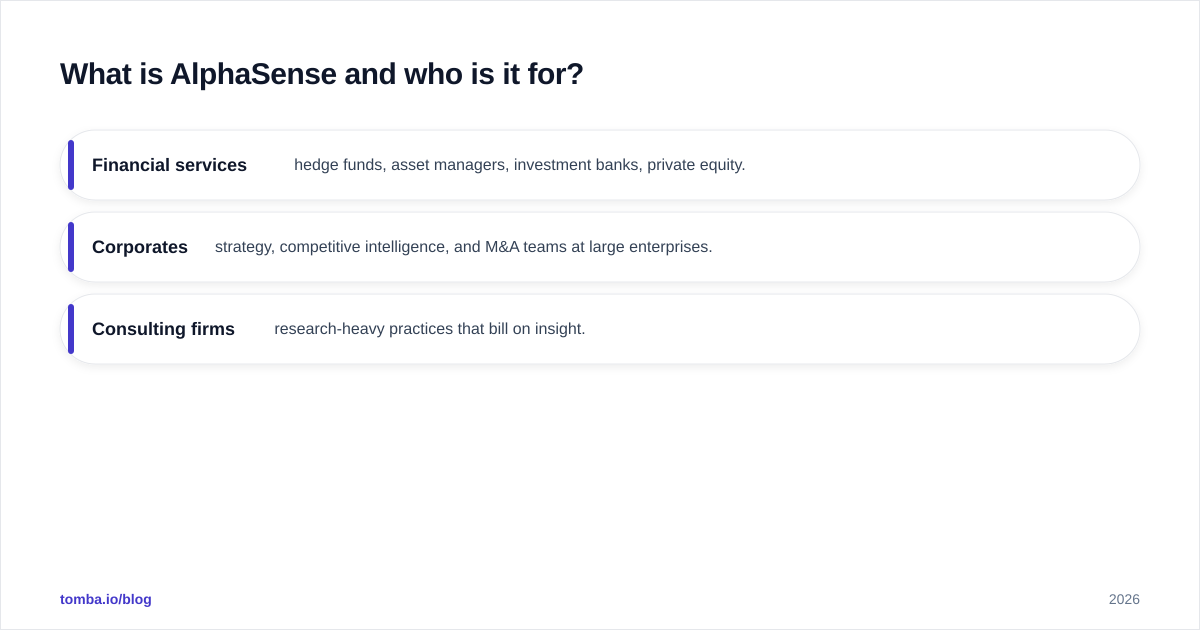
- Financial services — hedge funds, asset managers, investment banks, private equity.
- Corporates — strategy, competitive intelligence, and M&A teams at large enterprises.
- Consulting firms — research-heavy practices that bill on insight.
The common thread: these teams already spend heavily on research, and AlphaSense replaces or augments tools like Bloomberg, FactSet, or manual analyst hours. That context matters, because it explains the price.
How much does AlphaSense pricing actually cost?#
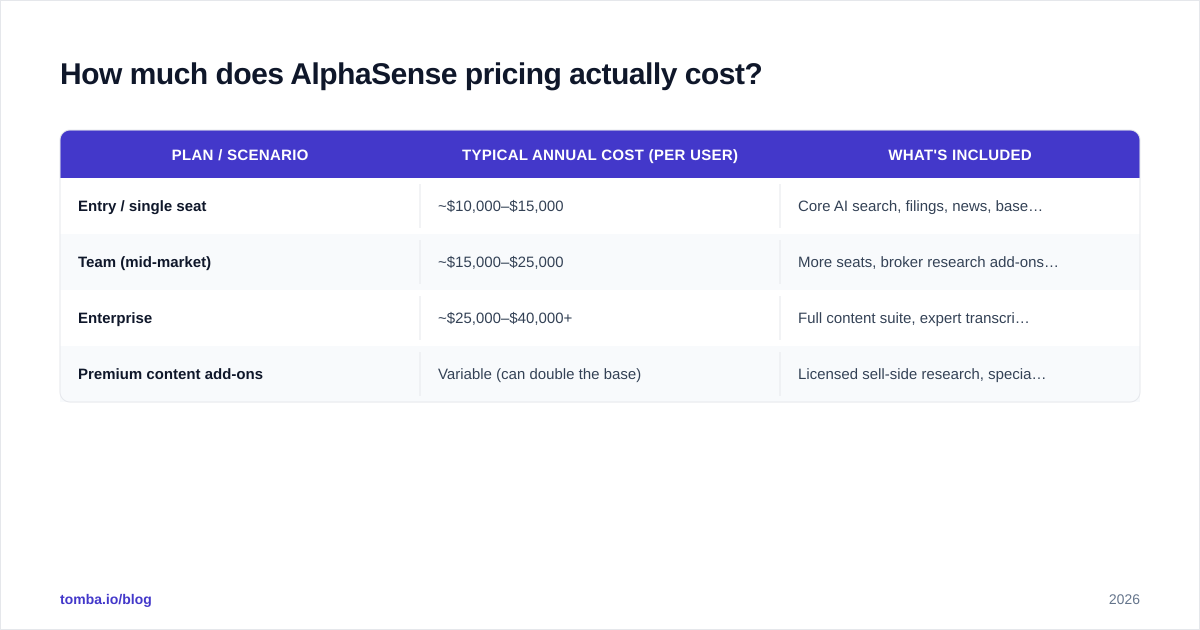
Bottom line up front: AlphaSense does not publish prices, and there is no free tier or self-serve plan. Every deal is a custom quote built around seat count, the content packages you license, and contract length.
Based on aggregated user reports, procurement disclosures, and third-party reviews, here's the realistic shape of AlphaSense pricing in 2026:
| Plan / scenario | Typical annual cost (per user) | What's included |
|---|---|---|
| Entry / single seat | ~$10,000–$15,000 | Core AI search, filings, news, base transcript library |
| Team (mid-market) | ~$15,000–$25,000 | More seats, broker research add-ons, collaboration features |
| Enterprise | ~$25,000–$40,000+ | Full content suite, expert transcripts (Tegus), API, admin controls |
| Premium content add-ons | Variable (can double the base) | Licensed sell-side research, specialized data sets |
A few things to internalize before you walk into a sales call:
- Content drives the bill. The base platform is one line item; premium broker research and expert-call libraries are separate, and they can be the bigger number.
- Seats are sold in bands. Adding a few users can push you into the next pricing tier.
- Annual contracts are standard. Month-to-month is rare; expect a 12-month minimum and pressure toward multi-year.
- Discounting exists but favors larger commitments. Small teams have the least leverage.
If transparent, flat pricing is a hard requirement for your org, this is the first place AlphaSense will frustrate you.

What do AlphaSense reviews say — the pros?#
Across G2, Capterra, and Gartner Peer Insights, AlphaSense holds roughly 4.4–4.6 out of 5. The praise is consistent and specific.
1. Search quality is the headline. Reviewers repeatedly call the semantic search and "smart synonyms" the best in class for financial content. It understands intent, not just keywords, and surfaces the relevant paragraph rather than making you read the whole filing.
2. Breadth and depth of content. One login spans filings, transcripts, news, and — with the right package — sell-side research and expert interviews. For analysts, consolidating sources into a single searchable index is the time-saver.
3. AI summaries that are actually useful. The generative summarization and "Smart Summaries" of earnings calls get cited as genuine productivity gains, not gimmicks.
4. Sentiment and trend tracking. Document- and topic-level sentiment helps teams spot shifts across a sector quickly.
5. Alerts and monitoring. Set a watch on a company or theme and get notified when new relevant content lands — useful for competitive intelligence teams.
In short: when the job is "read everything the market is saying and tell me what matters," AlphaSense delivers, and reviewers reward it for that.
What are the cons and complaints?#
No tool earns a fair review on its strengths alone. The recurring criticisms:
1. Price and price opacity. The most common complaint, by a wide margin. Teams dislike the quote-only model, the size of the number, and how fast add-ons inflate it. Smaller firms frequently conclude it's not justifiable.
2. Learning curve. The platform is powerful, which means it's dense. New users need time (and ideally onboarding) to use advanced search operators and features well.
3. Content gaps depend on your package. If you don't license premium research, you'll hit "not included" walls. The experience you saw in the demo may assume add-ons you haven't paid for.
4. Overkill for non-research jobs. Reviewers outside finance note they use a fraction of the capability. Paying analyst-desk prices for occasional lookups is poor ROI.
5. Contract rigidity. Annual commitments and limited month-to-month flexibility frustrate teams that want to trial at scale or scale down.
The pattern: AlphaSense is excellent at its core mission and expensive-to-wasteful for anything adjacent to it.
Is AlphaSense worth it for sales and GTM teams?#
Short answer: usually no — not as your primary stack. AlphaSense is a research tool, not a prospecting or pipeline tool. If your goal is to find decision-makers, enrich accounts, and run outbound, you're using a microscope to hammer a nail.
Here's the mismatch. Sales and revenue operations teams need:
- Verified contact details (email, phone, LinkedIn)
- Firmographic and technographic filters to build lists
- Data enrichment that plugs into a CRM
- Bulk workflows and an API priced for volume
AlphaSense optimizes for none of those. It tells you what the market thinks, not who to email and how to reach them. That's why the smart play is to separate the two jobs: use a market-intelligence tool for research signals, and a dedicated contact-data platform for execution.

How does AlphaSense compare to alternatives?#
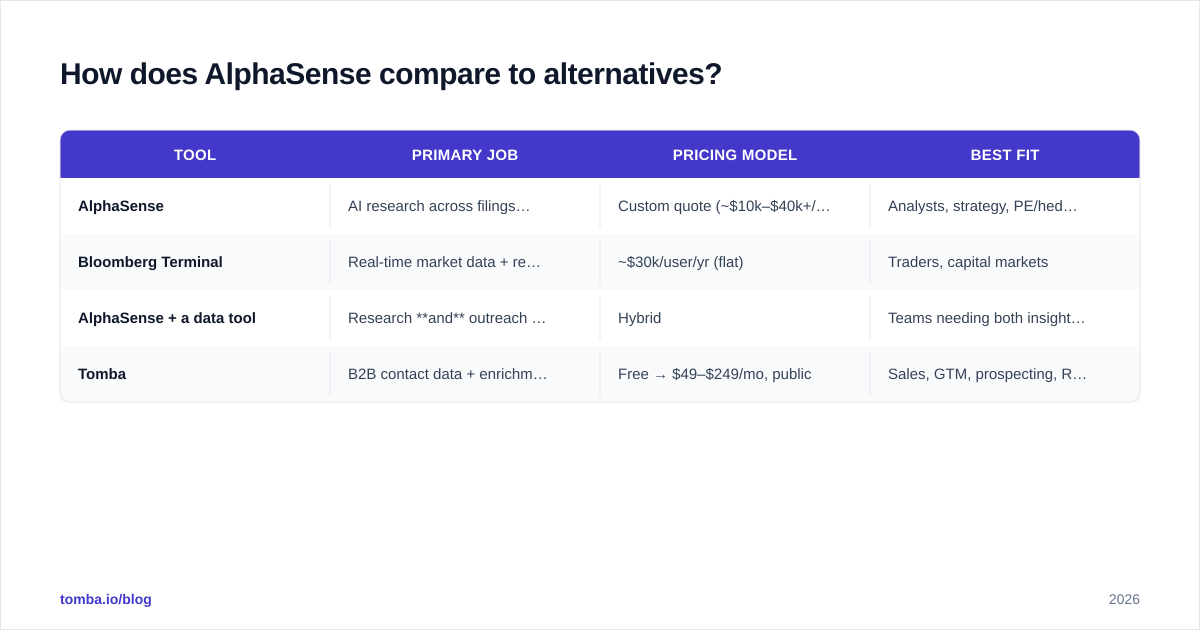
The right alternative depends on which job you're actually buying for. AlphaSense competes with research terminals on one axis and gets wrongly compared to data tools on another.
| Tool | Primary job | Pricing model | Best fit |
|---|---|---|---|
| AlphaSense | AI research across filings, transcripts, research | Custom quote (~$10k–$40k+/user/yr) | Analysts, strategy, PE/hedge funds |
| Bloomberg Terminal | Real-time market data + research | ~$30k/user/yr (flat) | Traders, capital markets |
| AlphaSense + a data tool | Research and outreach split | Hybrid | Teams needing both insight and contacts |
| Tomba | B2B contact data + enrichment | Free → $49–$249/mo, public | Sales, GTM, prospecting, RevOps |
The takeaway isn't "AlphaSense vs Tomba" — they solve different problems. It's that many teams think they need an all-in-one and overspend on a research platform to do prospecting work it was never built for. A focused stack costs less and performs each job better.
If you're a research desk, AlphaSense earns its place. If you're a go-to-market team, your money goes further on a transparent contact-data tool plus, optionally, a lighter research subscription.
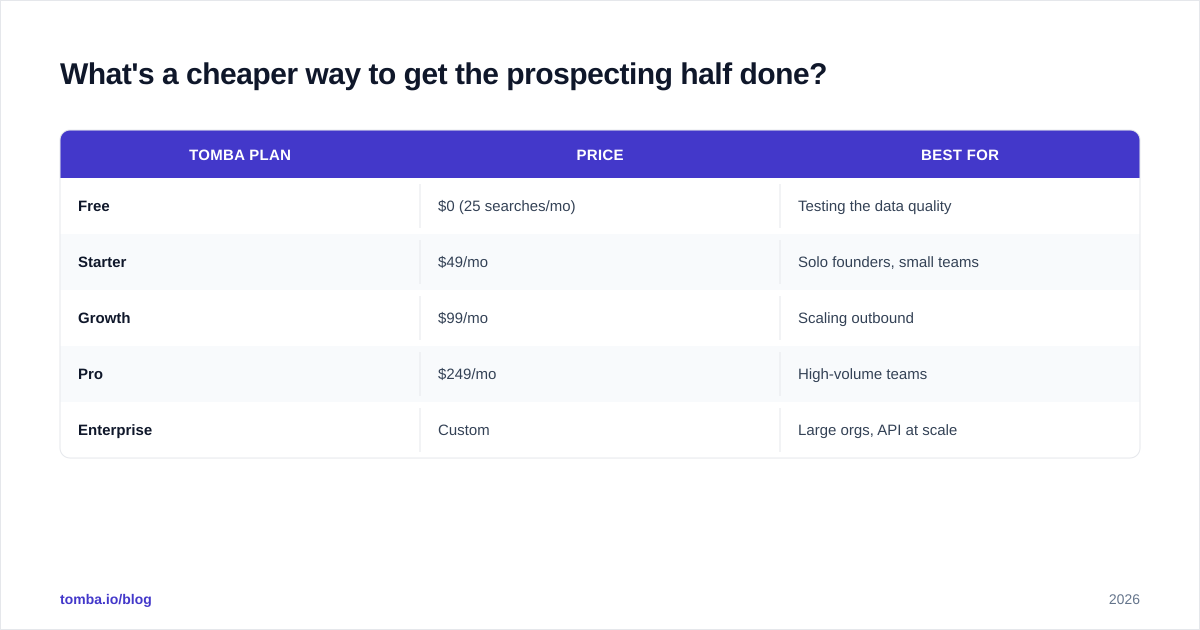
What's a cheaper way to get the prospecting half done?#
If the prospecting and contact-data piece is what you actually need day to day, you don't need a five-figure research contract — you need accurate, affordable contact discovery.
That's where Tomba fits. Compared to AlphaSense's opaque quote, Tomba pricing is public and predictable:
| Tomba plan | Price | Best for |
|---|---|---|
| Free | $0 (25 searches/mo) | Testing the data quality |
| Starter | $49/mo | Solo founders, small teams |
| Growth | $99/mo | Scaling outbound |
| Pro | $249/mo | High-volume teams |
| Enterprise | Custom | Large orgs, API at scale |
With Tomba you can run a domain search to pull every reachable contact at a target company, verify deliverability before you send, and push enriched records into your CRM. You can also tap the B2B database and the email finder API for programmatic workflows. For the cost of a fraction of one AlphaSense seat, an entire GTM team can prospect, verify, and enrich all year.
The combination most efficient teams land on: keep (or trial) a research tool for market signals if your work genuinely demands it, and run a transparent contact-data platform for the find-and-reach motion. Don't pay research-terminal prices to do prospecting.
The verdict on AlphaSense pricing#
AlphaSense is a genuinely strong AI market intelligence platform — the search quality, content breadth, and summarization are why it commands premium pricing and earns 4.4–4.6 star reviews. If you're a hedge fund, PE firm, consultancy, or corporate strategy team that lives in earnings calls and broker research, it can pay for itself in analyst hours saved.
But the pricing is high, opaque, and quote-only, with content add-ons that inflate the bill fast. For sales, RevOps, and general B2B teams, it's the wrong tool for the dominant job — and a costly one.
Match the tool to the job. If yours is finding and reaching the right people, skip the five-figure research contract and start with the Tomba Email Finder — find verified professional emails by domain, name, or company, on a free tier today and predictable plans from $49/mo. Run a few searches, check the accuracy yourself, and let your research budget go to research.
Ready to find emails that actually work?
Join 150,000+ professionals who stopped guessing and started sending. Free credits on signup — no credit card required.
Get the Tomba newsletter
Practical outbound tactics and product updates — once every two weeks.
About the author