Alternative Close: The 2026 Guide to Closing More Deals
The alternative close gives buyers two yes-options instead of one yes/no. Here's how the technique works, when to use it, and how it stacks up against other closes in 2026.
TL;DR
- The alternative close (also called the "either/or" or assumptive choice close) gives the buyer two affirmative options instead of a single yes-or-no decision — moving the conversation from whether to buy to how to buy.
- It works because it narrows decision fatigue and quietly assumes the sale, without the pressure of a hard close.
- Best used late in the cycle, after value is established and the prospect has signaled intent. Used too early, it backfires.
- It outperforms the blunt "So, are you in?" close on response and is gentler than the urgency or hard close — but it is weaker than a value-summary close for complex, multi-stakeholder deals.
- Pair it with clean pipeline hygiene and accurate contact data so the reps you train are closing real, reachable buyers — not chasing dead leads.
What is the alternative close?#
The alternative close is a closing technique where you offer the prospect a choice between two options, both of which assume the deal moves forward. Instead of asking "Do you want to buy?", you ask "Do you want to start with the monthly or the annual plan?" Either answer is a commitment.
Think of it like a waiter who doesn't ask "Do you want dessert?" but instead asks "Would you like the cheesecake or the tiramisu?" The question quietly skips past the if and lands the customer on the which. The decision feels smaller, friendlier, and easier to say yes to — because there is no explicit "no" sitting on the table.
This is one of the oldest moves in consultative selling, and it endures because it respects how people actually decide. Behavioral research consistently shows that fewer, framed choices reduce decision paralysis. The alternative close uses that principle on purpose.
It is worth being precise about what the alternative close is not. It is not a manipulation trick that forces a purchase. If the prospect isn't sold on value, two options just give them two things to decline. The technique assumes you've already done the hard work — discovery, qualification, and a clear value case. The close is the last 5%, not the whole sale.
How does the alternative close actually work?#
The mechanics are simple, but the timing and phrasing carry all the weight. A clean alternative close has three moving parts:
- A confirmed value position. The prospect has acknowledged a problem and agreed your solution fits. You've earned the right to ask.
- Two forward-moving options. Both choices presume the deal happens. Neither is "no."
- A calm, assumptive tone. You ask the question and then you stop talking. Silence does the closing.
Here's the shape of it in practice:
"It sounds like the Growth plan covers everything your team flagged. Would you like to kick off with a January 1 start date, or would early December give your ops team more runway?"
Notice what just happened. The rep didn't ask whether to buy. They asked when. The buyer's brain is now solving a scheduling problem, not a purchasing one — and answering either way confirms the sale.
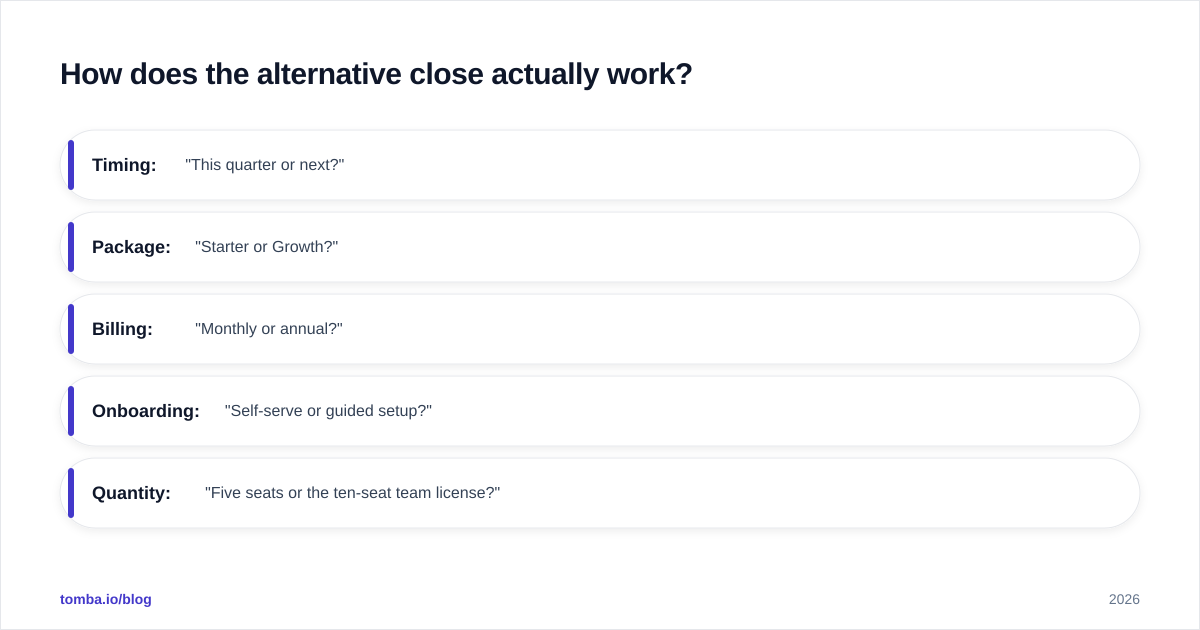
The two options should be roughly equivalent in value to you. Don't offer a "good" option and a "bad" one; offer two genuinely fine paths. Common axes for the two choices:
- Timing: "This quarter or next?"
- Package: "Starter or Growth?"
- Billing: "Monthly or annual?"
- Onboarding: "Self-serve or guided setup?"
- Quantity: "Five seats or the ten-seat team license?"
The most common failure is offering the choice before the prospect is ready. If you alternative-close someone who still has unresolved objections, you'll hear "Neither, actually — I'm not sure this is right for us." That's not the technique failing; that's the technique surfacing that you skipped a step. Treat a rejected alternative close as a signal to return to discovery, not to push harder.
When should you use the alternative close (and when not)?#
Use it when intent is high and the decision is relatively contained. It shines in transactional and mid-market deals where one or two people make the call and the value is already clear. It's also excellent on the phone, where you want to keep momentum and avoid the dead air of an open-ended ask. If you run a lot of cold calling and live demos, the alternative close belongs in your toolkit.
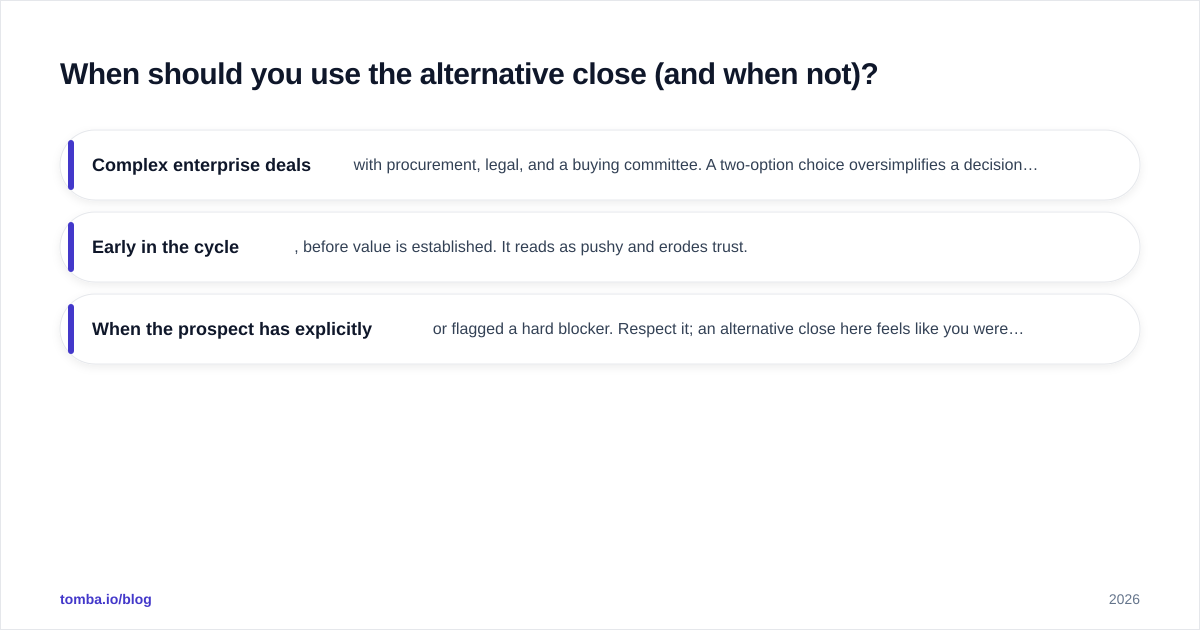
Avoid it — or use it very carefully — in these situations:
- Complex enterprise deals with procurement, legal, and a buying committee. A two-option choice oversimplifies a decision that genuinely has many moving parts, and sophisticated buyers notice the technique.
- Early in the cycle, before value is established. It reads as pushy and erodes trust.
- When the prospect has explicitly asked for time or flagged a hard blocker. Respect it; an alternative close here feels like you weren't listening.
A useful rule of thumb: the alternative close scales down well and scales up poorly. The smaller and faster the deal, the better it performs.
Alternative close vs other closing techniques#
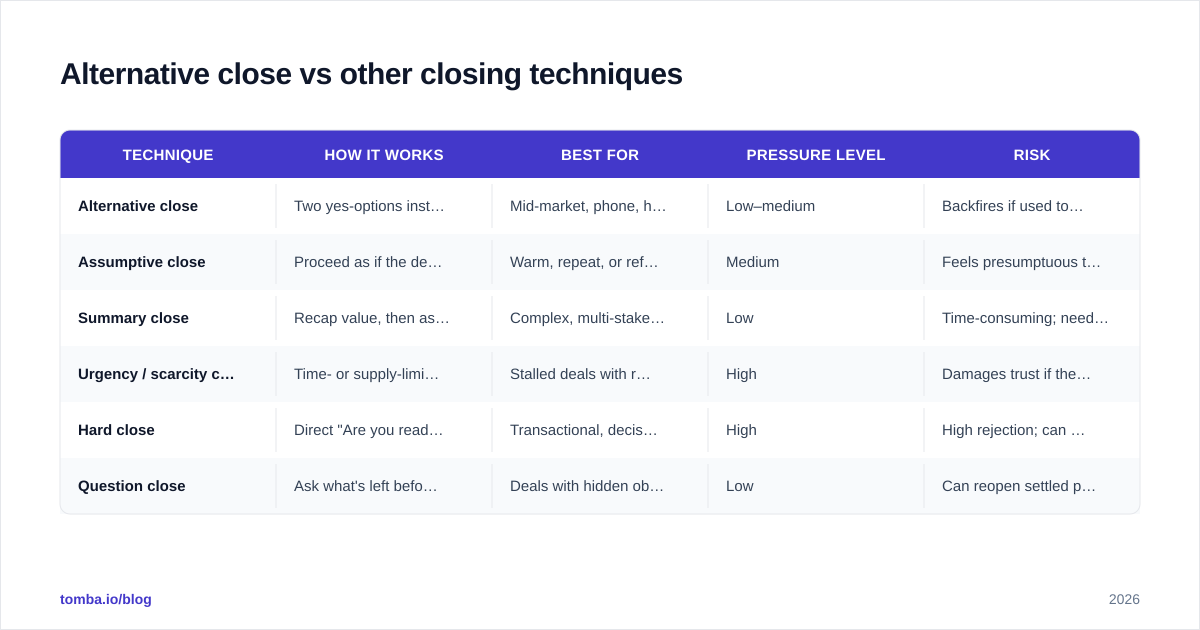
No single close wins every deal. The alternative close is one option on a spectrum that runs from soft to hard. Here's how it compares to the closes most reps actually use in 2026.
| Technique | How it works | Best for | Pressure level | Risk |
|---|---|---|---|---|
| Alternative close | Two yes-options instead of yes/no | Mid-market, phone, high intent | Low–medium | Backfires if used too early |
| Assumptive close | Proceed as if the deal is done ("I'll send the contract") | Warm, repeat, or referred buyers | Medium | Feels presumptuous to cautious buyers |
| Summary close | Recap value, then ask for the business | Complex, multi-stakeholder deals | Low | Time-consuming; needs strong discovery |
| Urgency / scarcity close | Time- or supply-limited incentive | Stalled deals with real deadlines | High | Damages trust if the urgency is fake |
| Hard close | Direct "Are you ready to sign today?" | Transactional, decisive buyers | High | High rejection; can sour relationships |
| Question close | Ask what's left before they'd commit | Deals with hidden objections | Low | Can reopen settled points |
The honest takeaway: the alternative close is a low-friction default for deals where you've earned intent and want to remove the last bit of decision drag. For high-stakes, multi-person purchases, lead with a summary close and use the alternative close only on the final scheduling or packaging detail.
Top sales orgs don't pick one close and stop. As HubSpot's sales research and practitioner guides repeatedly note, the best reps read the buyer and switch techniques mid-conversation. The alternative close is most powerful as the finisher after another technique has done the heavy lifting.
What does a great alternative close script look like?#
Scripts aren't meant to be read word-for-word — they're scaffolding. Internalize the pattern, then make it sound like you. Here are field-tested patterns by scenario.
SaaS demo wrap-up:
"Based on what you've seen, this solves the reporting gap your team raised. Do you want to start on the Growth plan, or would the Pro tier make more sense given the headcount you're adding next quarter?"
Phone close after a strong discovery call:
"Makes sense. Should I set up the pilot for your East Coast team first, or would you rather roll it out company-wide from day one?"
Renewal or upsell:
"We can keep your current seats and add the analytics module, or move you to the bundle that includes it at a lower per-seat rate. Which fits your budget cycle better?"
Scheduling the next concrete step (a "micro" alternative close):
"Would Thursday at 10 or Friday at 2 work better to get the contract reviewed with your ops lead?"
That last one is the most underused version. Even when you can't close the whole deal, you can alternative-close the next step — which keeps deals moving and is the single biggest lever on your sales win rate. A pipeline dies in the gaps between steps; the micro alternative close removes the gaps.
One caution on delivery: after you ask, stop. The most common rookie mistake is asking the alternative-close question and then immediately filling the silence with a third option, a discount, or a nervous justification. Ask, then wait. The pause is where the commitment forms.
How do you train a team to use it without sounding scripted?#
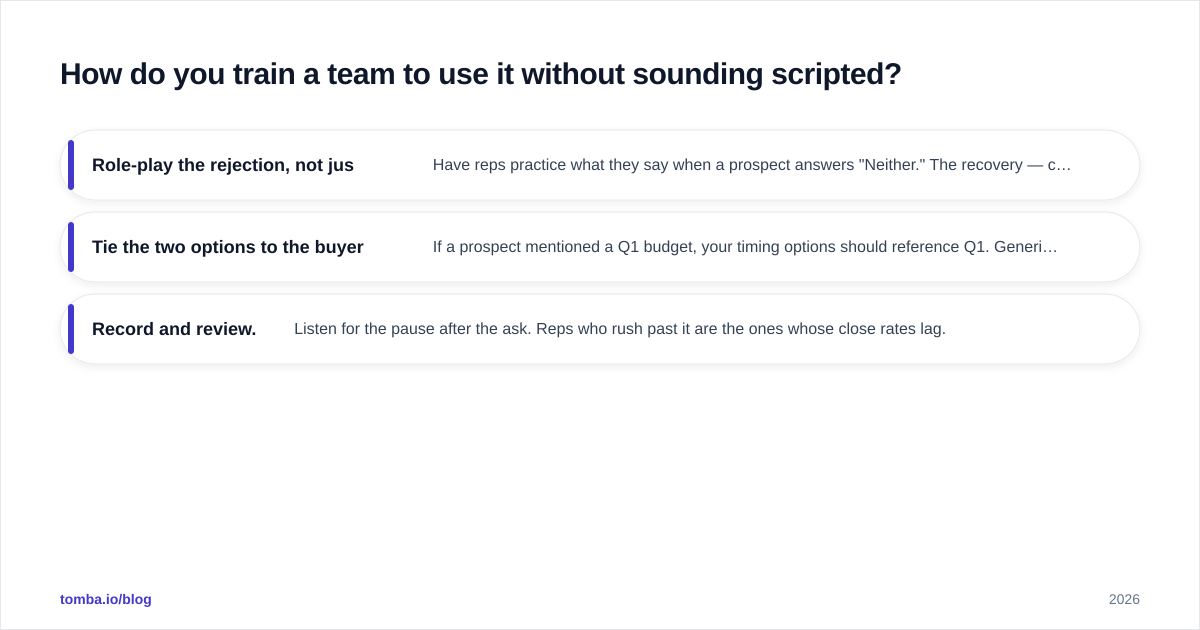
The alternative close fails when it sounds like a technique. Buyers in 2026 have sat through thousands of sales calls; a robotic "Would you like option A or option B?" triggers their defenses. Train for naturalness, not memorization.
Three coaching moves that work:
- Role-play the rejection, not just the win. Have reps practice what they say when a prospect answers "Neither." The recovery — calmly returning to discovery — is what separates pros from script-readers.
- Tie the two options to the buyer's own words. If a prospect mentioned a Q1 budget, your timing options should reference Q1. Generic options feel canned; specific ones feel consultative.
- Record and review. Listen for the pause after the ask. Reps who rush past it are the ones whose close rates lag.
It also helps to anchor closing technique inside a healthy sales process and pipeline. A great close on a badly qualified deal is wasted effort. The reps who close the most aren't necessarily the smoothest talkers — they're the ones working a clean pipeline of well-qualified, reachable buyers. That's a data problem as much as a skills problem.
According to Gartner's sales research, buyers spend the majority of their journey not talking to sales reps, which means the conversations you do get are precious. Don't burn them on bad-fit prospects. Closing technique compounds only when it sits on top of solid targeting and accurate contact data.
Common mistakes that kill the alternative close#
Even seasoned reps trip on the same handful of errors:
- Closing before value lands. The single biggest mistake. No amount of clever phrasing closes an unconvinced buyer.
- Offering a fake choice. If one option is obviously worse, buyers feel manipulated and trust drops.
- Stacking too many options. "Monthly, annual, quarterly, or biennial?" is not an alternative close — it's a menu, and menus cause paralysis. Two options. Always two.
- Talking past the silence. Filling the pause signals you don't believe in the close.
- Using it on every deal. Over-reliance makes you predictable. Vary your closes to match the buyer.
Avoid these and the technique quietly becomes one of the highest-ROI habits in your sales motion — low effort, no extra tooling, measurable lift on close rates.
Where does the alternative close fit in your 2026 sales stack?#
The alternative close is a finishing move, not a strategy. It belongs at the end of a well-run process, after discovery, qualification, and a clear value case. Treat it as the gentle nudge that converts a "probably" into a confirmed start date — and reserve heavier closes for the deals that genuinely need them.
But the best closing technique in the world can't save a pipeline full of wrong numbers and dead inboxes. If your reps are spending their day chasing contacts who never pick up, no amount of "Thursday or Friday?" will move the needle. Closing skill multiplies the value of every conversation — so make sure every conversation is with a real, reachable, well-fit buyer.
That's where your data foundation earns its keep. Use the Tomba Email Finder to put verified, accurate decision-maker contacts in front of your reps before they ever pick up the phone. Feed your team a clean list of qualified buyers, train them on the alternative close, and watch the "maybes" turn into start dates. Check Tomba pricing — there's a free tier with 25 searches a month to test it on your next batch of prospects before you commit.
// get started
Find, verify and enrich your first contacts today
Start on the free plan with 25 searches a month, then scale when your team is ready.
Free plan · No credit card required · GDPR & CCPA
// about the author