7 Best Altify Alternatives for Account Planning in 2026
Altify is powerful but heavy and Salesforce-locked. Here are the 7 best Altify alternatives for account planning, opportunity management, and relationship mapping in 2026 — with pricing and fit.
Altify built its reputation on one promise: turn account planning, relationship mapping, and opportunity management into a repeatable methodology inside Salesforce. It does that well. But "well" comes with trade-offs — deep Salesforce dependency, enterprise pricing, and a learning curve that can stall adoption with reps who just want to sell.
If you are evaluating Altify alternatives in 2026, you are probably weighing one of three things: cost, CRM flexibility, or how much process your team will actually adopt. This guide breaks down the seven strongest options, what each is genuinely good at, and how to pick the one that fits your motion.
TL;DR#
- Altify (now part of Upland) is best for large, Salesforce-committed enterprises that want formal account-planning and relationship-mapping methodology baked into the CRM.
- Membrain is the strongest alternative for complex B2B sales that need process guidance without forcing everyone onto Salesforce.
- DealHub wins if your real bottleneck is quoting, deal rooms, and revenue workflow rather than account mapping.
- Revenue Grid, Salesforce native (Sales Cloud + Maps), Prolifiq, and Kapta each cover a slice of what Altify does — usually cheaper or lighter.
- Whatever platform you choose, account plans are only as good as the contact data behind them. Mapping a buying committee you can't reach is busywork.
What is Altify and why look for alternatives?#
Altify is a sales effectiveness platform that lives inside Salesforce. Its core modules cover account planning, opportunity management ("Opportunity Manager"), and relationship maps that visualize the buying committee — who has influence, who is a blocker, and where you have coverage. It was acquired by Upland Software and is sold as part of their enterprise sales stack.
It is a serious tool for serious deals. So why do teams shop around?
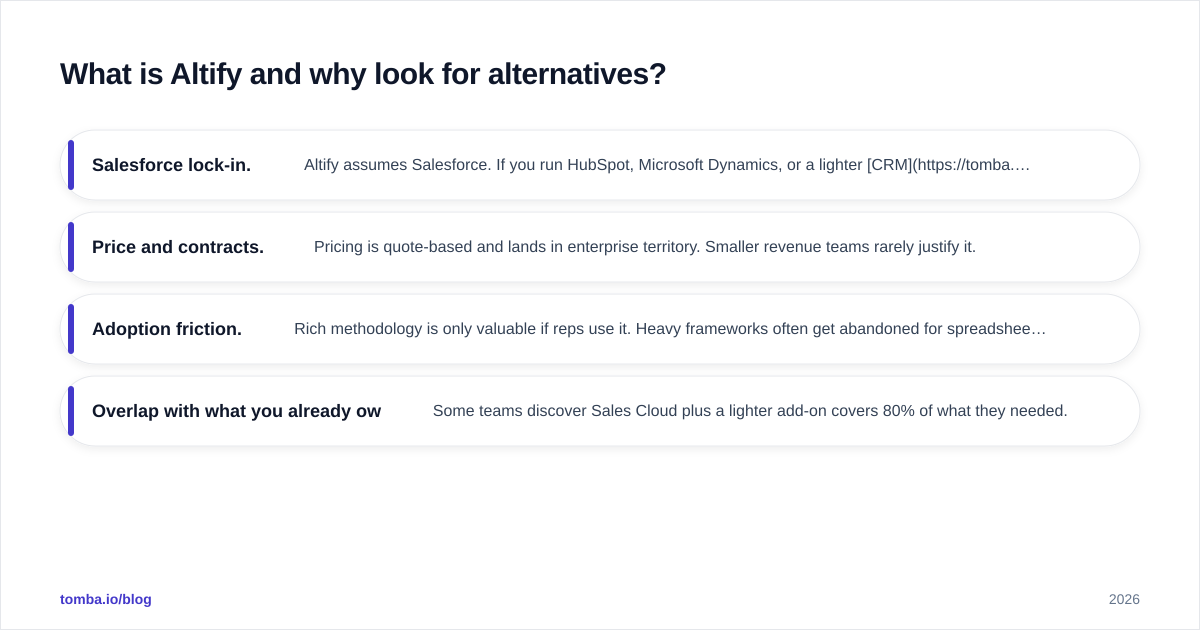
- Salesforce lock-in. Altify assumes Salesforce. If you run HubSpot, Microsoft Dynamics, or a lighter CRM, it is a non-starter or a forced migration.
- Price and contracts. Pricing is quote-based and lands in enterprise territory. Smaller revenue teams rarely justify it.
- Adoption friction. Rich methodology is only valuable if reps use it. Heavy frameworks often get abandoned for spreadsheets and sticky notes.
- Overlap with what you already own. Some teams discover Sales Cloud plus a lighter add-on covers 80% of what they needed.
What should you look for in an Altify alternative?#
Before comparing logos, get specific about which job you are hiring the tool to do. Most "account planning" platforms are actually three different products wearing the same label.
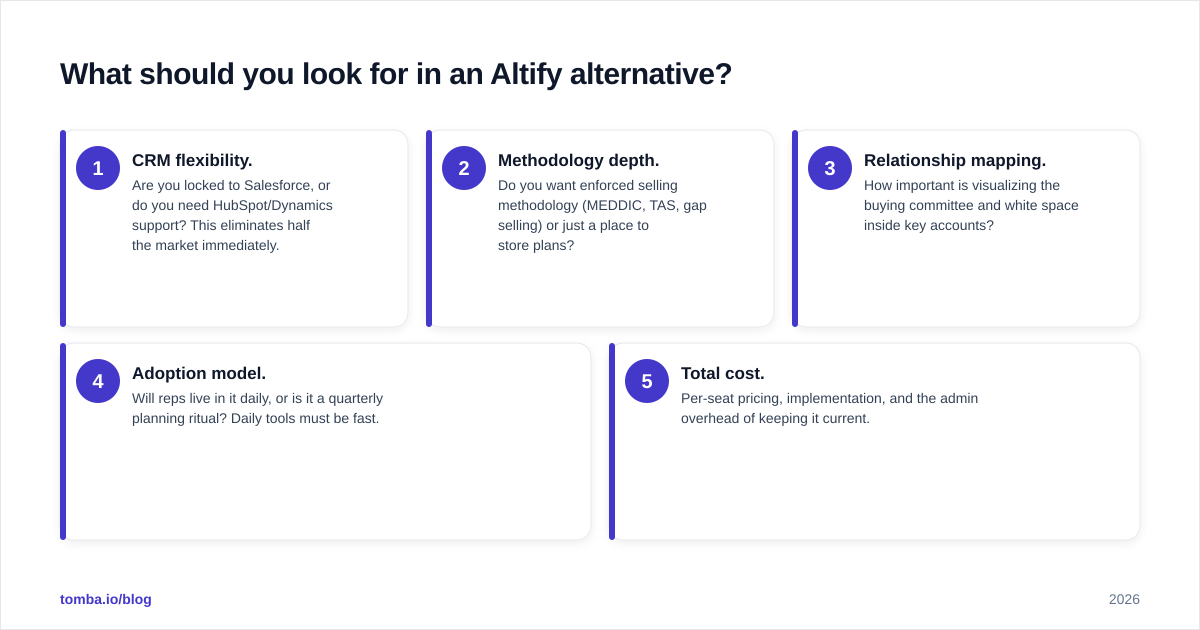
Use these five criteria to filter the field:
- CRM flexibility. Are you locked to Salesforce, or do you need HubSpot/Dynamics support? This eliminates half the market immediately.
- Methodology depth. Do you want enforced selling methodology (MEDDIC, TAS, gap selling) or just a place to store plans?
- Relationship mapping. How important is visualizing the buying committee and white space inside key accounts?
- Adoption model. Will reps live in it daily, or is it a quarterly planning ritual? Daily tools must be fast.
- Total cost. Per-seat pricing, implementation, and the admin overhead of keeping it current.
If your honest answer to "methodology depth" is low and "CRM flexibility" is high, you do not need Altify at all — you need a lighter tool. That realization alone saves most teams money.
What are the 7 best Altify alternatives in 2026?#
Here is the shortlist, with the specific scenario each one wins.
1. Membrain#
The closest philosophical match to Altify, and the best pick for complex B2B sales that want methodology without Salesforce. Membrain combines CRM, process guidance, account growth planning, and coaching analytics in one platform. Reps get prescriptive next steps tied to your actual sales process, and managers get visibility into where deals stall. It is CRM-agnostic in the sense that it can be your CRM, which removes the Salesforce dependency entirely.
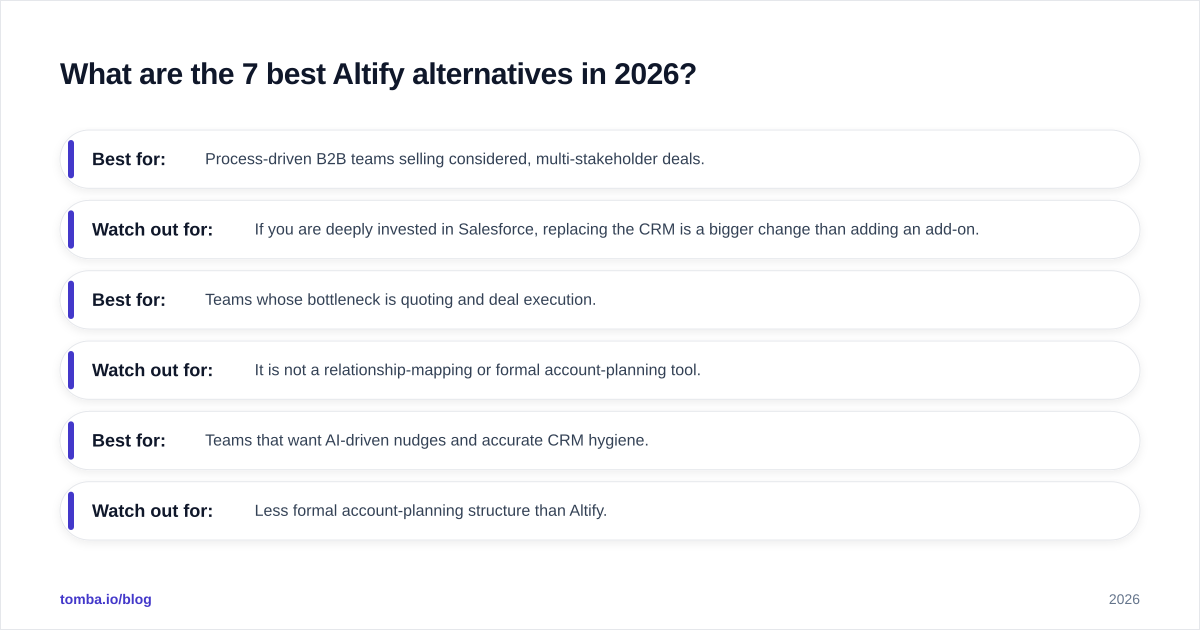
- Best for: Process-driven B2B teams selling considered, multi-stakeholder deals.
- Watch out for: If you are deeply invested in Salesforce, replacing the CRM is a bigger change than adding an add-on.
2. DealHub#
DealHub reframes the problem. Instead of mapping accounts, it focuses on the revenue workflow — CPQ, quotes, contracts, and digital DealRooms where buyers and sellers collaborate. If your friction is "deals stall in quoting and approvals," not "we don't understand the buying committee," DealHub is a better spend than Altify. It integrates with Salesforce, HubSpot, and Dynamics.
- Best for: Teams whose bottleneck is quoting and deal execution.
- Watch out for: It is not a relationship-mapping or formal account-planning tool.
3. Revenue Grid#
Revenue Grid leans into guided selling and revenue intelligence — signals that tell reps what to do next based on real engagement data captured from email and calendar. It overlaps with Altify's "guidance" angle but is lighter and more automation-driven, with strong activity capture.
- Best for: Teams that want AI-driven nudges and accurate CRM hygiene.
- Watch out for: Less formal account-planning structure than Altify.
4. Salesforce native (Sales Cloud + Maps)#
Sometimes the best Altify alternative is the CRM you already pay for. Between Sales Cloud account and opportunity objects, Salesforce Maps for territory and relationship visualization, and custom plan objects, many teams replicate the essentials without a third-party contract.
- Best for: Salesforce shops with strong admin resources and modest methodology needs.
- Watch out for: You build and maintain the structure yourself; no built-in methodology.
5. Prolifiq#
A native Salesforce app focused squarely on account planning and relationship mapping at a lighter weight than Altify. If you like the Altify concept but want something simpler and less expensive that still lives in Salesforce, Prolifiq is the direct comparison to run.
- Best for: Salesforce teams that want account plans without the enterprise overhead.
- Watch out for: Narrower scope than Altify's full suite.
6. Kapta#
Kapta is built for key account management and customer success, not net-new sales. It centers on account plans, voice-of-customer, and measurable outcomes for your most important existing relationships. If "account planning" to you means growing and retaining strategic accounts, Kapta fits better than a sales-cycle tool.
- Best for: KAM and post-sale account growth teams.
- Watch out for: Not designed for top-of-funnel opportunity management.
7. Salesforce-adjacent revenue intelligence (Gong, Clari)#
For some teams, the "account planning" gap is really a forecasting and deal-risk gap. Revenue intelligence platforms surface which deals are real and which are slipping. They do not map buying committees the way Altify does, but they answer the question executives actually ask: "Will we hit the number?"
- Best for: RevOps and leadership focused on forecast accuracy.
- Watch out for: Complementary to account planning, not a replacement.
How do the top Altify alternatives compare?#
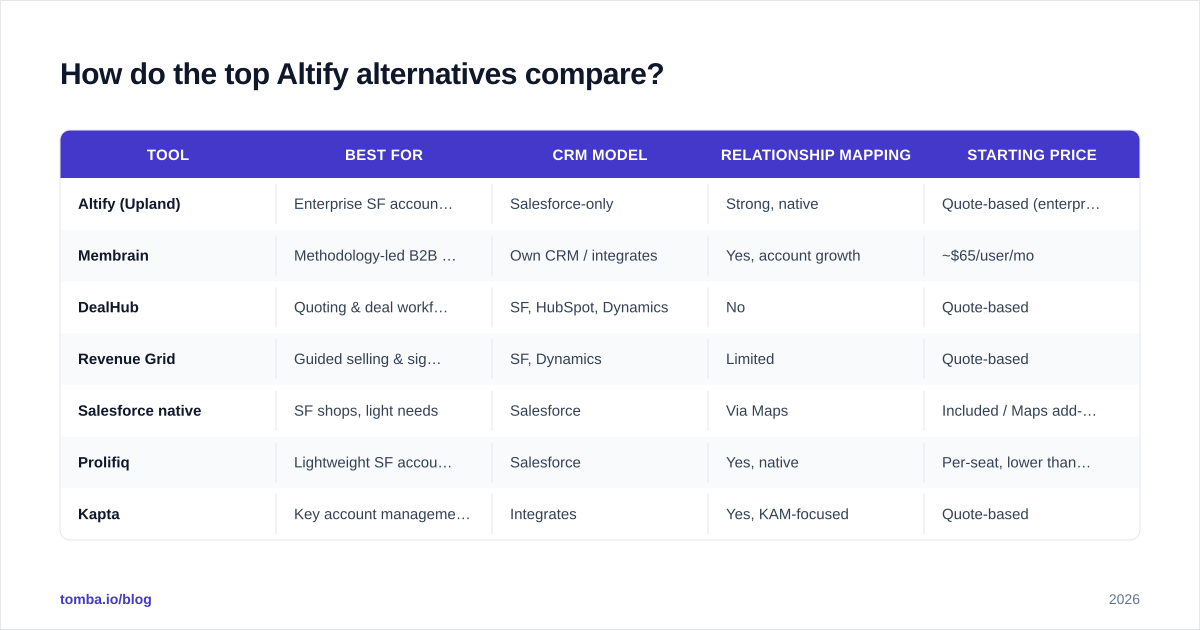
| Tool | Best for | CRM model | Relationship mapping | Starting price |
|---|---|---|---|---|
| Altify (Upland) | Enterprise SF account planning | Salesforce-only | Strong, native | Quote-based (enterprise) |
| Membrain | Methodology-led B2B sales | Own CRM / integrates | Yes, account growth | ~$65/user/mo |
| DealHub | Quoting & deal workflow | SF, HubSpot, Dynamics | No | Quote-based |
| Revenue Grid | Guided selling & signals | SF, Dynamics | Limited | Quote-based |
| Salesforce native | SF shops, light needs | Salesforce | Via Maps | Included / Maps add-on |
| Prolifiq | Lightweight SF account plans | Salesforce | Yes, native | Per-seat, lower than Altify |
| Kapta | Key account management | Integrates | Yes, KAM-focused | Quote-based |
Pricing for most enterprise sales tools is gated behind a sales call, so treat the figures above as directional. Always validate current numbers and read recent reviews on G2 before committing — categories and capabilities shift fast in this space.
Which Altify alternative is right for you?#
Match the tool to your actual constraint, not the feature list:
- You must leave Salesforce or run multiple CRMs → Membrain.
- Deals die in quoting and approvals → DealHub.
- You want Altify-style plans but cheaper and inside Salesforce → Prolifiq.
- You already pay for Salesforce and have admin capacity → Sales Cloud + Maps.
- Your priority is retaining and growing strategic accounts → Kapta.
- Leadership wants forecast confidence → a revenue intelligence layer like Gong or Clari.

The most common mistake is buying for methodology when the real problem is data. A beautiful relationship map of a 9-person buying committee is worthless if you have verified contact details for only three of them.
How does contact data fit into account planning?#
Every account plan rests on a list of stakeholders — economic buyer, champion, technical evaluator, blocker. The plan is only actionable if you can actually reach those people. This is where most account-planning rollouts quietly break: reps map the org chart, then can't find current emails or direct phone numbers for half the committee.
That gap is fixable. Once you have identified the named stakeholders in an account, you can find their professional email addresses by name and company domain, then push verified records into your CRM. Pairing an account-planning platform with reliable contact enrichment keeps your relationship maps connected to people you can email today, not titles in a diagram. If your team runs Salesforce, a direct Salesforce integration means enriched contacts land where your plans already live, and clean data lifts your win rate by making sure outreach reaches the right inbox.
Frequently asked questions#
Is Altify still around in 2026? Yes. Altify is sold as part of Upland Software's sales effectiveness suite. It remains a Salesforce-native enterprise product.
What is the cheapest Altify alternative? For most teams it is using Salesforce native objects plus Maps, since you already pay for the CRM. Among dedicated tools, Prolifiq and Membrain tend to undercut enterprise account-planning contracts.
Do any Altify alternatives work without Salesforce? Yes. Membrain can serve as your CRM, and DealHub and Kapta integrate with HubSpot and Dynamics in addition to Salesforce.
Are these tools email finders? No. They are account-planning and sales-process platforms. Finding and verifying the contact data for the stakeholders in your plans is a separate, complementary job.
The bottom line#
Altify is a strong product for the narrow case it serves: large, Salesforce-committed enterprises that want enforced account-planning methodology. For everyone else, one of these seven Altify alternatives will be lighter, cheaper, or more flexible — usually some combination of the three. Decide which single problem you are solving first, then pick the tool that solves that, not the one with the longest feature list.
And before you operationalize any plan, make the contacts real. Use Tomba Email Finder to find and verify professional emails for every stakeholder you map — by name, company, or domain — so your account plans turn into conversations instead of org charts. Start free with 25 searches a month, then scale on a plan that fits your team. See current Tomba pricing to match it to your pipeline.
Ready to find emails that actually work?
Join 150,000+ professionals who stopped guessing and started sending. Free credits on signup — no credit card required.
Get the Tomba newsletter
Practical outbound tactics and product updates — once every two weeks.
About the author