Altify Pricing, Reviews, Pros and Cons: 2026 Buyer's Guide
Altify promises Salesforce-native account planning and relationship maps — but is it worth the enterprise price tag? A neutral 2026 breakdown of pricing, reviews, pros, and cons.
Altify makes a simple promise. It turns account planning, relationship mapping, and deal management into a repeatable system inside Salesforce. The harder question is whether that promise is worth an enterprise contract you can't price from the website. Most buyers need that answer first. This guide breaks down Altify pricing, reviews, pros and cons in plain terms, so you can decide before you sit through a demo.
TL;DR#
- Altify (now Upland Altify) is a Salesforce-native suite for account planning, relationship mapping, and opportunity management aimed at mid-market and enterprise revenue teams.
- Pricing is quote-only. There is no public price and no free tier. Expect annual, per-user contracts that land in the enterprise bracket — typically far above point tools.
- Reviews are solid but mixed: roughly 4.2/5 on G2. Praise for methodology and Salesforce depth; complaints about cost, UI friction, and adoption effort.
- Best fit: complex, multi-stakeholder B2B deals where a structured selling methodology already exists or is being rolled out.
- Weak fit: SMBs, transactional sales, or teams that don't run on Salesforce — the value collapses without it.
What is Altify and who is it for?#
Altify is a sales effectiveness platform built natively on Salesforce. It started as TAS Group, rebranded to Altify, and is now part of Upland Software as Upland Altify. Unlike a CRM, it doesn't store your pipeline. Instead, it sits on top of Salesforce and adds structure to how your reps work large, complex accounts.
The suite has four core modules:
- Account Planning — whitespace maps, revenue goals, and action plans per strategic account.
- Relationship Map — visual org charts showing power, influence, and where you have (or lack) coverage.
- Opportunity Management — a guided framework (competitive position, decision criteria, close plans) closer to MEDDIC than a stage dropdown.
- Sales Process Manager — embeds your playbook and methodology into the opportunity record.
The target buyer is a VP of Sales, an enablement leader, or a RevOps team. These companies run six-figure, multi-threaded deals. If your average deal closes in two calls, this is not your tool.
How much does Altify cost in 2026?#
Short answer: Altify does not publish pricing, and there is no free plan or self-serve tier. Every deployment is quoted after a discovery call, scoped by seat count, modules, and contract length.
Based on buyer reports and analyst commentary, here's the realistic shape of an Altify deal in 2026:
- Licensing model: per-user, per-year, billed annually (multi-year discounts common).
- Seat minimums: vendors of this type typically enforce a floor (often 20–50 seats) before they'll engage.
- Modules priced separately: Account Planning, Relationship Map, and Opportunity Management can be bundled or bought individually, which changes the per-seat number significantly.
- Implementation fees: expect a separate professional-services line for onboarding, methodology workshops, and Salesforce configuration.
- Salesforce required: you must already license Salesforce. Altify is an add-on cost on top of that, not a replacement.
Because the number is negotiated, the effective price varies widely. Reviews agree on one thing: Altify lands in the enterprise band. That's well above a standalone planning app, and far above a contact-data point tool. If budget predictability matters to you, the quote-only model is itself a con.
Practical tip: ask the rep for the fully loaded first-year cost (licenses + implementation + any premium support), not just the per-seat sticker. The services line is where surprises live.
Altify pricing, reviews, pros and cons vs alternatives#
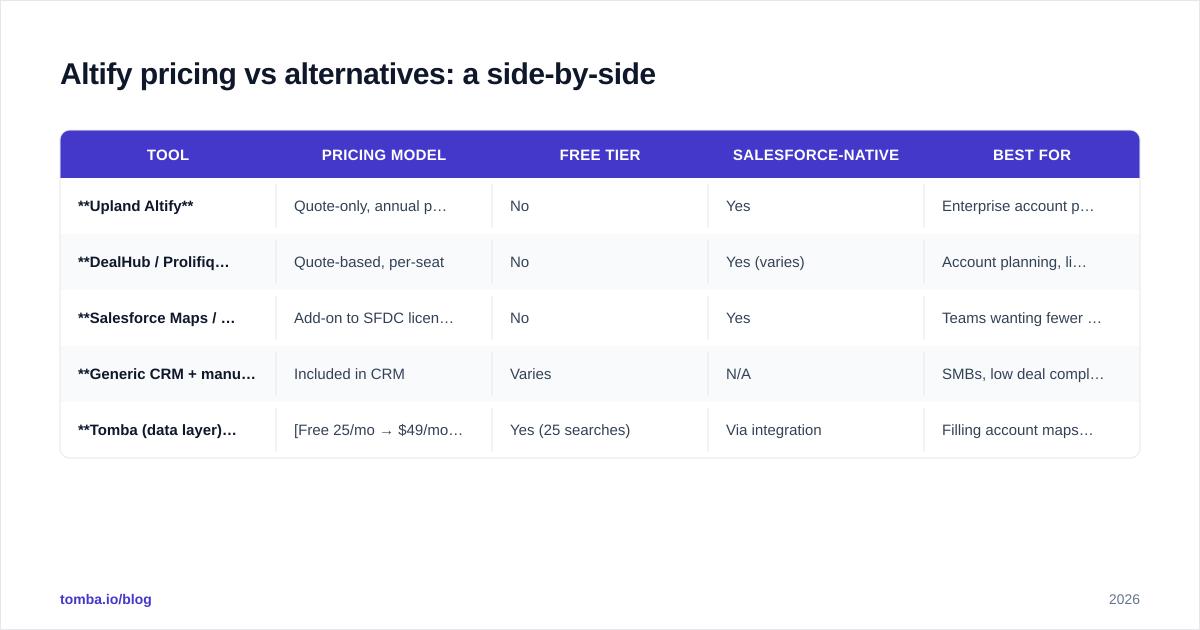
Altify won't give you a number up front. So the useful comparison is category and model, not exact dollars. Here's how it stacks up against the tools buyers shortlist alongside it.
| Tool | Pricing model | Free tier | Salesforce-native | Best for |
|---|---|---|---|---|
| Upland Altify | Quote-only, annual per-seat | No | Yes | Enterprise account planning + methodology |
| DealHub / Prolifiq | Quote-based, per-seat | No | Yes (varies) | Account planning, lighter footprint |
| Salesforce Maps / native | Add-on to SFDC license | No | Yes | Teams wanting fewer vendors |
| Generic CRM + manual decks | Included in CRM | Varies | N/A | SMBs, low deal complexity |
| Tomba (data layer) | Free 25/mo → $49/mo Starter | Yes (25 searches) | Via integration | Filling account maps with real contacts |
The bottom row matters more than it looks. Altify gives you the framework for who to reach inside an account. But it doesn't find those people's contact details. That's a separate job, and it's where a data tool earns its keep.
What do Altify reviews actually say?#
Across G2 and peer review sites, Altify settles around 4.2 out of 5. Strip away the marketing and the feedback clusters into clear themes.
What reviewers consistently praise:
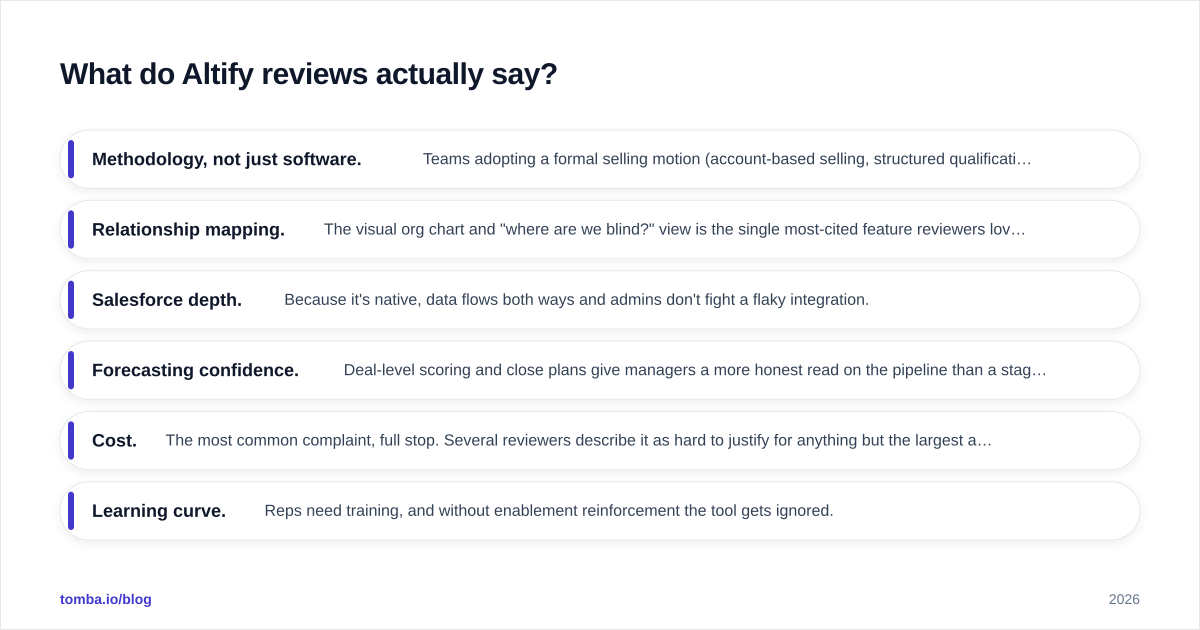
- Methodology, not just software. Teams adopting a formal selling motion (account-based selling, structured qualification) say Altify operationalizes it inside the CRM instead of leaving it in a slide deck.
- Relationship mapping. The visual org chart and "where are we blind?" view is the single most-cited feature reviewers love.
- Salesforce depth. Because it's native, data flows both ways and admins don't fight a flaky integration.
- Forecasting confidence. Deal-level scoring and close plans give managers a more honest read on the pipeline than a stage field alone.
What reviewers consistently criticize:
- Cost. The most common complaint, full stop. Several reviewers describe it as hard to justify for anything but the largest accounts.
- Learning curve. Reps need training, and without enablement reinforcement the tool gets ignored.
- UI friction. Some find the interface dated or clunky relative to newer, AI-first tools.
- Adoption risk. Like any methodology tool, it dies if leadership doesn't enforce usage. "Shelfware" appears in more than one review.
That last point is the real story. Altify's ROI depends on adoption, not features. Buy it and don't enforce it, and you've bought an expensive org chart.
What are the biggest pros of Altify?#
If you're a fit, the upside is genuine. The strongest arguments for Altify in 2026:
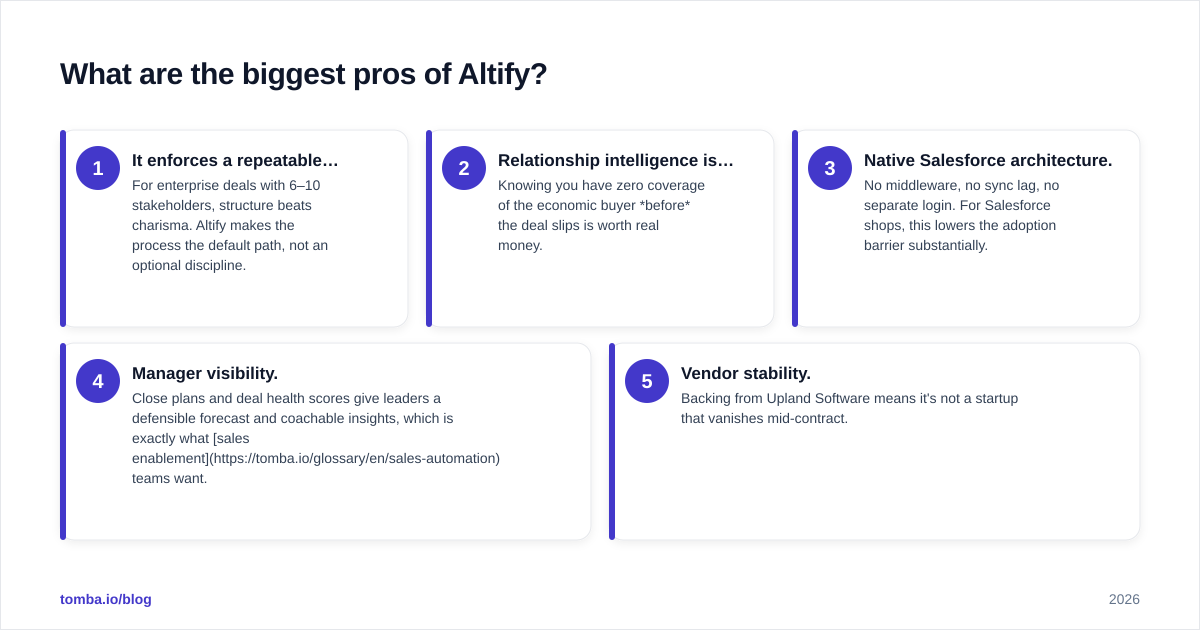
- It enforces a repeatable process. For enterprise deals with 6–10 stakeholders, structure beats charisma. Altify makes the process the default path, not an optional discipline.
- Relationship intelligence is first-class. Knowing you have zero coverage of the economic buyer before the deal slips is worth real money.
- Native Salesforce architecture. No middleware, no sync lag, no separate login. For Salesforce shops, this lowers the adoption barrier substantially.
- Manager visibility. Close plans and deal health scores give leaders a defensible forecast and coachable insights, which is exactly what sales enablement teams want.
- Vendor stability. Backing from Upland Software means it's not a startup that vanishes mid-contract.
What are the biggest cons of Altify?#
Be equally clear-eyed about the downsides:
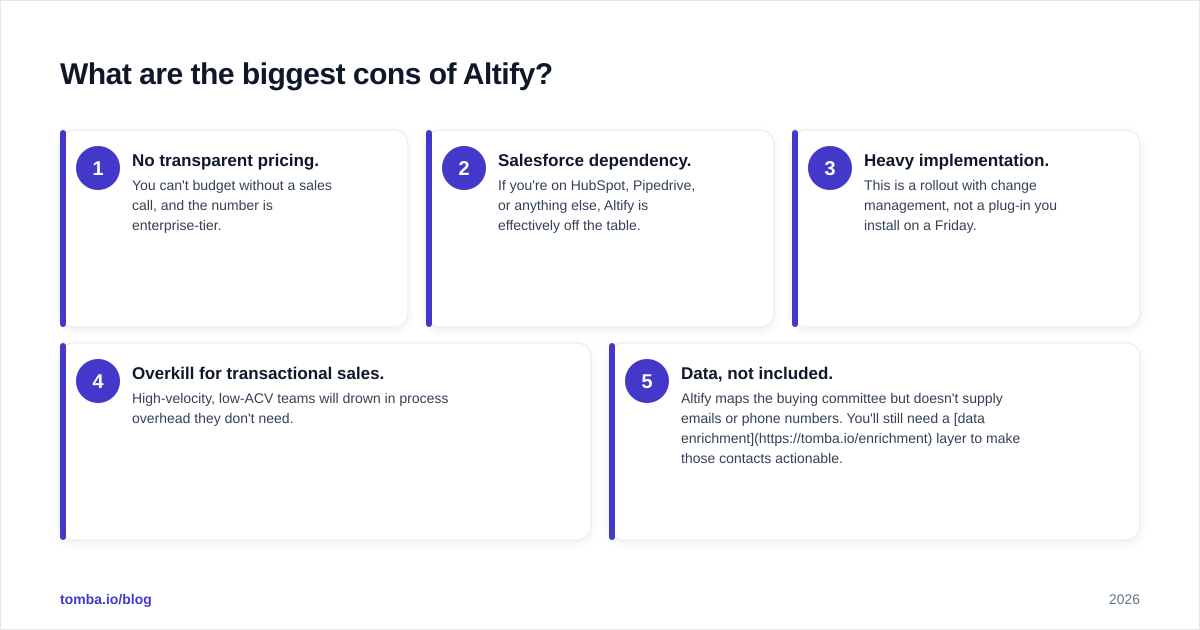
- No transparent pricing. You can't budget without a sales call, and the number is enterprise-tier.
- Salesforce dependency. If you're on HubSpot, Pipedrive, or anything else, Altify is effectively off the table.
- Heavy implementation. This is a rollout with change management, not a plug-in you install on a Friday.
- Overkill for transactional sales. High-velocity, low-ACV teams will drown in process overhead they don't need.
- Data, not included. Altify maps the buying committee but doesn't supply emails or phone numbers. You'll still need a data enrichment layer to make those contacts actionable.
Is Altify worth it, and what are the alternatives?#
Altify is worth it when three things are true: your deals are complex and multi-threaded, you're already standardized on Salesforce, and leadership will actually enforce adoption. Miss any one of those and the math gets shaky fast.
Here's a quick decision framework:
| Your situation | Recommended path |
|---|---|
| Enterprise, complex deals, on Salesforce, exec buy-in | Altify is a strong fit — negotiate hard on services |
| Mid-market, want planning but cost-sensitive | Evaluate lighter Salesforce-native planning apps first |
| Not on Salesforce | Skip Altify; choose a CRM-agnostic tool |
| SMB / transactional sales | A good CRM + simple template beats a methodology suite |
| You have the plan but not the contacts | Add a data layer like Tomba on top of any of the above |
Whatever planning tool you choose, the gap it won't fill is contact data. A relationship map with empty cells is just a diagram. To make account plans work, you need accurate emails and direct dials for every stakeholder the map exposes. That's a job for a dedicated finder, not a planning suite. Tools like Tomba's email finder, phone finder, and B2B database slot in beneath Altify or any CRM. They turn names on the org chart into real, reachable contacts. Many teams sync that data into Salesforce via the Tomba Salesforce integration so the map fills itself.
How does Altify fit into a modern sales stack?#
Think of your stack in three layers, like a building. The foundation is your CRM (Salesforce). The structure is the methodology layer — that's Altify, defining how reps work accounts. The utilities are the data and outreach tools that pipe real contacts and signals through the whole thing.
Altify owns the middle layer well. But buyers get into trouble when they expect it to do the utility layer's job. It won't find emails, verify them, or pull direct dials. It won't tell you which visitors from a target account just hit your pricing page. Those tools are separate, cheaper, and often higher-ROI. Pairing a structured method with a clean data feed is what moves win rate, not either one alone.
Analysts at Gartner make this point often. Tool sprawl without adoption or clean data produces negative ROI. So budget for the data layer in the same breath as the methodology layer, not as an afterthought six months later.
Frequently asked questions#
Does Altify have a free trial? No public free trial or free tier. Access is gated behind a sales conversation and a scoped quote.
Is Altify only for Salesforce? Effectively, yes. It's a Salesforce-native application; without Salesforce the product doesn't apply.
How is Altify different from a CRM? A CRM stores your data and pipeline. Altify adds the methodology — account plans, relationship maps, and guided opportunity management — on top of that data.
What's the main reason teams churn from Altify? Adoption and cost. When leadership doesn't enforce usage, the tool becomes shelfware and the enterprise price becomes impossible to justify at renewal.
The bottom line#
The short version on Altify pricing, reviews, pros and cons: it's a capable, enterprise-grade account-planning and relationship-mapping platform with real fans. The catch is simple. You need to live in Salesforce, run complex deals, and enforce adoption. The quote-only pricing and heavy rollout are the price of admission. Reviews reflect both the value and that friction honestly.
Just remember the layer Altify doesn't cover. A flawless account map is worthless if the contact cells are empty. So before or alongside any methodology investment, get your data layer right. Use Tomba's Email Finder to turn every stakeholder on the org chart into a verified, reachable contact. You start free with 25 searches a month, then scale on transparent, published pricing that doesn't require a sales call. Build the plan with Altify; fill it with Tomba.
// get started
Find, verify and enrich your first contacts today
Start on the free plan with 25 searches a month, then scale when your team is ready.
Free plan · No credit card required · GDPR & CCPA
// about the author