Altss vs Apollo.io 2026: Which B2B Data Tool Wins?
Altss bets on real-time email lookups; Apollo.io bets on a massive prospecting database. Here's the honest 2026 breakdown of accuracy, pricing, and fit.
TL;DR
- Altss is built around real-time, on-demand contact lookups — it fetches and validates data the moment you ask, which keeps records fresh but ties cost to volume.
- Apollo.io is a database-first sales platform: a huge stored contact pool plus sequences, a dialer, and CRM-style workflows bundled into one seat.
- Accuracy depends on the model: real-time providers tend to win on email validity for niche or recently-changed contacts; static databases win on coverage breadth and speed.
- Pricing favors Apollo for all-in-one teams; Altss can be cheaper for targeted, lower-volume enrichment but gets expensive at scale.
- If you mainly need verified emails without paying for a full sales suite, a focused tool like Tomba Email Finder is often the cheaper third option.
What are Altss and Apollo.io?#
The short answer: they solve the same problem — getting you accurate B2B contact data — but from opposite architectural philosophies.
Think of it like groceries. Apollo.io is the giant supermarket: everything is already on the shelf, stocked in advance, ready to grab in bulk. Altss is the made-to-order deli: nothing sits pre-packaged, but what you get is sliced fresh when you order it. Both feed you. The trade-off is freshness versus instant breadth.
Apollo.io is a sales intelligence and engagement platform. It pairs a large stored database of companies and contacts with outbound tooling — email sequences, a built-in dialer, LinkedIn workflows, and CRM enrichment. It's designed so a rep can prospect, enrich, and send from a single tab. Apollo is one of the most recognized names in the category, with thousands of reviews on G2.
Altss takes the real-time route. Instead of serving a record that may have been scraped months ago, it runs a live lookup and validation pass when you request a contact. The pitch is simple: data decays, so fetch it fresh. That design choice shapes everything downstream — coverage, pricing, and the kind of buyer it suits.
How does each tool actually get your data?#
This is the core distinction, so it's worth slowing down.
A database-first model (Apollo) continuously crawls public sources, community-contributed data, and partner feeds, then stores everything. When you search, you query the stored copy. The upside is speed and scale — you can pull thousands of matching contacts in seconds and filter by title, industry, headcount, or tech stack. The downside is decay: B2B email and job data goes stale fast. Industry estimates routinely put B2B contact data decay at 25–30% per year as people change roles, so a stored record's accuracy is a function of how recently it was refreshed.
A real-time model (Altss) skips the stale-copy problem by fetching at request time. When the record is good, it's genuinely current. The trade-offs: you can't browse a giant catalog the same way, lookups can be slower per record, and cost scales with how much you pull rather than a flat database subscription.
Neither approach is "better" in the abstract. They're better for different jobs. If you want to download a 5,000-row target list by filter, the database wins. If you want the freshest possible email for a specific decision-maker right before you send, real-time wins.
If you want to understand how a vendor's sourcing affects accuracy in general, our breakdown of where Tomba gets its data explains the same trade-offs every provider in this space wrestles with.
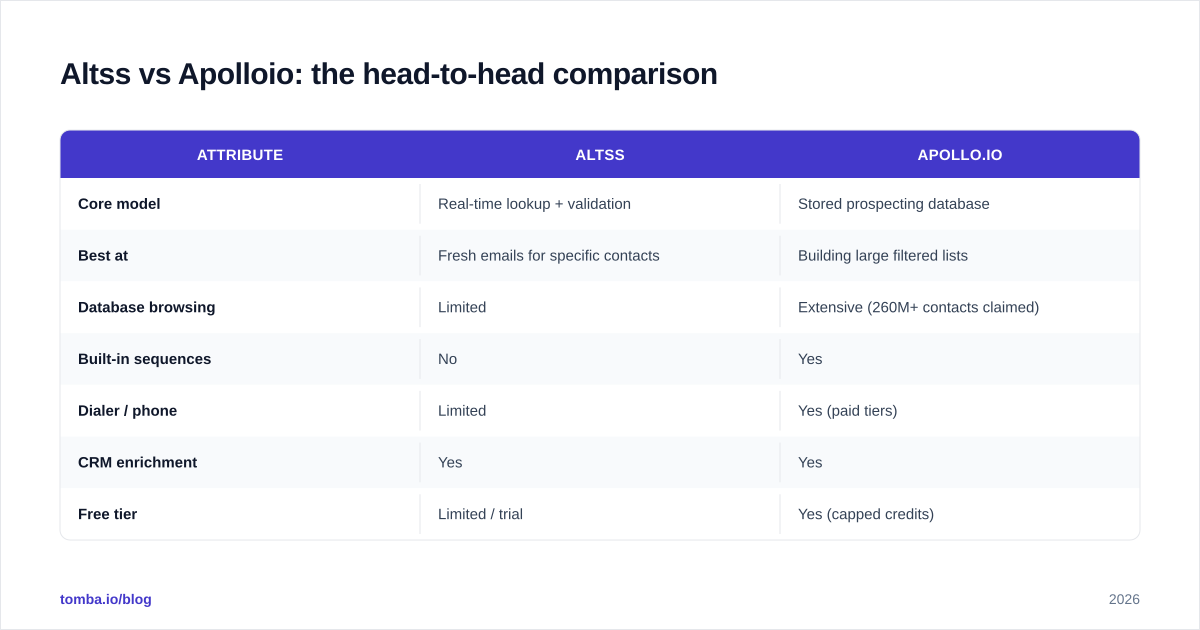
Altss vs Apolloio: the head-to-head comparison#
Here's the practical side-by-side. Treat ranges as directional — both vendors adjust packaging frequently, so confirm current numbers on their own pricing pages before you buy.
| Attribute | Altss | Apollo.io |
|---|---|---|
| Core model | Real-time lookup + validation | Stored prospecting database |
| Best at | Fresh emails for specific contacts | Building large filtered lists |
| Database browsing | Limited | Extensive (260M+ contacts claimed) |
| Built-in sequences | No | Yes |
| Dialer / phone | Limited | Yes (paid tiers) |
| CRM enrichment | Yes | Yes |
| Free tier | Limited / trial | Yes (capped credits) |
| Entry paid price | Volume-based | ~$49–$59/user/mo (annual) |
| Pricing model | Pay for what you pull | Per-seat + credit caps |
| Ideal user | Targeted enrichment, researchers | Full-cycle outbound SDR teams |

A few things this table doesn't capture. Apollo's per-seat pricing means a five-person team pays five times over even if only one person prospects heavily. Altss's volume pricing means a single power user can rack up costs fast if they pull large lists — the model that saves money on precision can punish you on bulk.
Which one is more accurate?#
Accuracy is the question everyone actually cares about, and the honest answer is: it depends on the contact.
For mainstream roles at well-known companies — a VP of Sales at a 2,000-person SaaS firm — Apollo's database usually has a current, verified email because those records get refreshed often and are validated by community usage. You'll get high hit rates instantly.
For recently-changed roles, smaller companies, or niche industries, a real-time tool like Altss tends to edge ahead, because it isn't serving a copy that went stale six months ago. It checks at the moment of request.
But raw "find" rates are misleading without verification. A tool can return an email that bounces. That's why the smart workflow — regardless of vendor — is to verify before you send. Running found addresses through a dedicated email verifier catches catch-alls, invalid syntax, and dead mailboxes that any finder, real-time or database, can miss. Bounce rate, not find rate, is the metric that protects your sender reputation.

One more nuance: Apollo's scale advantage cuts both ways. More records means more total correct records, but also more total stale ones. If you blast a large unverified Apollo list, your bounce rate can climb — which hurts deliverability for every future campaign. Volume without verification is a liability.
How do Altss and Apollo.io compare on price?#
Pricing is where the two models diverge most sharply, and where a lot of buyers get surprised.
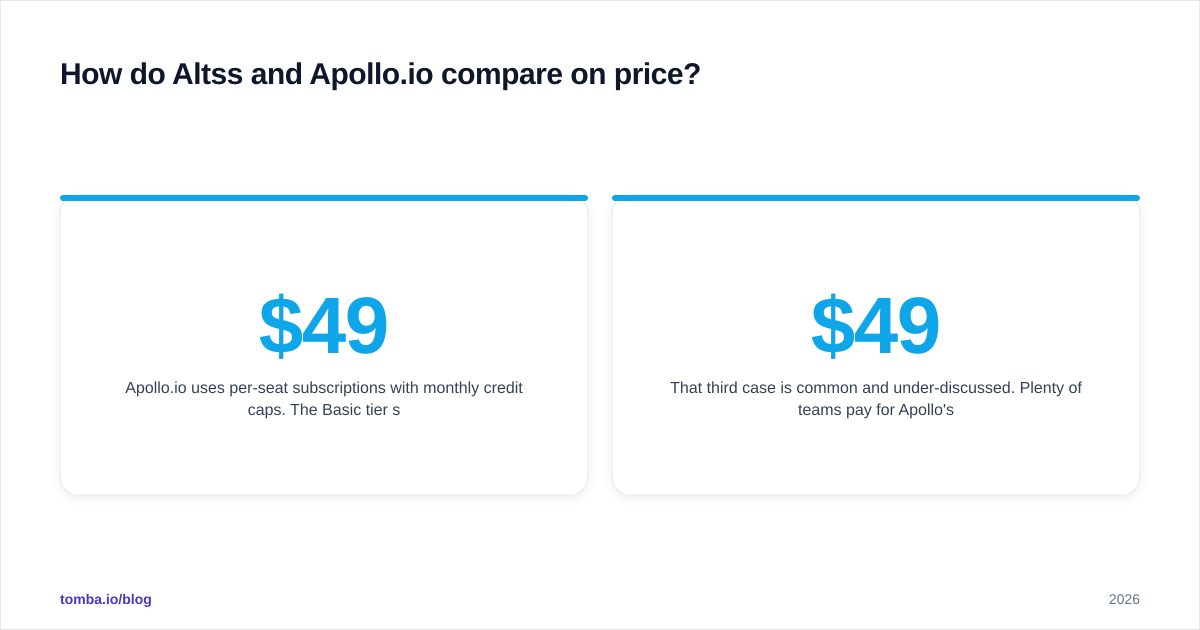
Apollo.io uses per-seat subscriptions with monthly credit caps. The Basic tier sits around $49–$59 per user per month on annual billing, climbing through Professional and Organization tiers that unlock more credits, the dialer, and advanced sequences. The catch is credit limits: hit your monthly cap and you either upgrade or wait. For a team of SDRs all prospecting, the per-seat math adds up quickly.
Altss ties cost to usage. You pay for the lookups and validations you run. For a researcher or a founder doing surgical, targeted outreach, this can be dramatically cheaper than carrying Apollo seats. For a team pulling tens of thousands of records a month, usage pricing can flip and become the more expensive option.
The decision framework is simple:
- Few users, high volume, full outbound workflow → Apollo's bundle is usually better value.
- Targeted lookups, lower volume, you already own a sequencer → Altss-style usage pricing wins.
- You only need verified emails, not a sales suite → a standalone finder is the cheapest path.
That third case is common and under-discussed. Plenty of teams pay for Apollo's full platform but only use the email finder. If that's you, compare against focused pricing — for reference, Tomba's plans run a free tier (25 searches/mo), Starter at $49/mo, Growth at $99/mo, and Pro at $249/mo, with no per-seat multiplier on the core finder. You can read more on the broader Apollo alternative angle if a lighter, finder-first stack fits your motion.

Which tool should you choose?#
Match the tool to your actual motion, not to the louder marketing.
Choose Apollo.io if you're running a full outbound team and want prospecting, enrichment, sequencing, and dialing in one seat. The integrated workflow saves real time, and the database breadth means your reps rarely come up empty on common roles. Just budget for verification and watch your credit caps.
Choose Altss if freshness is your priority and your volume is targeted. Account-based teams chasing a defined list of decision-makers, researchers, and founders doing precise outreach get the most from real-time lookups — you pay for accuracy where it matters and skip the seat tax.
Choose a focused finder if the only thing you actually need is verified email addresses (and maybe phone numbers and enrichment) without a bundled sequencer you won't use. This is where a tool like Tomba slots in: domain-level discovery, single and bulk email finder lookups, built-in verification, and an API — without paying for a sales-engagement platform you'd duplicate elsewhere.
A common, cost-smart pattern in 2026 is to split the stack: use a finder for accurate contact data, a dedicated sequencer for sending, and a verifier as the gate between them. That modular approach often beats paying for one platform that does everything at a B+ level.
Frequently asked questions#
Is Altss a direct Apollo.io competitor? Partially. They overlap on contact data, but Apollo is a full sales-engagement platform while Altss focuses on real-time data retrieval. If you need sequences and a dialer, only Apollo covers that natively.
Does real-time data mean Altss is always more accurate? No. Real-time lookups reduce decay, but accuracy still depends on the underlying sources and on whether you verify the result. For common roles at large companies, Apollo's refreshed database is often just as accurate and far faster to query in bulk.
Can I use either tool just for email finding? Yes, but you may overpay. If email finding is your only need, a dedicated Tomba Email Finder or another finder-first tool typically costs less than a full platform seat.
What protects my deliverability either way? Verification. Whatever finds the email, run it through verification before sending to keep bounce rates low and your sender reputation intact.
The bottom line#
Altss and Apollo.io aren't really fighting over the same square inch — they're two answers to the same question. Apollo gives you scale, workflow, and instant breadth at a per-seat price. Altss gives you freshness and pay-as-you-go precision. Pick based on volume, team size, and whether you need the surrounding outbound tooling.
And if, after the comparison, you realize you mostly just need clean, verified contact data — not a full suite — start lean. Tomba's Email Finder gives you domain search, name-to-email lookups, built-in verification, and an API on a free tier you can test today, then scale to a $49/mo Starter plan without paying for seats or features you won't touch. Find the emails, verify them, send with confidence — and skip the parts of the platform you were never going to use.
Ready to find emails that actually work?
Join 150,000+ professionals who stopped guessing and started sending. Free credits on signup — no credit card required.
Get the Tomba newsletter
Practical outbound tactics and product updates — once every two weeks.
About the author