Altss vs Exellius 2026: Which Lead Data Tool Wins?
Altss vs Exellius compared head-to-head for 2026: data coverage, email accuracy, pricing models, and integrations—plus where each one fits and a battle-tested alternative.
Choosing between Altss and Exellius comes down to one question most buyers skip: do you need a broad lead-discovery database, or a precision email layer your reps can actually trust on send day? Both tools promise "more contacts," but they solve different halves of the prospecting problem. This breakdown compares them on data coverage, accuracy, pricing, and workflow fit—so you don't pay for a database you can't email.
TL;DR: Altss vs Exellius at a glance#
- Altss leans toward broad B2B lead discovery and list-building—good when you need volume and want to explore total addressable market.
- Exellius positions closer to targeted contact sourcing and outreach enablement—good when you already know your ICP and want contacts mapped to it.
- Neither tool is only as good as its email accuracy. A big database with a 30% bounce rate costs you sender reputation, not just credits.
- Pricing models differ: evaluate cost per usable contact, not per record returned. Credits that surface unverified emails are not equivalent.
- A specialist alternative like the Tomba Email Finder pairs discovery with built-in verification, which is the gap most generalist databases leave open.

What are Altss and Exellius?#
Altss and Exellius are both B2B lead intelligence tools—software that helps sales and marketing teams find company and contact data, build prospect lists, and feed outreach campaigns. At a high level they occupy the same shelf as platforms you'll see categorized under "sales intelligence" on review sites like G2 and Capterra.
The category itself is crowded because the underlying job is hard: business contact data decays fast. Industry research from teams like HubSpot has long pegged B2B data decay at roughly 20–30% per year as people change jobs, companies rebrand, and domains shift. That single fact is why "how many contacts does it have" is the wrong lead question. The right one is "how many can I reach today without burning my domain?"
Altss is generally pitched as a discovery-first platform: search by firmographic and role filters, pull lists, and explore accounts. The appeal is breadth—casting a wide net across an industry or region.
Exellius tends to be framed around targeted sourcing and outreach readiness: find the specific people who match a defined ideal customer profile and prepare them for a sequence. The appeal is precision—fewer, more relevant contacts.
Both descriptions are directional. Vendor positioning changes, and feature sets overlap more than marketing pages admit. Verify current specifics on each tool's own site and recent third-party reviews before you commit budget—this post gives you the evaluation framework, not a frozen spec sheet.
How should you compare lead data tools like these?#
Score any lead data platform on five layers, in this order. Most teams over-weight the first and ignore the rest, which is how you end up with a 200,000-record export that produces 40 meetings.
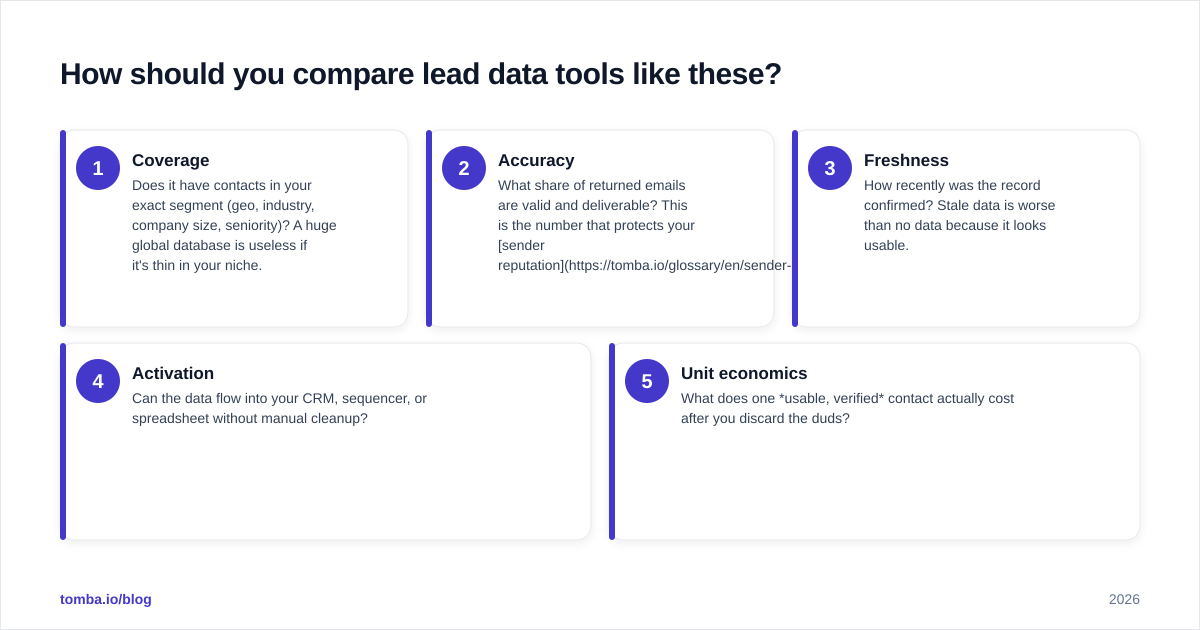
- Coverage — Does it have contacts in your exact segment (geo, industry, company size, seniority)? A huge global database is useless if it's thin in your niche.
- Accuracy — What share of returned emails are valid and deliverable? This is the number that protects your sender reputation.
- Freshness — How recently was the record confirmed? Stale data is worse than no data because it looks usable.
- Activation — Can the data flow into your CRM, sequencer, or spreadsheet without manual cleanup?
- Unit economics — What does one usable, verified contact actually cost after you discard the duds?
The trap with broad databases is they optimize layer 1 and let you assume layers 2 and 3. That's why pairing discovery with an independent email verifier matters regardless of which platform you pick—verification is the step that converts a record into a contact.
Altss vs Exellius: side-by-side comparison#
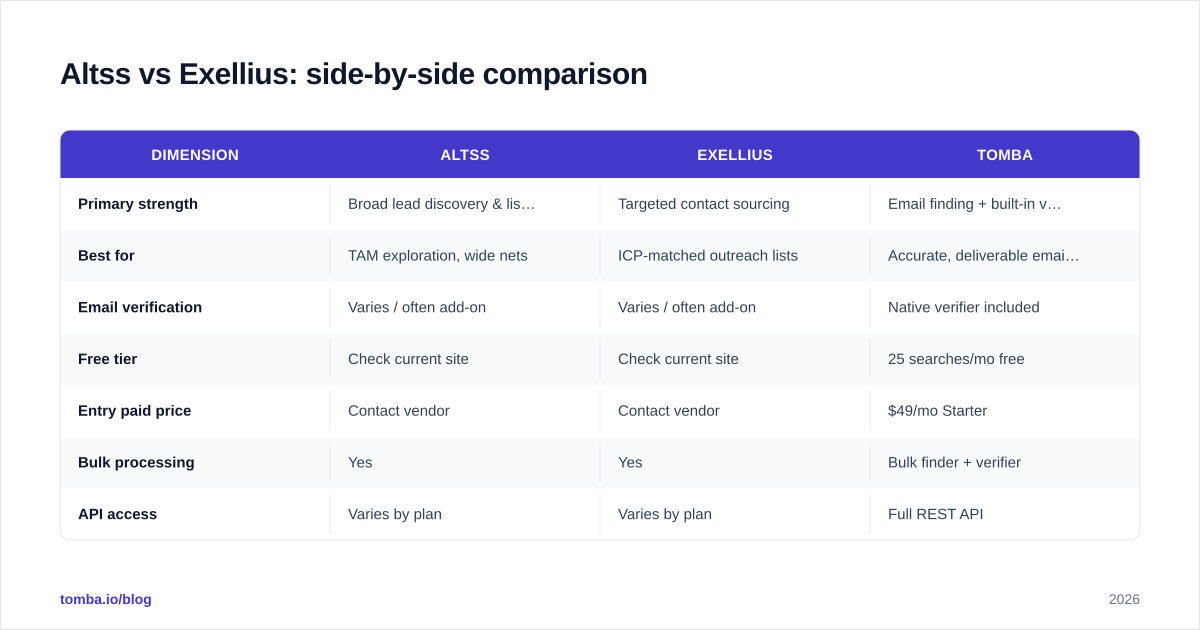
The table below compares the two on the dimensions that drive ROI, with Tomba included as a verification-first reference point. Treat vendor-specific cells as directional and confirm against current pricing pages—pricing and tiers in this category change frequently.
| Dimension | Altss | Exellius | Tomba |
|---|---|---|---|
| Primary strength | Broad lead discovery & list-building | Targeted contact sourcing | Email finding + built-in verification |
| Best for | TAM exploration, wide nets | ICP-matched outreach lists | Accurate, deliverable email at scale |
| Email verification | Varies / often add-on | Varies / often add-on | Native verifier included |
| Free tier | Check current site | Check current site | 25 searches/mo free |
| Entry paid price | Contact vendor | Contact vendor | $49/mo Starter |
| Bulk processing | Yes | Yes | Bulk finder + verifier |
| API access | Varies by plan | Varies by plan | Full REST API |
| Verification transparency | Limited | Limited | Per-email status + score |
Two things to notice. First, "verification" is listed as varies for both Altss and Exellius because discovery-first tools frequently treat verification as a separate step or upsell. Second, the cost comparison only becomes fair once you normalize to verified contacts—see the next section.
For Tomba specifics, current Tomba pricing runs Free (25 searches/mo), Starter $49/mo, Growth $99/mo, Pro $249/mo, and Enterprise custom.
Is Altss or Exellius more accurate?#
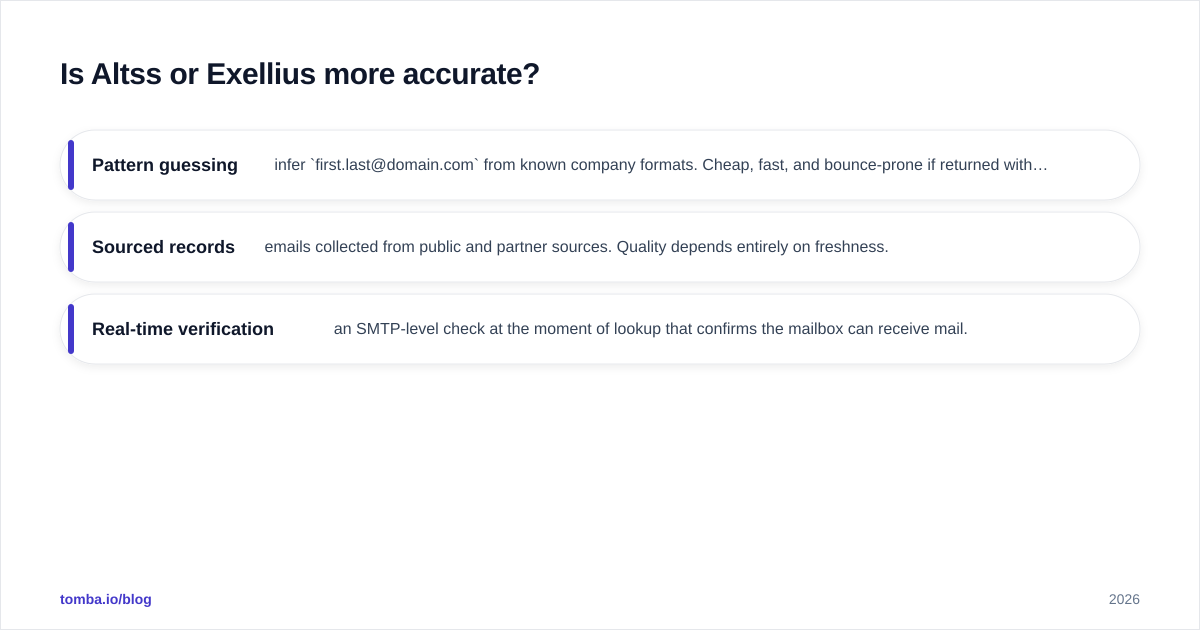
Accuracy is decided less by who has the bigger database and more by what each tool does before it hands you an email. There are three common approaches, and you should ask each vendor which one they use:
- Pattern guessing — infer
first.last@domain.comfrom known company formats. Cheap, fast, and bounce-prone if returned without a check. - Sourced records — emails collected from public and partner sources. Quality depends entirely on freshness.
- Real-time verification — an SMTP-level check at the moment of lookup that confirms the mailbox can receive mail.
Tools that stop at the first two and skip the third will quietly inflate your list size while deflating your deliverability. If Altss or Exellius returns emails without a verification status, run them through an independent check before loading them into a sequencer. Where the data gets sourced and how often it's re-validated is the real differentiator—it's worth reading each vendor's data-sourcing notes the same way you'd read Tomba's data sources page.

The practical test costs nothing: run the same 50 target accounts through both Altss and Exellius (and a verifier of your choice), then measure valid-email rate and duplicate rate. The tool that returns fewer records but more deliverable ones usually wins on real cost per meeting.
Which has better pricing and value?#
Compare value as cost per verified contact, not cost per credit. A simple way to normalize:
Effective cost = (plan price ÷ usable contacts), where usable = records that are deduplicated, in-ICP, and verified deliverable.
A plan that looks cheaper per credit can be more expensive per usable contact if half its returns bounce or fall outside your segment. When you price out Altss and Exellius, ask each vendor:
- Are verification checks included or metered separately?
- Do failed or catch-all lookups still consume credits?
- Is there a free tier or trial large enough to run the 50-account test above?
- What's the real cost at your monthly contact volume, not the headline tier?
This is where a verification-first tool changes the math. Because Tomba bundles finding and verification—and exposes a bulk email finder plus per-email status—you're paying for contacts you can actually use, with data enrichment available when you need more than an address. Catch-all domains, which silently wreck deliverability stats, can be screened with a dedicated catch-all verifier rather than guessed at.
What about integrations and workflow fit?#
Data only creates pipeline when it lands where your reps work. Before choosing, map the destination:
- CRM sync — Does the tool push cleanly into HubSpot, Salesforce, or Pipedrive without creating duplicate records?
- Sequencer handoff — Can verified contacts flow into your outreach tool automatically?
- Spreadsheet and no-code — Is there a Sheets add-on, Excel support, or a
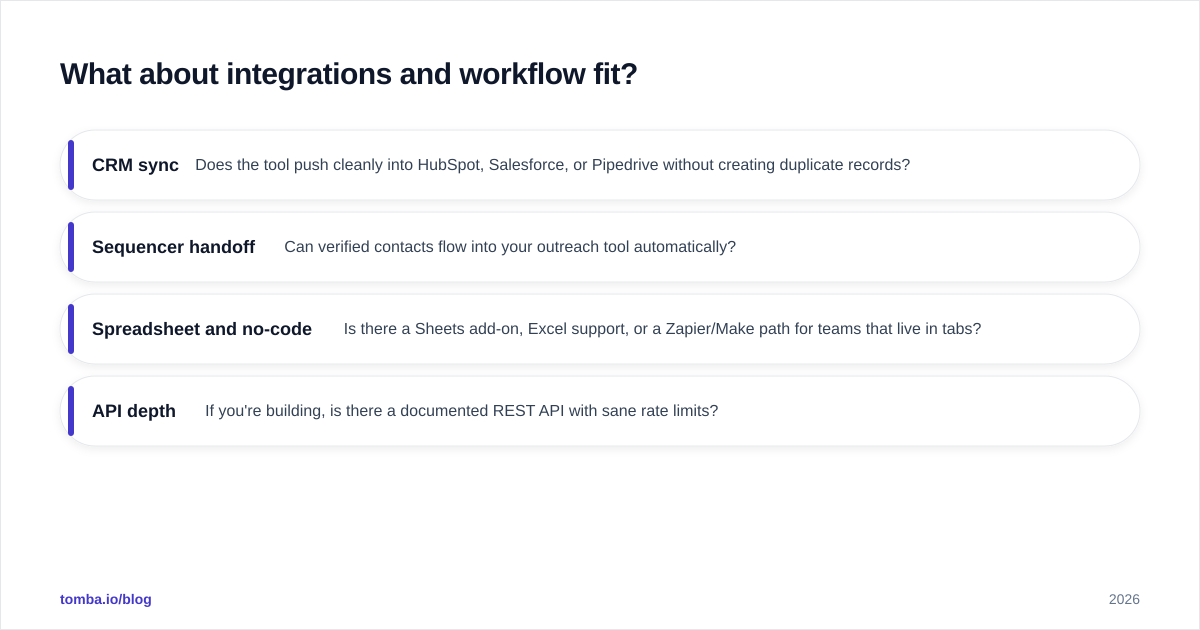
Zapier/Make path for teams that live in tabs?
- API depth — If you're building, is there a documented REST API with sane rate limits?
Altss and Exellius both offer integrations, but coverage varies by plan tier, so confirm your specific stack is supported on the plan you'd actually buy. For reference on what comprehensive coverage looks like, Tomba ships a documented email finder API alongside a Chrome extension, Google Sheets and Excel add-ons, and native HubSpot and Salesforce connectors—so the same verified data reaches every surface a rep touches.

Altss vs Exellius: which should you choose?#
Use these decision rules:
Choose Altss if your priority is exploration—you're mapping a new market, sizing a TAM, or building broad lists and you have a separate verification step downstream. Its discovery-first breadth fits top-of-funnel research where coverage matters more than send-readiness.
Choose Exellius if you already have a tight ICP and want contacts pre-filtered to match it, with less noise to sort through. Precision-oriented sourcing reduces the cleanup tax before outreach.
Choose a verification-first tool like Tomba if your bottleneck is deliverability—you're losing meetings to bounces, your domain reputation is fragile, or you simply want finding and verification in one place instead of stitching two vendors together. This is the most common real-world failure mode, which is why pairing discovery with verification beats betting everything on database size.
In practice, many teams run a hybrid: a discovery tool for breadth, plus a finder-and-verifier for the contacts they're about to email. That keeps your lists big at the research stage and clean at the send stage—the two goals that pull in opposite directions inside a single generalist platform.
How do you validate the winner before you buy?#
Don't trust marketing pages, including this one. Run a 60-minute bake-off:
- Pick 50 accounts that represent your real ICP.
- Pull contacts from Altss and Exellius for the same accounts.
- Verify every returned email with an independent checker.
- Score each tool on valid-email rate, in-ICP rate, duplicate rate, and cost per usable contact.
- Push 10 verified contacts into your CRM from each to test integration friction.
Whatever wins the bake-off on usable contacts—not raw volume—is your tool. If both come back thin or bouncy in your segment, that's your signal to test a finder built around accuracy. You can start that test free with the Tomba Email Finder: find professional emails by name, company, or domain search, with verification built in so the contacts you export are the contacts you can actually reach. Run the same 50 accounts through it, compare the valid-email rate against Altss and Exellius, and let the deliverability numbers pick your winner.
Ready to find emails that actually work?
Join 150,000+ professionals who stopped guessing and started sending. Free credits on signup — no credit card required.
Get the Tomba newsletter
Practical outbound tactics and product updates — once every two weeks.
About the author