Always Be Closing (ABC): Does It Still Work in 2026?
"Always Be Closing" built a generation of closers — and burned out just as many. Here's what the ABC mindset gets right, where it fails in 2026, and the modern framework that replaces it.
TL;DR
- "Always Be Closing" (ABC) is a sales philosophy that says every interaction should push the prospect toward a buying decision — popularized by the 1992 film Glengarry Glen Ross.
- The mindset still has value: discipline, momentum, and clear next steps win deals. The literal hard-close tactics behind it mostly do not survive a 2026 buyer.
- Modern teams swap ABC for ABH — Always Be Helping — closing as the byproduct of qualification, fit, and value, not pressure.
- The biggest lever today is who you close, not how hard you push. Bad-fit pipeline is the real conversion killer.
- Below: a side-by-side of ABC vs the modern stack, a closing framework you can run this quarter, and where prospecting data fits in.
What does "Always Be Closing" actually mean?#
"Always Be Closing" means treating every touchpoint with a prospect as a step toward the sale — never idle, never "just checking in." Coffee's for closers, as the movie line goes.
Think of it like a chess player who only ever thinks two moves ahead toward checkmate. Every pawn push has a purpose. The discipline is real and useful. The problem is when you treat the person across the table as a king to be cornered rather than a buyer to be served.
The phrase entered sales culture through Alec Baldwin's monologue in Glengarry Glen Ross, and it hardened into a whole school of high-pressure technique: assume the sale, stack closes, never take the first "no" as final. In a 1992 world of cold calls and information-poor buyers, that asymmetry worked. The rep knew more than the prospect, so pushing the prospect toward a decision often was the helpful move.
That asymmetry is gone. By the time a B2B buyer talks to you in 2026, they've read your pricing page, three competitor comparisons, and a Reddit thread. The rep is no longer the gatekeeper of information — which means the old ABC reflexes can actively repel a buyer who already knows the script.
Where does the ABC mindset still work?#
Strip away the cheesy tactics and a durable core remains. These parts of "always be closing" age well:
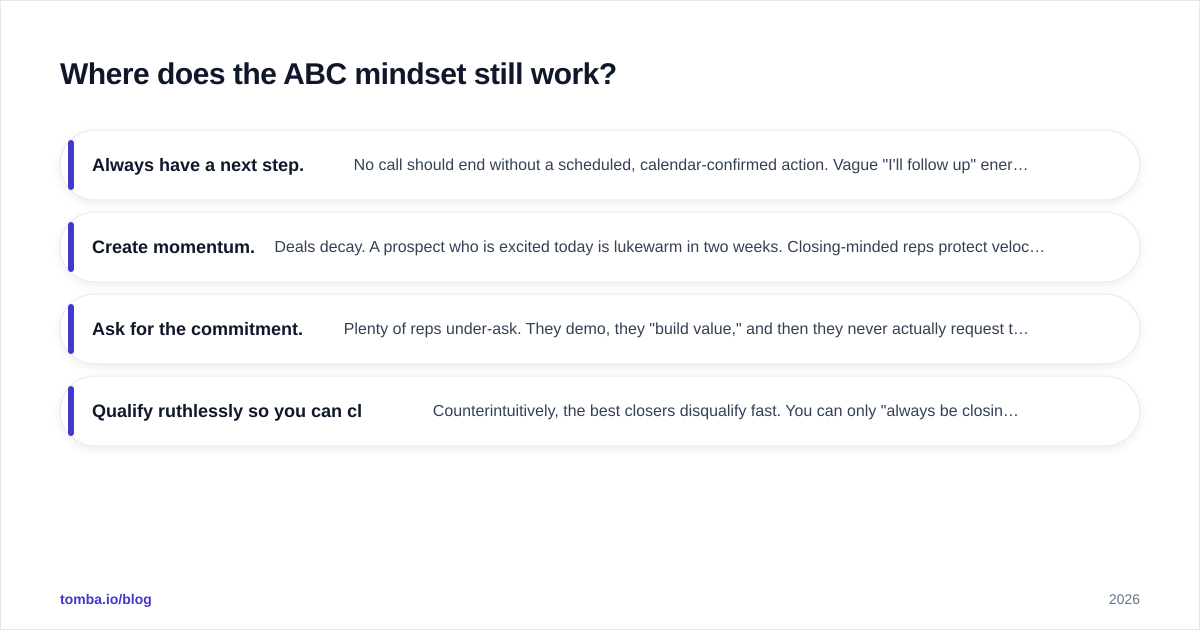
- Always have a next step. No call should end without a scheduled, calendar-confirmed action. Vague "I'll follow up" energy is where deals die.
- Create momentum. Deals decay. A prospect who is excited today is lukewarm in two weeks. Closing-minded reps protect velocity.
- Ask for the commitment. Plenty of reps under-ask. They demo, they "build value," and then they never actually request the decision. ABC's instinct to ask is correct.
- Qualify ruthlessly so you can close confidently. Counterintuitively, the best closers disqualify fast. You can only "always be closing" the deals that deserve it.
Where it breaks is the literal interpretation: manipulation tactics, fake urgency, and ignoring "no." Those torch trust, and trust is the entire B2B game now. HubSpot's sales research and most modern enablement playbooks point the same direction — consultative beats coercive on win rate and on retention.

What is ABH (Always Be Helping), and is it better?#
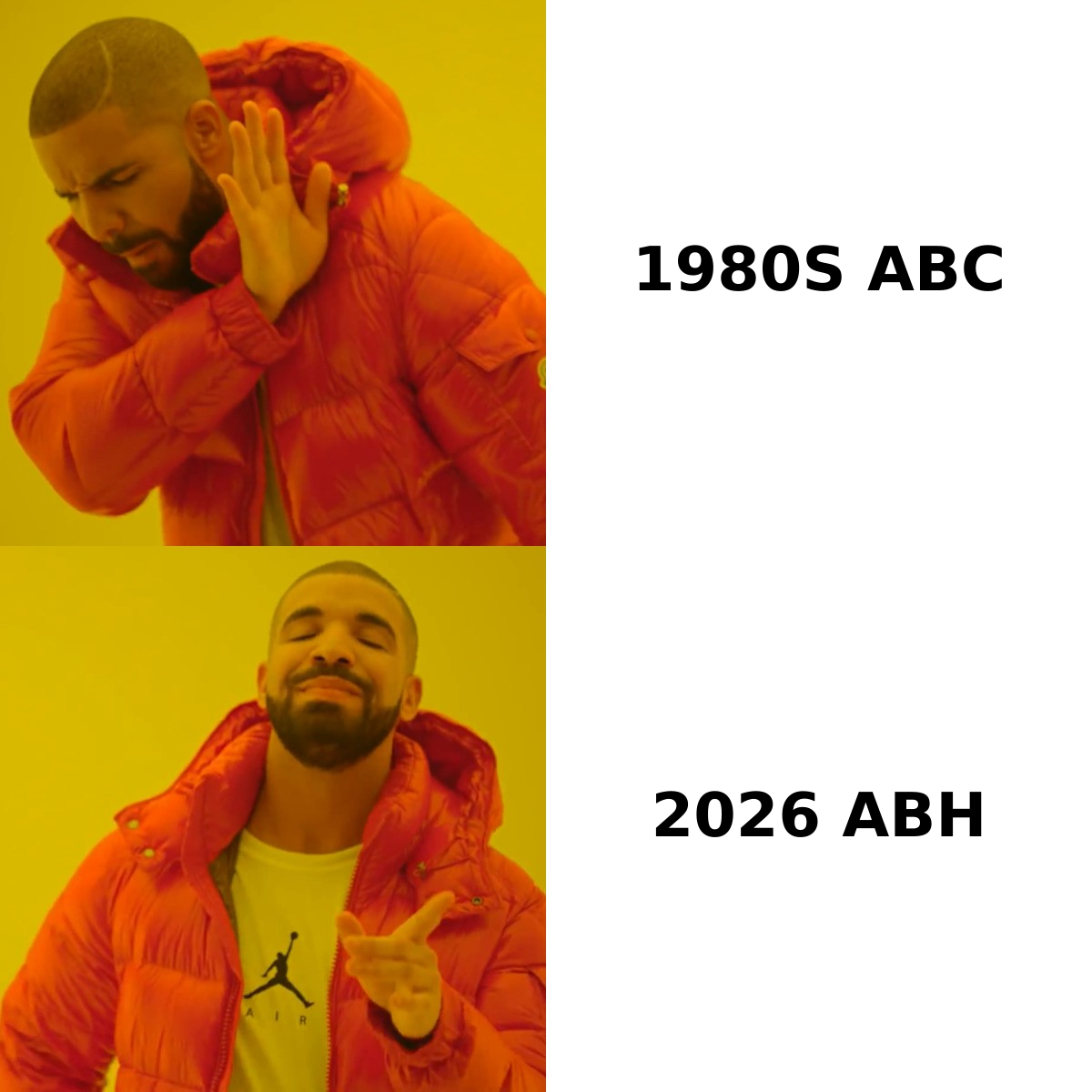
ABH — "Always Be Helping" — is the modern reframe: the close is what happens after you've genuinely solved the buyer's problem, not a move you perform on them.
In practice, ABH means:
- Diagnosing before prescribing. You earn the right to recommend by understanding the problem first.
- Telling a prospect when you're not a fit. This builds the credibility that closes the deals where you are a fit.
- Measuring success by the buyer's outcome, not just the signed contract.
Is it better? For complex, multi-stakeholder B2B sales, yes — and the data backs it. Gartner's research on B2B buying shows buyers spend only about 17% of their journey with sales reps and reward sellers who make the decision easier, not louder. Helping is how you win the share of that thin window.
But ABH without closing discipline becomes "always be chatting." The synthesis most strong teams land on: help relentlessly, then close decisively. Keep ABC's spine; drop its manipulation.
ABC vs the modern closing stack: a side-by-side#
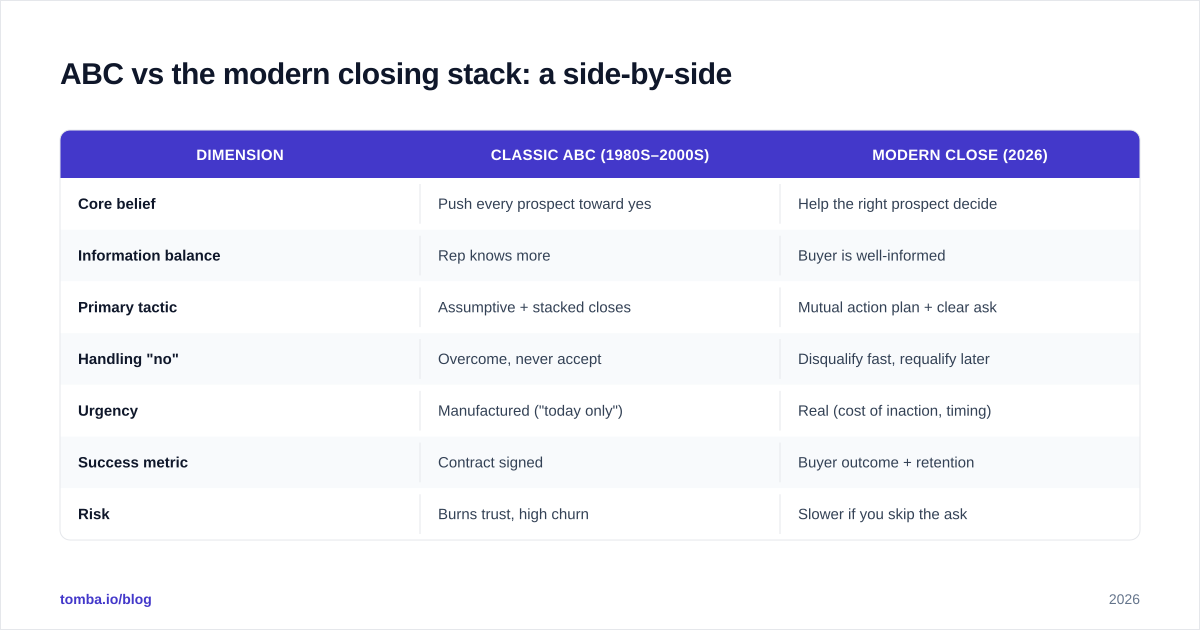
Here's how the classic mantra maps against what high-performing teams actually run in 2026.
| Dimension | Classic ABC (1980s–2000s) | Modern Close (2026) |
|---|---|---|
| Core belief | Push every prospect toward yes | Help the right prospect decide |
| Information balance | Rep knows more | Buyer is well-informed |
| Primary tactic | Assumptive + stacked closes | Mutual action plan + clear ask |
| Handling "no" | Overcome, never accept | Disqualify fast, requalify later |
| Urgency | Manufactured ("today only") | Real (cost of inaction, timing) |
| Success metric | Contract signed | Buyer outcome + retention |
| Risk | Burns trust, high churn | Slower if you skip the ask |
| Best fit | Transactional, one-call closes | Complex, multi-stakeholder B2B |
The takeaway: ABC isn't wrong so much as out of context. It was tuned for a market that no longer exists. The pieces worth keeping — discipline, momentum, asking — survive into the modern stack. The pressure tactics don't.
How do you actually run a modern closing framework?#
Here's a five-stage framework that keeps ABC's discipline without its baggage. Run it on every deal in your pipeline.
1. Qualify before you invest. Use a fit checklist — budget, authority, need, timing, plus technical fit. The goal is to earn the right to close by confirming the deal is real. This is where most "closing problems" actually originate: they're qualification problems wearing a costume.
2. Diagnose the problem out loud. Get the prospect to articulate the cost of their current state. When the buyer says the pain, you don't have to manufacture urgency — they bring it.
3. Build a mutual action plan. Co-author the path to a decision: who needs to sign off, what proof they need, the dates. This replaces fake urgency with a real, shared timeline. It also makes the eventual ask feel inevitable rather than confrontational.
4. Ask — clearly and early. Don't bury the ask. "Based on what we've covered, do you want to move forward?" The single most ABC-correct habit worth keeping is actually asking for the business. Most reps under-ask out of fear.
5. Confirm the next step in writing. Calendar invite, recap email, signed mutual plan — something concrete leaves every interaction. This is "always be closing" in its healthiest form: never leave a deal in limbo.
This framework lifts your win rate not by pushing harder but by spending your energy on deals that can actually close — and by never letting a winnable deal stall from neglect.
Why does pipeline quality beat closing technique?#
The uncomfortable truth: the best closing technique in the world can't save a pipeline full of bad-fit prospects.
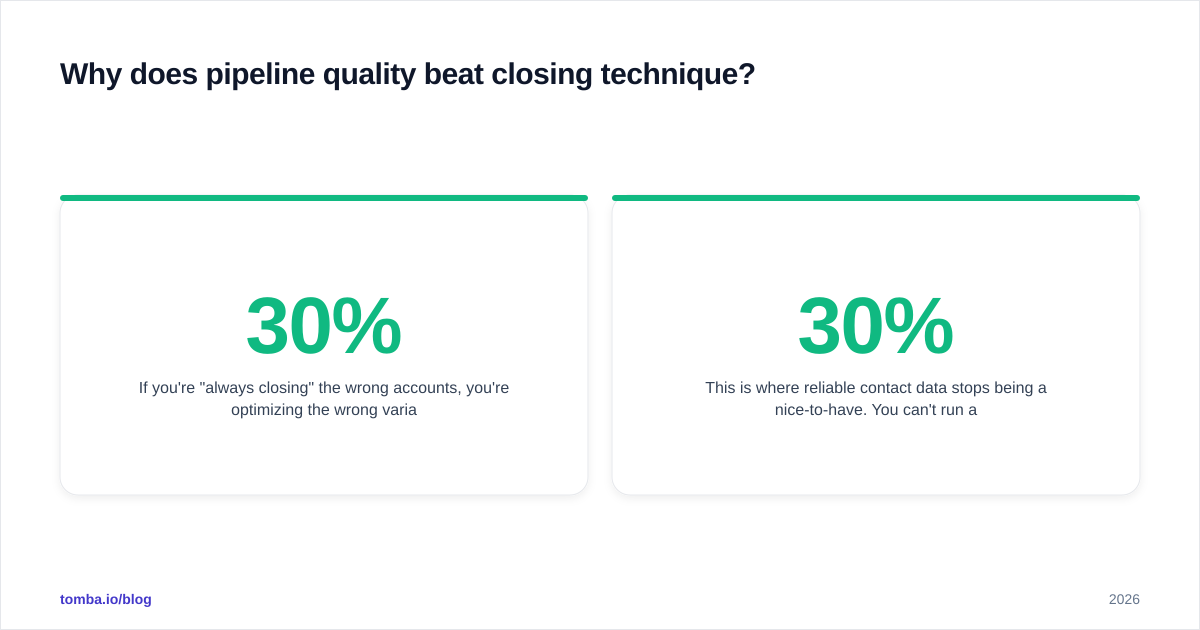
If you're "always closing" the wrong accounts, you're optimizing the wrong variable. A 30% close rate on well-qualified deals beats a 10% close rate on a list three times the size — and it costs less in rep time, in response rate burn, and in the morale hit of constant rejection.
That's why modern sales orgs invest upstream — in who lands in the pipeline — at least as much as in close training. The sequence that actually compounds:
- Targeting — define the ICP precisely so reps only work fits.
- Sourcing accurate contacts — reach the real decision-maker, not a stale or guessed email.
- Personalized outreach — earn the first conversation.
- Disciplined closing — the framework above.
Notice that three of the four happen before a single close attempt. If your team is missing quota, the fix is usually two stages earlier than where it hurts. Bad data at the top quietly caps everything downstream: bounced emails, wrong contacts, and reps "always closing" people who were never going to buy.
This is where reliable contact data stops being a nice-to-have. You can't run a tight closing framework on a list that bounces 30% of the time. Accurate emails mean your reps spend their closing energy on real, reachable buyers — which is the whole point of keeping ABC's discipline in the first place.
To pull verified decision-maker emails straight from a target company's domain, an email finder turns "I think this is their address" into a confirmed, deliverable contact — so step four of the framework lands in an inbox instead of a bounce log.
What are the most common ABC mistakes in 2026?#
Even teams that know better fall into these traps:
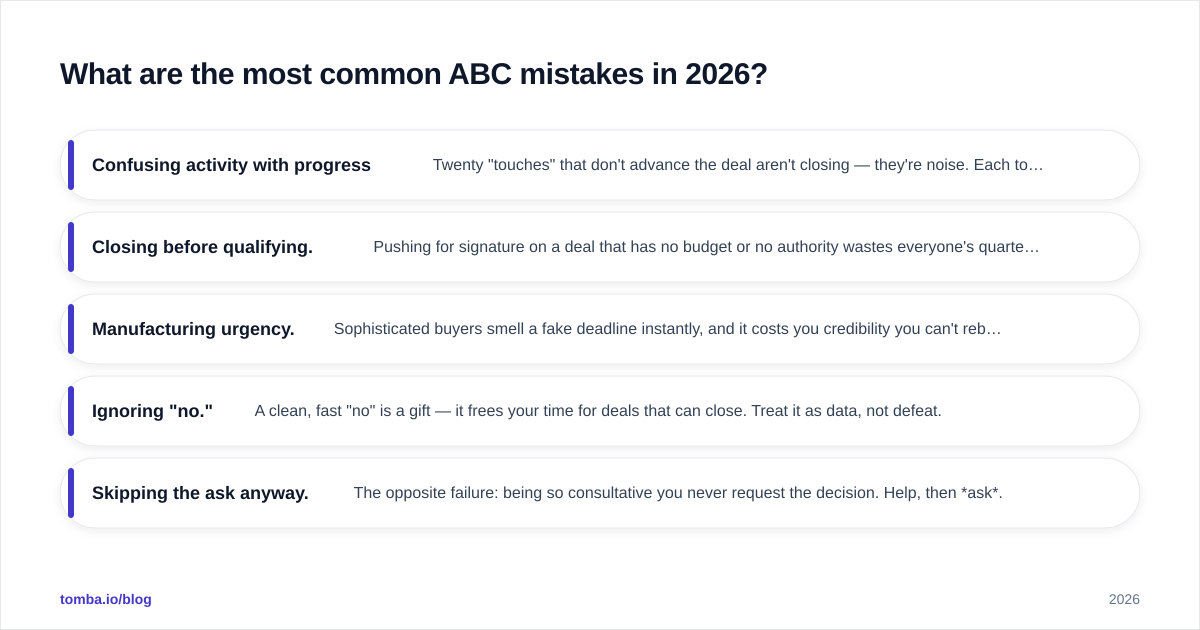
- Confusing activity with progress. Twenty "touches" that don't advance the deal aren't closing — they're noise. Each touch should change something.
- Closing before qualifying. Pushing for signature on a deal that has no budget or no authority wastes everyone's quarter.
- Manufacturing urgency. Sophisticated buyers smell a fake deadline instantly, and it costs you credibility you can't rebuy.
- Ignoring "no." A clean, fast "no" is a gift — it frees your time for deals that can close. Treat it as data, not defeat.
- Skipping the ask anyway. The opposite failure: being so consultative you never request the decision. Help, then ask.
The pattern across all five: the mistake is almost never "not pushing hard enough." It's pushing in the wrong place, on the wrong deal, at the wrong time.
So, should you still teach "Always Be Closing"?#
Teach the principle, retire the caricature.
The principle — be disciplined, keep momentum, always have a next step, and actually ask for the business — is timeless and worth drilling into every new rep. The caricature — pressure, manipulation, never accepting no — is a liability that loses modern deals and torches your reputation in a market where buyers talk to each other.
Reframe it for your team as Always Be Closing the right deals, by Always Be Helping the right buyers. Keep the spine, drop the sleaze. Then point your energy upstream, where pipeline quality is decided, because the deals you close in week twelve are determined by the prospects you sourced in week one.
The closers who win in 2026 aren't the loudest in the room. They're the ones with the cleanest pipeline, the sharpest qualification, and the confidence to ask for the deal precisely because they earned the right to.
Build a pipeline worth closing#
The fastest way to lift your close rate isn't a new script — it's a better top of funnel. Tomba's Email Finder lets you find verified, professional email addresses for decision-makers by name, company, or domain, so every deal your reps work is reachable and real. Start free with 25 searches a month, scale to the Starter plan at $49/mo as your team grows, and check current Tomba pricing for higher-volume tiers. Stop "always closing" bad-fit contacts. Source the right buyers first — then let your closing discipline do its job.
// get started
Find, verify and enrich your first contacts today
Start on the free plan with 25 searches a month, then scale when your team is ready.
Free plan · No credit card required · GDPR & CCPA
// about the author