Always Be Prospecting: The 2026 Pipeline Habit That Beats ABC
Always Be Prospecting replaces the old "Always Be Closing" mantra. Here's the 2026 framework, daily cadence, and tools that keep your pipeline full.
TL;DR
- "Always Be Prospecting" (ABP) replaces the 1980s "Always Be Closing" mantra: closing is a lagging outcome, prospecting is the daily input you actually control.
- Reps who block 30–60 minutes of prospecting every day avoid the feast-or-famine cycle that wrecks quotas in Q2 and Q4.
- ABP works as a system: a target list, a multi-channel cadence, a fixed time block, and a weekly pipeline-coverage metric (aim for 3x–4x).
- Accurate contact data is the bottleneck — bounced emails and dead numbers kill cadences faster than weak copy.
- Tools like a reliable email finder and email verifier turn ABP from a willpower exercise into a repeatable workflow.
What does "always be prospecting" actually mean?#
Always be prospecting means you treat new-pipeline creation as a non-negotiable daily habit, not a panic move you make when your deals dry up. The phrase is a deliberate rewrite of "Always Be Closing" (ABC), the line Alec Baldwin made famous in Glengarry Glen Ross. ABC told reps to push every conversation toward a signature. ABP says something more durable: if you keep the top of your funnel full every single day, closing takes care of itself.
Here is the everyday analogy. Closing is like harvesting a field, and prospecting is like planting seeds. If you only think about the harvest, you spend three weeks frantically picking crops and then stare at empty soil for the next month. Plant a little every day and you always have something ripening. Most reps who miss quota didn't forget how to close — they forgot to plant in March, so there was nothing to harvest in June.
The mindset shift matters because closing is a lagging indicator. You don't control whether a prospect signs this week; their budget cycle, their legal team, and their boss's mood all interfere. You do control how many qualified accounts you add to your pipeline today. ABP moves your attention to the one variable you own.
Why did "Always Be Closing" stop working?#
ABC stopped working because the buyer changed. In 1992, a salesperson held most of the information. Today a B2B buyer completes a large share of their research before they ever talk to sales, according to Gartner. Pushing hard for a close on the first call now reads as desperate, not confident. It breaks trust at exactly the moment you're trying to build it.
There are three practical problems with an ABC-only culture:
- It creates feast-or-famine pipelines. Reps prospect hard, land a batch of deals, stop prospecting to service those deals, close them, and then discover the cupboard is bare. The cycle repeats every quarter and the revenue chart looks like a heartbeat monitor.
- It punishes long sales cycles. Enterprise deals take months. If your only behavior is "close," you have no system for the 90 days of nurturing in between.
- It ignores the math. If your average deal cycle is 60 days and you stop prospecting for two weeks, you've punched a hole in your pipeline that won't show up until two months later — when it's too late to fix.
ABP fixes all three by making the input constant. You can't always close, but you can always prospect.
What is the "always be prospecting" framework?#
The ABP framework has four parts: a list, a cadence, a time block, and a metric. Skip any one and the habit collapses. Think of it like a gym routine — knowing the exercises (cadence) is useless without showing up at the same time every day (time block) and tracking your numbers (metric).
1. Build a living target list#
You can't prospect into a vacuum. Start with a clearly defined Ideal Customer Profile (ICP), then build a rolling list of accounts and contacts that match it. The list is "living" because you add to it every week as you research new accounts — it never runs to zero.
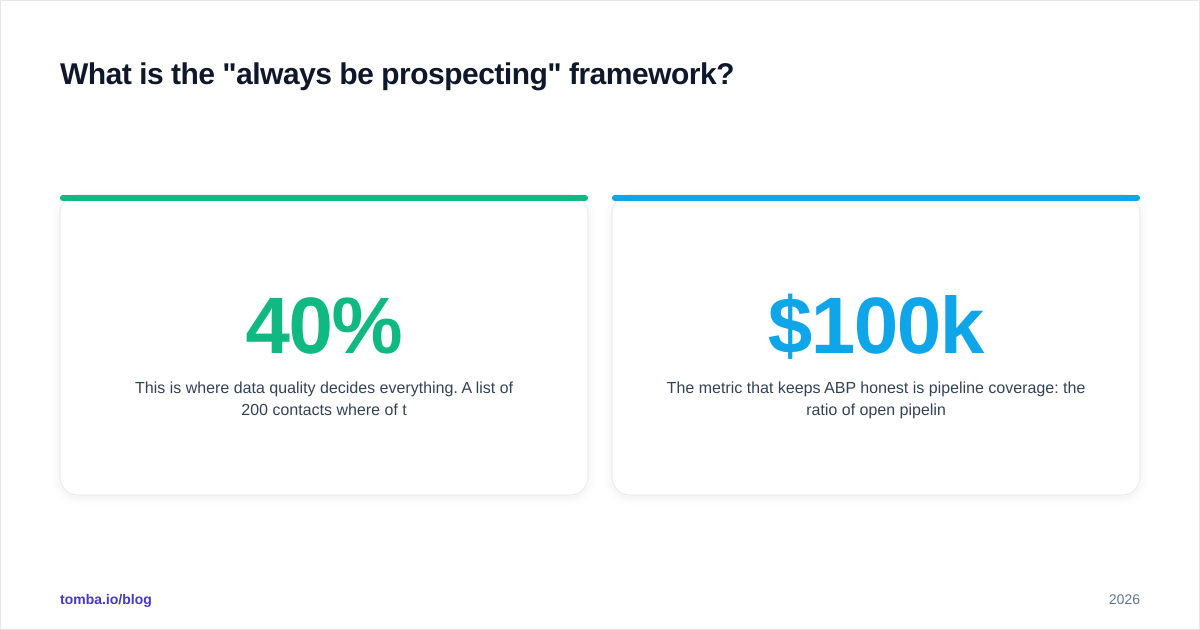
This is where data quality decides everything. A list of 200 contacts where 40% of the emails bounce is not a 200-contact list; it's a 120-contact list with a morale problem attached. Use a domain search to pull every reachable contact at a target company, then enrich the rows with titles and verified emails so your cadence doesn't die on send.
2. Run a multi-channel cadence#
A cadence is a scripted sequence of touches across channels over a fixed window — typically 10–14 touches across 2–3 weeks. Single-channel prospecting is fragile; if your prospect ignores email, you have no plan B. Mix email, phone, and LinkedIn so you meet the buyer where they actually pay attention. (Pull a buyer's mobile number with a phone finder so the call step isn't a guess.)
3. Protect a daily time block#
This is the part everyone skips and the part that makes ABP real. Block 30–60 minutes at the same time every day — ideally first thing, before email and meetings hijack your attention — and prospect. No Slack, no CRM admin, no "research" that's really procrastination. The block is sacred. If you only remember one sentence from this article, make it this one: a calendar block beats motivation every time.
4. Track pipeline coverage weekly#
The metric that keeps ABP honest is pipeline coverage: the ratio of open pipeline value to your quota for the period. If you need to close $100k and you have $300k in qualified pipeline, you're at 3x coverage. Most teams target 3x–4x. When coverage dips below your floor, that's your signal to prospect harder — long before the revenue gap appears.
ABC vs. ABP: how do they compare?#
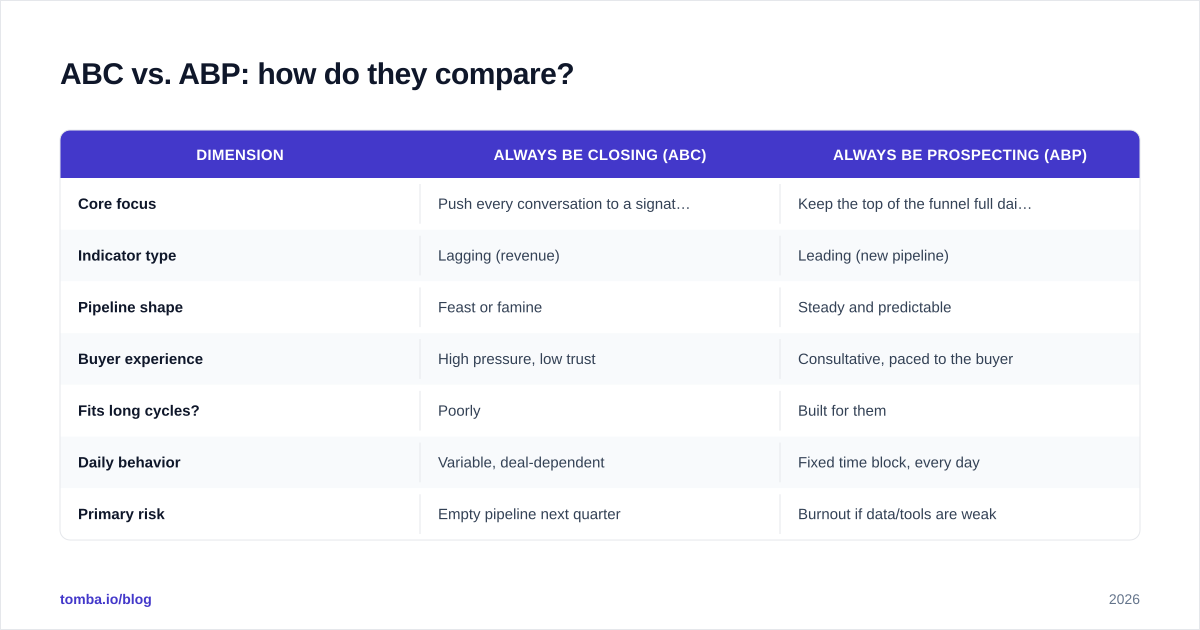
| Dimension | Always Be Closing (ABC) | Always Be Prospecting (ABP) |
|---|---|---|
| Core focus | Push every conversation to a signature | Keep the top of the funnel full daily |
| Indicator type | Lagging (revenue) | Leading (new pipeline) |
| Pipeline shape | Feast or famine | Steady and predictable |
| Buyer experience | High pressure, low trust | Consultative, paced to the buyer |
| Fits long cycles? | Poorly | Built for them |
| Daily behavior | Variable, deal-dependent | Fixed time block, every day |
| Primary risk | Empty pipeline next quarter | Burnout if data/tools are weak |
| Best for | Transactional, short cycles | B2B, considered purchases |
The honest takeaway: ABC isn't worthless. In a short, transactional sale, urgency works. But for the considered B2B purchases most reps live on in 2026, ABP is the system that protects your number across the whole year.
What does an "always be prospecting" day look like?#
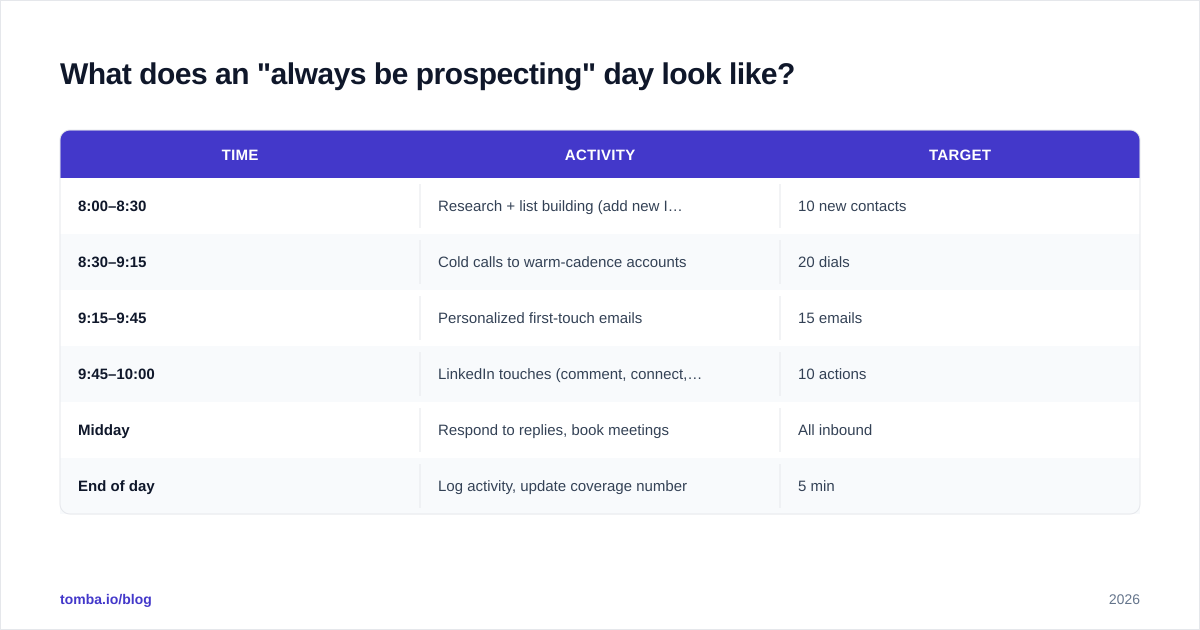
Here's a concrete daily template you can copy. Adjust the volumes to your motion — these are starting points for a mid-market SDR.
| Time | Activity | Target |
|---|---|---|
| 8:00–8:30 | Research + list building (add new ICP accounts) | 10 new contacts |
| 8:30–9:15 | Cold calls to warm-cadence accounts | 20 dials |
| 9:15–9:45 | Personalized first-touch emails | 15 emails |
| 9:45–10:00 | LinkedIn touches (comment, connect, DM) | 10 actions |
| Midday | Respond to replies, book meetings | All inbound |
| End of day | Log activity, update coverage number | 5 min |
The morning block is the engine. Notice that closing activity isn't on this list at all — meetings and demos happen later in the day and don't compete with the prospecting block. That separation is the whole point. When prospecting shares a time slot with everything else, it always loses.
A practical warning: protect the block from your own tools. Reps love to "get organized" inside the CRM and call it prospecting. It isn't. If a task doesn't put a new qualified human into your pipeline, it doesn't belong in the block.
Which metrics prove ABP is working?#
Track inputs and outputs separately so you can diagnose problems instead of just panicking about revenue. Inputs tell you whether you did the work; outputs tell you whether the work paid off.
Input metrics (you control these):
- Daily prospecting touches (calls + emails + social)
- New contacts added to the list per week
- Cadence completion rate (did you finish the sequence or quit at touch 3?)
Output metrics (results of the inputs):
- Reply rate and positive reply rate — benchmark yours against the broader response rate ranges for your channel
- Meetings booked per week
- Pipeline coverage ratio (the north star)
- Email deliverability and bounce rate
That last one is sneaky. If your bounce rate creeps up, your sender reputation drops, and soon your perfectly good emails land in spam — which silently tanks every other metric. Run new lists through an email verifier before you send, and keep an eye on email deliverability as a first-class metric, not an afterthought. A clean list is the cheapest deliverability upgrade you can buy.
How do tools make ABP sustainable?#
Always be prospecting is a willpower problem dressed up as a strategy problem — and tools are how you remove the willpower tax. The daily block only survives if the boring parts (finding contacts, verifying emails, logging activity) are fast. Every minute you spend hunting for an email address is a minute stolen from actual conversations.
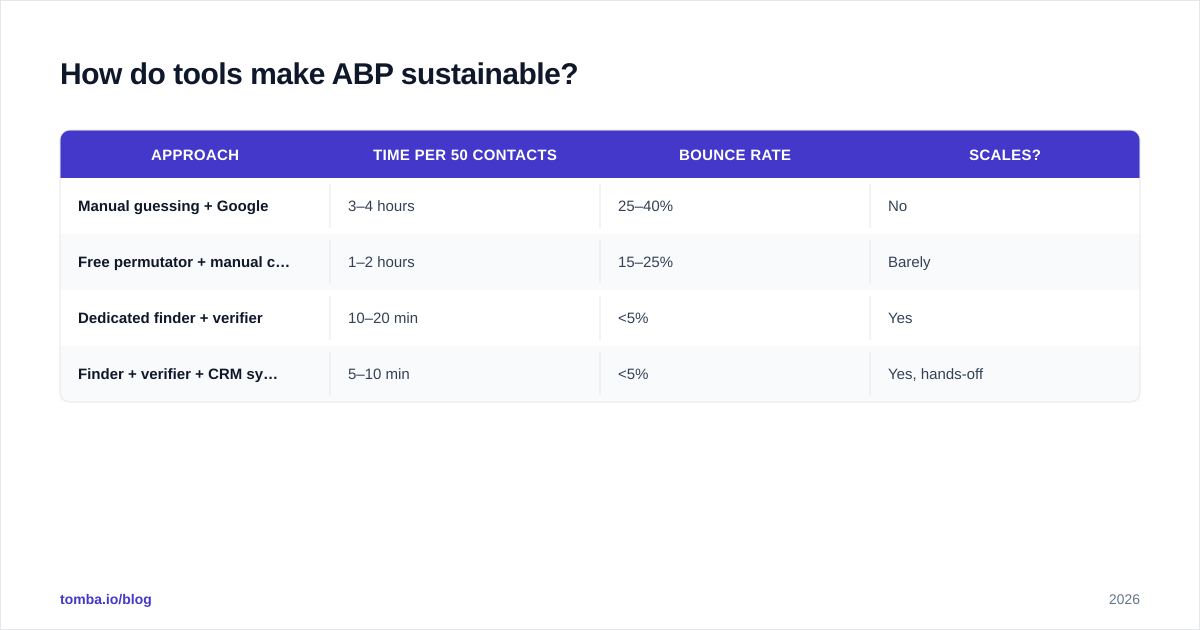
Here's how the workflow stacks up by approach:
| Approach | Time per 50 contacts | Bounce rate | Scales? |
|---|---|---|---|
| Manual guessing + Google | 3–4 hours | 25–40% | No |
| Free permutator + manual check | 1–2 hours | 15–25% | Barely |
| Dedicated finder + verifier | 10–20 min | <5% | Yes |
| Finder + verifier + CRM sync | 5–10 min | <5% | Yes, hands-off |
The pattern is obvious. The reps who keep ABP going for years are the ones who automated steps 1 and 2. Pull contacts with a finder, verify them in bulk, push them straight into your sequence, and protect the block for human conversations. For high-volume lists, a bulk email finder turns a morning of grunt work into a five-minute job, and a HubSpot integration keeps everything logged without manual data entry.
If you're comparing platforms, third-party reviews on G2 and Capterra are a sane place to sanity-check accuracy claims before you commit. And if you want to understand the discipline side of the habit rather than the tooling, HubSpot's sales blog has solid material on cadence design.
What are the most common ABP mistakes?#
Even reps who buy into the philosophy trip over the same five things:
- Treating ABP as "do it when I have time." You never have time. The block has to be scheduled, or it evaporates.
- Confusing activity with prospecting. Updating fields and "researching" can eat the whole block without producing one new conversation.
- Skipping verification. A big list with a 30% bounce rate damages your domain reputation and hides your real numbers.
- Single-channel dependence. Email-only cadences fold the moment a buyer's inbox gets crowded. Mix in phone and LinkedIn.
- Ignoring coverage until it's a crisis. By the time the revenue gap shows up, the prospecting you skipped is 60 days in the past. Watch coverage weekly so you catch the dip early.
Fix these and ABP stops being a slogan and starts being the reason your pipeline is boringly predictable — which, in sales, is the highest compliment there is.
Start prospecting smarter today#
The hardest part of "always be prospecting" isn't the philosophy — it's keeping the daily block productive instead of drowning in dead contacts and bounced emails. That's exactly the bottleneck Tomba removes. Use the Tomba Email Finder to pull verified, ready-to-contact email addresses by name, company, or domain in seconds, so your prospecting block goes to conversations instead of detective work. Pair it with the built-in verifier, start on the free tier (25 searches a month), and scale to the Starter plan at $49/mo when ABP becomes second nature — see full Tomba pricing for the rest. Plant a little every day. Your next quarter's pipeline is built by the prospecting you do this week.
Ready to find emails that actually work?
Join 150,000+ professionals who stopped guessing and started sending. Free credits on signup — no credit card required.
Get the Tomba newsletter
Practical outbound tactics and product updates — once every two weeks.
About the author