amoCRM vs Pipedrive 2026: Which CRM Is Right for You?
amoCRM (now Kommo) and Pipedrive both promise a tidy pipeline, but they win on opposite ground. Here is the honest 2026 breakdown of pricing, features, and fit.
Picking between amoCRM and Pipedrive feels harder than it should, mostly because they look similar from the pricing page and behave very differently once your reps are inside them all day. One is built around conversations; the other is built around deals. That single difference decides which one will actually fit your team.
TL;DR — amoCRM vs Pipedrive in 30 seconds#
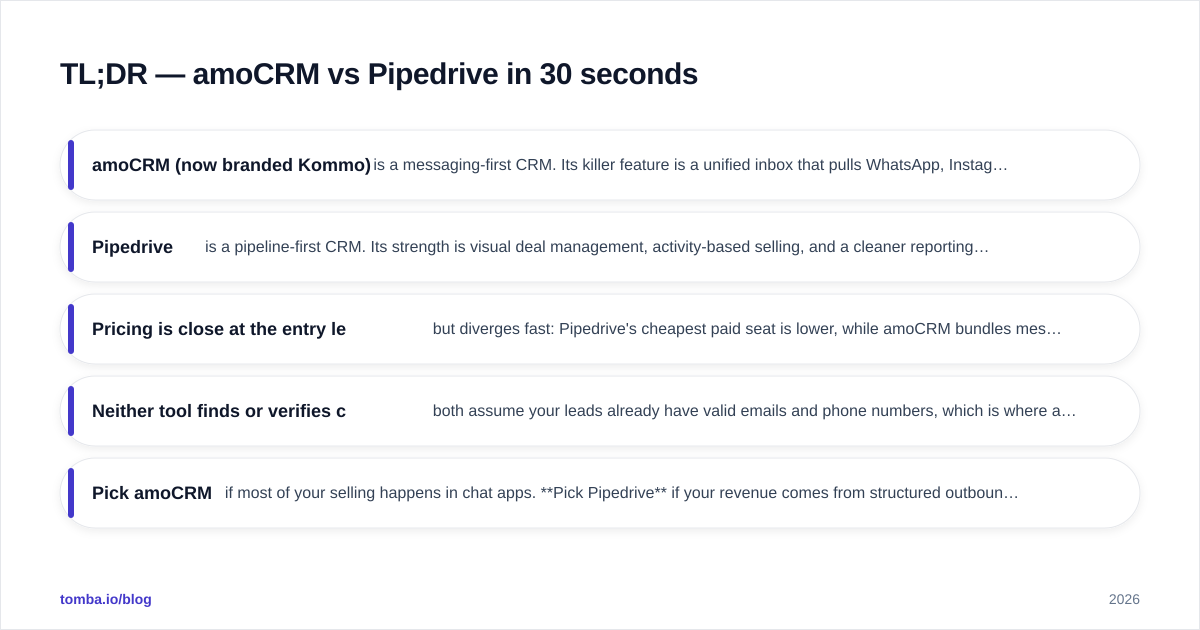
- amoCRM (now branded Kommo) is a messaging-first CRM. Its killer feature is a unified inbox that pulls WhatsApp, Instagram, Telegram, Facebook Messenger, and email into the deal record. Best for chat-driven, high-volume inbound sales.
- Pipedrive is a pipeline-first CRM. Its strength is visual deal management, activity-based selling, and a cleaner reporting layer. Best for outbound and consultative B2B teams that live in stages and forecasts.
- Pricing is close at the entry level but diverges fast: Pipedrive's cheapest paid seat is lower, while amoCRM bundles messaging automation that Pipedrive charges extra for.
- Neither tool finds or verifies contact data for you — both assume your leads already have valid emails and phone numbers, which is where a dedicated email finder earns its place in the stack.
- Pick amoCRM if most of your selling happens in chat apps. Pick Pipedrive if your revenue comes from structured outbound and you care about forecasting.
What is amoCRM (Kommo) and who is it for?#
amoCRM rebranded to Kommo in 2022, though the product, founders, and most of the documentation still carry the amoCRM DNA, and plenty of buyers search for the old name. At its core it is a sales CRM built for teams that sell through messengers rather than phone calls or formal email threads.
The defining feature is the unified chat inbox. When a prospect messages you on WhatsApp or Instagram, amoCRM creates or updates a lead automatically, threads the whole conversation into the deal card, and lets a rep reply from the same screen they manage the pipeline in. For a Shopify store, a real-estate agency, or an agency fielding DMs all day, that is genuinely powerful.
It also ships a no-code "Salesbot" builder for automating replies, qualifying leads, and nudging stale deals — the kind of conversational automation that competitors treat as a paid add-on.
What is Pipedrive and who is it for?#
Pipedrive is the more conventional sales CRM, and arguably the one that popularized the drag-and-drop visual pipeline. It was built by salespeople who were tired of CRMs designed for managers to report on reps rather than help reps close.
The philosophy is "activity-based selling": every deal should always have a next action attached to it, and the interface constantly pushes reps to schedule that next call, email, or meeting. Deals move left to right through customizable stages, and the reporting layer — forecasts, conversion rates, win/loss analysis — is noticeably more mature than amoCRM's.
Pipedrive leans into structured outbound. Email sync, templates, open/click tracking, a built-in (paid) caller, and a healthy marketplace of integrations make it a comfortable hub for B2B teams running sequences against a known account list. If you want to understand the broader category, this overview of revenue operations is a useful frame.
amoCRM vs Pipedrive: the head-to-head comparison#
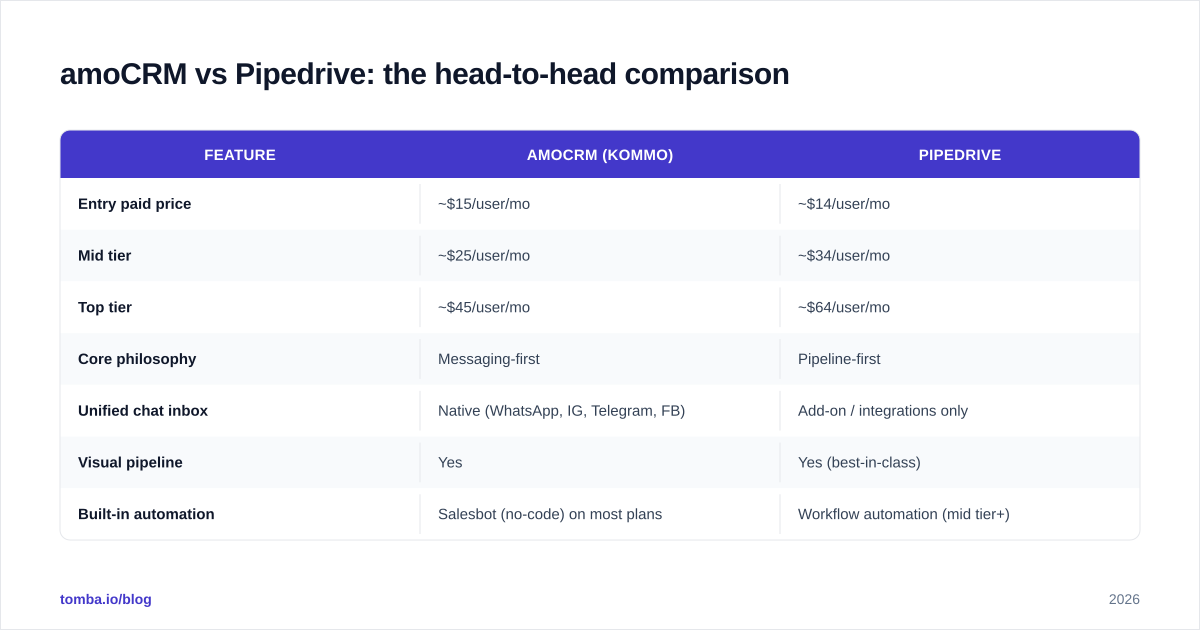
Here is where the two products actually diverge. Prices below reflect publicly listed per-user, per-month rates billed annually as of early 2026; always confirm current numbers on each vendor's pricing page since both adjust tiers regularly.
| Feature | amoCRM (Kommo) | Pipedrive |
|---|---|---|
| Entry paid price | ~$15/user/mo | ~$14/user/mo |
| Mid tier | ~$25/user/mo | ~$34/user/mo |
| Top tier | ~$45/user/mo | ~$64/user/mo |
| Core philosophy | Messaging-first | Pipeline-first |
| Unified chat inbox | Native (WhatsApp, IG, Telegram, FB) | Add-on / integrations only |
| Visual pipeline | Yes | Yes (best-in-class) |
| Built-in automation | Salesbot (no-code) on most plans | Workflow automation (mid tier+) |
| Forecasting & reporting | Basic | Advanced |
| Email sequences | Limited | Strong |
| Free tier | No (trial only) | No (trial only) |
| Best fit | Inbound chat sales | Outbound B2B sales |
A few honest caveats on that table. amoCRM's messaging features are the reason to buy it, so comparing it on forecasting alone undersells it. Likewise, Pipedrive can connect to WhatsApp and other channels through marketplace apps — it just is not native, and you pay for it in setup time and a monthly app fee.
Is amoCRM better than Pipedrive for automation?#
It depends on what you are automating. For conversational automation — auto-replying to a WhatsApp message, routing an Instagram DM to the right rep, qualifying a chat lead before a human touches it — amoCRM's Salesbot is more capable out of the box and available on lower tiers.
For process automation — moving a deal stage when an email is opened, creating follow-up tasks, triggering multi-step internal workflows — Pipedrive's workflow automation engine is more flexible and better documented, though it is gated behind the mid tier and up.
Think of it like two kinds of assistants. amoCRM's bot is a receptionist who handles incoming conversations gracefully. Pipedrive's automation is an operations manager who keeps the internal process moving. Most teams need one far more than the other, and knowing which is the fastest way to decide.
How do amoCRM and Pipedrive handle data quality?#
Neither does, and this is the part most comparison articles skip. Both amoCRM and Pipedrive are systems of record — they store and organize the contacts you put into them, but they do not source, find, or verify those contacts. Garbage in, garbage out applies fully.
In practice that means three gaps you have to fill yourself:
- Finding the email or phone in the first place when a lead arrives with only a name and a company.
- Verifying deliverability before you load thousands of addresses and torch your sender reputation.
- Enriching thin records with job title, company size, and social profiles so reps can prioritize.
This is where a data layer sits in front of the CRM. You can find emails by company with domain search, confirm they are safe to contact with an email verifier, and push clean records straight into Pipedrive through the native Pipedrive integration. amoCRM users can route the same data in via Zapier or the API. The CRM stays clean because the data was clean before it ever arrived.
amoCRM vs Pipedrive: pros and cons#
amoCRM (Kommo) pros and cons#
Pros
- Best-in-class unified messaging inbox across WhatsApp, Instagram, Telegram, and Facebook.
- No-code Salesbot included on most plans for conversational automation.
- Lower top-tier pricing than Pipedrive.
- Strong fit for inbound, chat-heavy, and ecommerce sales.
Cons
- Weaker forecasting and analytics.
- The Kommo/amoCRM rebrand created documentation and search confusion.
- Email-sequence tooling lags behind Pipedrive.
- Less of an "outbound B2B" feel.
Pipedrive pros and cons#
Pros
- Cleanest visual pipeline and activity-based selling model.
- Mature reporting, forecasting, and goal tracking.
- Large, well-maintained integration marketplace.
- Strong email sync and sequencing for outbound teams.
Cons
- Native messaging is missing — chat channels require paid add-ons.
- Automation and key reporting are locked behind higher tiers.
- Costs climb quickly as you move up plans and add the AI/caller extras.
- Can feel heavy for a tiny, chat-driven team.
You can sanity-check both products against verified buyer reviews on G2 before committing, since feature sets shift between releases.
Which CRM should you choose in 2026?#
Choose based on where your deals are actually born.
Choose amoCRM (Kommo) if: the majority of your leads reach you through messaging apps, you run an ecommerce or local-services business, you want conversational automation without buying a separate chatbot, and detailed forecasting is a nice-to-have rather than a requirement.
Choose Pipedrive if: your revenue comes from structured outbound or consultative selling, you need real pipeline forecasting and win/loss analysis, your reps work account lists and email sequences, and you want a deep integration ecosystem to build a wider GTM stack around.
A useful gut check: if your sales motion is "someone messages us and we respond," amoCRM was built for you. If your motion is "we identify accounts, reach out, and work them through stages," Pipedrive was built for you. For broader context on running that second motion, the CRM fundamentals overview pairs well with either tool.
Frequently asked questions#
Is amoCRM the same as Kommo? Yes. amoCRM rebranded to Kommo in 2022. The product is the same lineage, so older reviews and tutorials under the amoCRM name still largely apply.
Which is cheaper, amoCRM or Pipedrive? At the entry level they are nearly identical. Pipedrive's lowest paid seat edges slightly cheaper, but amoCRM's top tier is meaningfully cheaper than Pipedrive's, and amoCRM bundles messaging automation that Pipedrive charges extra for.
Can either CRM find email addresses for me? No. Both store contact data but do not source it. You need a dedicated finder and verifier in front of the CRM to keep records accurate.
Do both integrate with my other tools? Yes. Pipedrive has the larger native marketplace; amoCRM covers most needs through its API and Zapier. Both connect to enrichment and data tools.
Fill the gap both CRMs leave open#
amoCRM and Pipedrive are excellent at organizing the deals you feed them — neither one finds the contacts in the first place. Before a lead ever lands in your pipeline, Tomba's Email Finder turns a name and company into a verified, deliverable email address, so your reps spend their time selling instead of guessing addresses. Start free with 25 searches a month, scale up on the $49/mo Starter plan when you are ready, and check the full Tomba pricing to match the volume your CRM is hungry for. Clean data in, better forecasts out — whichever CRM you choose.
// get started
Find, verify and enrich your first contacts today
Start on the free plan with 25 searches a month, then scale when your team is ready.
Free plan · No credit card required · GDPR & CCPA
// about the author