Amplemarket vs ZoomInfo 2026: Which Sales Platform Wins?
Amplemarket bets on AI-driven outbound; ZoomInfo bets on the biggest B2B database. Here is the honest 2026 breakdown of pricing, data accuracy, and fit so you pick the right one.
TL;DR
- ZoomInfo is the heavyweight B2B database play: the deepest firmographic and intent data on the market, sold mostly through annual contracts that often start in the five figures.
- Amplemarket is an AI-native outbound platform: data plus sequencing, an AI "Duo" SDR layer, and deliverability tooling bundled into one workflow, priced per seat with credit packs.
- Pick ZoomInfo if you need maximum coverage, intent signals, and enterprise integrations and can absorb the cost and procurement cycle.
- Pick Amplemarket if you want a faster outbound engine for a small-to-mid sales team without stitching six tools together.
- If your real bottleneck is just accurate emails and enrichment at a sane price, a focused tool like Tomba Email Finder often beats paying platform money for data you barely use.
What are Amplemarket and ZoomInfo?#
Think of it like buying a car versus buying a whole logistics fleet. Amplemarket is the well-built car you drive yourself every day to close deals. ZoomInfo is the logistics fleet — enormous reach, expensive to run, and overkill unless you genuinely move at that scale.
ZoomInfo is a sales intelligence platform built around one of the largest commercial B2B databases in existence: hundreds of millions of contacts, company firmographics, technographics, org charts, and buyer-intent signals. Over the years it absorbed Chorus (conversation intelligence) and Engage (sales engagement), so it now markets itself as a full go-to-market operating system rather than just a data vendor.
Amplemarket is a younger, AI-first outbound platform. It combines a contact database, multichannel sequencing (email, LinkedIn, calls), deliverability and inbox-warmup tooling, and an AI assistant layer ("Duo") that drafts copy, scores leads, and flags buying signals like job changes. Its pitch is consolidation: replace your data tool, your sequencer, and half your manual research with one workflow.
The core difference in one line: ZoomInfo sells you the best data and lets you act on it; Amplemarket sells you the action and bundles good-enough data to feed it.
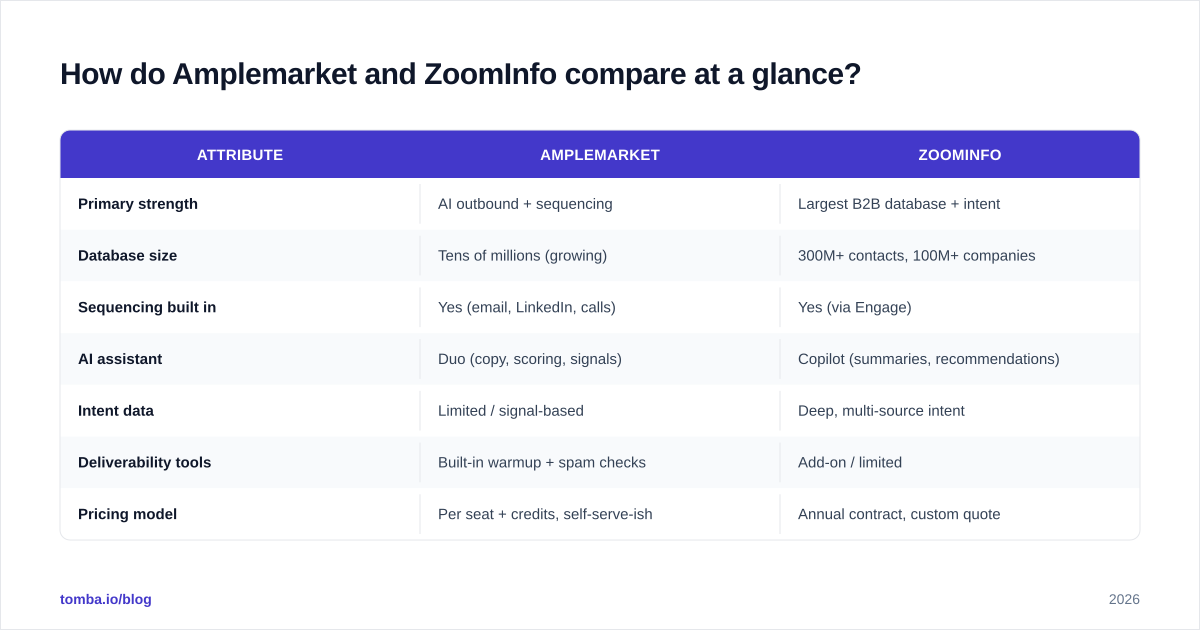
How do Amplemarket and ZoomInfo compare at a glance?#
Here is the side-by-side that matters before you talk to any sales rep.
| Attribute | Amplemarket | ZoomInfo |
|---|---|---|
| Primary strength | AI outbound + sequencing | Largest B2B database + intent |
| Database size | Tens of millions (growing) | 300M+ contacts, 100M+ companies |
| Sequencing built in | Yes (email, LinkedIn, calls) | Yes (via Engage) |
| AI assistant | Duo (copy, scoring, signals) | Copilot (summaries, recommendations) |
| Intent data | Limited / signal-based | Deep, multi-source intent |
| Deliverability tools | Built-in warmup + spam checks | Add-on / limited |
| Pricing model | Per seat + credits, self-serve-ish | Annual contract, custom quote |
| Typical entry cost | Low four figures/year | Often $15k+/year |
| Contract flexibility | More flexible | Annual lock, multi-year common |
| Best for | SMB to mid-market outbound teams | Mid-market to enterprise GTM |
Is ZoomInfo's data actually better?#
Short answer: usually yes on coverage, not always on cost-efficiency.
ZoomInfo's database is the reason most enterprises buy it. If you sell into a niche vertical, need verified org charts, or run account-based plays that depend on knowing every stakeholder at a 5,000-person company, ZoomInfo's depth is hard to beat. Its intent data — aggregating signals from a large publisher co-op — tells you which accounts are researching your category right now, which is genuinely valuable for prioritization.
Amplemarket's database is smaller but more tightly coupled to outreach. Its data is "good enough to send to" and its real edge is the enrichment and verification that happens at the moment you build a sequence, plus signal triggers (a prospect changed jobs, a company is hiring for a relevant role) that fire automatically.
But raw database size is a vanity metric if you only need a few thousand accurate contacts a month. Both platforms charge a premium for data you may never touch. This is where a dedicated email tool earns its keep: you can run targeted data enrichment and verify emails against either platform's export, catching the stale records before they wreck your bounce rate. No database is 100% fresh — people change jobs constantly — so a verification step is non-negotiable regardless of which vendor you choose.

How much do Amplemarket and ZoomInfo cost in 2026?#
This is where the two diverge most sharply, and where the marketing pages stay vague on purpose.
**
ZoomInfo** does not publish standard pricing. Deals are quoted per seat with platform fees layered on top, and most teams report annual commitments starting around $15,000 and climbing fast with add-ons (intent, Engage, Chorus, API access, extra credits). Multi-year contracts and steep overage fees are common. Procurement is a real project — expect demos, negotiation, and legal review.
Amplemarket is more transparent and more flexible. It sells per seat with monthly credit allowances for finding and verifying contacts, and entry plans land in the low four figures per year per seat. There is still a sales conversation, but the gap between "interested" and "sending sequences" is days, not months.
For comparison, a focused finder like Tomba is radically cheaper because it does one job well. Tomba's tiers run Free (25 searches/mo), Starter $49/mo, Growth $99/mo, Pro $249/mo, and Enterprise custom — see full Tomba pricing for limits. That is not a like-for-like swap for a full GTM platform, but it reframes the question: how much of what you are paying ZoomInfo or Amplemarket for is data you could source for a fraction of the price?
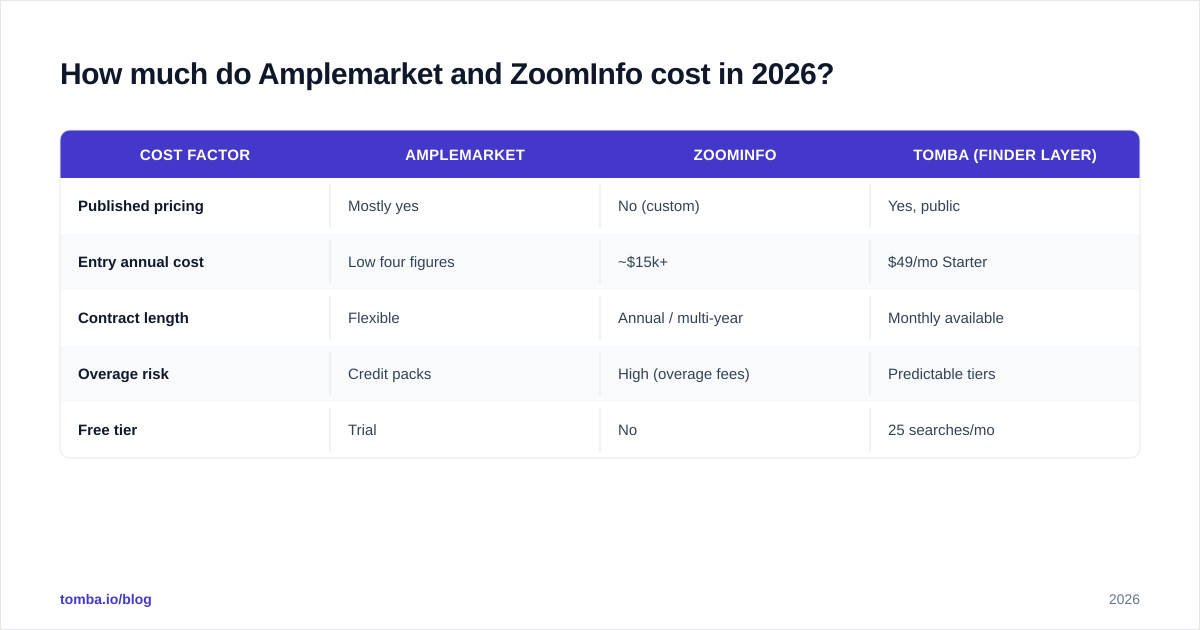
| Cost factor | Amplemarket | ZoomInfo | Tomba (finder layer) |
|---|---|---|---|
| Published pricing | Mostly yes | No (custom) | Yes, public |
| Entry annual cost | Low four figures | ~$15k+ | $49/mo Starter |
| Contract length | Flexible | Annual / multi-year | Monthly available |
| Overage risk | Credit packs | High (overage fees) | Predictable tiers |
| Free tier | Trial | No | 25 searches/mo |
Which one is better for outbound and AI workflows?#
Amplemarket wins on day-to-day outbound velocity for most teams.
Because Amplemarket was built outbound-first, the loop from "find a lead" to "send a personalized multichannel sequence" lives in one place. Its Duo AI drafts opening lines from a prospect's recent activity, scores which leads to prioritize, and surfaces buying signals without you running manual searches. The built-in deliverability layer — warmup, spam-word checks, sending limits — is the kind of thing teams usually bolt on with a separate tool, and it directly protects your email deliverability and sender reputation.
ZoomInfo can do outbound through Engage and offers Copilot for AI summaries and recommendations, but it feels like a powerful data platform that added a sequencer, not a sequencer with data. For teams whose primary motion is research-heavy ABM and routing intent signals to reps inside Salesforce, that is exactly right. For a lean team that just wants to prospect and send, it is more machinery than needed.

The diagram below maps where each platform sits in a typical outbound process.
What are the pros and cons of each?#
ZoomInfo pros
- Deepest contact and company coverage available
- Strong, multi-source intent data for prioritization
- Mature enterprise integrations (Salesforce, HubSpot, Marketo)
- Conversation intelligence (Chorus) under one roof
ZoomInfo cons
- Expensive, opaque pricing with annual lock-in
- Overage fees and add-on creep
- Heavier than small teams need
- Long procurement cycle
Amplemarket pros
- AI-native outbound in a single workflow
- Built-in deliverability and warmup
- More transparent, flexible pricing
- Fast time-to-value for SMB/mid-market
Amplemarket cons
- Smaller database than ZoomInfo
- Less depth on intent and enterprise ABM
- Fewer native integrations than ZoomInfo's ecosystem
- Still a sales-led purchase
If Amplemarket's price or scope feels off, it is worth scanning a neutral roundup on G2 and weighing an Amplemarket alternative before committing to a seat count.
Which should you choose: Amplemarket or ZoomInfo?#
Match the tool to your actual motion, not your ambition.
Choose ZoomInfo if you are mid-market or enterprise, run account-based selling, depend on intent data to time outreach, need verified org charts in complex accounts, and have budget plus procurement patience. You are buying coverage and signal, and nobody does that at greater scale.
Choose Amplemarket if you are an SMB or mid-market team that wants to prospect, personalize, and send from one place without managing a stack of point tools. You are buying speed and an AI assist, and you want pricing you can reason about.
Choose neither — yet — if your bottleneck is simpler than either vendor assumes. A lot of teams buy a platform to solve what is really a contact-data problem: bounced emails, stale records, missing addresses for known accounts. In that case, layer a precise finder and verifier on top of the CRM you already have. You can pull emails by company with domain search, enrich a list in bulk, and verify before you send — for a tiny fraction of platform pricing.
How does a focused email tool fit alongside these platforms?#
It fills the accuracy gap both platforms quietly leave open.
No B2B database stays perfectly current. Whether you run ZoomInfo, Amplemarket, or a spreadsheet of scraped LinkedIn data, the highest-leverage move before any send is verification. Feeding your exports through an independent finder-and-verifier catches the records that have gone stale since the platform last refreshed them, which is the difference between a clean inbox placement and a spam-folder spiral. That is the most common, least glamorous reason outbound underperforms — and it is cheap to fix.
The bottom line#
ZoomInfo is the database king with enterprise-grade depth and enterprise-grade pricing. Amplemarket is the AI-native challenger that consolidates outbound into one fast, more affordable workflow. Neither is "better" in the abstract — they serve different team sizes and motions.
But before you sign any annual contract, pressure-test how much of your spend is really about finding and trusting contact data. If that is your core need, start with Tomba Email Finder to get accurate, verified professional emails by name, company, or domain — on a free tier and predictable plans — and let your platform budget go toward the capabilities you'll actually use every day.
// get started
Find, verify and enrich your first contacts today
Start on the free plan with 25 searches a month, then scale when your team is ready.
Free plan · No credit card required · GDPR & CCPA
// about the author