Ampliz Pros and Cons (2026): Honest Review for B2B Teams
A neutral 2026 breakdown of Ampliz pros and cons — data accuracy, pricing, APAC and healthcare coverage, and where lighter tools fit better.
Ampliz markets itself as a B2B contact-intelligence platform with unusually deep healthcare and Asia-Pacific (APAC) data. That niche focus is real, and for some teams it's the whole reason to buy. For others, it's an expensive way to get data they could source faster and cheaper elsewhere. This post lays out the Ampliz pros and cons without the marketing gloss, so you can decide where it fits — and where it doesn't.
TL;DR — Ampliz at a glance#
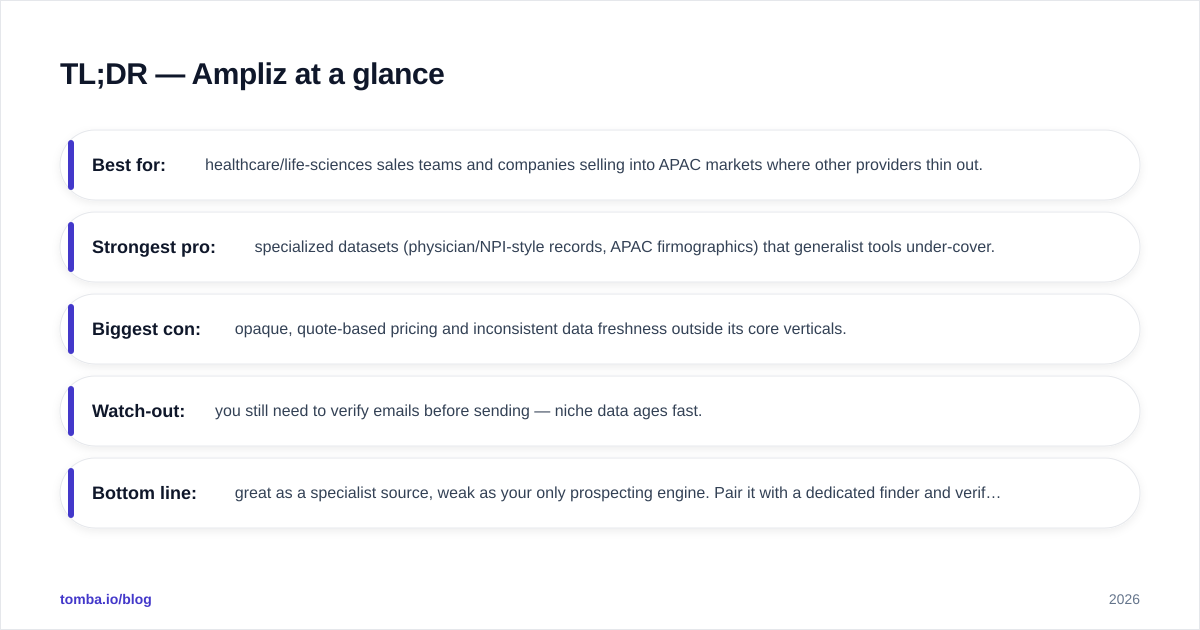
- Best for: healthcare/life-sciences sales teams and companies selling into APAC markets where other providers thin out.
- Strongest pro: specialized datasets (physician/NPI-style records, APAC firmographics) that generalist tools under-cover.
- Biggest con: opaque, quote-based pricing and inconsistent data freshness outside its core verticals.
- Watch-out: you still need to verify emails before sending — niche data ages fast.
- Bottom line: great as a specialist source, weak as your only prospecting engine. Pair it with a dedicated finder and verifier.
What is Ampliz and who is it for?#
Ampliz is a sales-intelligence and data-enrichment vendor. Its pitch centers on two things generalist databases handle poorly: healthcare contact data (hospitals, clinics, practitioners, decision-makers tied to specialties) and APAC market coverage (India, Singapore, Australia, and surrounding regions). On top of the raw data, it sells enrichment APIs, a Chrome extension, intent signals, and list-building tools.
The honest framing: Ampliz is a specialist dressed in generalist clothing. If your ICP lives inside its strong verticals, the depth is genuinely useful. If you're selling generic SaaS to North American mid-market accounts, you're paying for coverage you won't use while competing tools do that job better.
To evaluate any data vendor — Ampliz included — score it on five axes rather than a single "is it accurate?" gut check. The framework above maps the dimensions that actually move pipeline: coverage of your ICP, record freshness, verification quality, integration friction, and true cost per usable contact.
What are the main pros of Ampliz?#
1. Genuine healthcare depth. This is the headline strength. Generalist providers treat "Dr. Jane Smith, Cardiology" as one more row; Ampliz structures around specialty, facility type, and role. For medical-device, pharma, and health-IT sellers, that granularity shortens list-building.
2. APAC coverage that doesn't fall off a cliff. Most US-built databases get sparse east of Europe. Ampliz keeps reasonable firmographic and contact density across India and Southeast Asia, which is rare and hard to replicate by scraping.
3. Enrichment API and Chrome extension. You can push contacts into your workflow programmatically or grab them from LinkedIn and company sites. The API is the part power users like — it slots into custom enrichment jobs without manual exports.
4. Intent and firmographic layering. Beyond names and emails, you get company attributes and intent signals you can filter on, which helps prioritize accounts instead of blasting a flat list.
5. Human-assisted list building. For accounts that matter, Ampliz offers custom list services — useful when self-serve filters can't express a weird, specific ICP.

What are the main cons of Ampliz?#
1. Opaque, quote-based pricing. There's no clean public price ladder you can reason about. You talk to sales, you get a custom number, and comparison shopping gets harder. For small teams that just want to start, this is friction — and often a budget surprise.
2. Data freshness is inconsistent outside the core. Niche data is a double-edged sword: it's deep where it's deep, and stale where it isn't. Contacts in non-priority regions or verticals can lag, which means more bounces if you skip verification.
3. You still have to verify. No B2B database — Ampliz, ZoomInfo, Apollo, anyone — should be trusted to send-ready accuracy on export. Treating Ampliz output as pre-verified is how sender reputation gets wrecked. Run every list through an email verifier before the first send.
4. Overkill for generalist ICPs. If you're not selling into healthcare or APAC, you're paying a specialist premium for data that broader, cheaper tools cover just as well.
5. UI and onboarding friction. Reviewers on G2 repeatedly mention a learning curve and occasional credit-burn confusion. Not fatal, but it slows ramp.
How does Ampliz compare to the alternatives in 2026?#
No single tool wins every column. Here's how Ampliz stacks against the categories of tools teams actually evaluate alongside it.
| Factor | Ampliz | Generalist DB (e.g. Apollo/ZoomInfo) | Dedicated finder + verifier (e.g. Tomba) |
|---|---|---|---|
| Healthcare/APAC depth | Excellent | Fair to good | Good (domain + pattern based) |
| Pricing transparency | Quote-only, opaque | Tiered, mid-to-high | Public: Free → $49 → $99 → $249/mo |
| Free tier | Limited/trial | Limited | 25 free searches/mo |
| Email verification | Add-on, verify yourself | Built-in, variable | Native verifier + catch-all checks |
| API / automation | Strong API | Strong API | Email finder API, CLI, MCP |
| Best fit | Niche verticals | Broad NA/EU outbound | Accurate, cost-controlled finding at scale |
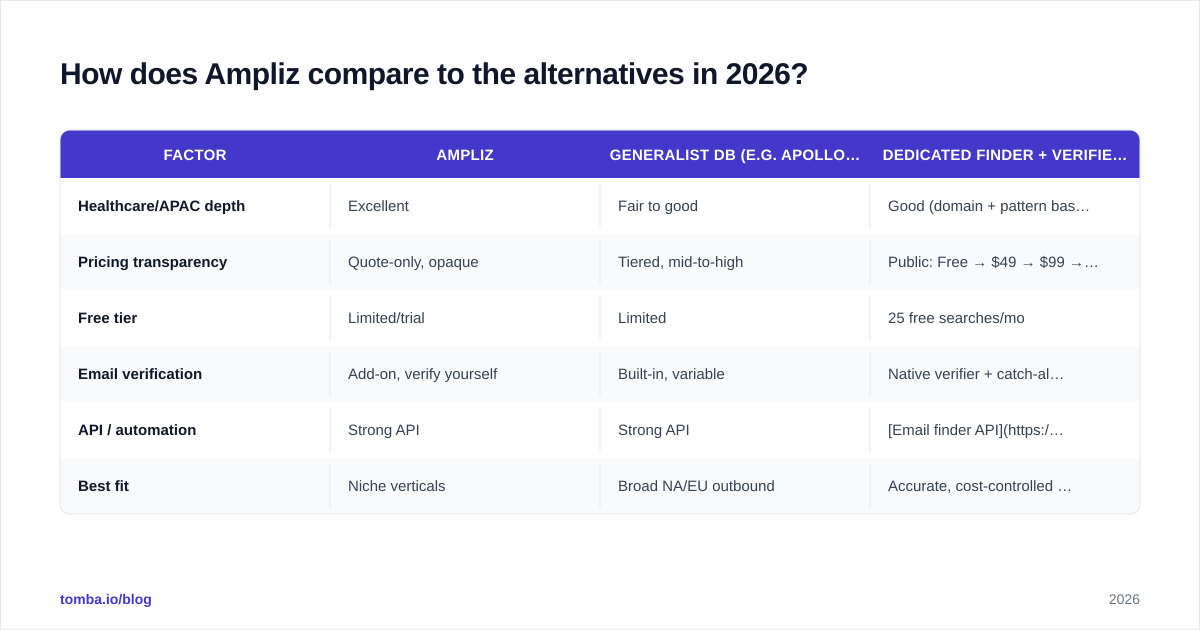
The takeaway: Ampliz competes on specialist coverage, not on price or breadth. If transparency and cost-per-usable-contact matter more than vertical depth, a dedicated email finder paired with a verifier usually wins on economics. If your ICP is genuinely healthcare or APAC, Ampliz earns its premium — but you'll still bolt a verifier onto the workflow.

Is Ampliz worth the price?#
It depends almost entirely on how much of your ICP lives inside its strong zones. A useful way to decide: estimate your cost per usable contact, not your monthly bill.
- Pull a sample list for your real ICP.
- Verify it (deliverable vs. bounced vs. catch-all).
- Divide spend by the count of contacts that are both on-target and deliverable.
If Ampliz returns dense, fresh records for your niche, that number can beat generalist tools because you waste fewer credits on irrelevant rows. If half your sample is stale or off-ICP, the specialist premium stops making sense — and you're better served by transparent Tomba pricing plus targeted enrichment.
Two financial cautions worth stating plainly:
- Quote-based pricing favors the vendor. Without a public ladder, you can't easily benchmark renewals. Get multi-year terms in writing and cap overage rates.
- Verification is a line item, not a freebie. Budget for it regardless of vendor. A "cheap" list that bounces 20% is the expensive one once you count sender reputation damage.
When should you choose Ampliz over a finder like Tomba?#
Choose Ampliz when:
- Healthcare/life-sciences or APAC is your core market, not a side segment.
- You need specialty- and facility-level filtering generalists can't express.
- You have budget for quote-based enterprise pricing and a buyer who'll negotiate.
Choose a dedicated finder + verifier when:
- You want transparent, predictable pricing and a real free tier to test first.
- Your prospecting is domain- and role-driven (find the right person at a known company).
- Deliverability and cost control matter more than vertical-specific depth.
- You want to enrich at scale via API, CLI, or bulk lead generation without per-seat negotiation.
These aren't mutually exclusive. A common 2026 setup: Ampliz (or a similar specialist) as a source for hard-to-reach verticals, a finder to fill domain-based gaps, and a verifier as the mandatory gate before any campaign. That stack gives you depth where you need it and economics everywhere else.
How do you get clean, send-ready contacts from any data source?#
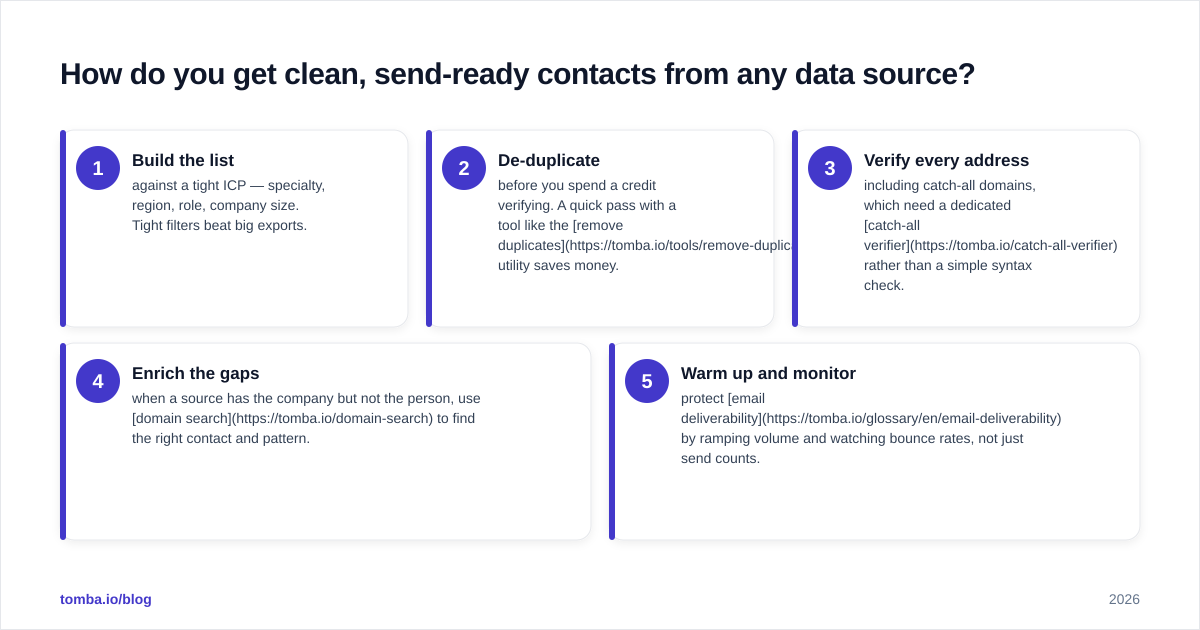
Whatever vendor you pick, the workflow that protects deliverability looks the same:
- Build the list against a tight ICP — specialty, region, role, company size. Tight filters beat big exports.
- De-duplicate before you spend a credit verifying. A quick pass with a tool like the remove duplicates utility saves money.
- Verify every address — including catch-all domains, which need a dedicated catch-all verifier rather than a simple syntax check.
- Enrich the gaps — when a source has the company but not the person, use domain search to find the right contact and pattern.
- Warm up and monitor — protect email deliverability by ramping volume and watching bounce rates, not just send counts.
Skip step 3 and the quality of your source stops mattering — a pristine Ampliz record still bounces if the person left the company last quarter.
Frequently asked questions about Ampliz#
Is Ampliz accurate? In its core verticals (healthcare, APAC), accuracy is competitive and often better than generalists. Outside those, freshness varies — always verify before sending.
Does Ampliz publish pricing? No. Pricing is quote-based and tied to data volume, seats, and modules. Expect to negotiate; benchmark against transparent alternatives first.
Can Ampliz replace my email finder and verifier? Not cleanly. It's a data source, not a deliverability tool. You'll still want a dedicated verifier and, for domain-driven prospecting, a finder.
Who competes with Ampliz? On the data-breadth side, ZoomInfo and Apollo. On cost-controlled finding and verification, dedicated tools like Tomba. The right comparison depends on whether you're buying depth or economics.
The verdict on Ampliz pros and cons#
Ampliz is a sharp tool for a specific job. Its pros — healthcare depth, APAC coverage, a solid enrichment API — are real and hard to replicate. Its cons — opaque pricing, uneven freshness outside the core, and the fact that you still must verify everything — mean it's a poor fit as your only data engine. Buy it for the niche it owns; don't overpay for it to do work a transparent finder does better.
If most of your prospecting is "find the right person at a known company, verified, without negotiating a contract," start with the Tomba Email Finder. You get 25 free searches a month to test accuracy on your own ICP, public pricing from $49/mo, and a native verifier plus catch-all checks so the contacts you export are ones you can actually send to. Use a specialist like Ampliz where its depth pays off — and let a dedicated finder handle the everyday volume at a price you can predict.
// get started
Find, verify and enrich your first contacts today
Start on the free plan with 25 searches a month, then scale when your team is ready.
Free plan · No credit card required · GDPR & CCPA
// about the author