Ampliz Reviews 2026: Features, Pricing, and Top Alternatives
An honest breakdown of Ampliz in 2026 — what its healthcare and APAC data does well, where the accuracy slips, real pricing, and the alternatives worth testing first.
You are weighing Ampliz for B2B contact data — probably for healthcare or APAC outreach — and you want to know if the data holds up before you commit a budget line to it. This review walks through what Ampliz actually does, where it is strong, where the cracks show, what it costs in 2026, and which alternatives deserve a side-by-side test.
TL;DR#
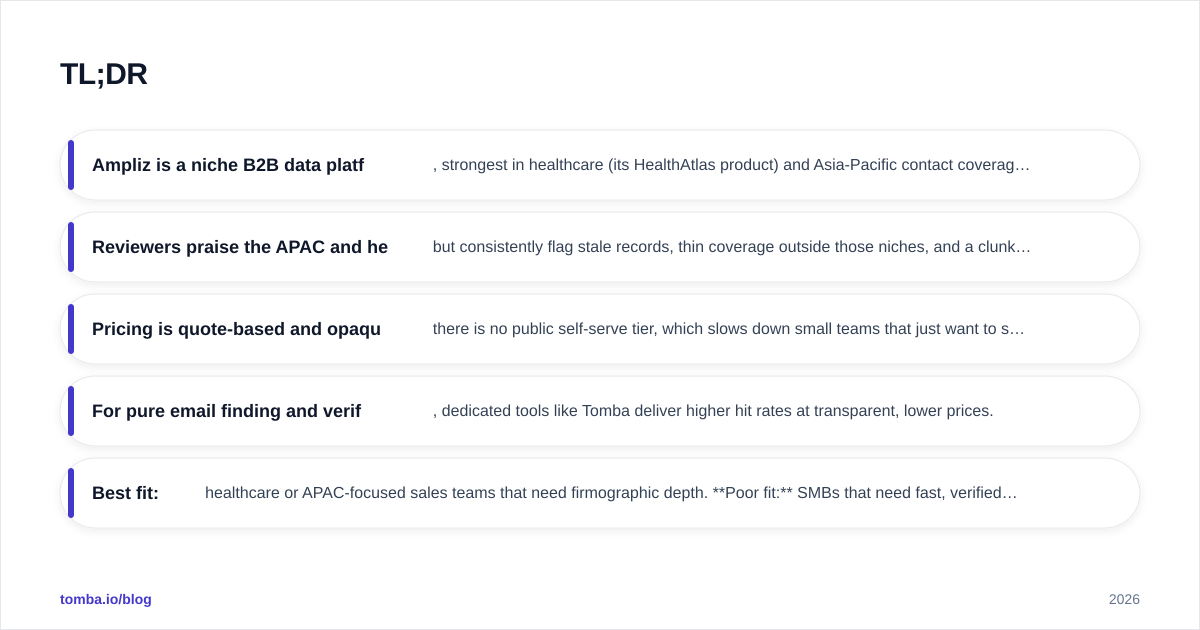
- Ampliz is a niche B2B data platform, strongest in healthcare (its HealthAtlas product) and Asia-Pacific contact coverage — not a general-purpose email finder.
- Reviewers praise the APAC and healthcare depth but consistently flag stale records, thin coverage outside those niches, and a clunky credit model.
- Pricing is quote-based and opaque — there is no public self-serve tier, which slows down small teams that just want to start.
- For pure email finding and verification, dedicated tools like Tomba deliver higher hit rates at transparent, lower prices.
- Best fit: healthcare or APAC-focused sales teams that need firmographic depth. Poor fit: SMBs that need fast, verified emails across all regions.
What is Ampliz?#
Ampliz is a B2B data and sales intelligence company that sells contact and company records, with a sharp specialization in two areas: healthcare data (doctors, hospitals, decision-makers) and Asia-Pacific market coverage. Think of it less like a Swiss-army email finder and more like a regional specialist shop — deep stock in two aisles, lighter everywhere else.
The platform bundles a few products: Ampliz Salesify (general B2B contact and company intelligence), Ampliz HealthAtlas (the healthcare-specific database), and a contact and email lookup layer with a Chrome extension. You search by company, title, geography, or specialty, then export contacts or push them into your workflow. You can read the vendor's own positioning on the official Ampliz site.
If your entire motion is "find a verified work email for this person at this domain," that is a narrower job than what Ampliz is built for — and a job where a focused email finder tends to win on both speed and accuracy.
How does Ampliz work? A buyer's framework#
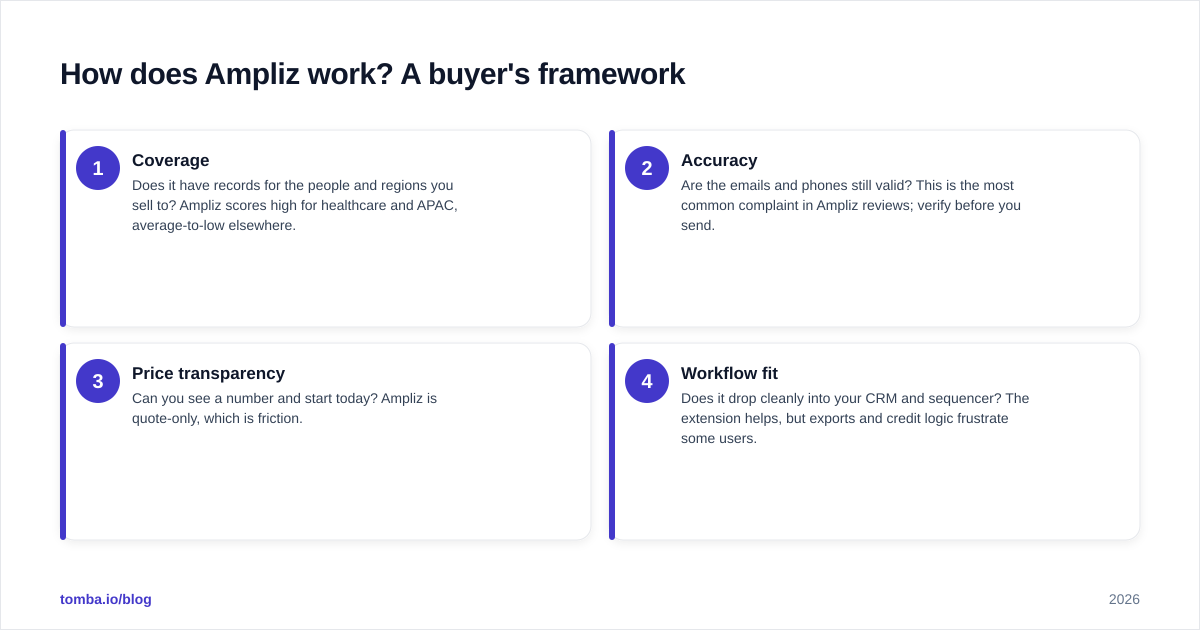
Before judging any data vendor, score it on the same four axes. Ampliz looks very different depending on which one you weight most.
- Coverage — Does it have records for the people and regions you sell to? Ampliz scores high for healthcare and APAC, average-to-low elsewhere.
- Accuracy — Are the emails and phones still valid? This is the most common complaint in Ampliz reviews; verify before you send.
- Price transparency — Can you see a number and start today? Ampliz is quote-only, which is friction.
- Workflow fit — Does it drop cleanly into your CRM and sequencer? The extension helps, but exports and credit logic frustrate some users.
Run any tool through this grid and the trade-offs become obvious. Ampliz is a coverage specialist that asks you to absorb accuracy and pricing friction in exchange for niche depth.
Is Ampliz data accurate?#
Accuracy is the make-or-break question, and the honest answer is: it depends heavily on the segment.
In healthcare and APAC, multiple reviewers report solid, hard-to-find records — specialty physicians, regional decision-makers, and firmographics that broader databases simply miss. Outside those niches, the same reviewers describe bounced emails, outdated titles, and records that clearly were not re-verified recently. On review sites like G2 and Capterra, the recurring theme is "great niche data, inconsistent freshness."

The practical takeaway: never send to an Ampliz export without a verification pass. Run the list through a dedicated email verifier first. Treating any third-party database — Ampliz included — as pre-cleaned is how you torch your sender reputation. If you want to understand why that matters, the mechanics of email deliverability explain how a few percent of bounces can sink a whole campaign.
How much does Ampliz cost in 2026?#
Here is the part that frustrates buyers most: Ampliz does not publish self-serve pricing. Plans are credit-based and quote-driven, so you talk to sales, describe your volume, and get a custom number. Reported figures from user reviews land in the range of a few thousand dollars per year for healthcare-focused plans, but your mileage will vary by data volume and product mix.
That opacity is a real cost. A solo founder or a three-person SDR team often just wants to swipe a card and start today — and Ampliz makes them book a call instead. Compare that to the fully public Tomba pricing, where you can see every tier before you commit.
Ampliz vs. the alternatives: a side-by-side#
Here is how Ampliz stacks up against three common alternatives for B2B contact data and email finding. Prices reflect publicly listed self-serve tiers as of 2026; Ampliz remains quote-only.
| Attribute | Ampliz | Tomba | Apollo | ZoomInfo |
|---|---|---|---|---|
| Starter price | Quote only | $49/mo | ~$49/user/mo | Quote only |
| Free tier | Limited trial | 25 searches/mo | 5 free credits/mo style | No |
| Core strength | Healthcare + APAC | Email finding + verification | All-in-one prospecting | Enterprise firmographics |
| Email verification | Add-on | Built in | Built in | Built in |
| Public pricing | No | Yes | Yes | No |
| Best for | Niche healthcare/APAC | SMB email outreach | Mid-market prospecting | Enterprise GTM |
| Catch-all handling | Limited | Dedicated catch-all verifier | Basic | Basic |
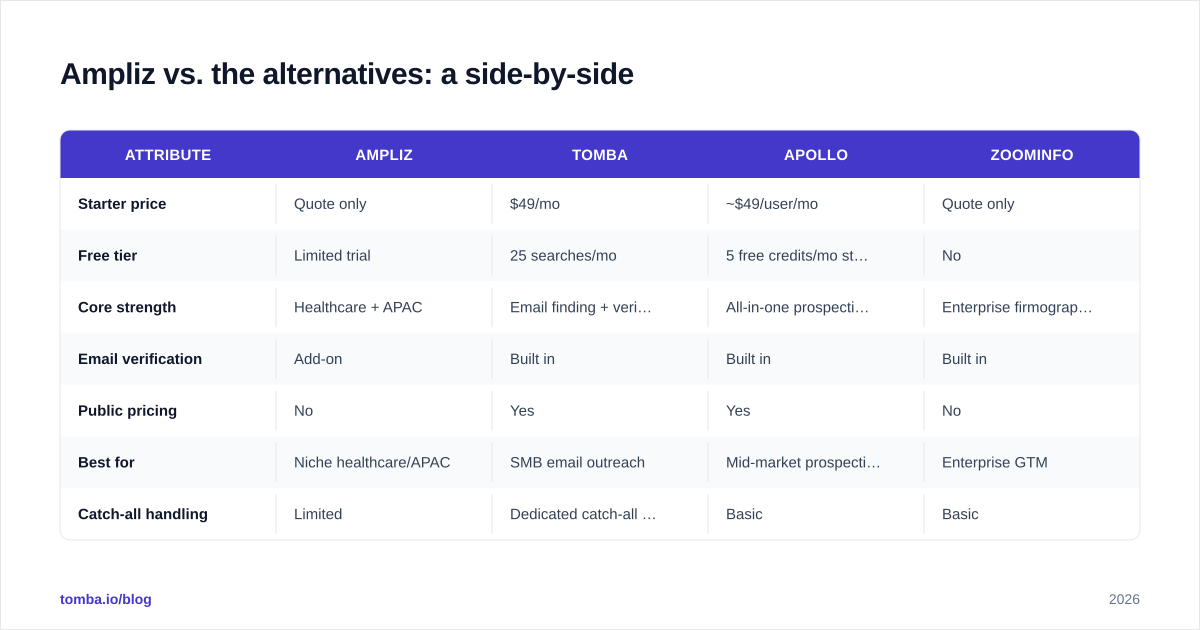
The pattern is clear. Ampliz wins when your ICP lives inside its niche. For broad, transparent, verification-first email finding, a focused tool is the simpler buy.

What do Ampliz reviews say? Pros and cons#
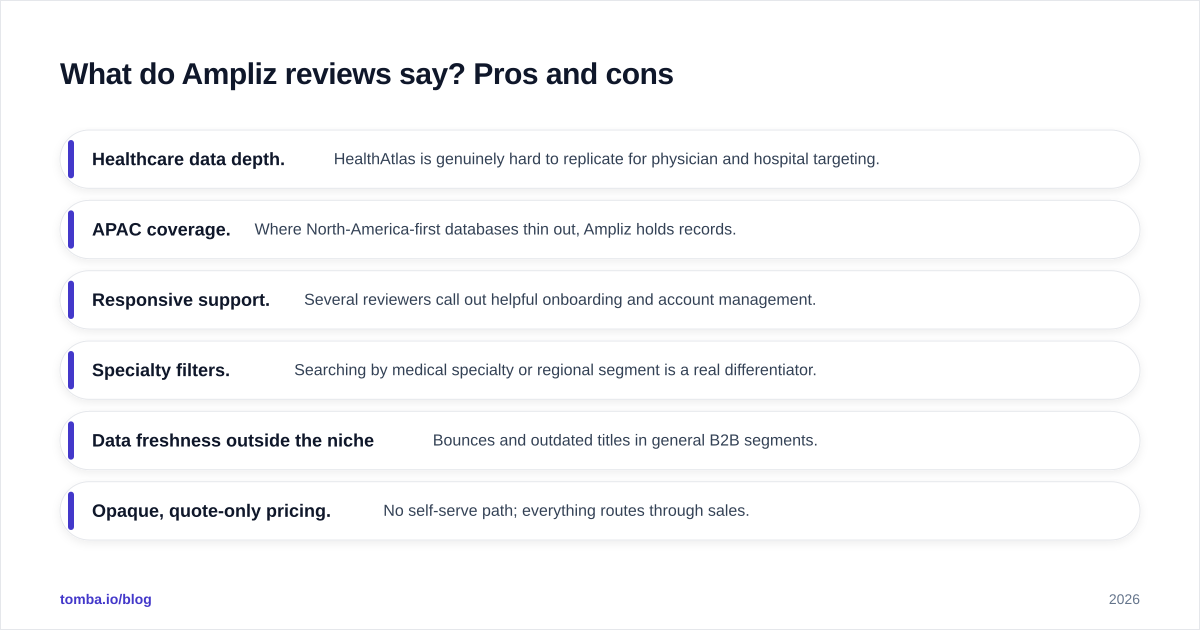
Pulling together the consistent threads from public Ampliz reviews:
What users like:
- Healthcare data depth. HealthAtlas is genuinely hard to replicate for physician and hospital targeting.
- APAC coverage. Where North-America-first databases thin out, Ampliz holds records.
- Responsive support. Several reviewers call out helpful onboarding and account management.
- Specialty filters. Searching by medical specialty or regional segment is a real differentiator.
What users criticize:
- Data freshness outside the niche. Bounces and outdated titles in general B2B segments.
- Opaque, quote-only pricing. No self-serve path; everything routes through sales.
- Credit model confusion. Users report uncertainty about what consumes credits and how fast.
- Export and UI friction. Getting data into a CRM is more manual than with newer tools.
- Coverage gaps. Outside healthcare and APAC, you will hit empty searches.

Who should actually use Ampliz?#
Match the tool to the job. Ampliz is the right call in a specific set of situations and the wrong one in others.
Strong fit:
- You sell into healthcare — devices, pharma, SaaS for clinics, staffing — and need physician-level targeting.
- Your market is Asia-Pacific and you keep hitting coverage holes in US-centric databases.
- You have a defined ICP in those niches and the budget to run a quote-based annual contract.
Weak fit:
- You are an SMB or startup that needs to start today without a sales call.
- Your motion is high-volume cold email across many regions, where verified deliverability matters more than firmographic depth.
- You want a transparent, predictable monthly cost and built-in verification.
If you fall in the second group, you are really shopping for an email finder and verifier, not a niche intelligence database. That is a different category — and a cheaper one. You can also layer in data enrichment only on the records you actually work, rather than paying for a giant database up front. Buyers cross-shopping broader platforms often start with an Apollo alternative comparison before deciding.
How do you replace Ampliz for general email finding?#
If Ampliz is overkill for your use case, the swap is straightforward. Most teams that move off it for non-niche outreach follow the same three steps:
- Find the emails. Use a domain or name-based finder to pull verified work emails for your target accounts — no annual contract, pay for what you use.
- Verify before you send. Run every address through verification, including catch-all domains, so your bounce rate stays under control and your domain reputation stays clean.
- Enrich selectively. Add titles, company size, and phone numbers only on the contacts that reach a real conversation, instead of buying a full database.
This keeps your stack lean and your costs tied to actual usage. It is the opposite of the "buy the big database and hope" model that quote-only vendors push.
Frequently asked questions#
Is Ampliz worth it in 2026? For healthcare and APAC-focused teams with a clear ICP and budget, yes — the niche data is hard to match. For general or SMB outreach, it is usually more cost and friction than you need.
Does Ampliz have a free trial? Ampliz offers a limited trial, but there is no public self-serve free tier with transparent credits. You typically engage sales to get full access.
Is Ampliz data accurate? Strong in healthcare and APAC, inconsistent elsewhere. Always run exports through verification before sending.
What is the cheapest Ampliz alternative? For email finding and verification specifically, tools with public pricing — starting around $49/mo, plus a genuine free tier — undercut Ampliz's quote-based contracts.
The bottom line#
Ampliz earns its reputation as a niche specialist: buy it for healthcare or APAC depth, not as a general email finder. The recurring knocks — stale data outside the niche, opaque pricing, and a fiddly credit model — mean most teams cross-shopping it actually need something simpler.
If your real job is finding and verifying professional emails at scale, skip the annual contract and start with the Tomba Email Finder. You get find-by-domain and find-by-name lookups, built-in verification, catch-all handling, and a free tier of 25 searches a month — with pricing you can read before you commit, starting at $49/mo. Test it against your real target list, measure the hit rate, and let the bounce numbers decide.
// get started
Find, verify and enrich your first contacts today
Start on the free plan with 25 searches a month, then scale when your team is ready.
Free plan · No credit card required · GDPR & CCPA
// about the author