Ampliz vs Apollo.io 2026: Which B2B Data Platform Wins?
Ampliz leans healthcare and APAC intelligence; Apollo.io is the all-in-one prospecting suite. Here's an honest 2026 breakdown of data, pricing, and accuracy.
The choice in Ampliz vs Apolloio comes down to one question. Do you need deep, niche data, or a broad all-in-one prospecting engine? Ampliz goes deep on healthcare and APAC. Apollo.io handles data, sequencing, and dialing in one tab. The two tools serve different buyers. Pick the wrong one and you waste both budget and pipeline.
This Ampliz vs Apolloio breakdown covers data coverage, accuracy, pricing, and workflows. It lays out the honest trade-offs of each. The goal is simple: match the tool to how your team actually sells.
TL;DR — Ampliz vs Apollo.io at a glance#
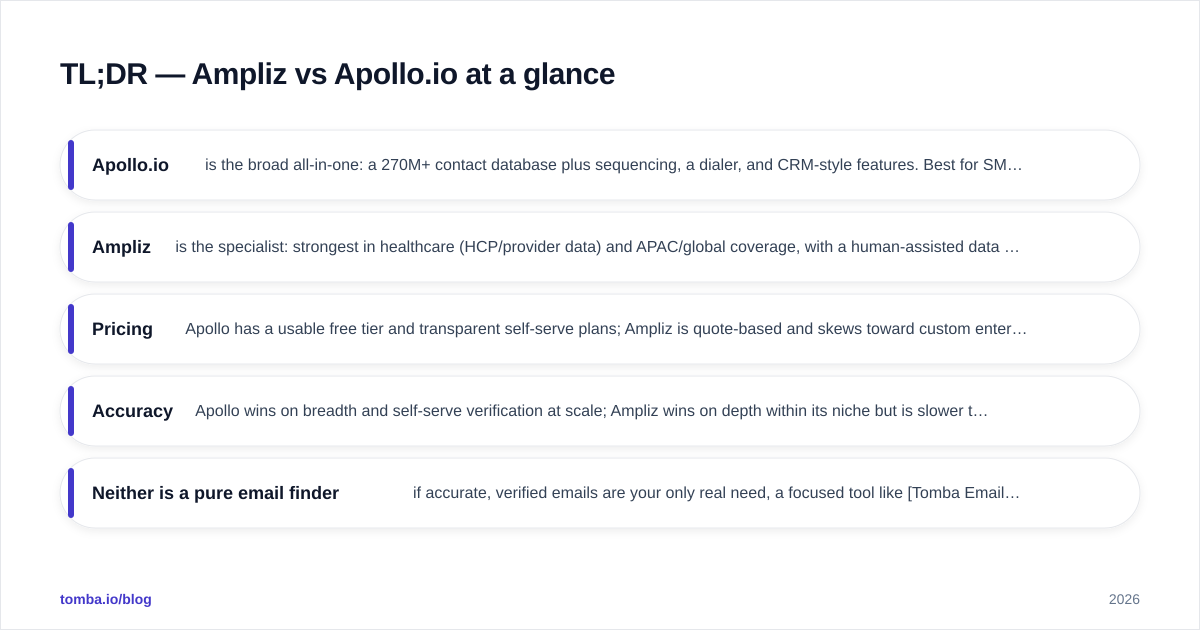
- Apollo.io is the broad all-in-one: a 270M+ contact database plus sequencing, a dialer, and CRM-style features. Best for SMB and mid-market outbound teams that want everything in one place.
- Ampliz is the specialist: strongest in healthcare (HCP/provider data) and APAC/global coverage, with a human-assisted data request model. Best for teams selling into medical, life sciences, or hard-to-reach regional markets.
- Pricing: Apollo has a usable free tier and transparent self-serve plans; Ampliz is quote-based and skews toward custom enterprise pricing.
- Accuracy: Apollo wins on breadth and self-serve verification at scale; Ampliz wins on depth within its niche but is slower to pull.
- Neither is a pure email finder — if accurate, verified emails are your only real need, a focused tool like Tomba Email Finder is cheaper and more precise than buying a full suite.
What is Ampliz?#
Ampliz is a B2B data and sales intelligence platform. It is best known for its healthcare database and global (especially Asia-Pacific) contact coverage. It does not try to be a generic everyone-database. Instead, it leans into verticals where data is hard to source: hospitals, physicians, clinics, and life sciences. It also reaches decision-makers across APAC markets that US-centric tools cover poorly.
Ampliz combines self-serve tools — a "People Finder" and "Website Visitor" intelligence — with a more consultative model. You can request specific data sets, and their team helps assemble and verify them. That human-assisted layer is the differentiator. It is slower than instant export. But for a niche list of 400 cardiology heads in Southeast Asia, it often returns data no general tool has.
Where Ampliz is weaker: it is not a sequencing or outreach platform. You get the data, then you take it elsewhere to actually run campaigns.
What is Apollo.io?#
Apollo.io is an all-in-one sales intelligence and engagement platform. It pairs a large contact database (Apollo reports 270M+ contacts and 70M+ companies) with the tools to act on it. Those tools include email sequences, a built-in dialer, LinkedIn workflows, deal tracking, and CRM enrichment.
The pitch is consolidation. Instead of buying a database, a sequencer, and a dialer separately, an SMB team runs the whole motion inside Apollo. The free tier is genuinely usable. The self-serve paid plans are transparent too. You can sign up and start prospecting without talking to sales.
Apollo's weakness is the flip side of its breadth. Data quality varies by region and seniority. Niche verticals, like detailed healthcare provider records, are thinner. And "all-in-one" means you sometimes accept a B-grade dialer or B-grade enrichment for the convenience of one login. You can read more about replacing it specifically on the Apollo alternative page.

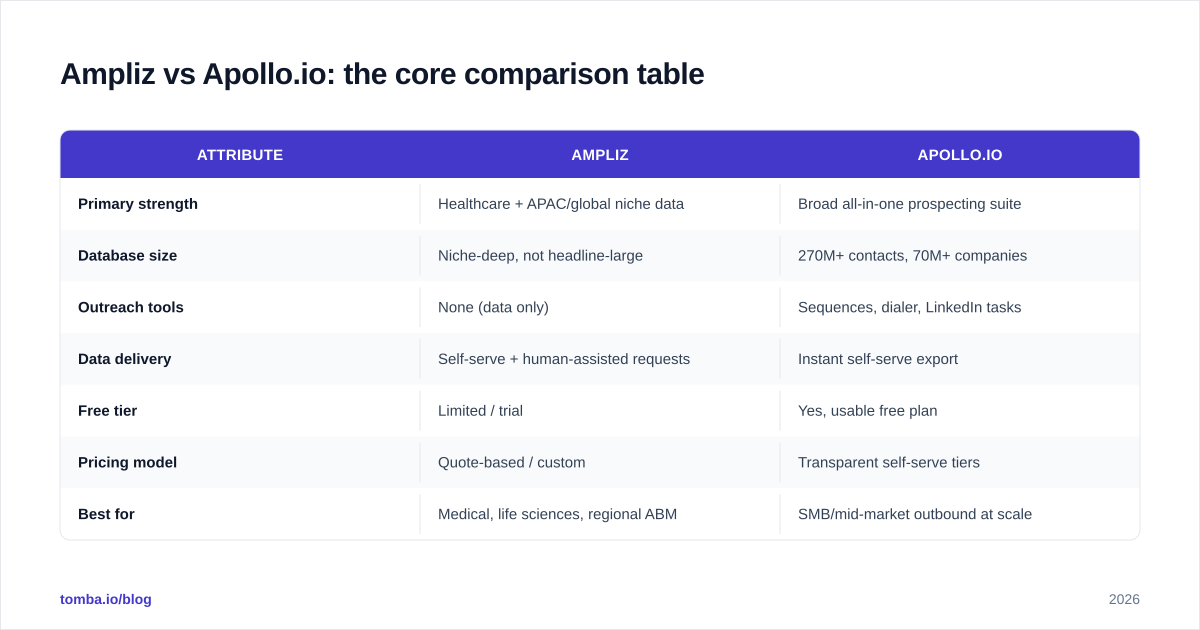
Ampliz vs Apolloio: the core comparison table#
| Attribute | Ampliz | Apollo.io |
|---|---|---|
| Primary strength | Healthcare + APAC/global niche data | Broad all-in-one prospecting suite |
| Database size | Niche-deep, not headline-large | 270M+ contacts, 70M+ companies |
| Outreach tools | None (data only) | Sequences, dialer, LinkedIn tasks |
| Data delivery | Self-serve + human-assisted requests | Instant self-serve export |
| Free tier | Limited / trial | Yes, usable free plan |
| Pricing model | Quote-based / custom | Transparent self-serve tiers |
| Best for | Medical, life sciences, regional ABM | SMB/mid-market outbound at scale |
| Verification | Strong within niche, slower | Self-serve, scalable, variable quality |
Which has better data accuracy?#
It depends on the segment, and that is the honest answer. Apollo wins on breadth. Across standard B2B roles in North America and Western Europe, its self-serve verification and crowd-refreshed data are hard to beat at the price. Ampliz wins on depth. Inside healthcare and APAC, it surfaces and validates records that Apollo does not carry in usable density.
Two practical truths apply to both:
- Any database decays. Contact data goes stale at roughly 22–30% per year as people change jobs. A bigger database is not automatically a more accurate one — freshness matters more than raw count.
- Provider-claimed accuracy is marketing until you test it. Run a sample of 100 contacts through an independent email verifier before you trust any vendor's "95% accurate" badge. Bounce rate on a real send is the only number that counts.

If your only goal is accurate, deliverable emails — not full prospecting workflows — neither suite is the most cost-efficient path. A dedicated finder with built-in verification gets you cleaner addresses for a fraction of a seat license. That is why many teams pair a niche or broad database with a specialist tool for the final email validation step.
How do Ampliz and Apollo.io compare on pricing?#
Pricing is where these two diverge most sharply.
Apollo.io is transparent and self-serve. There is a free plan with limited monthly credits, and paid tiers scale up from there with clear per-seat pricing. You can estimate your cost before committing, which makes budgeting easy for a founder or a small SDR team.
Ampliz is quote-based. You talk to sales, describe your data needs, and get a custom proposal. This fits enterprise procurement and niche projects, but it removes the "try before you commit" simplicity that smaller teams want.
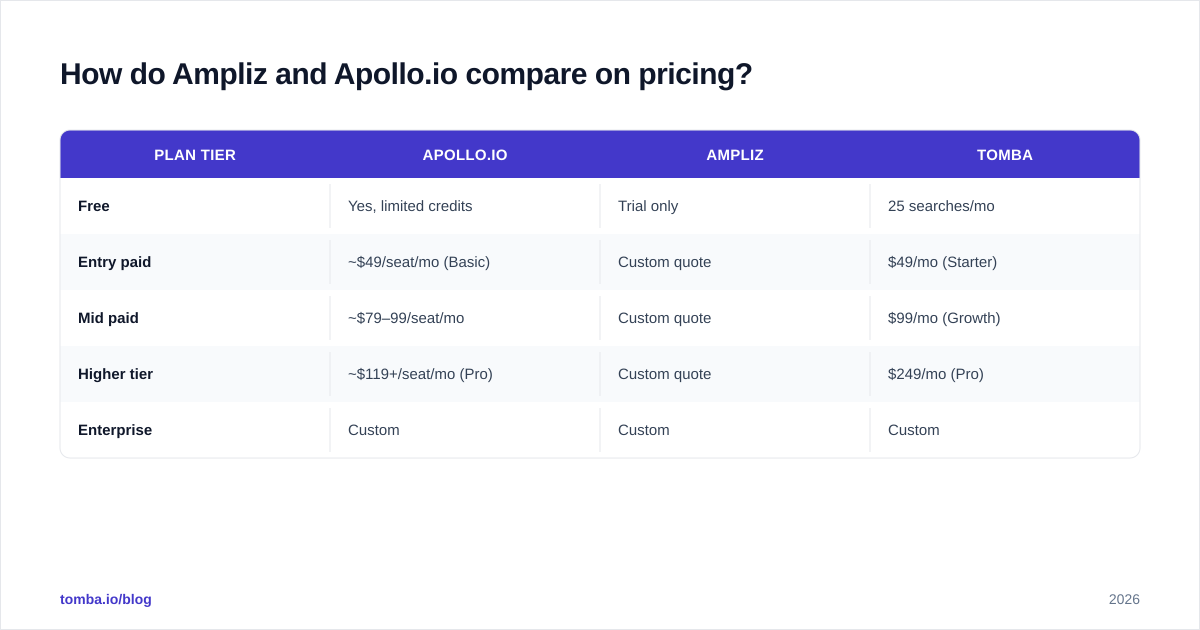
For reference, here is how the all-in-one and specialist models stack up against a focused finder like Tomba (see full Tomba pricing for current details):
| Plan tier | Apollo.io | Ampliz | Tomba |
|---|---|---|---|
| Free | Yes, limited credits | Trial only | 25 searches/mo |
| Entry paid | ~$49/seat/mo (Basic) | Custom quote | $49/mo (Starter) |
| Mid paid | ~$79–99/seat/mo | Custom quote | $99/mo (Growth) |
| Higher tier | ~$119+/seat/mo (Pro) | Custom quote | $249/mo (Pro) |
| Enterprise | Custom | Custom | Custom |
The takeaway: if you need predictable, self-serve pricing, Apollo and Tomba are easier to plan around. If you are running a one-off niche data project, Ampliz's custom model can actually be a better fit despite the friction.
Which workflows does each tool fit?#
Think of it like buying a vehicle. Apollo is the all-purpose SUV — it does everything reasonably well and you only park one thing in the garage. Ampliz is the specialist off-road rig — overkill on the highway, but the only thing that gets you up the mountain.
Pick Apollo.io if you:
- Run high-volume outbound and want data, sequencing, and dialing in one tool.
- Are an SMB or mid-market team without budget for a separate sales-engagement stack.
- Sell into mainstream B2B roles in well-covered geographies.
- Value a free tier and self-serve onboarding.
Pick Ampliz if you:
- Sell into healthcare, hospitals, or life sciences and need verified HCP data.
- Target APAC or other regions where US-centric tools are thin.
- Run account-based plays that need hand-assembled, hard-to-find lists.
- Have procurement that is comfortable with custom contracts.
For the deeper account-research layer, both tools benefit from a B2B database and clean data enrichment to fill gaps neither vendor covers on its own.

What are the honest drawbacks of each?#
No tool is perfect. Here is the part vendors leave out.
Apollo.io drawbacks:
- Data quality dips outside core US/EU business roles and is thin in specialized verticals.
- The "all-in-one" dialer and enrichment are convenient but not best-in-class versus standalone tools.
- Heavy reliance on crowd-sourced data means duplicate and stale records show up at scale.
- Free-tier limits push you to upgrade faster than the marketing implies.
Ampliz drawbacks:
- No native outreach — it is a data source, not a sending platform.
- Quote-based pricing slows down evaluation and small purchases.
- Human-assisted data requests are powerful but not instant.
- Outside its healthcare/APAC sweet spot, general-purpose tools usually match or beat it.
The common thread: both are databases first. The actual emails you export still need independent validation before you press send, because a wrong address damages your sender reputation and drags down every future campaign from that domain.
How do you choose between them?#
Run this quick decision framework before you sign anything:
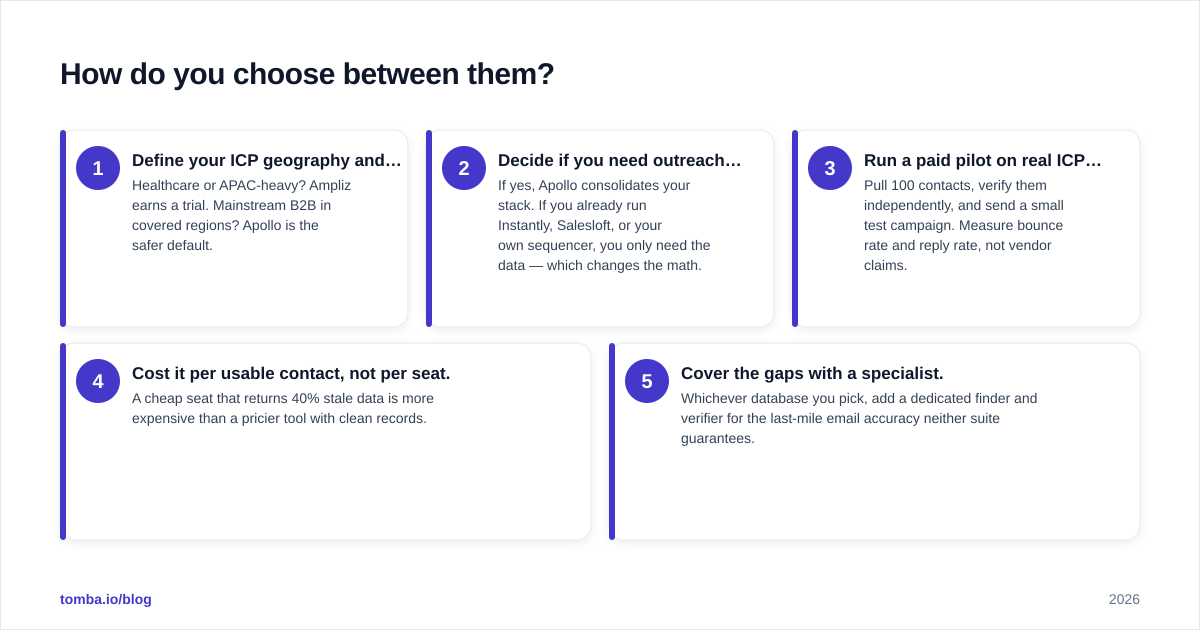
- Define your ICP geography and vertical. Healthcare or APAC-heavy? Ampliz earns a trial. Mainstream B2B in covered regions? Apollo is the safer default.
- Decide if you need outreach built-in. If yes, Apollo consolidates your stack. If you already run Instantly, Salesloft, or your own sequencer, you only need the data — which changes the math.
- Run a paid pilot on real ICP records. Pull 100 contacts, verify them independently, and send a small test campaign. Measure bounce rate and reply rate, not vendor claims.
- Cost it per usable contact, not per seat. A cheap seat that returns 40% stale data is more expensive than a pricier tool with clean records.
- Cover the gaps with a specialist. Whichever database you pick, add a dedicated finder and verifier for the last-mile email accuracy neither suite guarantees.
To validate any list you build, the cleanest workflow is: source from the database → enrich → run every address through a bulk email verifier → send. That sequence protects deliverability regardless of which platform you start with.
You can also cross-check independent reviews on G2 and compare both vendors' own claims directly at Apollo.io and Ampliz before committing.
Frequently asked questions#
Is Apollo.io better than Ampliz? For broad B2B outbound with built-in outreach, yes — Apollo's all-in-one model and transparent pricing make it the default for most SMB teams. For healthcare or APAC-specific data, Ampliz is often better despite lacking outreach tools.
Is Ampliz only for healthcare? No, but healthcare and life sciences are its strongest verticals. It also covers general B2B and APAC markets well. Outside those, general-purpose tools usually match it.
Do I still need an email verifier with these tools? Yes. Both platforms' data decays, and provider-claimed accuracy rarely survives a real send. Always verify before launching a campaign to protect deliverability.
Can I use Tomba alongside Apollo or Ampliz? Yes. Many teams use a database for discovery, then use Tomba to find and verify the exact professional emails — a cleaner, cheaper last-mile step than relying on suite data alone.
The bottom line#
Apollo.io is the better default for most teams: broad data, real outreach tooling, and pricing you can plan around. Ampliz is the smarter choice when your ICP lives in healthcare, life sciences, or APAC — places where niche depth beats raw database size. Match the tool to your ICP, run a verified pilot, and never trust a "95% accurate" badge without testing it yourself.
Whichever platform you land on, the email accuracy gap is where pipelines quietly leak. Close it with Tomba Email Finder — find verified professional emails by name, domain, or company, with built-in verification so every address you send to is one you can trust. Start free with 25 searches a month, then scale on a plan that costs less than a single wasted database seat.
// get started
Find, verify and enrich your first contacts today
Start on the free plan with 25 searches a month, then scale when your team is ready.
Free plan · No credit card required · GDPR & CCPA
// about the author