Ampliz vs B2B Lists 2026: B2B Data Provider Comparison
Ampliz sells enriched intent-rich contacts; B2B Lists sells static prospect files. Here is how the two stack up on data freshness, pricing, and ROI in 2026.
TL;DR
- Ampliz is a B2B data and intelligence platform built around healthcare and APAC/global contacts, on-demand enrichment, and intent signals — you query live and pull verified records.
- B2B Lists (and the broader "buy a B2B list" category it represents) is a static-file model: you pay for a pre-built CSV of contacts segmented by industry, title, or geography.
- The real divide is live data vs frozen data. Ampliz refreshes and verifies on request; a purchased list starts decaying the day it is exported.
- For accuracy and deliverability, a verify-on-send workflow beats both — pair any data source with an email verifier before you hit send.
- If your goal is outbound that actually lands in the inbox, you want fresh, verified, self-served data — not a one-time list dump.
If you are weighing ampliz vs b2b lists, you are really choosing between two philosophies of how B2B contact data should reach your reps. One treats data as a living service. The other treats it as a product you buy once. This guide breaks down where each wins, where each fails, and how to avoid the most expensive mistake in outbound: building a campaign on stale records.
What is Ampliz and who is it for?#
Ampliz is a B2B data and intelligence provider known for two things: deep healthcare/provider data (its "Ampliz Healthcare Intelligence" product) and global B2B contact enrichment with a strong APAC footprint. Instead of handing you a frozen file, Ampliz is designed for query-and-pull workflows — you search by firmographic and demographic filters, layer on intent signals, and export verified contacts on demand.
Think of Ampliz like a tap connected to a reservoir. You open it when you need water, and what comes out is current. That model matters because B2B data rots fast: people change jobs, companies rebrand, domains migrate. A platform that re-verifies at query time gives you a fighting chance at accuracy.
Ampliz tends to fit:
- Healthcare and life-sciences sales teams that need NPI-style provider data with specialty, hospital affiliation, and decision-maker mapping.
- Companies expanding into APAC or global markets where US-centric databases thin out.
- RevOps teams that want to enrich existing CRM records rather than start from a blank list.
The trade-off: platform pricing is quote-based and skews enterprise, and the healthcare specialization means you may pay for depth you do not need if you sell horizontal SaaS.
What does "B2B Lists" actually mean?#
"B2B Lists" describes the buy-a-list category — vendors (B2B Lists being one named example, alongside dozens of resellers) that sell pre-compiled contact files. You pick a segment ("VP Marketing, SaaS, 50–200 employees, North America"), pay a per-record or per-list price, and download a spreadsheet.
The appeal is obvious: it is fast, cheap up front, and requires no platform onboarding. You get a CSV today and can load it into your sequencer tonight.
The problem is equally obvious once you have done it twice. A purchased list is a photograph, not a video. It captures a moment. The day it is generated, maybe 90% of records are accurate. Ninety days later, after the normal 2–3% monthly B2B data decay compounds, a meaningful chunk is wrong — bounced emails, departed contacts, dead domains. You cannot re-verify it without exporting it to another tool, and the vendor has no incentive to refresh what they already sold you.
List-buying tends to fit:
- One-off campaigns with a tight budget and a short shelf life.
- Event or webinar pushes where you need volume fast and accept higher bounce rates.
- Teams without a data platform who just need names to start.
Ampliz vs B2B Lists: how do they compare head to head?#
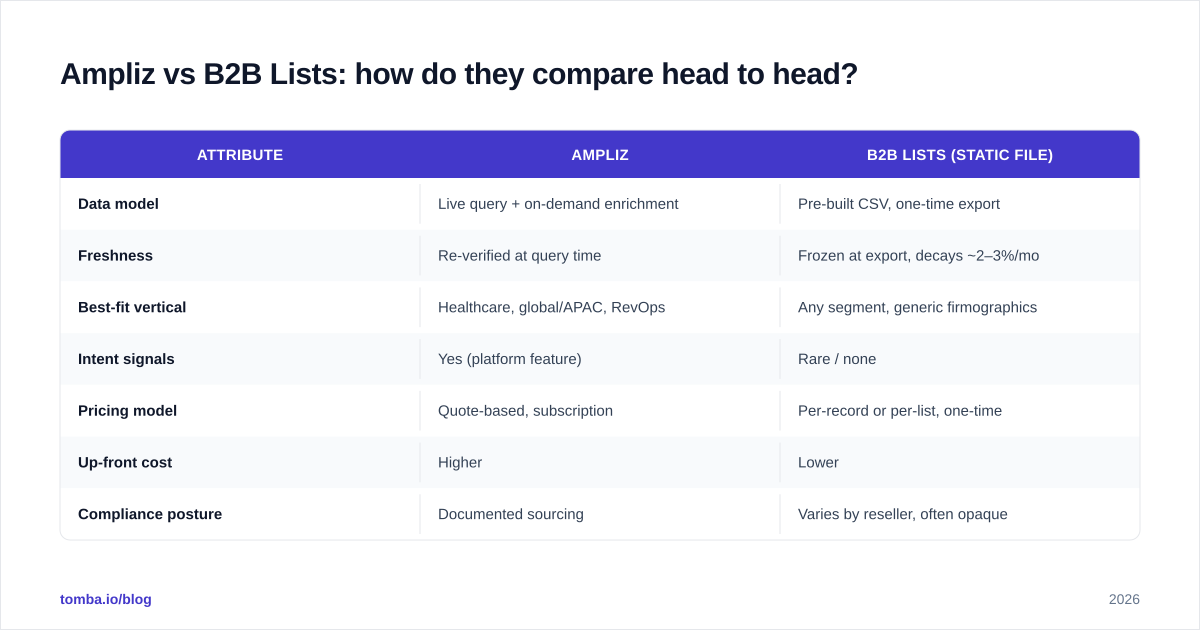
Here is the side-by-side. The columns below map the practical decision points teams actually argue about in procurement.
| Attribute | Ampliz | B2B Lists (static file) |
|---|---|---|
| Data model | Live query + on-demand enrichment | Pre-built CSV, one-time export |
| Freshness | Re-verified at query time | Frozen at export, decays ~2–3%/mo |
| Best-fit vertical | Healthcare, global/APAC, RevOps | Any segment, generic firmographics |
| Intent signals | Yes (platform feature) | Rare / none |
| Pricing model | Quote-based, subscription | Per-record or per-list, one-time |
| Up-front cost | Higher | Lower |
| Compliance posture | Documented sourcing | Varies by reseller, often opaque |
| Re-verification | Built into workflow | Requires a separate tool |
| Time to first contact | Onboarding required | Same-day |
| Risk | Cost, vertical fit | Bounce rate, deliverability damage |
Two honest takeaways from this table. First, Ampliz wins on data integrity and intelligence — freshness, intent, documented sourcing. Second, a static list wins on speed and up-front cost — and almost nothing else that survives contact with a real campaign.

Is fresh data really worth the price difference?#
Yes — and the math is not close once you price in bounces. A high bounce rate does not just waste the contacts that bounced. It damages your sender reputation, which depresses inbox placement for the good addresses in the same send. One stale list can poison a sending domain you spent months warming.
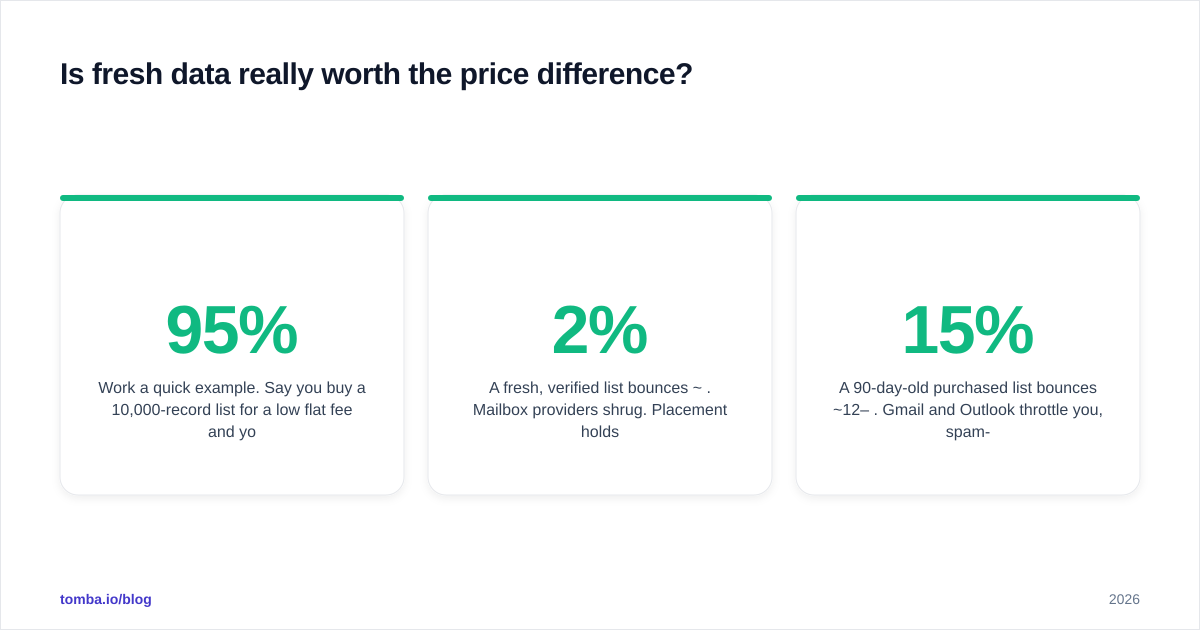
Work a quick example. Say you buy a 10,000-record list for a low flat fee and your warmed domain currently lands 95% in the primary inbox.
- A fresh, verified list bounces ~2%. Mailbox providers shrug. Placement holds.
- A 90-day-old purchased list bounces ~12–15%. Gmail and Outlook throttle you, spam-folder rate climbs, and your next campaign — even to clean data — underperforms.
The "cheap" list was never cheap. It cost you a sending domain. That is why mature outbound teams treat email deliverability as the real budget line, and treat data freshness as a deliverability input, not a nice-to-have.
This is also where the Ampliz model structurally wins: querying live means the records you export were checked recently. But "recently" is not "at the moment you send," which is why neither tool removes the need for a final verification pass.
Where do both tools fall short — and how do you fix it?#
Neither Ampliz nor a purchased list guarantees a clean send at the moment your sequencer fires. Provider databases, however good, carry catch-all domains, role accounts, and recently-departed contacts. The fix is a verification layer between data source and send.
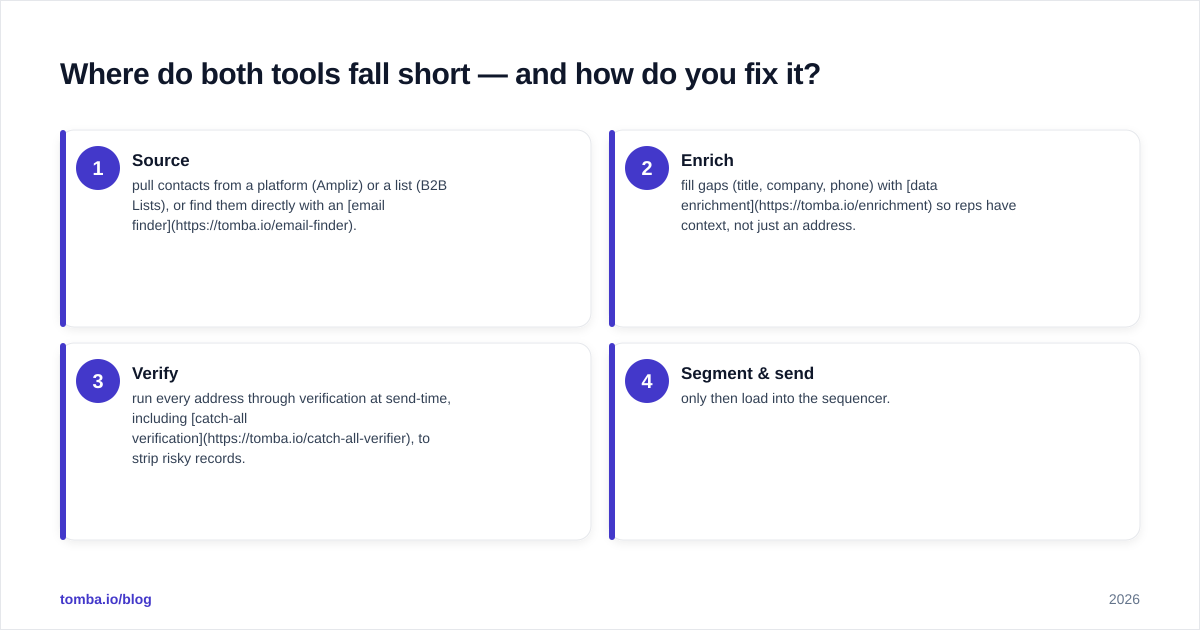
A reliable outbound data stack looks like this:
- Source — pull contacts from a platform (Ampliz) or a list (B2B Lists), or find them directly with an email finder.
- Enrich — fill gaps (title, company, phone) with data enrichment so reps have context, not just an address.
- Verify — run every address through verification at send-time, including catch-all verification, to strip risky records.
- Segment & send — only then load into the sequencer.
The framework above is provider-agnostic on purpose. Whether your raw data came from Ampliz, a CSV, or a manual prospecting session, step 3 is non-negotiable. Skipping it is how teams with "good data sources" still post 10%+ bounce rates.

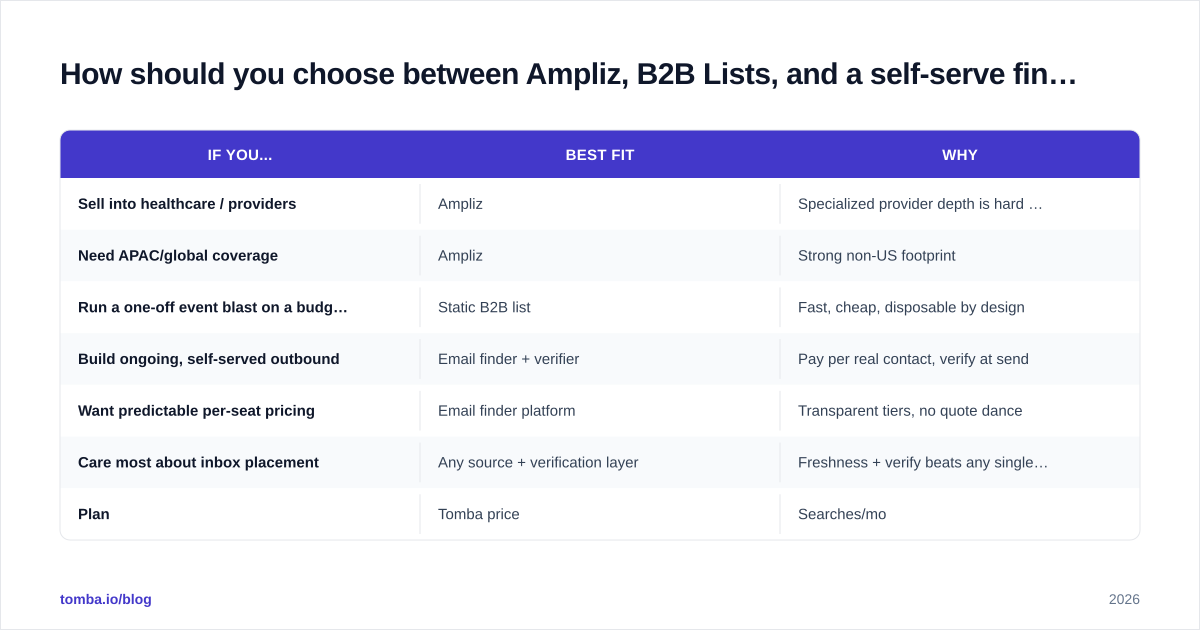
How should you choose between Ampliz, B2B Lists, and a self-serve finder?#
Match the tool to your motion, not to the loudest sales pitch. Use this decision guide.
| If you... | Best fit | Why |
|---|---|---|
| Sell into healthcare / providers | Ampliz | Specialized provider depth is hard to replicate |
| Need APAC/global coverage | Ampliz | Strong non-US footprint |
| Run a one-off event blast on a budget | Static B2B list | Fast, cheap, disposable by design |
| Build ongoing, self-served outbound | Email finder + verifier | Pay per real contact, verify at send |
| Want predictable per-seat pricing | Email finder platform | Transparent tiers, no quote dance |
| Care most about inbox placement | Any source + verification layer | Freshness + verify beats any single vendor |
There is a third option the head-to-head framing hides: skip the buy-a-list model entirely and find contacts yourself, on demand, at the moment you need them. A self-serve domain search returns the current email pattern and named contacts for any company, and a finder pulls the specific person you are targeting — no minimum order, no stale file, no enterprise quote.
This is where Tomba sits relative to both Ampliz and list vendors. Instead of buying a frozen segment or licensing a healthcare-specialized platform, you query exactly the companies in your ICP, get current addresses, and verify before you send — with transparent Tomba pricing rather than a custom quote.
| Plan | Tomba price | Searches/mo |
|---|---|---|
| Free | $0 | 25 |
| Starter | $49/mo | scaling credits |
| Growth | $99/mo | higher volume |
| Pro | $249/mo | team volume |
| Enterprise | Custom | unlimited-tier |
Note the Starter plan is $49/mo — predictable and self-serve, which is the opposite of the quote-based enterprise motion you hit with platform vendors, and the opposite of the sunk-cost one-time fee you pay for a list you cannot refresh.
What about compliance and data sourcing?#
Compliance is the quiet risk in this whole category. Under GDPR, CCPA, and similar regimes, how a contact was sourced matters as much as whether the email works. Platform vendors like Ampliz typically document their sourcing and offer DPA terms. Resold static lists are the wild west — a cheap list from an opaque reseller may carry contacts with no lawful basis, and you inherit that liability the moment you send.
Before you commit to either, do the boring diligence:
- Ask for the data sourcing documentation and a DPA.
- Check independent reviews on G2 and Capterra for bounce-rate and accuracy complaints, not just star averages.
- Read the vendor's own claims at the source — for Ampliz, that is ampliz.com — and treat unverifiable accuracy percentages with healthy skepticism.
A provider that hides its sourcing is telling you something. Transparency about where the data comes from should be table stakes, not a premium feature.
The bottom line: which one should you pick?#
Choose Ampliz if you sell into healthcare or global markets, need intent signals, and have the budget for a specialized, quote-based platform. Choose a static B2B list only for disposable, one-off campaigns where speed beats accuracy and you have accepted the bounce risk in advance.
But for most teams running repeatable outbound, the honest answer is neither in isolation. The winning pattern is fresh, self-served data plus a verification layer at send-time — find the exact contacts in your ICP when you need them, enrich for context, and verify before the sequencer fires.
That is the workflow Tomba is built for. Start with the Tomba Email Finder to pull current, verified professional emails by company, name, or domain — then layer verification on top so what you send actually reaches a human. No quote calls, no decaying CSV, $49/mo to start, and 25 free searches to test it against whatever list or platform you are comparing today. Find your next 100 prospects, verify them, and watch your bounce rate — that single number will tell you which approach really won.
// get started
Find, verify and enrich your first contacts today
Start on the free plan with 25 searches a month, then scale when your team is ready.
Free plan · No credit card required · GDPR & CCPA
// about the author