Ampliz vs BookYourData 2026: B2B Data Tools Compared
Ampliz pushes APAC healthcare intelligence; BookYourData sells pay-as-you-go lists. We compare data accuracy, pricing, coverage, and compliance to find the better fit for your 2026 pipeline.
Choosing a B2B data vendor in 2026 is less about who has the biggest database and more about who has data you can actually email today. Ampliz and BookYourData both promise contact records at scale, but they solve different problems for different buyers.
TL;DR#
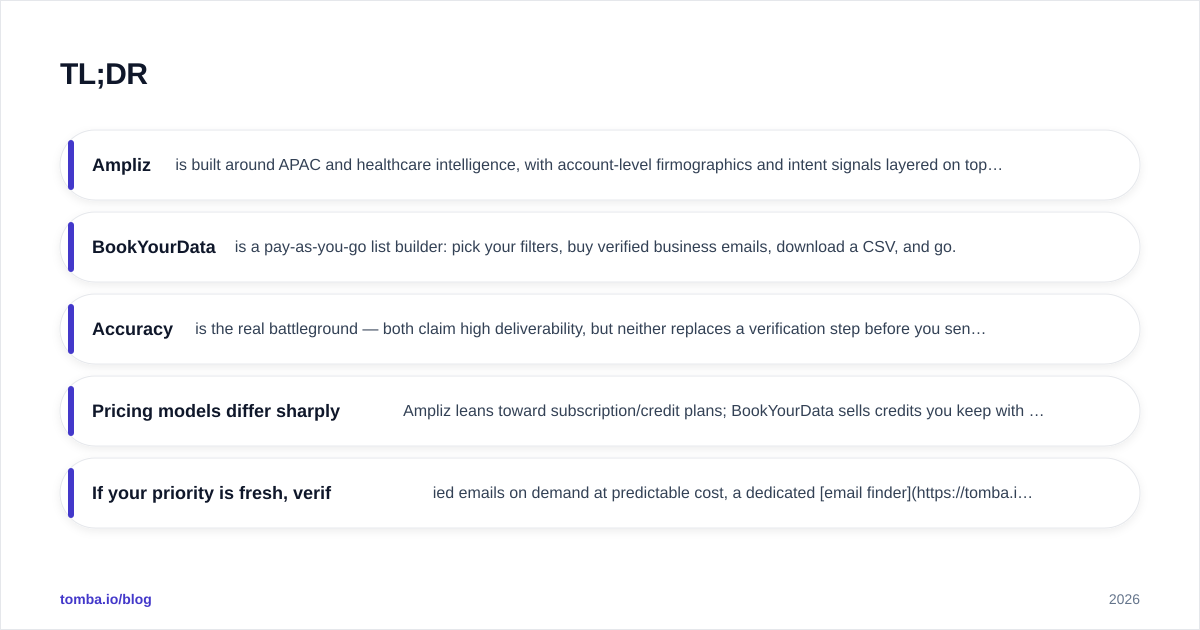
- Ampliz is built around APAC and healthcare intelligence, with account-level firmographics and intent signals layered on top of contact data.
- BookYourData is a pay-as-you-go list builder: pick your filters, buy verified business emails, download a CSV, and go.
- Accuracy is the real battleground — both claim high deliverability, but neither replaces a verification step before you send.
- Pricing models differ sharply: Ampliz leans toward subscription/credit plans; BookYourData sells credits you keep with no forced monthly commitment.
- If your priority is fresh, verified emails on demand at predictable cost, a dedicated email finder like Tomba often beats buying static lists outright.
What is Ampliz?#
Ampliz positions itself as a B2B data intelligence platform with a strong tilt toward the Asia-Pacific region and the healthcare vertical. Rather than only handing you a contact's email, it tries to wrap each record in context: company revenue, employee count, technographics, and buying-intent signals so sales teams can prioritize accounts, not just blast contacts.
That account-centric framing makes Ampliz feel closer to a sales-intelligence tool than a simple list shop. Their HealthLink dataset, for example, targets physicians, hospitals, and healthcare decision-makers — a niche where generic providers tend to be thin. You can review their positioning on the official Ampliz site.
The trade-off is complexity. Intelligence platforms reward teams that have a defined account-based motion and the time to act on signals. If you just need 5,000 verified emails for a campaign next week, that machinery is overhead you may not use.
What is BookYourData?#
BookYourData is a self-serve, pay-as-you-go B2B contact list builder. You open the builder, filter by industry, job title, location, company size, and technology, see a live count of matching records, and buy exactly the number of contacts you want. Credits don't expire on a monthly clock the way many subscriptions do, which appeals to teams with spiky, campaign-driven needs.
Its headline promise is a high email-accuracy guarantee — the company advertises a 95%+ deliverability commitment and offers credit replacement for bounces above that threshold. You can read the specifics on the BookYourData homepage. That guarantee is the core of its pitch: buy a list, send it, and if too many bounce, you're topped back up.
The catch with any list-download model is freshness. The moment you export a CSV, it starts decaying — people change jobs, companies rebrand, domains move. A static file is a snapshot, not a live source.
Ampliz vs BookYourData: how do they compare?#
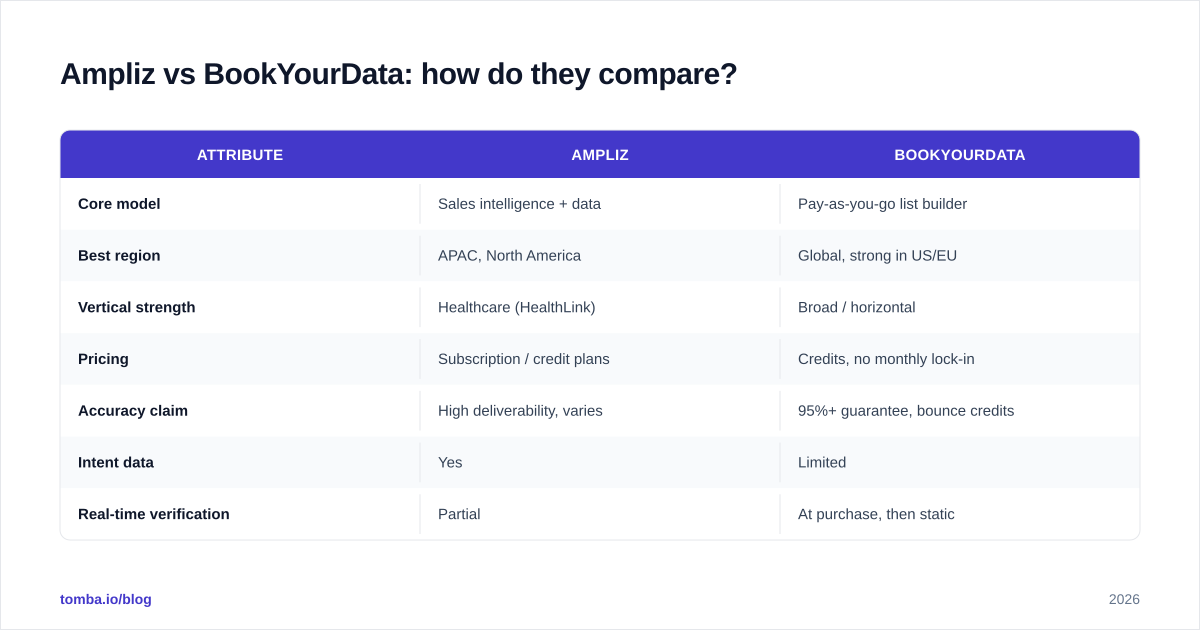
Here's the side-by-side on the attributes that actually move the needle for an outbound team.
| Attribute | Ampliz | BookYourData |
|---|---|---|
| Core model | Sales intelligence + data | Pay-as-you-go list builder |
| Best region | APAC, North America | Global, strong in US/EU |
| Vertical strength | Healthcare (HealthLink) | Broad / horizontal |
| Pricing | Subscription / credit plans | Credits, no monthly lock-in |
| Accuracy claim | High deliverability, varies | 95%+ guarantee, bounce credits |
| Intent data | Yes | Limited |
| Real-time verification | Partial | At purchase, then static |
| Free trial | Sample credits | Sample / pay-as-you-go entry |
| Best for | ABM, healthcare GTM | One-off campaign lists |
The pattern is clear: Ampliz is the richer platform for account-based selling in specific regions and verticals, while BookYourData is the faster, simpler route to a usable list when you know exactly who you want.

Is Ampliz or BookYourData more accurate?#
Accuracy is where comparisons get slippery, because every vendor measures it differently. BookYourData's 95%+ deliverability guarantee is concrete and easy to reason about — if more bounce than promised, you get credits back. Ampliz emphasizes accuracy too, but its value is spread across the whole record (firmographics, intent), not just the email field.
The honest answer: no purchased list is verified at the moment you press send. BookYourData verifies at purchase, but if you export today and email in three weeks, you're sending to a three-week-old snapshot. Ampliz records age the same way. B2B email data decays at roughly 22–30% per year, and job-change churn concentrates that decay in your most senior, most valuable contacts.
That's why mature teams treat any provider's export as a starting point, then run it through a dedicated email verifier right before a send. Re-verifying at send time, not purchase time, is the single highest-leverage habit for protecting your sender reputation. For more on why this matters, see our breakdown of email deliverability fundamentals.

How does pricing compare between Ampliz and BookYourData?#
The pricing philosophies are genuinely different, and that difference should drive your choice more than feature checklists.
Ampliz uses subscription and credit-based plans, with custom enterprise tiers for teams that need volume, API access, and intent data. It's a "commit and consume" model that rewards consistent, ongoing use. If you dip in once a quarter, you're likely overpaying for idle capacity.
BookYourData is the opposite: buy credits when you need them, keep them, build a list, done. There's no forced monthly spend. For an agency running sporadic client campaigns, that flexibility is the whole appeal.
But there's a hidden cost in both: you pay for records whether or not they're still valid, and you pay again to re-verify. A platform that combines finding and verification in one credit pool — and charges only for results — often produces a lower true cost per usable contact. That's worth modeling against the published Tomba pricing before you commit to either incumbent.

Which one should you choose?#
Match the tool to your motion, not to the longest feature list.
Choose Ampliz if:
- You run account-based selling and want intent + firmographics, not just emails.
- Your ICP concentrates in APAC or in healthcare.
- You have the team and time to act on signals, and you'll use the platform consistently.
Choose BookYourData if:
- You need a clean, filtered list fast for a specific campaign.
- You prefer pay-as-you-go over monthly subscriptions.
- A concrete bounce guarantee is what helps you sleep at night.
Consider an email-finder-first approach if:
- You'd rather find and verify contacts in real time than buy aging snapshots.
- You want one predictable credit pool across finding, verification, and enrichment.
- You sell into mixed regions and verticals and don't want to be locked into one provider's strongest segment.
What's the smarter alternative to buying static lists?#
The category both tools belong to — buying pre-built contact records — is being squeezed by a simpler model: find the exact people you need, verified, the moment you need them.
Instead of purchasing a 10,000-row list and hoping 70% is still good, you can run a targeted domain search on the companies in your ICP, pull the right decision-makers, and verify each address on the spot. You pay for the contacts you'll actually use, and they're as fresh as the day you found them. For large pushes, a bulk email finder does the same thing at list scale without the decay tax of a one-time export.
This approach also sidesteps the compliance gray area of buying lists you didn't build. With a finder that documents its data sources, you know how each address was discovered — which matters as GDPR and CAN-SPAM enforcement tightens. Industry analysts at G2 track dozens of vendors in this space, and the trend line favors verification-at-source over bulk list resale.

How do these tools handle compliance and data sourcing?#
Compliance is the quiet risk in any data-buying decision. Both Ampliz and BookYourData state they source data from public and partner channels and offer suppression and opt-out handling. But when you buy a list, you inherit responsibility for how you use it — and "the vendor said it was compliant" is a weak position if a recipient files a complaint.
The defensible posture is to (1) keep records of where each contact came from, (2) verify before every send, and (3) honor opt-outs at the list level, not just per campaign. A finder that returns sourcing context per email makes that recordkeeping far easier than a flat CSV with no provenance. If you want the conceptual background, our B2B glossary covers sender reputation, deliverability, and the terms that show up in vendor contracts.
What does the workflow actually look like?#
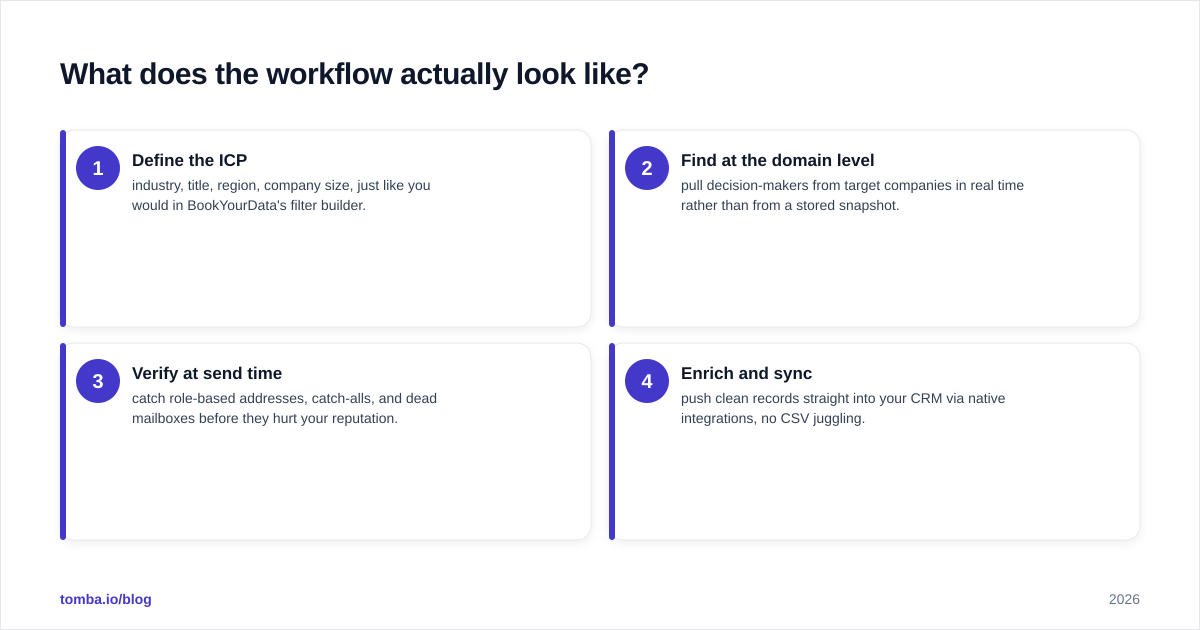
Here's how a verification-first pipeline replaces the buy-a-list step entirely.
- Define the ICP — industry, title, region, company size, just like you would in BookYourData's filter builder.
- Find at the domain level — pull decision-makers from target companies in real time rather than from a stored snapshot.
- Verify at send time — catch role-based addresses, catch-alls, and dead mailboxes before they hurt your reputation.
- Enrich and sync — push clean records straight into your CRM via native integrations, no CSV juggling.
The result is a list that's smaller, fresher, and cheaper per usable contact than a bulk purchase — and one you can rebuild on demand instead of re-buying.
Final verdict: Ampliz vs BookYourData#
Both tools are legitimate, and the right pick depends on your motion. Ampliz wins for APAC and healthcare account-based selling where intelligence beats raw volume. BookYourData wins for fast, pay-as-you-go campaign lists with a clear bounce guarantee. Neither, on its own, solves data decay — because both sell snapshots.
If your real goal is verified contacts you can email today, with predictable cost and clean provenance, start with the source instead of the list. The Tomba Email Finder finds professional email addresses by name, company, or domain and verifies them in the same workflow — so you're not paying for stale rows or re-verifying someone else's export. Spin up the free tier (25 searches a month), test it against a slice of your ICP, and compare the true cost per usable contact against what you'd spend on a one-time list buy. The numbers tend to settle the argument.
Ready to find emails that actually work?
Join 150,000+ professionals who stopped guessing and started sending. Free credits on signup — no credit card required.
Get the Tomba newsletter
Practical outbound tactics and product updates — once every two weeks.
About the author