Ampliz vs Bytemine 2026: B2B Data Platform Comparison
Ampliz pushes healthcare and APAC contact data; Bytemine leans on intent and firmographics. Here's which B2B data platform actually fits your pipeline in 2026.
Choosing between Ampliz and Bytemine usually comes down to one question: do you need deep contact data in a specific vertical, or broad firmographic and intent coverage to feed a wide outbound motion? Both platforms promise "better B2B data," but they were built for different buyers, and picking the wrong one quietly taxes every campaign you run.
This guide breaks down where each tool is strong, where each one leaks, and how to decide without a three-month trial.
TL;DR#
- Ampliz is strongest in healthcare/life-sciences contacts and APAC coverage, with human-assisted data appends. It shines when your ICP is narrow and specialized.
- Bytemine leans toward firmographics, technographics, and intent signals for broader B2B prospecting across regions and industries.
- Accuracy is the real battleground. Both publish high numbers; both degrade on stale records and catch-all domains unless you re-verify before sending.
- Pricing is quote-driven for both, which makes per-record cost hard to compare. Budget for a verification layer on top of either.
- If your core need is simply finding and verifying professional emails at scale, a dedicated tool like the Tomba Email Finder often beats bolting a full data suite onto a single use case.
What are Ampliz and Bytemine?#
Ampliz is a B2B data intelligence platform known for its healthcare and life-sciences database — physicians, hospital decision-makers, and pharma contacts — plus a broader global company dataset with notable strength in the Asia-Pacific region. It markets human-verified appends and "data on demand," meaning you can request enrichment for a target list rather than self-serving everything from a UI.
Bytemine positions itself as a B2B prospecting and data platform built around firmographics, technographics, and buyer intent. The pitch is breadth: filter accounts by industry, size, tech stack, and signals that suggest a company is in-market, then pull the associated contacts to fuel outbound.
In plain terms: Ampliz is the specialist surgeon, Bytemine is the general practitioner. One goes deep in a vertical; the other covers a lot of ground. Technically, both maintain proprietary contact graphs stitched from public web data, partnerships, and user contributions, then layer verification on top with varying rigor.
How do Ampliz and Bytemine compare at a glance?#
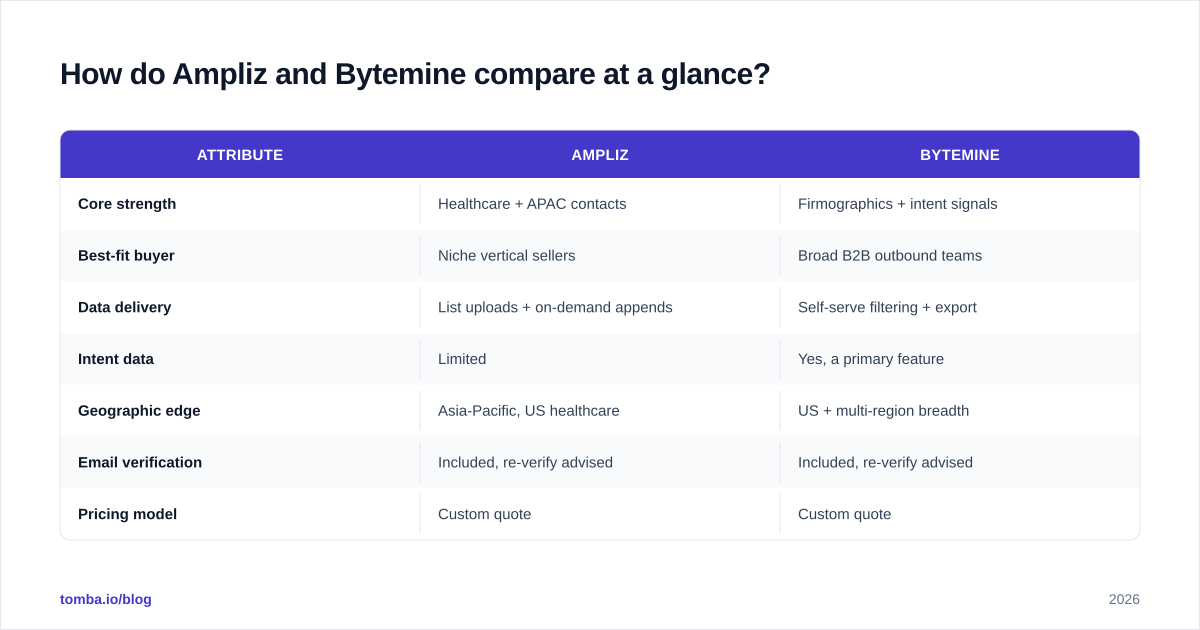
Here's the side-by-side before we go deeper. Treat vendor-published accuracy figures as ceilings, not guarantees — they reflect freshly verified records, not the average row you'll pull six months from now.
| Attribute | Ampliz | Bytemine |
|---|---|---|
| Core strength | Healthcare + APAC contacts | Firmographics + intent signals |
| Best-fit buyer | Niche vertical sellers | Broad B2B outbound teams |
| Data delivery | List uploads + on-demand appends | Self-serve filtering + export |
| Intent data | Limited | Yes, a primary feature |
| Geographic edge | Asia-Pacific, US healthcare | US + multi-region breadth |
| Email verification | Included, re-verify advised | Included, re-verify advised |
| Pricing model | Custom quote | Custom quote |
| Free self-serve tier | No | No |
The takeaway: these tools rarely compete head-to-head for the same buyer. The healthcare ABM team and the horizontal SaaS SDR org will lean opposite directions. Your job is to know which one you are.
Which platform has better data accuracy?#
Accuracy is where deals are won or lost, and it's also where marketing claims and field reality diverge most.
Both vendors cite high deliverability and match rates. The honest answer is that accuracy depends on three things they can't fully control: how recently a contact changed jobs, whether the domain is a catch-all that accepts every address, and how aggressively the record was re-verified before you used it. A 95% claim on a freshly scrubbed sample becomes a very different number on a list that's been sitting in your CRM for a quarter.
Ampliz benefits from human-assisted verification in its specialty datasets. For healthcare records — where a wrong contact can mean a wasted, compliance-sensitive outreach — that manual layer is worth real money. Outside its core verticals, coverage thins and accuracy becomes more variable.
Bytemine trades some per-record depth for breadth and intent. When you're casting wide, a slightly lower hit rate is acceptable because volume absorbs it. But broad datasets are exactly where catch-all domains and role-based addresses hide, so the gap between "matched" and "actually deliverable" widens.

The practical move with either tool is the same: never trust a vendor's match status as send-ready. Run every list through an independent email verifier before it touches your sequence. A catch-all domain in particular needs a dedicated catch-all verifier because standard SMTP checks can't confirm whether a specific mailbox exists. Skipping this step is the single fastest way to torch sender reputation and watch deliverability collapse.
Which is better for coverage and reach?#
Coverage is a two-axis question: geography and persona.
On geography, Ampliz has a genuine APAC advantage. If you're selling into India, Singapore, or the wider Asia-Pacific market, its dataset tends to surface contacts that US-centric tools miss entirely. Bytemine is stronger as a broad multi-region play, with solid North American and European firmographics.
On persona, it's the vertical question again. Ampliz owns healthcare and life-sciences depth — clinical, administrative, and procurement roles that generic databases barely touch. Bytemine spreads across industries, which is ideal when your ICP is "any mid-market SaaS company using Salesforce" rather than "cardiologists at 200-bed hospitals."
There's also a workflow difference worth flagging. Ampliz's on-demand append model means you sometimes wait for a list to be enriched rather than exporting instantly. Bytemine's self-serve filtering is faster for ad-hoc prospecting but puts more of the verification burden on you. Neither is wrong — they suit different tempos. High-volume SDR teams usually want self-serve; targeted ABM teams tolerate a turnaround for higher precision.
How does pricing compare for Ampliz vs Bytemine?#
Both platforms run on custom quotes, which is the polite way of saying "it depends on volume and negotiation." That opacity makes apples-to-apples comparison hard, so anchor on cost-per-usable-record, not headline list size.
A dataset of 100 million contacts is meaningless if only a fraction match your ICP and a slice of those bounce. Calculate it like this: total annual cost, divided by the number of records that are (a) in your ICP, (b) deliverable after independent verification, and (c) not already in your CRM. That third filter alone reprices most "cheap" data deals.
| Cost factor | What to ask the vendor |
|---|---|
| Pricing basis | Per credit, per seat, or per record? |
| Minimum commitment | Annual contract or monthly option? |
| Verification included | Is re-verification free or metered? |
| Overage handling | What happens past your credit cap? |
| Data refresh | How often are records re-checked? |
| Export limits | Caps on rows per export or per month? |
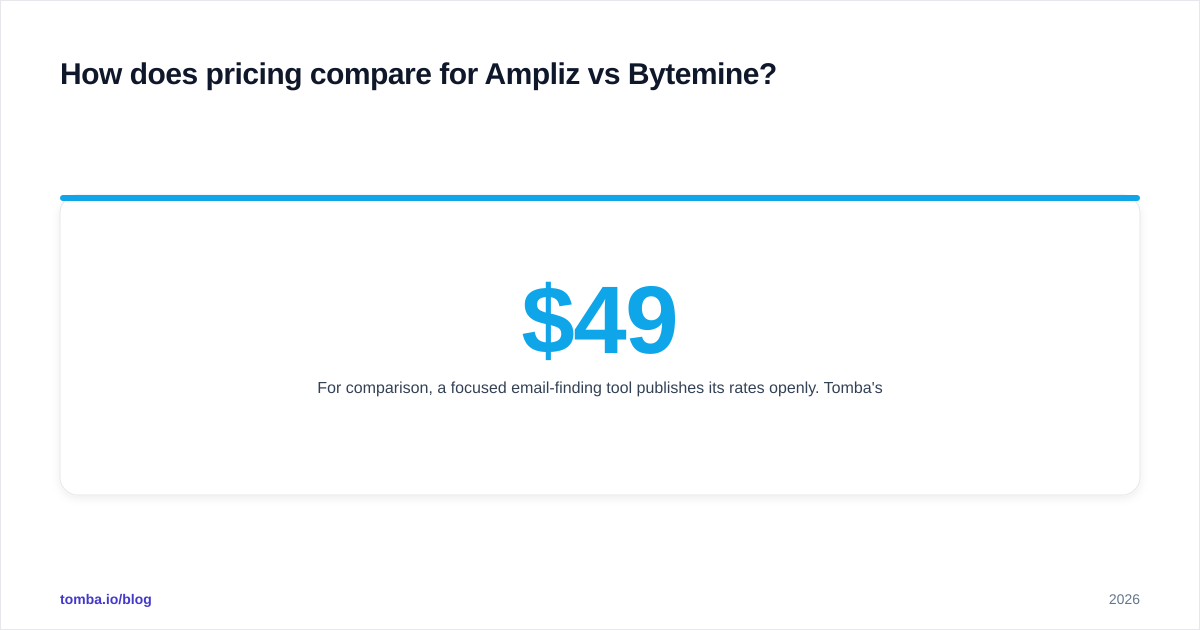
For comparison, a focused email-finding tool publishes its rates openly. Tomba's plans run from a free tier (25 searches/month) through Starter at $49/mo, Growth at $99/mo, and Pro at $249/mo — see the full Tomba pricing for credit details. The point isn't that one is cheaper in the abstract; it's that transparent, per-credit pricing makes your cost-per-usable-record trivial to model, while quote-driven suites require a sales cycle just to get a number.
When should you choose Ampliz?#
Pick Ampliz when:
- Your ICP sits in healthcare or life sciences, where its human-verified vertical data is a genuine moat.
- You're targeting APAC markets and need contacts US-centric databases don't carry.
- You prefer a managed, on-demand enrichment model over self-serve and can tolerate a short turnaround for higher precision.
- Your campaigns are narrow and high-value, where one accurate contact is worth more than a hundred mediocre ones.
Ampliz is the wrong choice if you need broad horizontal coverage, real-time intent signals, or instant self-serve exports across dozens of unrelated industries.
When should you choose Bytemine?#
Pick Bytemine when:
- You run broad, multi-industry outbound and value breadth over vertical depth.
- Intent and technographic signals are central to how you prioritize accounts — knowing who's in-market shapes your sequencing.
- Your SDRs need fast, self-serve filtering to build lists without waiting on a data team.
- You're comfortable owning the verification step yourself in exchange for volume and speed.
Bytemine is the wrong choice if your entire business lives in one specialized vertical where a generalist database simply doesn't go deep enough.
Is there a better alternative for finding and verifying emails?#
Often, yes — and this is the part vendors won't tell you.
A lot of teams buy a full data suite when their actual recurring need is narrow: find the right person's professional email, confirm it's deliverable, and push it into the CRM. If that's 80% of your usage, a heavyweight platform with intent dashboards and firmographic filters is overkill you pay for monthly.
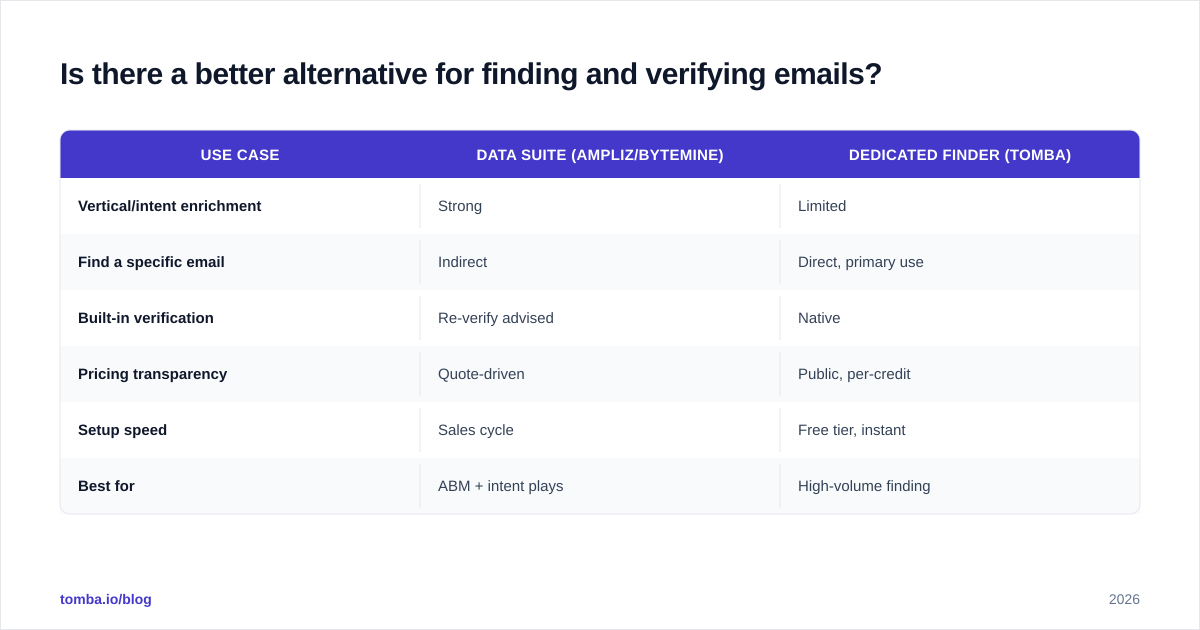
This is where a purpose-built tool earns its place. The Tomba Email Finder locates professional addresses by name, company, or domain, and pairs with a domain search to pull every reachable contact at a target account. Need to process thousands at once? The bulk email finder handles list-scale lookups, and a Tomba API wires the whole thing into your stack. Crucially, verification is native — so you're not exporting "matched" records and praying they land.
| Use case | Data suite (Ampliz/Bytemine) | Dedicated finder (Tomba) |
|---|---|---|
| Vertical/intent enrichment | Strong | Limited |
| Find a specific email | Indirect | Direct, primary use |
| Built-in verification | Re-verify advised | Native |
| Pricing transparency | Quote-driven | Public, per-credit |
| Setup speed | Sales cycle | Free tier, instant |
| Best for | ABM + intent plays | High-volume finding |
None of this means data suites are bad — it means you should match the tool to the recurring job. Many teams run a hybrid: a specialist suite for vertical enrichment plus a dedicated finder for everyday email discovery and verification. You can sanity-check any platform's claims against independent reviews on G2 before committing budget.

How should you actually run the evaluation?#
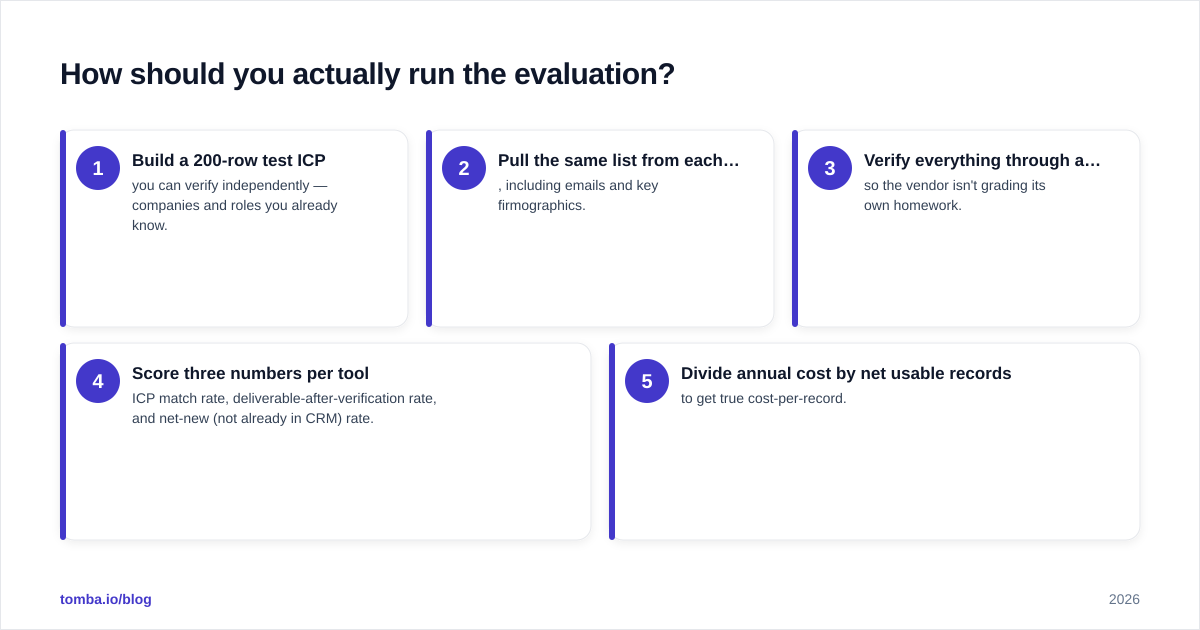
Don't trust the demo. Run a controlled bake-off:
- Build a 200-row test ICP you can verify independently — companies and roles you already know.
- Pull the same list from each tool, including emails and key firmographics.
- Verify everything through a neutral third party so the vendor isn't grading its own homework.
- Score three numbers per tool: ICP match rate, deliverable-after-verification rate, and net-new (not already in CRM) rate.
- Divide annual cost by net usable records to get true cost-per-record.
Whichever platform wins that math wins your budget. For deeper methodology and how data providers source their records, vendor documentation like the HubSpot data quality resources and Tomba's own data sources breakdown are worth reading before you sign anything.
The bottom line#
Ampliz and Bytemine solve different problems. Ampliz is your pick for healthcare, life sciences, and APAC depth with human-verified precision. Bytemine wins for broad, intent-driven outbound across many industries at speed. Neither is "better" in a vacuum — the better tool is the one that matches your ICP shape and tempo.
But before you commit to a full data suite, be honest about what you actually do all day. If your recurring job is finding verified professional emails and getting them into sequences fast, you may not need a sprawling platform at all. Start with the Tomba Email Finder — spin up the free tier in minutes, test it against your real ICP, and verify every address before you send. Let the cost-per-usable-record decide, not the sales deck.
Ready to find emails that actually work?
Join 150,000+ professionals who stopped guessing and started sending. Free credits on signup — no credit card required.
Get the Tomba newsletter
Practical outbound tactics and product updates — once every two weeks.
About the author