Ampliz vs ContactOut 2026: B2B Data & Email Finder Compared
Ampliz vs ContactOut in 2026: one is an APAC-heavy sales intelligence database, the other a LinkedIn email scraper. Here's which fits your pipeline, and where both fall short.
Choosing between Ampliz and ContactOut feels harder than it should, because the two tools barely play the same sport. One is a regional sales-intelligence database; the other is a LinkedIn-first contact scraper. This guide cuts through the marketing and tells you which one actually belongs in your stack in 2026 — and when neither is the right call.
TL;DR#
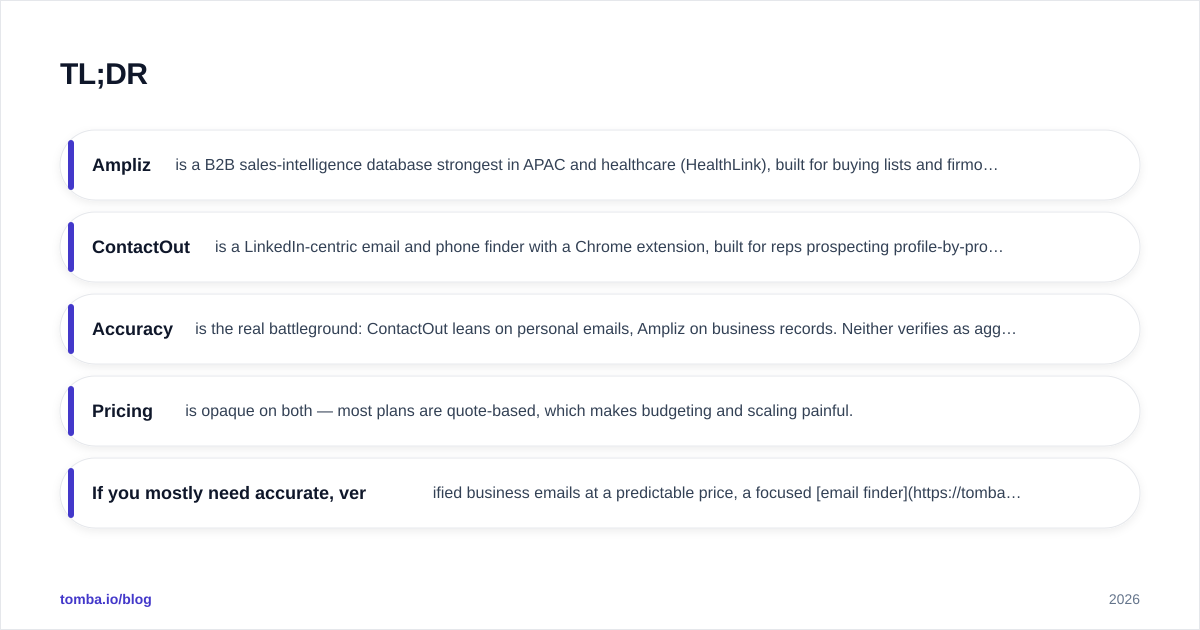
- Ampliz is a B2B sales-intelligence database strongest in APAC and healthcare (HealthLink), built for buying lists and firmographic enrichment, not one-off lookups.
- ContactOut is a LinkedIn-centric email and phone finder with a Chrome extension, built for reps prospecting profile-by-profile.
- Accuracy is the real battleground: ContactOut leans on personal emails, Ampliz on business records. Neither verifies as aggressively as a dedicated finder.
- Pricing is opaque on both — most plans are quote-based, which makes budgeting and scaling painful.
- If you mostly need accurate, verified business emails at a predictable price, a focused email finder like Tomba is usually the cheaper, simpler answer.
What is Ampliz?#
Ampliz is a B2B sales-intelligence platform that sells access to a contact and company database, with a well-known specialty in the Asia-Pacific region and a separate healthcare dataset branded HealthLink. Think of it less like a search box and more like a data vendor: you tell it the segment you want — say, hospital procurement leads in Singapore — and it returns enriched records with firmographics, intent signals, and contact details.
Its core strengths are segmentation depth and regional coverage. If your ICP is APAC-heavy or you sell into healthcare, Ampliz often surfaces records that US-centric databases miss. It also pushes "intent" and customized list-building as managed services, which appeals to teams that would rather receive a finished list than build one.
The trade-off is that Ampliz behaves like an enterprise data contract. Pricing is quote-driven, onboarding is sales-led, and the value depends heavily on whether your territory overlaps with its strongest data. Outside APAC and healthcare, coverage thins out fast. You can read more about Ampliz on its official site.
What is ContactOut?#
ContactOut is an email and phone finder built around LinkedIn. Its flagship product is a Chrome extension that overlays profiles and recruiter searches, revealing personal and work emails plus phone numbers as you browse. It markets heavy coverage of professional profiles and is popular with recruiters and individual sales reps who live inside LinkedIn all day.
The mental model here is different from Ampliz. ContactOut is a per-profile reveal tool: you find a person, click, and it tries to return their contact info — often a personal Gmail alongside a work address. That makes it excellent for targeted, low-volume prospecting where you already know exactly who you want to reach.
Where it gets weaker is structured, large-scale list building and verification. Bulk workflows exist, but the product's center of gravity is the browser extension, and the personal-email focus that recruiters love can create deliverability and compliance headaches for cold B2B outbound. ContactOut's plans are also largely quote-based above the entry tier. See its official site for the current feature set.

Ampliz vs ContactOut: how do they actually compare?#
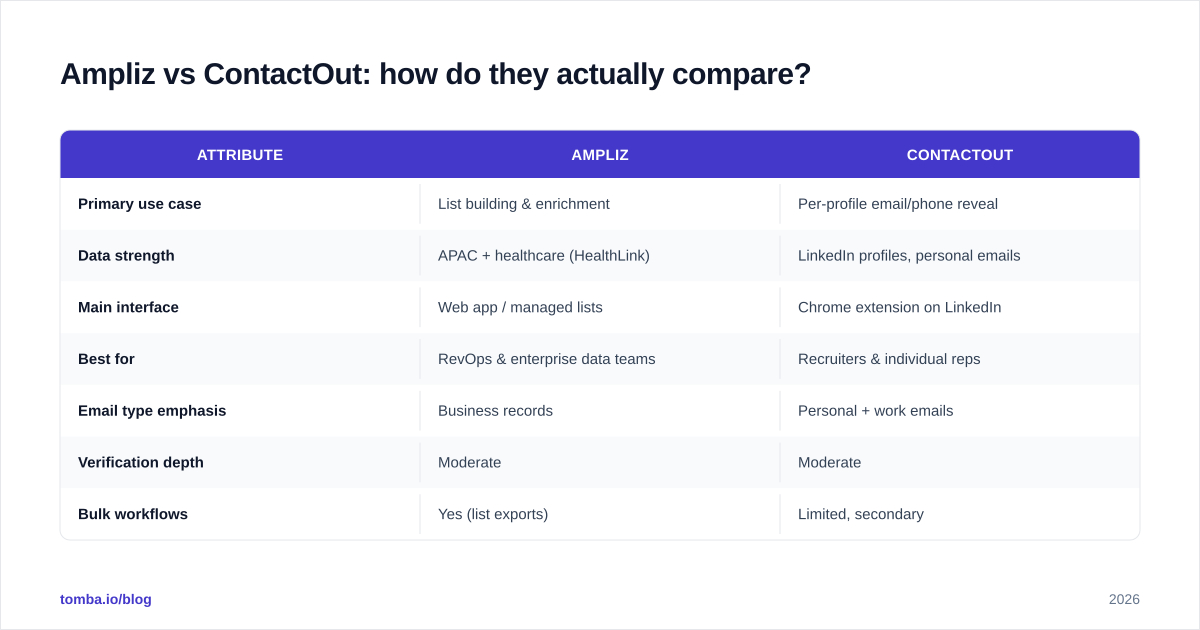
The fastest way to see the gap is side by side. The table below maps the attributes that decide most buying decisions.
| Attribute | Ampliz | ContactOut |
|---|---|---|
| Primary use case | List building & enrichment | Per-profile email/phone reveal |
| Data strength | APAC + healthcare (HealthLink) | LinkedIn profiles, personal emails |
| Main interface | Web app / managed lists | Chrome extension on LinkedIn |
| Best for | RevOps & enterprise data teams | Recruiters & individual reps |
| Email type emphasis | Business records | Personal + work emails |
| Verification depth | Moderate | Moderate |
| Bulk workflows | Yes (list exports) | Limited, secondary |
| Pricing transparency | Quote-based | Mostly quote-based |
| Free tier | Limited credits | Limited free lookups |
| Compliance fit (cold B2B) | Region-dependent | Personal-email risk |
The pattern is clear: these tools win in different lanes. Ampliz is a database you query in bulk; ContactOut is a scalpel you use one profile at a time. Picking "the better tool" without naming your workflow is how teams overpay for capability they never touch.
Which one has better data coverage?#
It depends entirely on geography and motion. Ampliz wins in APAC and healthcare, full stop — that is its moat. If you sell into North America or EMEA and need work emails for standard B2B roles, ContactOut's LinkedIn-derived coverage is usually broader, because almost everyone you target has a profile.
But coverage is not the same as usable coverage. ContactOut's habit of surfacing personal Gmail and Yahoo addresses inflates its hit-rate numbers while handing you contacts you arguably should not cold-email. Ampliz returns more business-shaped records, but the freshness varies outside its core regions.
Which one has better email accuracy?#
Neither tool is built primarily as a verifier, and that shows. Both return a contact and a confidence label, but a label is not a validated mailbox. The safest workflow with either tool is to treat their output as candidate data and run it through a dedicated email verifier before you send. That single step does more for your bounce rate than choosing between Ampliz and ContactOut ever will.

How should you choose between them?#
Match the tool to the job, not the brand. The decision framework below walks the three questions that actually settle it: where your buyers are, how you work, and how predictable your spend needs to be.
- Where are your buyers? APAC or healthcare → Ampliz has a genuine edge. Global or North America → ContactOut's LinkedIn coverage is hard to beat for breadth.
- How do you work? Building large segmented lists for a RevOps motion → Ampliz. Reps prospecting inside LinkedIn one profile at a time → ContactOut.
- How predictable must spend be? Both lean on quotes. If you need a published price you can scale against, that gap pushes many teams toward a transparent third option.

When Ampliz is the right call#
Choose Ampliz when your pipeline depends on regional depth — selling medical devices into Southeast Asian hospitals, for example — and you would rather receive a curated list than assemble one. Its managed, segment-first approach saves time for teams that don't want to operate a finder themselves, and its data enrichment angle fits RevOps groups that already have a CRM full of half-empty records to fill in.
When ContactOut is the right call#
Choose ContactOut when LinkedIn is your hunting ground and your volume is targeted rather than industrial. Recruiters sourcing candidates and AEs working a named-account list both benefit from a click-to-reveal extension that lives where they already work. Just budget for verification and think hard about whether personal emails belong in your outbound — for cold B2B, they often don't.
What are the pricing and value differences?#
Here is the honest part: both vendors make you ask for a number. Entry tiers exist, but serious usage on either platform routes through a sales conversation, and the per-contact cost can climb quickly once you scale. That opacity is the single most common complaint in reviews on sites like G2, and it is the main reason teams comparison-shop in the first place.
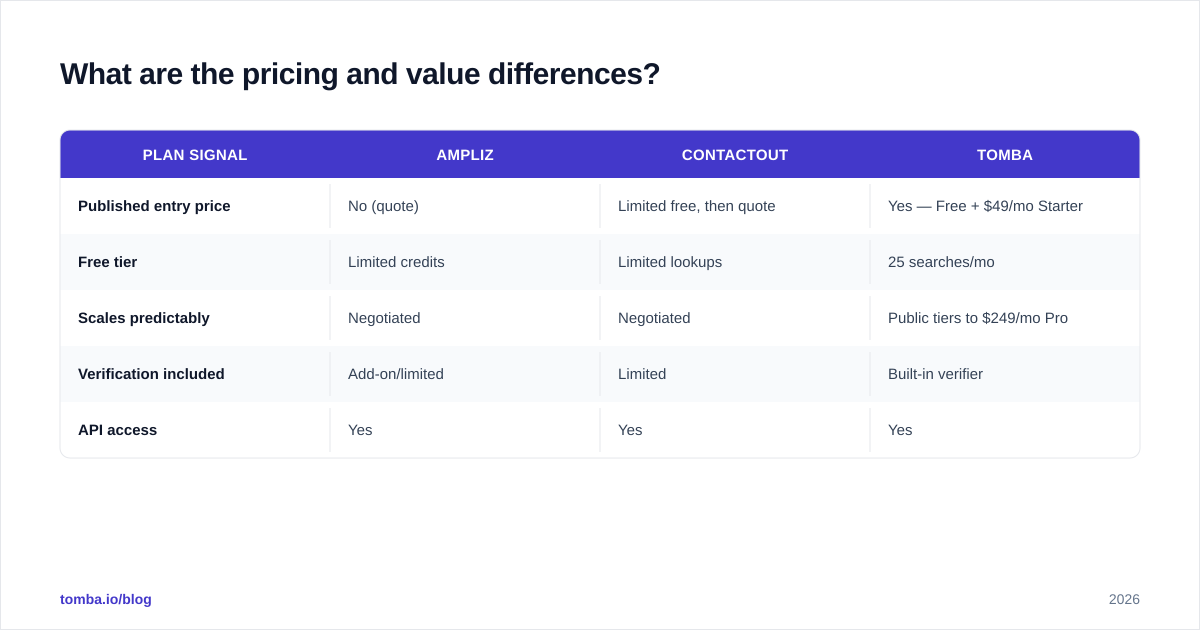
For predictable budgeting, transparent published pricing matters more than a marginal coverage edge. As a reference point, Tomba publishes its tiers openly — a Free plan with 25 searches per month, Starter at $49/mo, Growth at $99/mo, and Pro at $249/mo — so you can model cost before you ever talk to anyone. You can see the full breakdown on the Tomba pricing page.
| Plan signal | Ampliz | ContactOut | Tomba |
|---|---|---|---|
| Published entry price | No (quote) | Limited free, then quote | Yes — Free + $49/mo Starter |
| Free tier | Limited credits | Limited lookups | 25 searches/mo |
| Scales predictably | Negotiated | Negotiated | Public tiers to $249/mo Pro |
| Verification included | Add-on/limited | Limited | Built-in verifier |
| API access | Yes | Yes | Yes |
The takeaway is not that Tomba "beats" both on every axis — it is that price transparency removes a whole category of risk. When you can see the ceiling, you can plan against it.

Is there a simpler alternative to both?#
For most teams whose core need is "find accurate, verified business emails without a sales call," a focused email finder is the simpler answer. Ampliz and ContactOut are powerful in their niches — regional data and LinkedIn reveals respectively — but they ask you to either sign an enterprise data contract or live inside a browser extension and clean up personal-email noise afterward.
A dedicated finder collapses that into one predictable workflow. With Tomba you can search by domain, name, or company, verify in the same place, and pull everything through an email finder API when you're ready to automate. If you're specifically evaluating the LinkedIn-reveal motion, it's worth reading the dedicated ContactOut alternative breakdown before you commit.
Tools like Wikipedia's overview of email address harvesting are also a useful reminder that how you source contacts carries compliance weight — a point that favors business-record finders over personal-email scrapers for cold outbound.
A practical workflow that beats either tool alone#
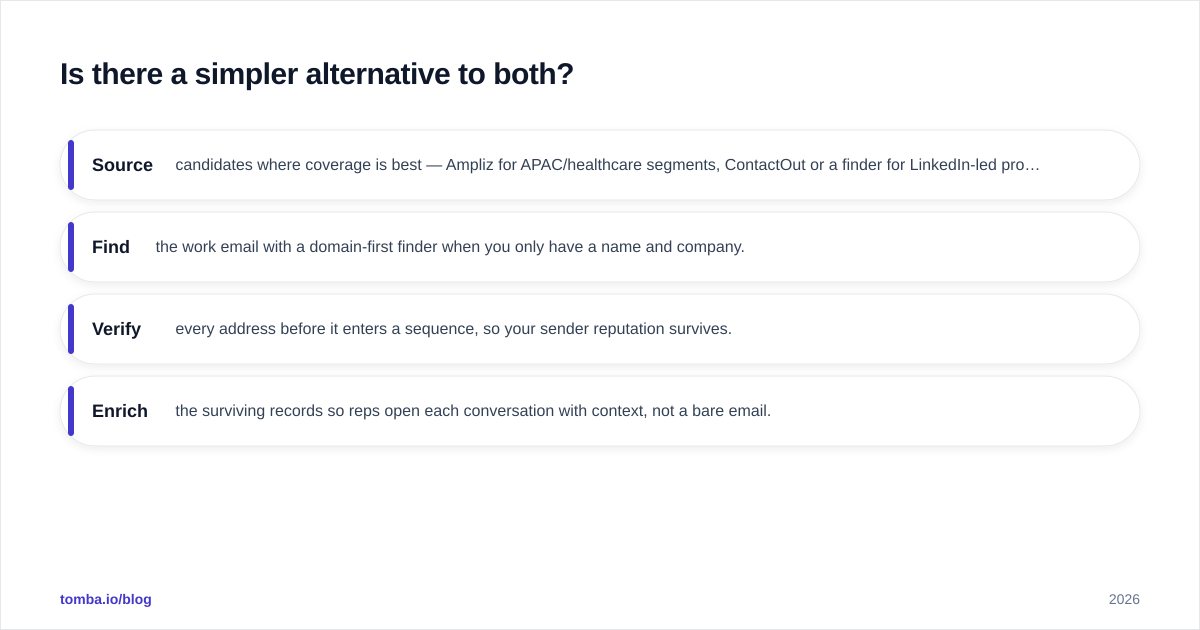
You don't have to pick a single vendor and live with its weakness. A pragmatic stack looks like this:
- Source candidates where coverage is best — Ampliz for APAC/healthcare segments, ContactOut or a finder for LinkedIn-led prospecting.
- Find the work email with a domain-first finder when you only have a name and company.
- Verify every address before it enters a sequence, so your sender reputation survives.
- Enrich the surviving records so reps open each conversation with context, not a bare email.
That sequence treats finding and verifying as separate jobs — which they are — instead of trusting a single confidence label.
Frequently asked questions#
Is Ampliz better than ContactOut? Only for the right job. Ampliz is better for APAC and healthcare list building; ContactOut is better for LinkedIn-led, per-profile prospecting. Neither is universally "better."
Does ContactOut give personal emails? Yes, and that's both its appeal and its risk. Personal Gmail/Yahoo addresses help recruiters but can hurt deliverability and compliance for cold B2B outbound.
Are Ampliz and ContactOut accurate? Both return confidence-scored contacts, but neither is a dedicated verifier. Run results through verification before sending regardless of which you choose.
Why is pricing so hard to find? Both lean on quote-based sales for serious volume. If predictable, published pricing matters to you, a transparent finder is the easier path.
The bottom line#
Ampliz and ContactOut solve different problems: regional/healthcare data versus LinkedIn contact reveals. Map your buyers, your workflow, and your budget tolerance, and the choice usually makes itself. But if what you actually need is accurate, verified business email at a price you can see in advance, skip the quote queue. Start free with the Tomba Email Finder — search by domain or name, verify in the same workflow, and scale on public pricing instead of a negotiation.
Ready to find emails that actually work?
Join 150,000+ professionals who stopped guessing and started sending. Free credits on signup — no credit card required.
Get the Tomba newsletter
Practical outbound tactics and product updates — once every two weeks.
About the author