Ampliz vs D7 Lead Finder: B2B Data Tool Comparison 2026
Ampliz targets healthcare and enterprise B2B contact data; D7 Lead Finder scrapes local business leads in bulk. Here's which one fits your pipeline in 2026 — and where a verified email finder beats both.
Choosing between Ampliz and D7 Lead Finder usually means choosing between two completely different jobs. One is built to enrich and target enterprise B2B contacts — heavy in healthcare. The other is a bulk scraper that pulls local business listings into a CSV as fast as you can type a keyword. Picking the "better" tool without knowing which job you're hiring for is how teams waste a quarter of budget on data they can't use.
This guide breaks down both tools on data depth, accuracy, pricing, and real workflows, then shows where a dedicated, verified email finder outperforms either one for cold outbound.
TL;DR#
- Ampliz is a B2B data intelligence platform strongest in healthcare/HealthTech and enterprise account targeting, sold mostly through custom quotes and API access.
- D7 Lead Finder is a fast, cheap bulk scraper for local businesses (think "dentists in Austin") that exports name, phone, website, and sometimes email.
- Accuracy differs by design: Ampliz curates and enriches; D7 scrapes public listings, so email quality is inconsistent and needs verification.
- Pricing models clash: D7 is transparent monthly tiers; Ampliz is sales-led custom pricing.
- For cold email at scale, neither replaces a verified email finder plus an email verifier — that's where deliverability is actually won.
What is Ampliz?#
Ampliz is a B2B data and sales intelligence platform. Its core pitch is contextual contact and company data — firmographics, technographics, and decision-maker details — with a notably deep bench in the healthcare and life-sciences space (physicians, hospitals, HealthTech buyers).
You use Ampliz when you need to target precisely: build account lists that match an ICP, enrich records you already have, and pull intelligence (revenue band, employee count, tech stack) before a rep ever reaches out. It leans toward mid-market and enterprise teams that care more about fit than raw volume, and it exposes an API for programmatic enrichment.
The trade-off is that Ampliz is sales-led. You typically request a demo and get a custom quote rather than swiping a card for a $29 plan. That's normal for curated enterprise data, but it means slower onboarding and less predictable cost for a small team.
What is D7 Lead Finder?#
D7 Lead Finder is a bulk local-business lead generator. You type a search like "plumbers in Chicago," and it scrapes business listings into a downloadable list: business name, phone, website, address, category, social profiles, and sometimes an email.
It's built for speed and volume at a low price. Agencies, local SEO shops, and SMB service sellers love it because one search can return hundreds of businesses in minutes. The data comes from public directories and maps-style listings, so it's broad but shallow — you get the storefront, not the specific decision-maker's verified inbox.
D7's strength is also its weakness. Because it pulls from public listings, email coverage is partial and unverified. A scraped info@ address is fine for some campaigns and useless for others. You're trading precision for throughput.

Ampliz vs D7 Lead Finder: how do they compare?#
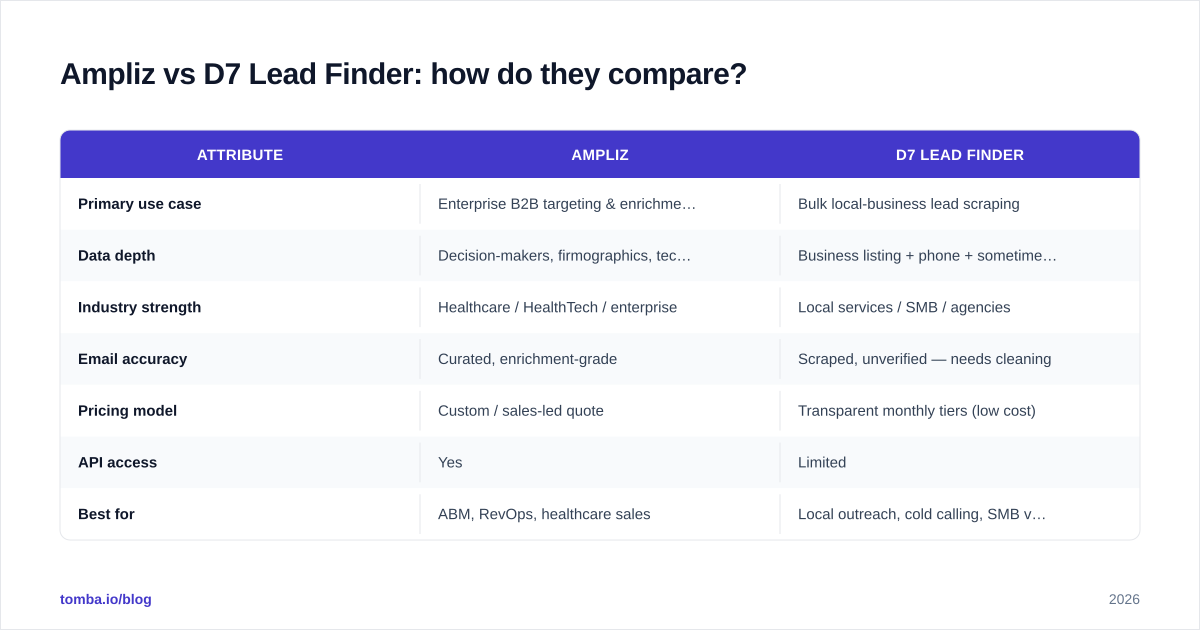
Here's the head-to-head on the attributes that actually change your results.
| Attribute | Ampliz | D7 Lead Finder |
|---|---|---|
| Primary use case | Enterprise B2B targeting & enrichment | Bulk local-business lead scraping |
| Data depth | Decision-makers, firmographics, technographics | Business listing + phone + sometimes email |
| Industry strength | Healthcare / HealthTech / enterprise | Local services / SMB / agencies |
| Email accuracy | Curated, enrichment-grade | Scraped, unverified — needs cleaning |
| Pricing model | Custom / sales-led quote | Transparent monthly tiers (low cost) |
| API access | Yes | Limited |
| Best for | ABM, RevOps, healthcare sales | Local outreach, cold calling, SMB volume |
| Verification built in | Partial | No — verify before sending |
The pattern is clear: these tools rarely compete for the same buyer. If your motion is account-based and you sell into healthcare or enterprise, Ampliz is the natural fit. If you run high-volume local outreach and price sensitivity is real, D7 wins on cost-per-lead.
For the data-accuracy question specifically — which tool gives you contacts you can actually reach — it helps to see how purpose-built finders benchmark against general data providers.

Which one is more accurate?#
Ampliz is more accurate for who — D7 is faster for how many. They optimize different ends of the funnel.
Ampliz curates and enriches, so when it returns a healthcare decision-maker, the title and company context are usually reliable. That's the value of a managed data operation: fewer records, higher confidence per record.
D7 scrapes public listings, which means the business exists but the email may be generic, outdated, or missing. None of that is a knock on D7 — it's doing exactly what a scraper does. It just means you cannot send cold email straight off a D7 export without cleaning it first. Bounce rates on raw scraped lists routinely run high enough to dent your sender reputation.
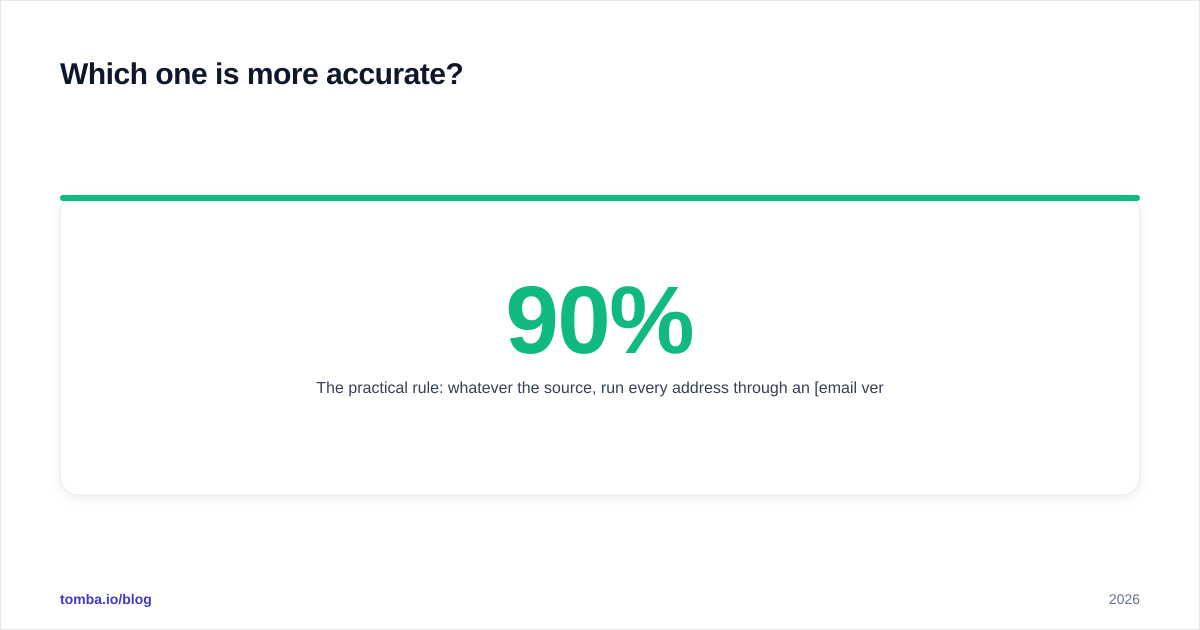
The practical rule: whatever the source, run every address through an email verification step before your first send. A list that's 90% deliverable beats a list that's 3x bigger and 40% dead, every time. If you're working catch-all domains (common with larger companies), a dedicated catch-all verifier tells you which "risky" addresses are actually safe.
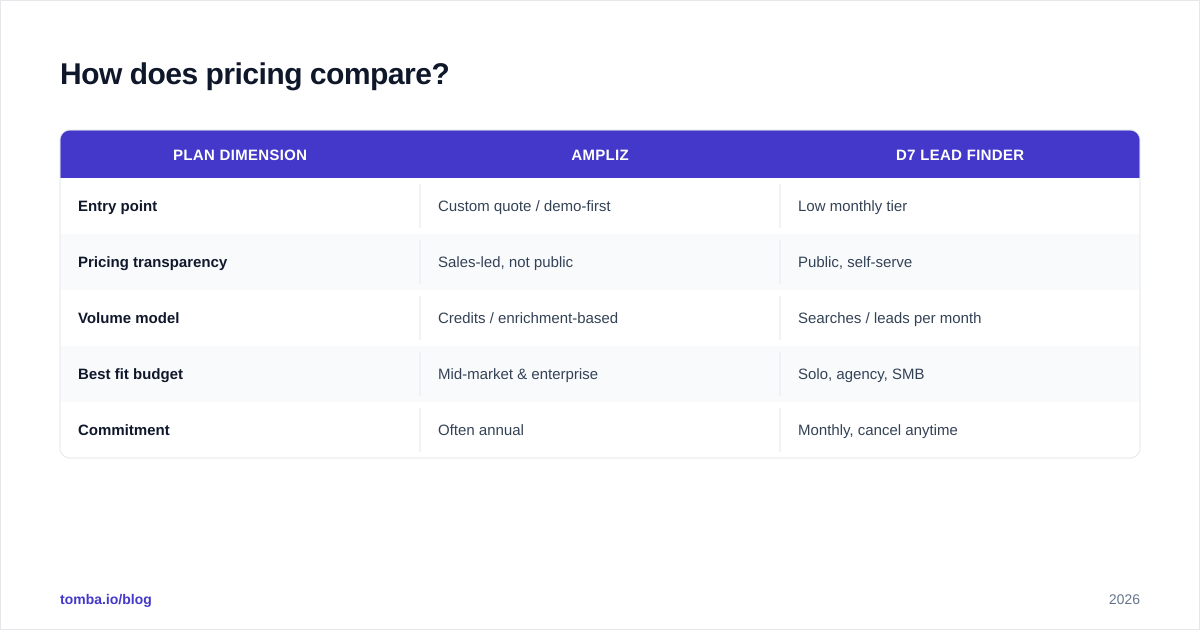
How does pricing compare?#
Pricing is where the two tools feel most different.
| Plan dimension | Ampliz | D7 Lead Finder |
|---|---|---|
| Entry point | Custom quote / demo-first | Low monthly tier |
| Pricing transparency | Sales-led, not public | Public, self-serve |
| Volume model | Credits / enrichment-based | Searches / leads per month |
| Best fit budget | Mid-market & enterprise | Solo, agency, SMB |
| Commitment | Often annual | Monthly, cancel anytime |
D7's model rewards people who want to start today without a sales call. Ampliz's model rewards teams that need depth and are willing to scope a contract for it. Neither is "cheaper" in the abstract — D7 is cheaper per raw lead, Ampliz is cheaper per qualified, enriched record if your ICP is narrow.
One honest caveat: if your only goal is finding and verifying professional emails by domain or name, paying enterprise data prices or stacking a scraper plus a separate verifier can cost more than a focused tool. Compare it against transparent Tomba pricing — a free tier with 25 searches, Starter at $49/mo, Growth at $99/mo — before you commit to either platform for that specific job.
When should you pick a dedicated email finder instead?#
Pick a purpose-built email finder when your real goal is reaching specific people by email, not browsing a database or dumping local listings.
Ampliz and D7 both produce leads, but a cold outbound engine needs three things they only partially deliver:
- Pinpoint addresses for named decision-makers, not generic
info@inboxes. - Verification baked in, so you don't ship a separate cleaning step.
- Workflow fit — bulk, API, CRM, and spreadsheet entry points where your team already works.
This is where a tool like Tomba slots in. You can run a domain search to pull every public address pattern at a target company, use the bulk email finder to process a whole prospect list at once, and push results straight into your stack via the Tomba API. Every result is verifiable in the same flow, so the list that lands in your sequence is already clean.
A common, effective workflow that uses each tool for what it's best at:
- Source the account list in Ampliz (great ICP targeting) or D7 (great local volume).
- Find and verify the actual decision-maker emails with a dedicated finder.
- Enrich the rest — phone, LinkedIn, role — with data enrichment before the rep makes contact.
You're not replacing your sourcing tool; you're fixing the weakest link, which is almost always email accuracy.
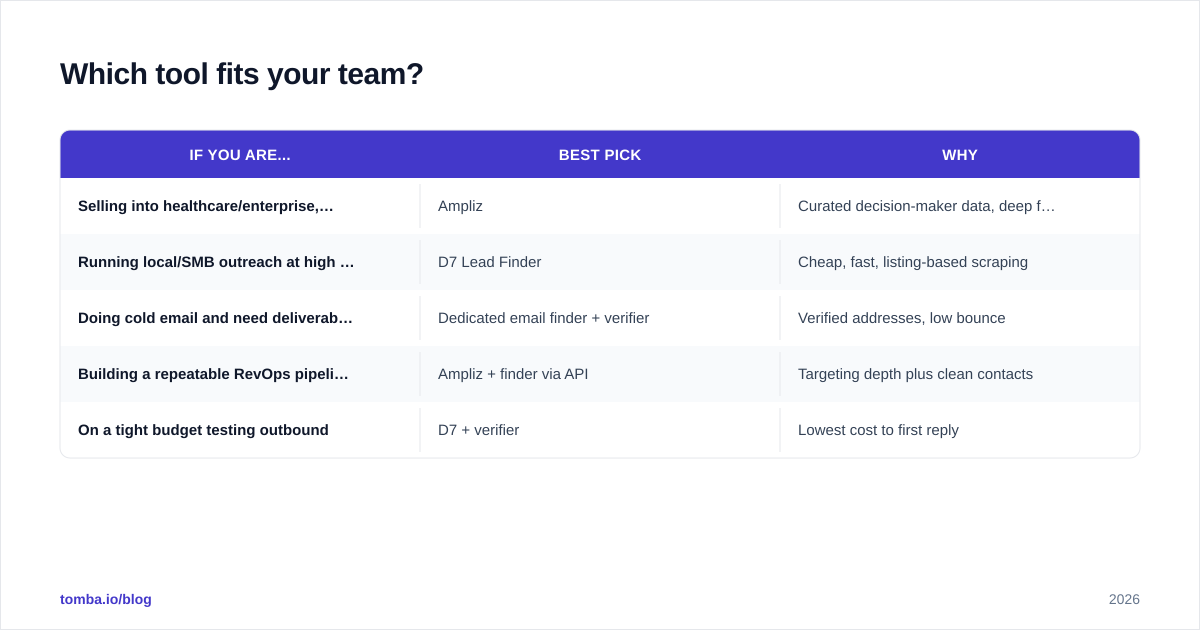
Which tool fits your team?#
Use this quick decision matrix.
| If you are... | Best pick | Why |
|---|---|---|
| Selling into healthcare/enterprise, ABM motion | Ampliz | Curated decision-maker data, deep firmographics |
| Running local/SMB outreach at high volume | D7 Lead Finder | Cheap, fast, listing-based scraping |
| Doing cold email and need deliverability | Dedicated email finder + verifier | Verified addresses, low bounce |
| Building a repeatable RevOps pipeline | Ampliz + finder via API | Targeting depth plus clean contacts |
| On a tight budget testing outbound | D7 + verifier | Lowest cost to first reply |
The biggest mistake is treating this as a single winner-take-all choice. Ampliz and D7 answer "who should I talk to and how do I find businesses." A verified finder answers "how do I actually reach the right person without burning my domain." Most strong outbound stacks use one sourcing tool and a finder, not one tool stretched past what it was built for.
Frequently asked questions#
Is Ampliz better than D7 Lead Finder? Neither is universally better. Ampliz wins for enterprise and healthcare targeting with enriched decision-maker data; D7 wins for cheap, high-volume local lead scraping. Match the tool to your motion.
Does D7 Lead Finder provide verified emails? No. D7 scrapes public listings, so emails are inconsistent and unverified. Always run exports through an email verifier before sending to protect your sender reputation.
Can I use both tools together? Yes, and many teams do. Source accounts with Ampliz or D7, then find and verify decision-maker emails with a dedicated finder before outreach.
Which is cheaper? D7 is cheaper per raw lead with transparent monthly tiers. Ampliz is sales-led and priced for enterprise. For the narrow job of finding verified emails, a focused finder is usually the most cost-effective.
The bottom line#
Ampliz and D7 Lead Finder solve different problems: precision enterprise targeting versus bulk local volume. Decide which job you're hiring for, then don't skip the step both tools leave half-finished — turning a list into verified, reachable inboxes.
If your real bottleneck is finding accurate professional emails and reaching the right people, start with the Tomba Email Finder. Search by domain, name, or company, verify in the same flow, and export clean lists ready for your sequences — free for your first 25 searches, no sales call required. Pair it with your sourcing tool of choice and you get the best of both: strong targeting and a list that actually lands.
External references: see verified user reviews on G2, the Ampliz site, and D7 Lead Finder for current feature details before you buy.
Ready to find emails that actually work?
Join 150,000+ professionals who stopped guessing and started sending. Free credits on signup — no credit card required.
Get the Tomba newsletter
Practical outbound tactics and product updates — once every two weeks.
About the author