Ampliz vs Data Marketers Group: 2026 B2B Data Comparison
Ampliz sells live sales intelligence; Data Marketers Group sells pre-built email lists. Here is which B2B data source actually fits your pipeline in 2026.
TL;DR
- Ampliz is a live B2B sales-intelligence platform with healthcare/APAC depth, real-time enrichment, and an API. Data Marketers Group is a list broker that sells pre-built and custom email lists by industry, title, and geography.
- If you need always-fresh, verified contacts on demand, Ampliz wins. If you want a one-time bulk file for a broad campaign, Data Marketers Group is cheaper up front — but you carry the decay risk.
- Pre-built lists degrade fast: B2B data goes stale at roughly 22–30% per year, so a list bought today is meaningfully wrong within months.
- Neither tool removes your obligation to verify before you send. Bounces wreck sender reputation no matter where the data came from.
- For most teams in 2026, the smart move is a live data source plus a verification layer — not a static CSV you trust on faith.
What are Ampliz and Data Marketers Group?#
They solve the same problem — "get me B2B contacts" — from opposite ends of the market.
Ampliz is a sales-intelligence platform. You search its database by industry, title, technographic, or geography and pull contact records (email, phone, company firmographics) in real time, either in-app, via a Chrome extension, or through its data enrichment API. Its calling card is depth in healthcare data and the APAC region, where most US-centric providers are thin.
Data Marketers Group is a B2B list provider — closer to a data broker than a software product. You tell them the segment you want (say, "IT directors at US manufacturers, 500+ employees"), and they deliver a list, typically as a CSV or Excel file. They sell pre-packaged industry lists and build custom lists to spec.
The core difference in one line: Ampliz is a tap you turn on when you need data; Data Marketers Group hands you a bucket and walks away.
How do they differ on data freshness and accuracy?#
This is the whole ballgame, and it's where the two models diverge hardest.
A platform like Ampliz re-queries and re-verifies records closer to the moment you pull them. A static list from Data Marketers Group is a snapshot — accurate (at best) on the day it was compiled, and decaying every day after.
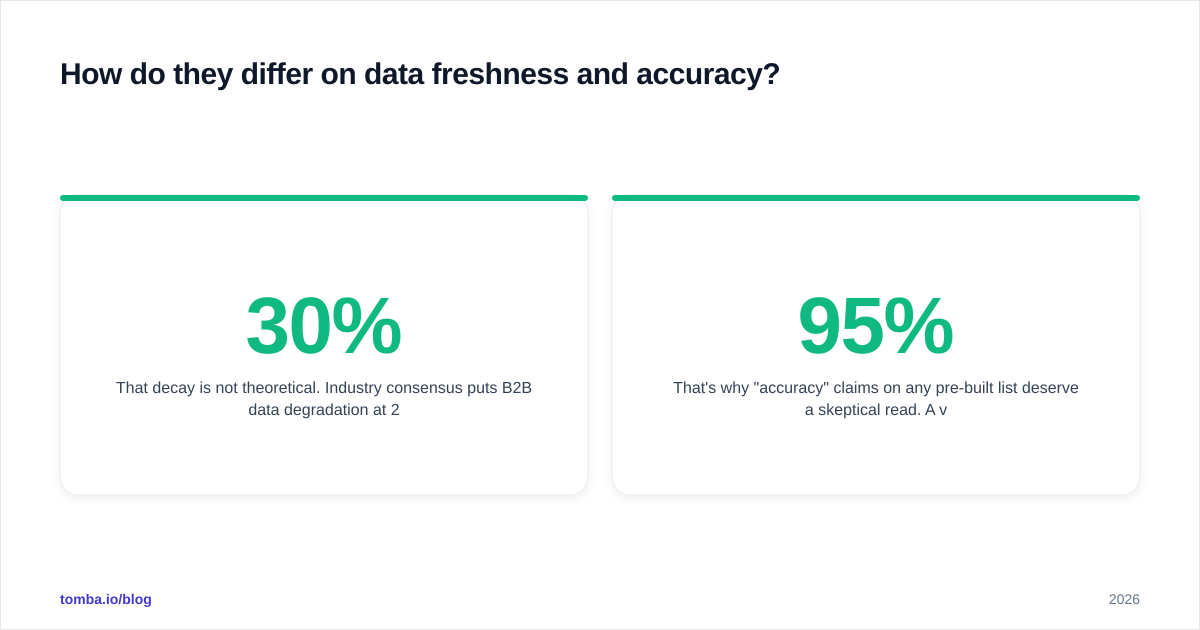
That decay is not theoretical. Industry consensus puts B2B data degradation at 22–30% per year as people change jobs, companies rebrand, and domains shuffle. A list you buy in January is materially wrong by summer.
ZoomInfo, HubSpot, and other vendors have published similar churn figures for years — it's one of the few things everyone in the data business agrees on.

That's why "accuracy" claims on any pre-built list deserve a skeptical read. A vendor can honestly say a list was 95% accurate at compilation and still ship you something that bounces 20% of the time three months later. Live platforms aren't immune either — but their decay window is shorter because the data is pulled fresh.
The practical takeaway: whatever you buy, run it through an email verifier before the first send. Treat the source's accuracy claim as a starting point, not a guarantee.

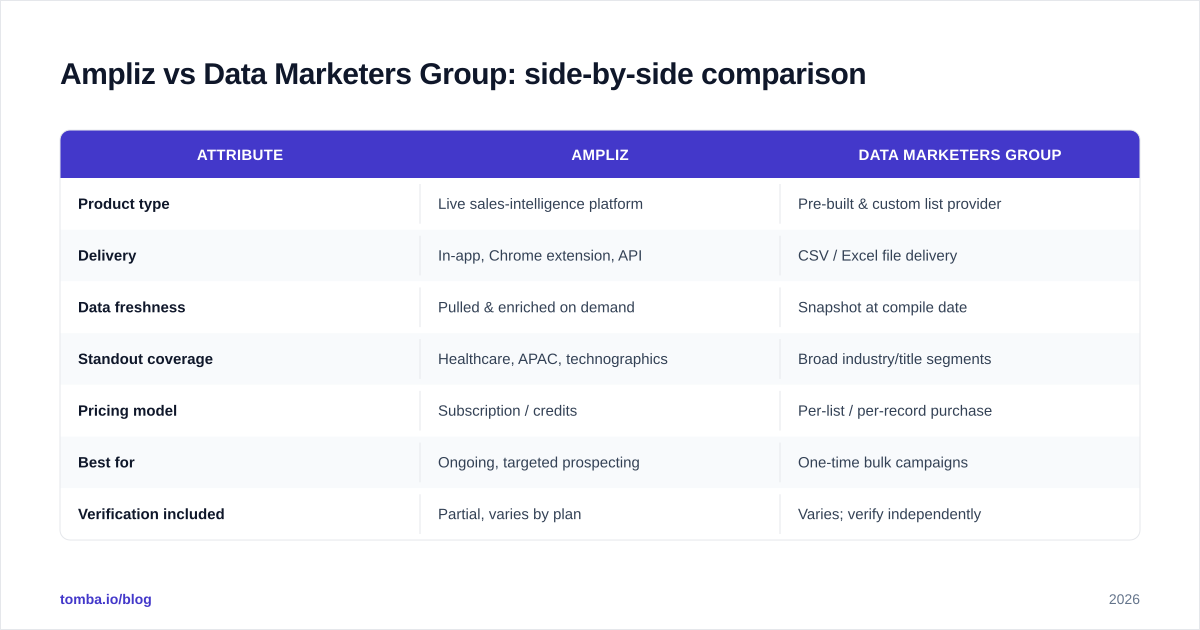
Ampliz vs Data Marketers Group: side-by-side comparison#
| Attribute | Ampliz | Data Marketers Group |
|---|---|---|
| Product type | Live sales-intelligence platform | Pre-built & custom list provider |
| Delivery | In-app, Chrome extension, API | CSV / Excel file delivery |
| Data freshness | Pulled & enriched on demand | Snapshot at compile date |
| Standout coverage | Healthcare, APAC, technographics | Broad industry/title segments |
| Pricing model | Subscription / credits | Per-list / per-record purchase |
| Best for | Ongoing, targeted prospecting | One-time bulk campaigns |
| Verification included | Partial, varies by plan | Varies; verify independently |
| Compliance burden | On platform + you | Largely on you |
| API access | Yes | Limited / none |
The table makes the trade-off obvious. Ampliz is the better fit for a team running continuous, targeted outbound that needs current data and integrations. Data Marketers Group is the better fit for a marketer who wants a large file for a broad blast and is willing to absorb decay and verification work.
Which one is more accurate for email outreach?#
Short answer: a live platform like Ampliz starts more accurate, but neither is "send-ready" without verification.
Here's the reasoning. Accuracy degrades from the compile date. Ampliz compiles closer to your query, so its starting accuracy is higher for the records you actually pull. A bulk list from Data Marketers Group may have been assembled weeks or months before it reaches you, and you have less visibility into when each record was last validated.
But the gap matters less than people think — because your sending reputation doesn't care where the data came from. A 15% bounce rate from a fresh-but-unverified Ampliz pull damages your domain exactly as much as a 15% bounce from an old purchased list. Mailbox providers measure your behavior, not your vendor.

So the accuracy question collapses into a workflow question: do you have a verification step? If yes, both sources become viable and you choose on coverage and price. If no, both sources will eventually torch your sender reputation — the fresher source just takes slightly longer to do it.
This is the part teams skip. They buy on the accuracy headline, send straight from the file, and wonder why open rates crater. Build the verification step first.
What about pricing and total cost?#
Up-front, Data Marketers Group usually looks cheaper — you pay once for a file and you're done. Ampliz, as a subscription/credit platform, is a recurring line item.
But up-front cost is the wrong lens. Run the real math:
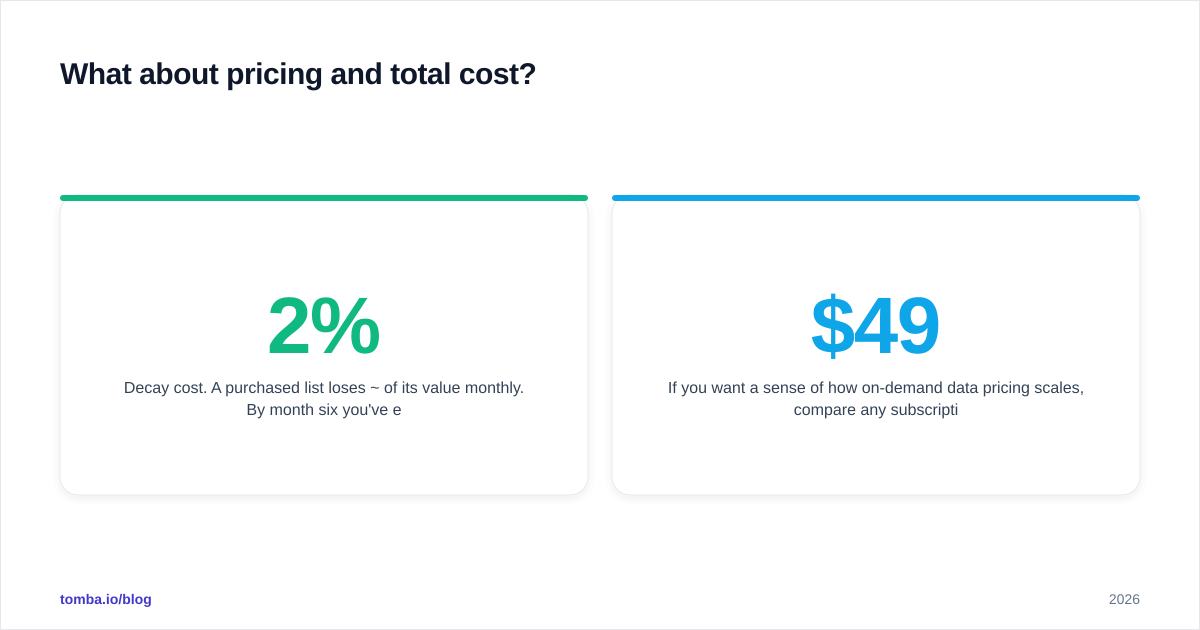
- Decay cost. A purchased list loses ~2% of its value monthly. By month six you've effectively paid for a list that's ~12–15% dead weight, and every dead record you mail costs you reputation.
- Verification cost. You'll pay to verify a purchased list anyway (you should), so add that to the sticker price.
- Re-purchase cadence. A static list isn't a one-time cost if you prospect continuously — you re-buy as it ages. A live platform amortizes that into the subscription.
- Reputation cost. The most expensive line item, and the one nobody invoices you for. One bad blast can suppress deliverability for weeks.
For a team doing one campaign a quarter, a purchased list can pencil out. For a team prospecting every week, a live platform almost always wins on total cost — and you stop re-buying the same decaying data.
If you want a sense of how on-demand data pricing scales, compare any subscription model against transparent per-credit pricing like Tomba's plans (free tier at 25 searches/mo, Starter at $49/mo) before you commit to a recurring contract.

What are the compliance and deliverability risks?#
This is where purchased lists get genuinely dangerous, and it's underdiscussed.
Purchased email lists are a recognized deliverability and legal hazard. GDPR (EU), CAN-SPAM (US), and CASL (Canada) all impose consent and disclosure requirements. A list you didn't collect consent for puts the compliance burden squarely on you — the sender — not the broker. Major ESPs like HubSpot explicitly prohibit sending to purchased lists on their platform, and many will suspend accounts that do.
Deliverability-wise, purchased lists are correlated with:
- Spam traps — recycled or pristine addresses that flag you as a list buyer the moment you hit one.
- High bounce rates — stale records that signal poor list hygiene to mailbox providers.
- Spam complaints — recipients who never opted in and hit "report spam."
A live platform doesn't eliminate these risks, but pulling a targeted set of fresh records you then verify is a far lower-risk pattern than blasting a broad bought file. Either way, lean on tooling: check your domain against a blacklist checker and confirm your authentication with an SPF checker before you scale any new data source.
If you want the regulatory specifics, read the GDPR overview on Wikipedia and your ESP's acceptable-use policy before importing any list — purchased or pulled.
When should you choose each one?#
Choose Ampliz if you:
- Prospect continuously and need current data, not a snapshot.
- Sell into healthcare or APAC markets, where Ampliz has real depth.
- Want API access and CRM enrichment, not a manual file import.
- Care about starting from the freshest possible records.
Choose Data Marketers Group if you:
- Need a large, broad list for a one-time or infrequent campaign.
- Have a niche segment request you want built to spec.
- Have a verification and compliance workflow already in place to de-risk the file.
- Are optimizing for lowest up-front cost on a single push.
Choose neither — and use a precision email-finder workflow — if you:
- Already know your target accounts and just need verified contacts for them.
- Want to control data quality address-by-address instead of buying in bulk.
- Need the lowest possible bounce rate and tightest compliance story.
That third path is where a lot of modern outbound teams have landed. Instead of buying a list or subscribing to a broad database, they identify accounts, then find and verify each contact on demand. It's slower per-record but produces the cleanest, most defensible data — and you only pay for what you actually use.
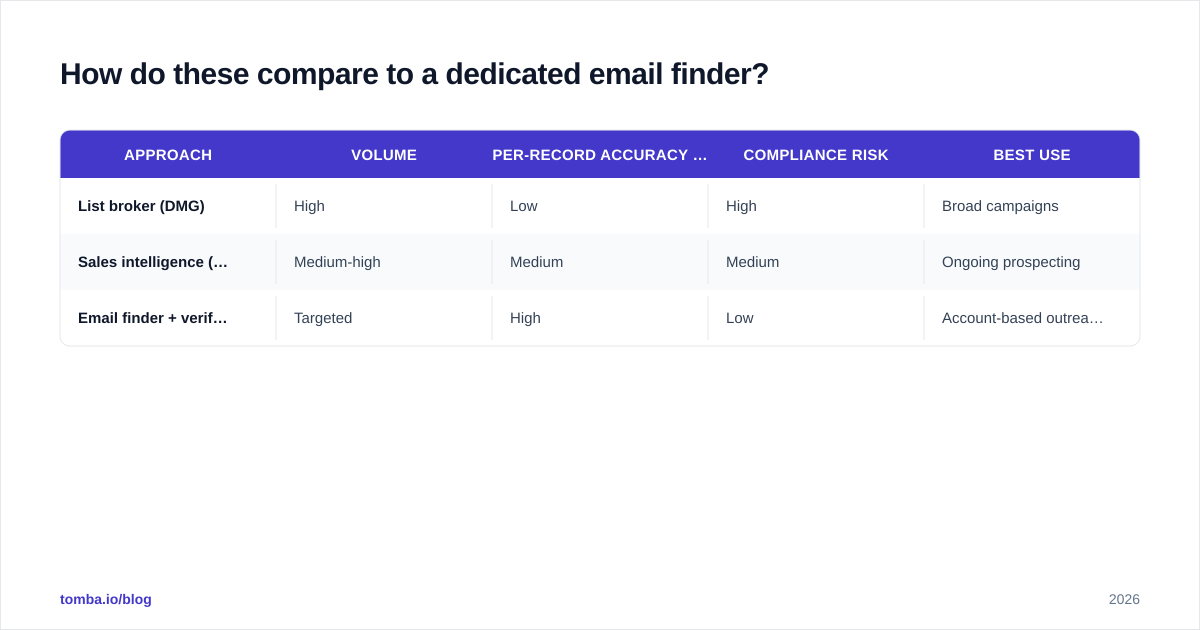
How do these compare to a dedicated email finder?#
List brokers and intelligence platforms optimize for volume. A dedicated email finder optimizes for precision — you give it a name and domain (or just a domain), and it returns the verified address for that specific person.
| Approach | Volume | Per-record accuracy control | Compliance risk | Best use |
|---|---|---|---|---|
| List broker (DMG) | High | Low | High | Broad campaigns |
| Sales intelligence (Ampliz) | Medium-high | Medium | Medium | Ongoing prospecting |
| Email finder + verifier | Targeted | High | Low | Account-based outreach |
For account-based outbound, the finder model is hard to beat. You're not paying for 50,000 records you'll never email — you're finding the 200 people who actually matter and verifying every one. Tools like Tomba's domain search let you pull every contact at a target company, and the built-in verification keeps your bounce rate low. That's a different shape of spend than a bulk list, and for targeted teams it's usually the better one.
The bottom line#
Ampliz and Data Marketers Group are both legitimate B2B data sources, but they reward different buyers. Ampliz is the choice for teams that prospect continuously and need fresh, integrable data — especially in healthcare and APAC. Data Marketers Group is the choice for a marketer who needs a broad file for an occasional campaign and has the verification discipline to de-risk it.
The mistake either way is trusting the data on faith. Both decay. Both can hurt your reputation if you send blind. Build a verification step, respect the compliance rules, and choose your source based on how often you prospect — not just the sticker price.
If your outreach is account-based — you know who you want to reach and you want every address verified before it touches your sequence — skip the bulk file entirely. Use the Tomba Email Finder to pull verified, professional emails by name or domain on demand, pay only for what you use, and keep your bounce rate (and your sender reputation) where it belongs. Start free with 25 searches a month and scale into a paid plan only when your pipeline does.
// get started
Find, verify and enrich your first contacts today
Start on the free plan with 25 searches a month, then scale when your team is ready.
Free plan · No credit card required · GDPR & CCPA
// about the author