Ampliz vs Datanyze 2026: B2B Data Platform Comparison
Ampliz leans healthcare and APAC intelligence; Datanyze owns technographics. Here is an honest 2026 breakdown of accuracy, pricing, coverage, and which fits your GTM motion.
TL;DR
- Ampliz specializes in healthcare and APAC B2B intelligence — strong for medical, life-sciences, and Asia-Pacific account targeting.
- Datanyze (owned by ZoomInfo) is a lightweight technographics tool — it tells you what software a company runs, plus basic contact lookup via a Chrome extension.
- They solve different problems. Ampliz is a data provider with depth in verticals; Datanyze is a prospecting add-on for tech-stack-based targeting.
- Neither is a pure email finder. If verified contact emails at scale are your bottleneck, a dedicated tool like Tomba Email Finder plus enrichment fills the gap more cheaply.
- Pick Ampliz for vertical depth, Datanyze for technographic signals, and pair either with a verification layer before you send.
What are Ampliz and Datanyze?#
Ampliz and Datanyze both sell B2B data, but they aim at different buyers.
Ampliz is a sales intelligence and data platform with a clear specialty: healthcare and APAC markets. If you sell to hospitals, clinics, physicians, or life-sciences companies — or you need contact and firmographic data across India, Southeast Asia, and Australia — Ampliz built its database around exactly that. Think of it as a regional specialist who knows one neighborhood block-by-block rather than a national chain with shallow coverage everywhere.
Datanyze is a technographics tool. Its core question is: "What technology does this company use?" It scrapes and infers tech stacks — CRM, analytics, hosting, payment processors — so you can target companies based on the software they run. Datanyze was acquired by ZoomInfo in 2019 and now runs as a lower-cost, lightweight prospecting product with a Chrome extension that surfaces contact and company data while you browse.
The honest framing: these aren't head-to-head rivals so much as two tools people shortlist when they say "I need better B2B data." The right answer depends on which data problem is actually hurting you.
How do Ampliz and Datanyze compare at a glance?#
| Attribute | Ampliz | Datanyze |
|---|---|---|
| Primary strength | Healthcare + APAC B2B intelligence | Technographics (tech-stack data) |
| Data type | Contacts, firmographics, healthcare specialty data | Tech install data, basic contacts |
| Best region | Asia-Pacific, plus global healthcare | North America (strongest) |
| Delivery | Platform, API, custom lists | Chrome extension + web app |
| Owned by | Independent | ZoomInfo (since 2019) |
| Email verification | Built-in checks | Limited |
| Typical buyer | Healthcare/life-sci sales, APAC GTM | SDRs targeting by tech stack |
| Free option | Trial / limited credits | Free tier with monthly credit caps |
| Entry pricing | Custom quote (mid-market) | Lower-cost tiers + free |
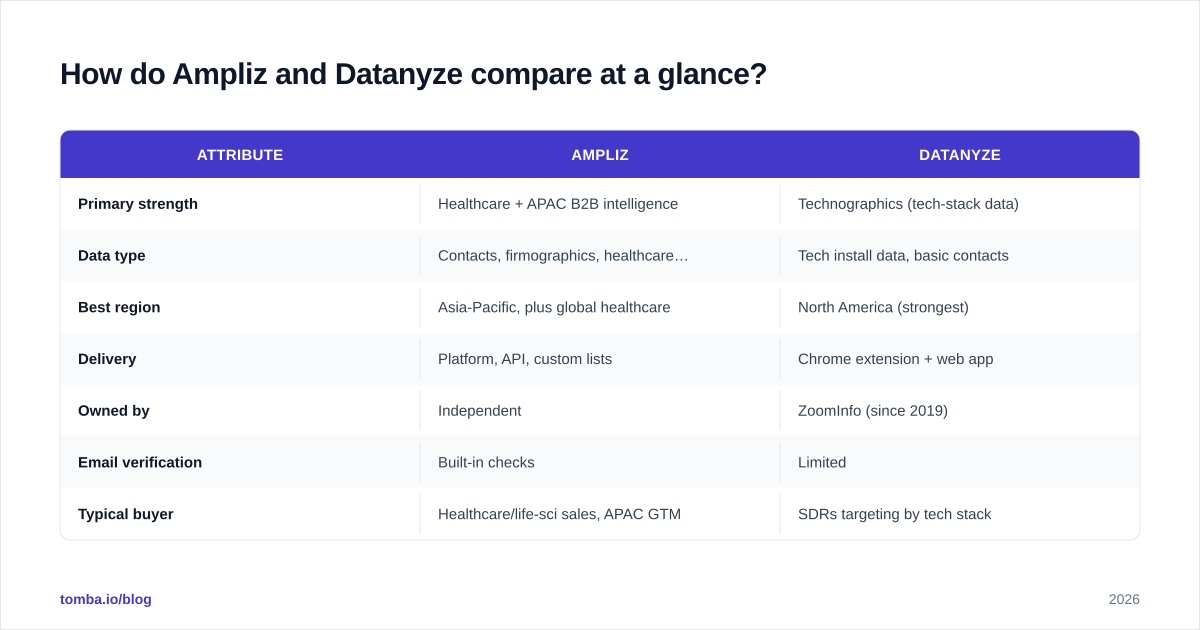
The pattern is clear. Ampliz wins on vertical and regional depth; Datanyze wins on technographic signal and low entry cost. Neither is a complete prospecting stack on its own.
Which tool has better data accuracy and coverage?#
Accuracy depends entirely on whether the tool's specialty matches your target market.
Ampliz maintains human-verified records in healthcare and APAC, and that focus shows. If you need a cardiologist's verified contact in Mumbai or a hospital procurement lead in Singapore, Ampliz's curated data tends to beat generalist databases that treat those regions as an afterthought. Outside its core verticals, coverage thins out — you'll notice gaps in, say, North American SaaS mid-market contacts.
Datanyze is accurate at what it measures: technographics. Its tech-detection is genuinely useful for "show me companies running Shopify and HubSpot." But contact data is secondary to the product. Emails and direct dials are thinner and less frequently refreshed than what you'd get from a dedicated contact provider, and reviews on G2 consistently flag stale records as the main complaint.
A practical reality with any third-party database: records decay. People change jobs, companies rebrand, and catch-all domains hide invalid addresses. That's why the accuracy conversation can't end at "which vendor has cleaner data" — it has to include a verification step. Running exports through an email verifier before you load them into a sequence protects your sender reputation regardless of source. You can read more about where contact data actually comes from and why freshness matters more than raw volume.
Is Ampliz better than Datanyze for healthcare and APAC?#
Yes — for healthcare and Asia-Pacific, Ampliz is the stronger choice, and it isn't close.
Datanyze's coverage and tech-detection are tuned for North American technology companies. Its technographic database is most reliable for companies with a public web presence running detectable software. That model works poorly for hospitals, clinics, and many APAC firms whose tech footprints are less visible and whose buying committees aren't captured by stack-based targeting.
Ampliz, by contrast, was built for exactly these segments. Its healthcare intelligence includes specialty, license, and facility-level detail that a technographics tool simply doesn't track. If your ICP is "infectious-disease physicians at 200+ bed hospitals," Ampliz gives you a filterable list; Datanyze gives you whatever it can infer from website code.
So if your GTM motion lives in healthcare or APAC, Ampliz is the better data backbone. Just budget for a verification pass — vertical depth doesn't make email addresses immortal.
Is Datanyze better than Ampliz for technographic targeting?#
Yes. If your entire prospecting thesis is "target companies by the software they use," Datanyze is purpose-built for it and Ampliz is not.
Datanyze's strength is letting an SDR filter by tech stack and instantly see which accounts run a competitor's product, a complementary tool, or a platform you integrate with. For displacement plays ("we replace X") or integration plays ("we plug into Y"), that signal is gold. The Chrome extension also makes in-the-flow prospecting easy — you're on a company site, you click, you get firmographics and a few contacts.
Where Datanyze falls down is depth and contact volume. It's a prospecting accelerator, not a full database. Teams that adopt it usually pair it with another contact source because the email and phone coverage runs out fast on serious list-building. For an honest look at lighter, lower-cost alternatives across this category, the broader B2B database landscape is worth scanning before you commit.
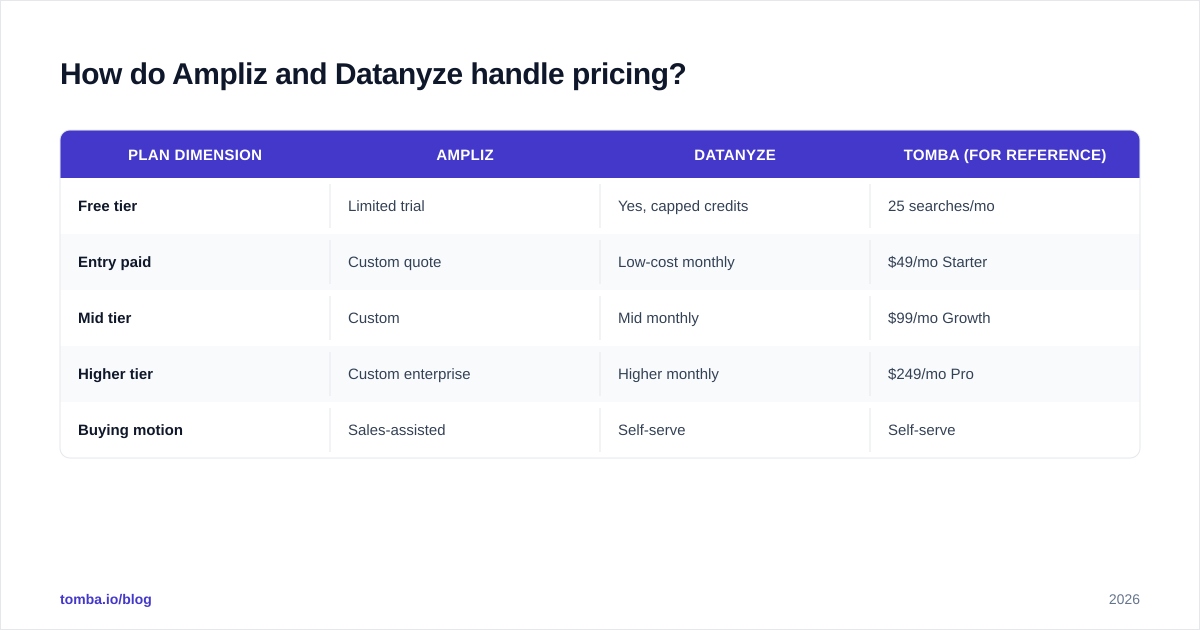
How do Ampliz and Datanyze handle pricing?#
Pricing philosophies differ sharply.
Datanyze leans transparent and low-cost. It offers a free tier with a small monthly credit allotment and affordable paid plans, which makes it attractive for individual SDRs and small teams testing technographic targeting without a procurement cycle.
Ampliz runs a custom, quote-based model typical of vertical data providers. You talk to sales, scope your list needs, and get priced accordingly. That suits enterprise and mid-market healthcare teams buying curated data, but it removes the "swipe a card and start today" option.
| Plan dimension | Ampliz | Datanyze | Tomba (for reference) |
|---|---|---|---|
| Free tier | Limited trial | Yes, capped credits | 25 searches/mo |
| Entry paid | Custom quote | Low-cost monthly | $49/mo Starter |
| Mid tier | Custom | Mid monthly | $99/mo Growth |
| Higher tier | Custom enterprise | Higher monthly | $249/mo Pro |
| Buying motion | Sales-assisted | Self-serve | Self-serve |
If predictable, self-serve pricing matters to you, both Datanyze and a tool like Tomba beat Ampliz's quote-based approach. You can see full Tomba pricing for comparison — the point isn't that one is "cheapest," it's that data depth, contact volume, and verification often live in different line items, and you should price the whole workflow, not one tool.
What do Ampliz and Datanyze miss — and how do you fill the gap?#
Both tools share the same blind spot: verified, send-ready email at scale.
Ampliz gives you depth in a vertical. Datanyze gives you technographic signal. Neither is engineered to take a list of companies and hand you fresh, verified, deliverable email addresses for the exact people you want to reach — across any industry — at a self-serve price. That's a distinct job, and it's the one that most directly affects whether your outbound actually lands.
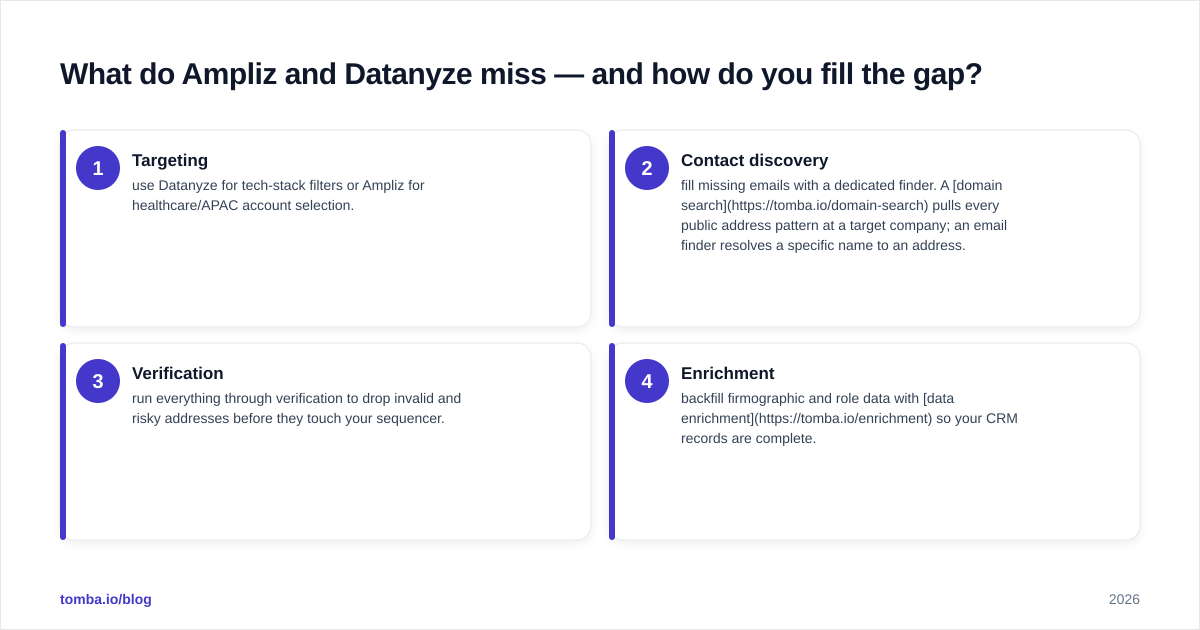
Here's a clean division of labor that works in 2026:
- Targeting — use Datanyze for tech-stack filters or Ampliz for healthcare/APAC account selection.
- Contact discovery — fill missing emails with a dedicated finder. A domain search pulls every public address pattern at a target company; an email finder resolves a specific name to an address.
- Verification — run everything through verification to drop invalid and risky addresses before they touch your sequencer.
- Enrichment — backfill firmographic and role data with data enrichment so your CRM records are complete.
This is why "Ampliz vs Datanyze" is often the wrong question. The better question is "what's the cheapest reliable way to go from an ICP to a verified, enriched contact list?" — and the answer is usually a targeting tool plus a finder/verifier, not a single platform pretending to do both.
When should you choose each tool?#
Choose Ampliz if:
- Your ICP is healthcare, life sciences, or pharma.
- You sell into APAC and need region-native data.
- You buy curated lists and have budget for sales-assisted pricing.
Choose Datanyze if:
- Your targeting depends on what software accounts run.
- You're an SDR or small team wanting a cheap, self-serve technographic edge.
- You already have a contact-data source and just need the tech signal.
Add a dedicated finder + verifier if:
- You need verified emails across many industries, not one vertical.
- Deliverability and sender reputation are at risk from stale lists.
- You want self-serve, predictable pricing and an API to automate the whole flow.
Final verdict: Ampliz vs Datanyze in 2026#
There's no universal winner — there's a winner for your motion. Ampliz is the specialist's database for healthcare and APAC; Datanyze is the technographic accelerator for stack-based prospecting. They rarely compete directly, and the teams that get the most out of either treat them as the targeting layer, not the whole stack.
Whichever you pick, the contact-quality gap is real, and it's the part that decides whether your emails reach a human or bounce. That's where a focused tool earns its keep: use Tomba Email Finder to turn your Ampliz or Datanyze account lists into verified, deliverable email addresses — start free with 25 searches a month, then scale on the $49/mo Starter plan when you're ready. Pair targeting depth with verified contacts, and your pipeline stops leaking at the one step that matters most.
Ready to find emails that actually work?
Join 150,000+ professionals who stopped guessing and started sending. Free credits on signup — no credit card required.
Get the Tomba newsletter
Practical outbound tactics and product updates — once every two weeks.
About the author