Ampliz vs Influno (2026): B2B Data & Outreach Compared
Ampliz sells APAC and healthcare contact data; Influno runs cold email sequences. Here's which one fits your 2026 GTM stack — and where neither is enough.
Ampliz and Influno get lumped into the same shortlist, but they solve opposite halves of the same problem. One hands you contact data. The other sends the emails. Picking between them as if they were interchangeable is how teams end up paying for two tools that do the same 40% and none of the 60% they actually needed.
This breakdown cuts through the category confusion: what each tool is built for, where the data and deliverability actually land, what you pay, and the use cases where one clearly beats the other.
TL;DR — Ampliz vs Influno at a glance#
- Ampliz is a data company. Its strength is B2B contact and company intelligence, with unusually deep coverage of APAC markets and healthcare/physician records. You use it to build a list.
- Influno is an outreach company. Its strength is cold email sequencing, inbox rotation, and reply handling. You use it to work a list.
- They are not direct competitors. Comparing them is like comparing a quarry to a delivery truck — most serious GTM stacks need both a data source and a sending engine.
- Both have gaps. Ampliz coverage thins outside its core regions; Influno's built-in enrichment is shallow compared to a dedicated finder.
- The practical 2026 setup is a verified data layer feeding a sending tool — which is why most teams pair a dedicated email finder with whichever outreach engine they prefer.
What is Ampliz?#
Ampliz is a B2B sales intelligence and data platform. Think of it as a specialized phone book: instead of trying to cover every company on earth shallowly, it goes deep in specific verticals — most notably healthcare (the "Ampliz HealthData" product, with physician, hospital, and provider records) and the Asia-Pacific region, where many US-built databases run thin.
You query Ampliz by company, geography, industry, or job function and it returns contact records: names, titles, business emails, and firmographic context. There's an API and a Chrome extension for pulling contacts while you browse. The pitch is accuracy and regional depth rather than raw volume.
Where Ampliz earns its keep is the long tail US tools miss — a cardiology group in Singapore, a manufacturing buyer in Jakarta, a hospital procurement lead in Mumbai. If your ICP lives in those rows, Ampliz is genuinely differentiated.
What is Influno?#
Influno is a cold email and outreach automation platform. Its job starts after you have a list. You import contacts, write sequences, connect sending mailboxes, and Influno handles the mechanics: multi-step campaigns, automatic follow-ups, inbox rotation across multiple sending accounts, reply detection, and basic analytics on opens, clicks, and responses.
The mental model: Influno is the delivery truck. It doesn't dig up the addresses — it drives the route, drops the packages, and tells you which doors opened. Some plans bundle light email-finding or enrichment, but that's a convenience feature, not the core engine.
Influno competes with tools like Instantly, Lemlist, and Smartlead. If you've evaluated any Instantly alternative, you already understand Influno's lane: deliverability-focused sending at volume.
Ampliz vs Influno: how do they actually compare?#
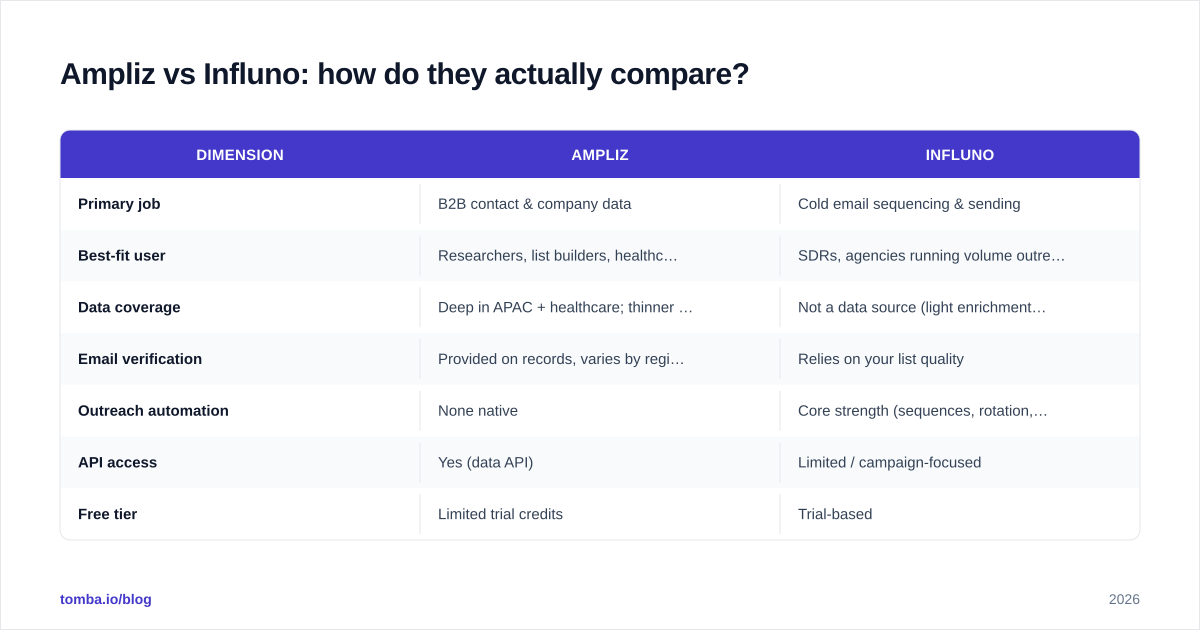
The honest answer is they sit at different stages of the funnel. Here's the side-by-side on the dimensions that matter when you're deciding where your budget goes.
| Dimension | Ampliz | Influno |
|---|---|---|
| Primary job | B2B contact & company data | Cold email sequencing & sending |
| Best-fit user | Researchers, list builders, healthcare/APAC teams | SDRs, agencies running volume outreach |
| Data coverage | Deep in APAC + healthcare; thinner elsewhere | Not a data source (light enrichment only) |
| Email verification | Provided on records, varies by region | Relies on your list quality |
| Outreach automation | None native | Core strength (sequences, rotation, replies) |
| API access | Yes (data API) | Limited / campaign-focused |
| Free tier | Limited trial credits | Trial-based |
| Where it breaks | Coverage gaps outside core verticals | Garbage-in, garbage-out on unverified lists |
The table makes the real decision obvious: you're rarely choosing one instead of the other — you're deciding which problem you have right now. No list? You need data (Ampliz, or a finder). List but no engine? You need outreach (Influno).
Which has better data accuracy?#
Ampliz wins on data because Influno isn't really in the data business. But "Ampliz wins" comes with an asterisk: accuracy is regional.
Inside Ampliz's strongholds — APAC firmographics, healthcare provider records — match rates and freshness are strong, and that's the whole reason to buy it. Step outside those verticals into, say, North American SaaS mid-market, and coverage gets patchy. You'll see more null fields and more stale titles, because that's not where Ampliz invests its data-collection effort.
Influno's "accuracy" is entirely a function of what you feed it. Import a clean, verified list and it performs. Import a scraped CSV full of guesses and Influno will faithfully blast catch-all addresses and dead inboxes straight into spam traps — tanking your domain reputation in the process. That's not an Influno flaw; it's the law of outreach. Sending volume amplifies list quality in both directions.
This is exactly why a verification step belongs between any data source and any sender. Running addresses through an email verifier before they hit a sequence is the single highest-ROI habit in cold outreach. It protects the sender reputation that tools like Influno depend on but can't repair once it's burned.
Which is better for deliverability?#
Influno, structurally — because deliverability is its entire reason to exist. Inbox rotation, sending limits, warm-up pacing, and reply handling are deliverability features. Ampliz has none of these because it never sends anything.
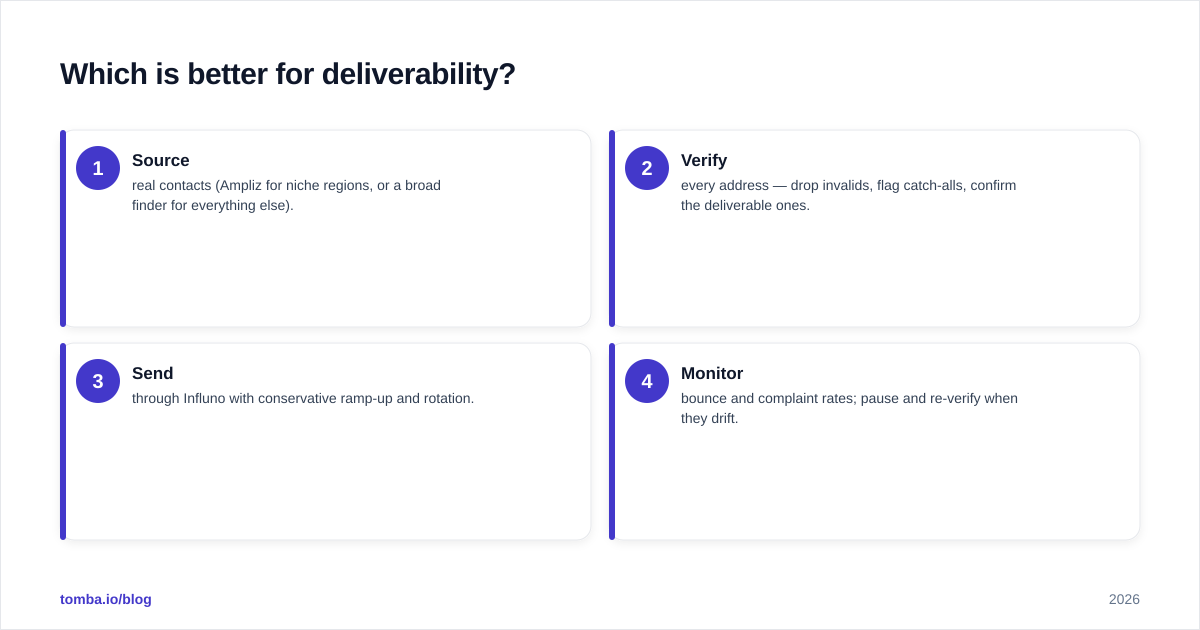
But here's the trap: deliverability features can't save a bad list. Influno can rotate across ten mailboxes flawlessly and still get throttled if 30% of your recipients bounce. Mailbox providers read bounce rate and spam complaints as the primary trust signal. The order of operations that actually works in 2026:
- Source real contacts (Ampliz for niche regions, or a broad finder for everything else).
- Verify every address — drop invalids, flag catch-alls, confirm the deliverable ones.
- Send through Influno with conservative ramp-up and rotation.
- Monitor bounce and complaint rates; pause and re-verify when they drift.
Skip step two and the most sophisticated sending engine on the market won't keep you out of the promotions tab. If you want the mechanics, the fundamentals of email deliverability haven't changed — provider trust is earned through list hygiene first, clever sending second.
What about pricing?#
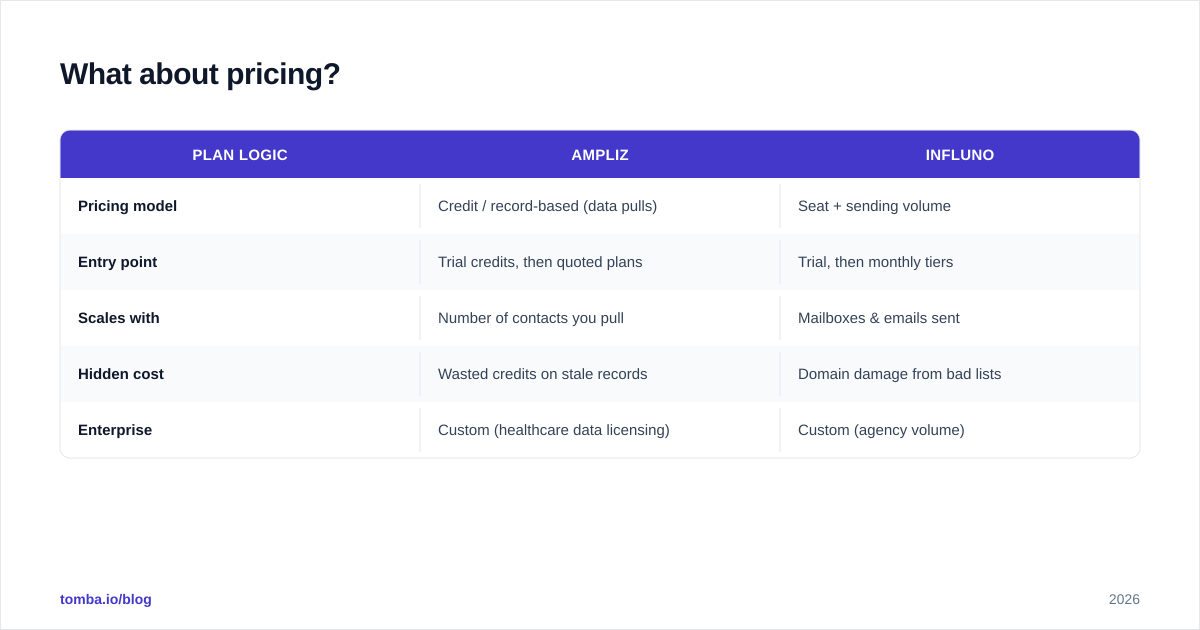
Both vendors gate pricing behind quotes for their serious tiers, which makes apples-to-apples hard. The structural difference matters more than the exact dollar figures:
| Plan logic | Ampliz | Influno |
|---|---|---|
| Pricing model | Credit / record-based (data pulls) | Seat + sending volume |
| Entry point | Trial credits, then quoted plans | Trial, then monthly tiers |
| Scales with | Number of contacts you pull | Mailboxes & emails sent |
| Hidden cost | Wasted credits on stale records | Domain damage from bad lists |
| Enterprise | Custom (healthcare data licensing) | Custom (agency volume) |
Ampliz's cost risk is paying for records you can't use — credits spent on contacts that turn out stale or out-of-region. Influno's cost risk is indirect but worse: a torched sending domain costs weeks of recovery and lost pipeline, which dwarfs the subscription.
For comparison, a dedicated finder like Tomba prices transparently — Free (25 searches/mo), Starter $49/mo, Growth $99/mo, Pro $249/mo, Enterprise custom. You can see the full breakdown on the Tomba pricing page. The point isn't that one is "cheapest"; it's that you should know your cost-per-verified-contact before you commit, regardless of vendor.
Ampliz vs Influno: which should you choose?#
Match the tool to the problem in front of you.
Choose Ampliz if:
- Your ICP is concentrated in APAC or healthcare, where generic US databases fail you.
- You need firmographic depth and physician/provider records specifically.
- You're a researcher or list-builder, not a high-volume sender.
Choose Influno if:
- You already have a clean, verified list and need to send at scale.
- Deliverability, inbox rotation, and sequence automation are your bottleneck.
- You're an SDR team or agency running volume outbound.
Choose neither — alone — if:
- You're building a full pipeline from scratch. You'll need a broad data layer Ampliz doesn't cover globally, plus the verification Influno can't do, plus the sending Ampliz can't do.
That last case is the most common one, and it's why the "Ampliz vs Influno" framing is a bit of a false binary. Most teams need a flexible data-and-verification layer that feeds whatever outreach tool they like.
Where does a dedicated email finder fit?#
Between the two. A finder solves the gap each tool leaves open: broader-than-Ampliz coverage when your prospects aren't in healthcare or APAC, and the verification Influno assumes you've already done.
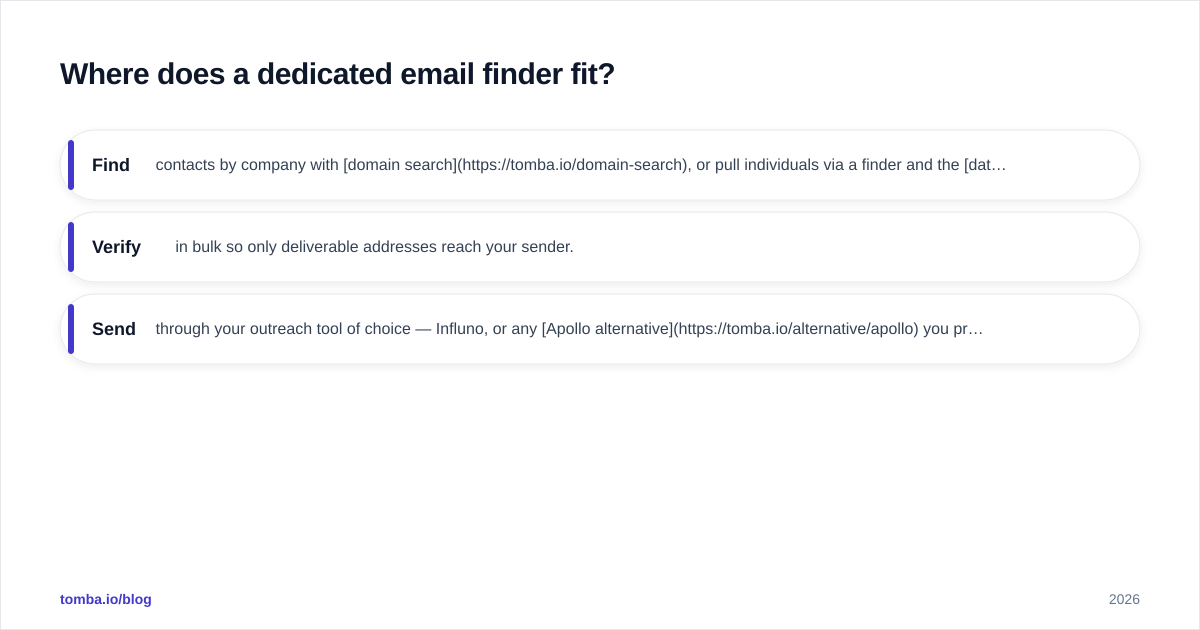
A typical 2026 stack looks like this:
- Find contacts by company with domain search, or pull individuals via a finder and the data enrichment API.
- Verify in bulk so only deliverable addresses reach your sender.
- Send through your outreach tool of choice — Influno, or any Apollo alternative you prefer.
This is also the cleaner architecture: your data layer stays independent of your sending tool, so you can swap senders without re-sourcing contacts, and swap data providers without rebuilding campaigns. Coupling everything to one vendor is how teams get locked in and overcharged.
For evaluating any of these tools beyond vendor marketing, real buyer reviews on G2 and Capterra are worth more than feature lists — sort by your company size and region to filter out noise. And always confirm current capabilities on the vendor's own site (Ampliz and Influno) since both ship changes frequently.
The bottom line#
Ampliz and Influno aren't rivals — they're two-thirds of a pipeline that needs a third piece. Ampliz gives you niche data, Influno gives you a sending engine, and neither verifies the addresses that determine whether the whole thing works. The accuracy of your list decides your deliverability, and your deliverability decides your reply rate. Everything else is secondary.
Before you pay for either, fix the foundation: source broadly, verify ruthlessly, then send. The Tomba Email Finder covers the contacts Ampliz misses outside its core verticals and verifies every address before it ever reaches a sequence — so whatever you send through Influno actually lands in the inbox. Start free with 25 searches a month, and only scale once the data underneath your outreach is clean.
// get started
Find, verify and enrich your first contacts today
Start on the free plan with 25 searches a month, then scale when your team is ready.
Free plan · No credit card required · GDPR & CCPA
// about the author