Ampliz vs Kaspr 2026: B2B Contact Data Tools Compared
Ampliz pushes APAC and healthcare intelligence; Kaspr lives inside LinkedIn for instant phone and email reveals. Here's which B2B data tool fits your pipeline in 2026 — and where a verified email finder beats both.
Choosing between Ampliz and Kaspr usually means choosing between two very different ideas of what a prospecting tool should be. One is a data-intelligence platform built around firmographics and regional reach. The other is a browser-native contact reveal tool that lives where your reps already work: LinkedIn. They overlap just enough to confuse a buyer, and differ enough that picking wrong wastes a quarter of budget.
This guide breaks down Ampliz vs Kaspr on the dimensions that actually decide outcomes — data coverage, accuracy, workflow fit, compliance, and price — so you can match the tool to your motion instead of the marketing.
TL;DR — Ampliz vs Kaspr at a glance#
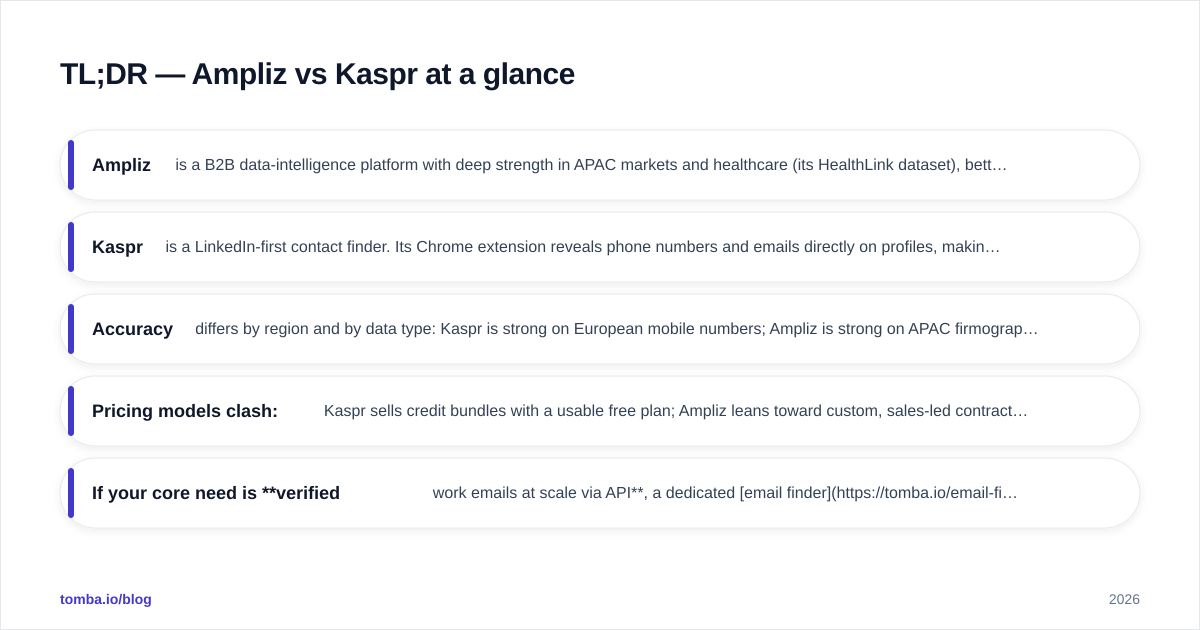
- Ampliz is a B2B data-intelligence platform with deep strength in APAC markets and healthcare (its HealthLink dataset), better suited to list-building and account intelligence than to one-by-one prospecting.
- Kaspr is a LinkedIn-first contact finder. Its Chrome extension reveals phone numbers and emails directly on profiles, making it a rep-friendly tool for fast, in-flow outbound.
- Accuracy differs by region and by data type: Kaspr is strong on European mobile numbers; Ampliz is strong on APAC firmographics and healthcare contacts.
- Pricing models clash: Kaspr sells credit bundles with a usable free plan; Ampliz leans toward custom, sales-led contracts.
- If your core need is verified work emails at scale via API, a dedicated email finder like Tomba is often cheaper and more accurate than either, and pairs well with both.
What is Ampliz and who is it for?#
Ampliz positions itself as a global B2B data-intelligence platform, but its real differentiator is geographic and vertical depth. It is one of the few providers that markets serious APAC coverage — India, Singapore, Australia, and surrounding markets where most US-centric databases thin out. It also runs a dedicated healthcare dataset (physicians, hospitals, decision-makers) that few horizontal competitors match.
The product is built around list-building and account intelligence rather than single-record lookups. You define an ideal customer profile — industry, revenue, employee count, technology, geography — and Ampliz returns matching companies and contacts with firmographic context. That makes it a fit for demand-gen, ABM, and market-entry teams who need to map a territory, not just grab one email.
Where Ampliz gets weaker is the daily rep workflow. It is not the tool a BDR pops open mid-LinkedIn-session to grab a mobile number in two seconds. It is the tool RevOps uses to build the territory those BDRs then work. If you confuse those two jobs, Ampliz will feel slow.
What is Kaspr and who is it for?#
Kaspr is the opposite design philosophy: meet the rep where they already are. Its core surface is a Chrome extension that overlays LinkedIn (and Sales Navigator) profiles, lists, and groups, surfacing phone numbers and email addresses on demand. Click a profile, hit reveal, push the contact into your CRM or a Kaspr sequence — no tab-switching, no CSV round-trips.
Kaspr is owned by Cognism, which gives it access to a sizable European contact pool and a compliance posture built for GDPR-heavy markets. Its sweet spot is European mobile (cell phone) data, where it consistently outperforms US-first tools. For SDR teams running LinkedIn-led outbound into EMEA, that phone coverage is the headline feature.
The trade-off is breadth and depth of intelligence. Kaspr is excellent at "give me this person's contact details right now." It is not built to answer "show me every healthcare CFO in Singapore at companies over $50M." That is Ampliz territory.

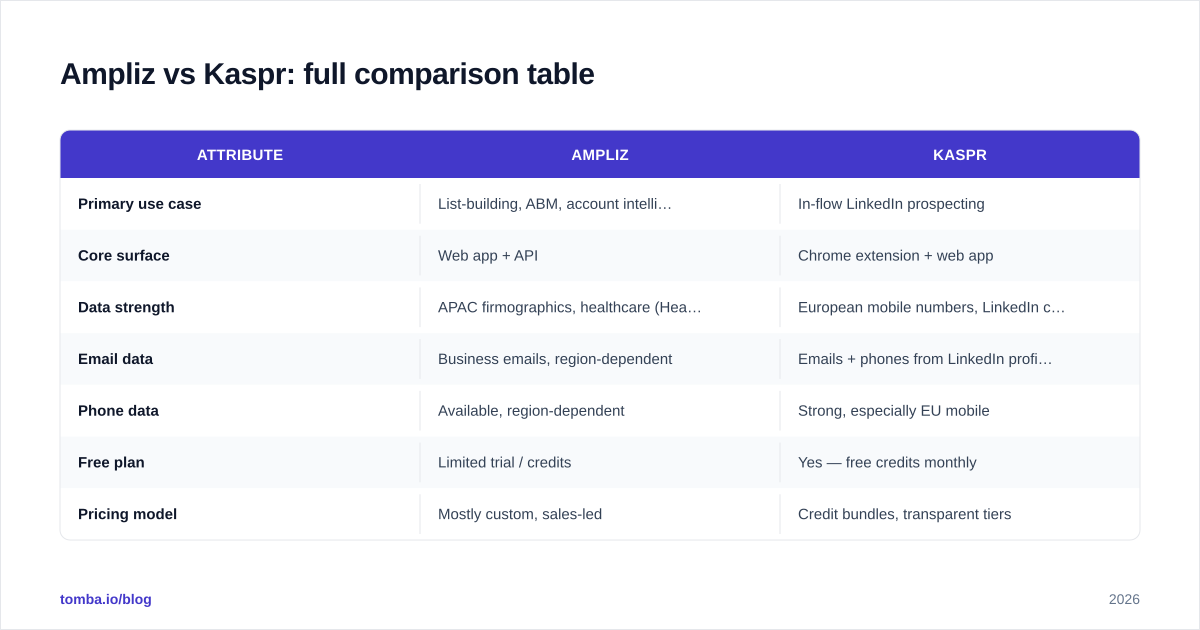
Ampliz vs Kaspr: full comparison table#
| Attribute | Ampliz | Kaspr |
|---|---|---|
| Primary use case | List-building, ABM, account intelligence | In-flow LinkedIn prospecting |
| Core surface | Web app + API | Chrome extension + web app |
| Data strength | APAC firmographics, healthcare (HealthLink) | European mobile numbers, LinkedIn contacts |
| Email data | Business emails, region-dependent | Emails + phones from LinkedIn profiles |
| Phone data | Available, region-dependent | Strong, especially EU mobile |
| Free plan | Limited trial / credits | Yes — free credits monthly |
| Pricing model | Mostly custom, sales-led | Credit bundles, transparent tiers |
| GDPR posture | Compliant, varies by source | Strong (Cognism-backed, EU-first) |
| Best for | RevOps / demand-gen / APAC entry | SDRs / BDRs running LinkedIn outbound |
| Weak spot | Slow for 1-by-1 rep workflow | Shallow firmographic intelligence |
Which tool has more accurate data?#
Accuracy is the wrong question; accuracy where is the right one. Neither tool wins globally.
Kaspr's edge is European direct dials and mobile numbers. Because it draws on Cognism's network and community-contributed data, its EU phone match rates are among the better ones in the category. If your reps cold-call into France, Germany, or the UK, that matters more than any aggregate accuracy claim.
Ampliz wins on APAC firmographics and healthcare records. If you are selling into Indian enterprises or mapping hospital decision-makers, its dataset has records that US-first tools simply do not carry. Outside those strengths, Ampliz behaves like a mid-tier global database — fine, not exceptional.
The honest takeaway: validate both against your territory with a sample before you commit. Pull 100 of your real target accounts, run them through each tool's trial, and measure match rate and bounce rate yourself. Vendor-published accuracy numbers rarely survive contact with a niche ICP. For a primer on how providers actually source records, the G2 category for marketing account intelligence is a useful neutral reference.
Whatever you pick, verify before you send. Even a 95%-accurate list still hides enough invalid addresses to dent your sender reputation. Running exports through an email verifier before the first send is the cheapest insurance against a deliverability problem you can't easily undo.
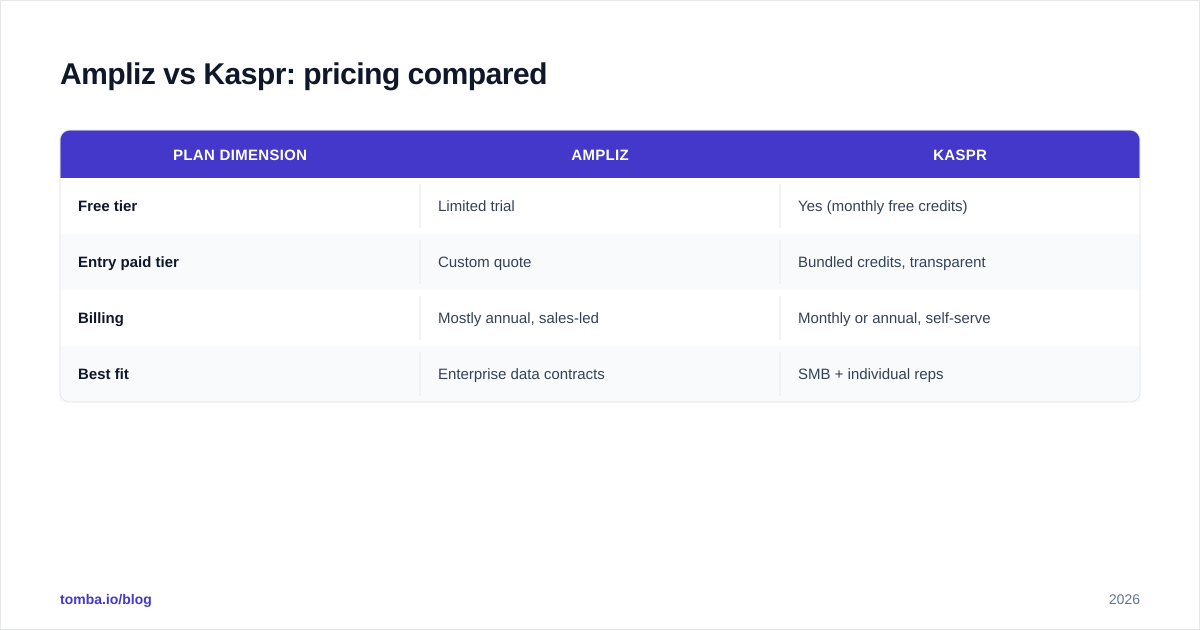
Ampliz vs Kaspr: pricing compared#
Pricing is where the two diverge most in experience, not just numbers.
Kaspr offers a genuinely usable free plan (a small monthly credit allowance) and transparent paid tiers built on credit bundles. A team can self-serve, test, and scale without a sales call. That low-friction model is a real advantage for small teams and individual reps.
Ampliz leans sales-led. Pricing is largely quote-based and tied to data volume, regions, and seats. That suits enterprise buyers negotiating annual data contracts, but it slows down anyone who just wants to try the product this afternoon.
| Plan dimension | Ampliz | Kaspr |
|---|---|---|
| Free tier | Limited trial | Yes (monthly free credits) |
| Entry paid tier | Custom quote | Bundled credits, transparent |
| Billing | Mostly annual, sales-led | Monthly or annual, self-serve |
| Best fit | Enterprise data contracts | SMB + individual reps |
A note on credit math: both tools meter usage, so "cost per verified contact" — not sticker price — is the metric that matters. A cheap plan that burns credits on stale or unverifiable records is more expensive than it looks. If predictable, transparent pricing is a priority, compare the effective per-result cost, not the headline tier.

How do Ampliz and Kaspr fit into a real workflow?#
Think of these tools as two stages of one motion, not rivals for the same slot.
Stage 1 — Map the market (Ampliz-shaped work). You define the ICP and build the account list. This is firmographic, batch-oriented, and owned by RevOps or demand-gen. Account intelligence, not contact reveal, is the job.
Stage 2 — Work the accounts (Kaspr-shaped work). Reps open target profiles on LinkedIn and pull direct dials and emails in-flow. Speed and CRM push matter more than dataset breadth here.
Stage 3 — Verify and enrich (the gap both leave). Neither tool is primarily a verification engine, and contact data decays fast — people change jobs, domains rebrand, catch-all servers hide bounces. This is where a dedicated finder/verifier and data enrichment layer earns its place, cleaning and completing whatever the first two stages produced.
Mapping your stack to those three stages prevents the most common mistake: buying one tool and expecting it to do all three jobs well. For more on building a repeatable outbound engine, see our breakdown of the sales prospecting fundamentals.
What are the alternatives to Ampliz and Kaspr?#
Neither tool is a category monopoly, and the right answer often involves a third tool for the verification/email layer.
- For LinkedIn-native reveal, Kaspr competes with Lusha, Wiza, and ContactOut. If you like Kaspr's surface but want different data, those are the natural comparisons.
- For account intelligence, Ampliz competes with
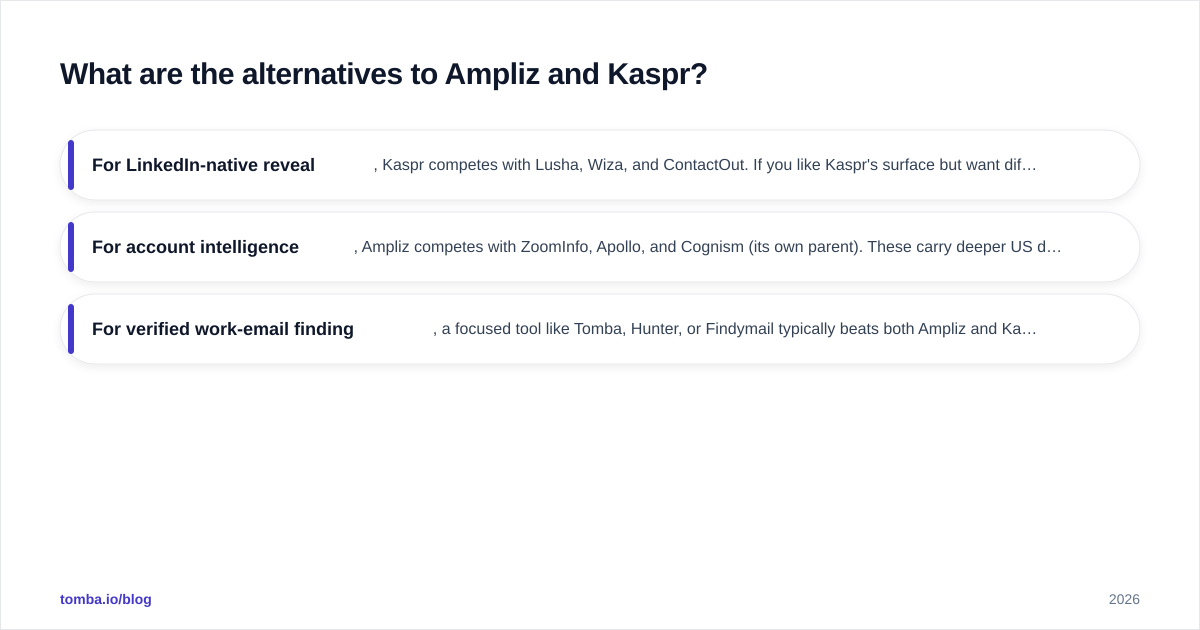
ZoomInfo, Apollo, and Cognism (its own parent). These carry deeper US data but cost more.
- For verified work-email finding at API scale, a focused tool like Tomba, Hunter, or Findymail typically beats both Ampliz and Kaspr on email accuracy-per-dollar.
The practical pattern many teams land on: a data/intelligence tool for list-building, a LinkedIn tool for rep workflow, and a dedicated email finder + verifier for the part that actually protects deliverability. You can find detailed head-to-heads in our Apollo alternative and broader vendor guides on the blog.
For independent vendor research before you sign anything, Gartner's sales technology coverage and peer reviews on Capterra are worth a pass — both let you filter by company size and region, which is exactly where Ampliz-vs-Kaspr decisions get made.
So, which should you choose?#
Pick based on your dominant motion:
- Choose Kaspr if you are an SDR/BDR team running LinkedIn-led outbound, especially into Europe, and you value speed, self-serve pricing, and strong mobile data over deep firmographics.
- Choose Ampliz if you are a RevOps or demand-gen team building lists for ABM or entering APAC/healthcare markets, and you need account intelligence more than one-click reveal.
- Choose neither as your email layer. Both are contact-data tools first; for verified, deduplicated, API-deliverable work emails, add a specialist.
That third point is where most pipelines quietly leak. A list is only as good as its deliverable addresses, and both Ampliz and Kaspr leave the verify-and-complete step largely to you.
Close the gap with a verified email finder#
If your real bottleneck is getting accurate, verified work emails into your sequences — not just more raw contacts — start with the Tomba Email Finder. Find professional email addresses by domain, name, or company, verify them in the same flow, and push clean records straight into your CRM via the Tomba API. Tomba's free tier gives you 25 searches a month to test against your own list, with Starter at $49/mo and Growth at $99/mo when you scale. Use Ampliz or Kaspr to source and reveal — then let Tomba make sure what you send actually lands.
// get started
Find, verify and enrich your first contacts today
Start on the free plan with 25 searches a month, then scale when your team is ready.
Free plan · No credit card required · GDPR & CCPA
// about the author