Ampliz vs LakeB2B 2026: B2B Data Provider Comparison
Ampliz vs LakeB2B, compared head to head for 2026: data accuracy, coverage, pricing, compliance, and which one actually fits your outbound motion.
You are choosing between two B2B data vendors that look similar on a pricing page and behave very differently once the records hit your CRM. This guide breaks down Ampliz vs LakeB2B on the things that actually move pipeline: accuracy, coverage, delivery model, compliance, and total cost.
TL;DR — Ampliz vs LakeB2B in 30 seconds#
- Ampliz is strongest in healthcare and APAC data, sold mostly as a platform plus on-demand intelligence. Good fit if you sell into hospitals, clinics, or healthcare IT.
- LakeB2B is a custom list-building and data-services shop. It spans many industries and will hand-assemble a list to spec, but you are buying a project, not a self-serve tool.
- Accuracy is the real battleground. Both ship stale records at scale, so any list from either vendor needs independent verification before you send.
- Pricing is quote-based for both. Expect custom proposals, not transparent per-seat tiers — budget for negotiation and minimum commitments.
- The smart play in 2026 is to treat purchased data as a starting point and re-verify every address yourself. That is where a tool like Tomba earns its keep.
What are Ampliz and LakeB2B?#
Think of these two as a specialist clinic versus a general contractor.
Ampliz positions itself as a B2B data intelligence platform with a heavy lean into healthcare. It offers a global B2B contact database, a dedicated healthcare dataset (physicians, hospitals, decision-makers), and enrichment APIs. Its sweet spot is the Asia-Pacific region and medical verticals, where generic US-centric databases tend to thin out. You can read its own positioning on the Ampliz homepage.
LakeB2B is a data-services company first and a platform second. Its model is custom list building: tell them the titles, industries, geographies, and firmographics you want, and they assemble and deliver a list. They cover healthcare, technology, education, manufacturing, and more, and they bundle in services like data appending, cleansing, and campaign execution. Their public catalog is on the LakeB2B homepage.
The practical difference: Ampliz feels more like a product you log into, while LakeB2B feels more like an agency you brief. Neither is wrong — they fit different buying motions.
How do Ampliz and LakeB2B compare on features?#
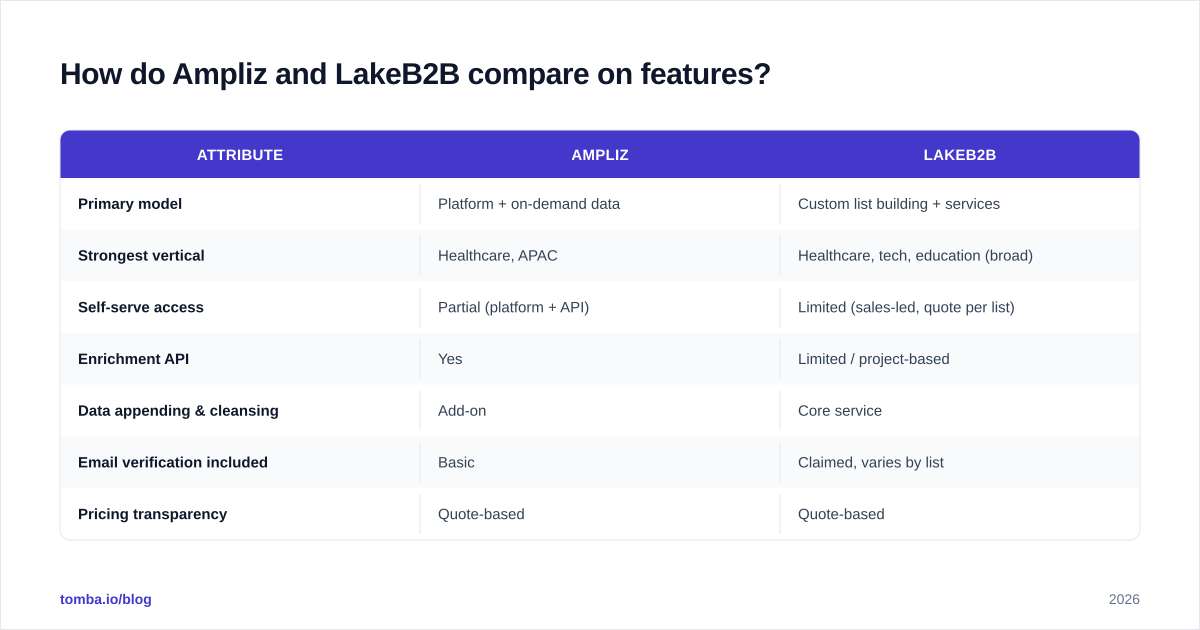
Here is the side-by-side on the attributes that decide whether a vendor survives contact with your sales team.
| Attribute | Ampliz | LakeB2B |
|---|---|---|
| Primary model | Platform + on-demand data | Custom list building + services |
| Strongest vertical | Healthcare, APAC | Healthcare, tech, education (broad) |
| Self-serve access | Partial (platform + API) | Limited (sales-led, quote per list) |
| Enrichment API | Yes | Limited / project-based |
| Data appending & cleansing | Add-on | Core service |
| Email verification included | Basic | Claimed, varies by list |
| Pricing transparency | Quote-based | Quote-based |
| Best for | Healthcare ABM, APAC outbound | One-off targeted list pulls |
The headline: Ampliz wins if you want repeatable, API-driven access to a defined dataset. LakeB2B wins if you have a one-time, highly specific list need and would rather brief a team than run queries yourself.
)
Which has more accurate data?#
Neither vendor should be trusted blind — and that is not a knock on them specifically, it is true of every list seller.
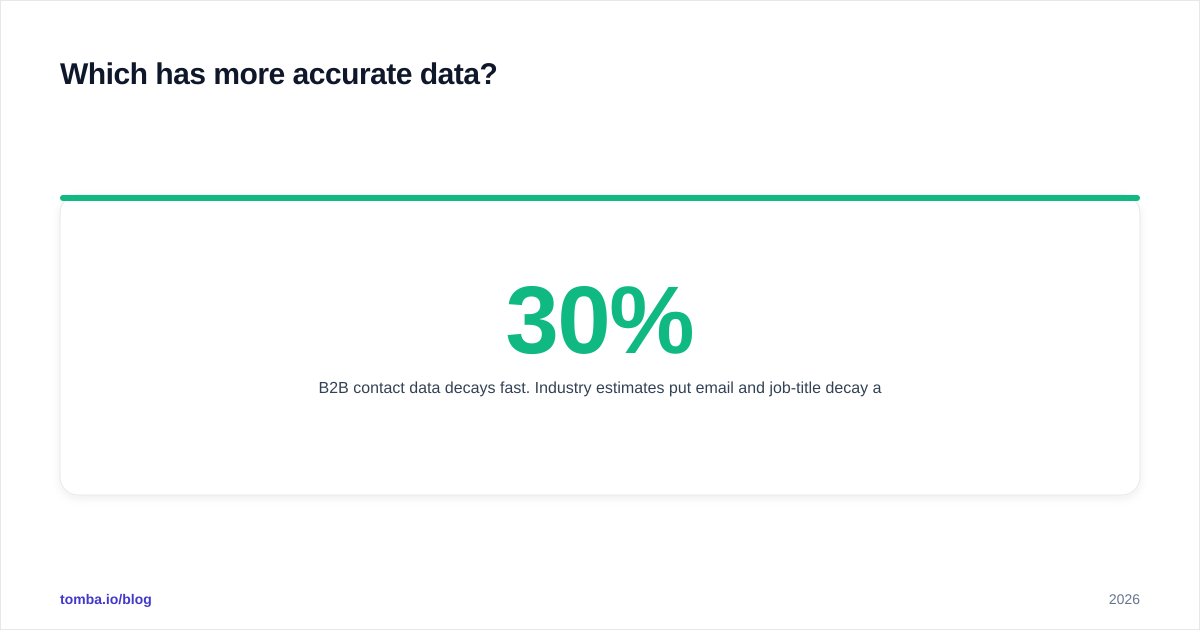
B2B contact data decays fast. Industry estimates put email and job-title decay at roughly 22–30% per year as people change roles, companies rebrand, and domains shift. A list that was 95% accurate at delivery can be 70% accurate six months later. Both Ampliz and LakeB2B advertise high accuracy figures (often 85–95%), but those numbers describe the moment of capture, not the moment you hit send.
What actually differs between them:
- Ampliz refreshes its core platform data on a rolling basis, so records pulled from the live database tend to be fresher than a static export. Its healthcare set is its most carefully maintained.
- LakeB2B assembles lists from multiple sourced pools, which means quality can vary list-to-list depending on how niche your request is. A common, high-demand segment will be cleaner than an obscure one.
The honest takeaway: treat any vendor accuracy claim as a ceiling, not a floor. Before a single email goes out, run the full list through an email verifier to strip invalid, risky, and catch-all addresses. This one step protects your sender reputation more than any vendor SLA. If you are unsure how the underlying data is assembled, scrutinize each vendor's data sources the same way you would audit your own.
)
How does pricing work for Ampliz vs LakeB2B?#
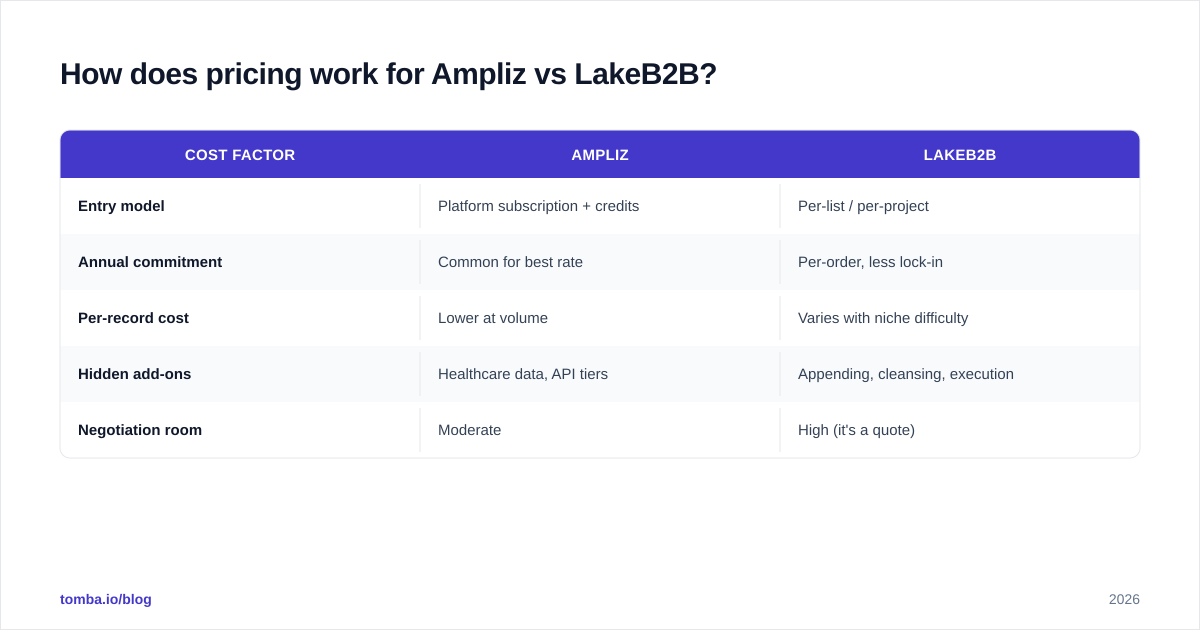
Both are quote-based, which means the sticker you see is rarely the price you pay.
Ampliz typically sells platform access plus credit or volume tiers, with healthcare data often priced separately from general B2B. Expect annual commitments for the best per-record rate.
LakeB2B prices per list or per project. Cost scales with list size, how niche the targeting is, and which services (appending, verification, campaign execution) you bolt on. A broad list of 10,000 generic contacts is cheap per record; a hand-built list of 500 hard-to-find specialists is not.
| Cost factor | Ampliz | LakeB2B |
|---|---|---|
| Entry model | Platform subscription + credits | Per-list / per-project |
| Annual commitment | Common for best rate | Per-order, less lock-in |
| Per-record cost | Lower at volume | Varies with niche difficulty |
| Hidden add-ons | Healthcare data, API tiers | Appending, cleansing, execution |
| Negotiation room | Moderate | High (it's a quote) |
A useful frame: with LakeB2B you are paying for labor (someone builds your list), and with Ampliz you are paying for access (you build your own pulls). Labor scales with difficulty; access scales with volume.
Before you sign either contract, compare the all-in cost against running enrichment yourself. A transparent, published rate — like Tomba pricing starting with a free tier (25 searches/mo) and a $49/mo Starter plan — gives you a baseline to judge whether a five-figure data contract is actually worth it for your volume.
Is Ampliz better than LakeB2B?#
It depends on three questions, and your answers should pick the winner for you.
1. Do you sell into healthcare or APAC? If yes, Ampliz has a structural advantage. Its healthcare dataset and Asia-Pacific coverage are deeper than most general-purpose providers, LakeB2B included. Physician, hospital, and clinic targeting is its home turf.
2. Do you need a repeatable workflow or a one-time list? For an ongoing outbound machine that pulls fresh contacts every week, you want platform access and an API — that favors Ampliz. For a single campaign into a tightly defined niche, LakeB2B's hand-built lists can be faster than learning a new tool.
3. How much do you value control over verification? Ampliz's API lets you wire data into your own enrichment and validation pipeline. LakeB2B hands you a file, and what you do with it afterward is on you. If you want to own the quality-control loop, the API model wins.
There is no universal winner. Ampliz is the better product; LakeB2B is the better service. Match the model to how your team actually works.
What are the real risks of buying from either?#
Purchased B2B data carries three risks that vendor marketing tends to gloss over.
- Deliverability damage. Stale or invalid addresses trigger hard bounces. A bounce rate above 2–3% tells inbox providers you are not maintaining your list, and your sender reputation drops for everyone on your domain. One bad purchased list can poison months of warmup.
- Compliance exposure. GDPR, CAN-SPAM, and CCPA all care about lawful basis and opt-out handling. Both vendors claim compliant sourcing, but liability for how you use the data sits with you. Verify consent posture before importing anything into a regulated market.
- Catch-all noise. Many corporate domains accept every address (catch-all servers), so a list can look "valid" while half of it goes nowhere. Standard verification often can't tell. You need a catch-all verifier to separate genuinely reachable mailboxes from servers that accept and silently drop.
The mitigation for all three is the same: never send to a raw purchased list. Verify, deduplicate, and segment first. Independent review platforms like G2 are worth a scan for recent buyer complaints about either vendor's deliverability before you commit.
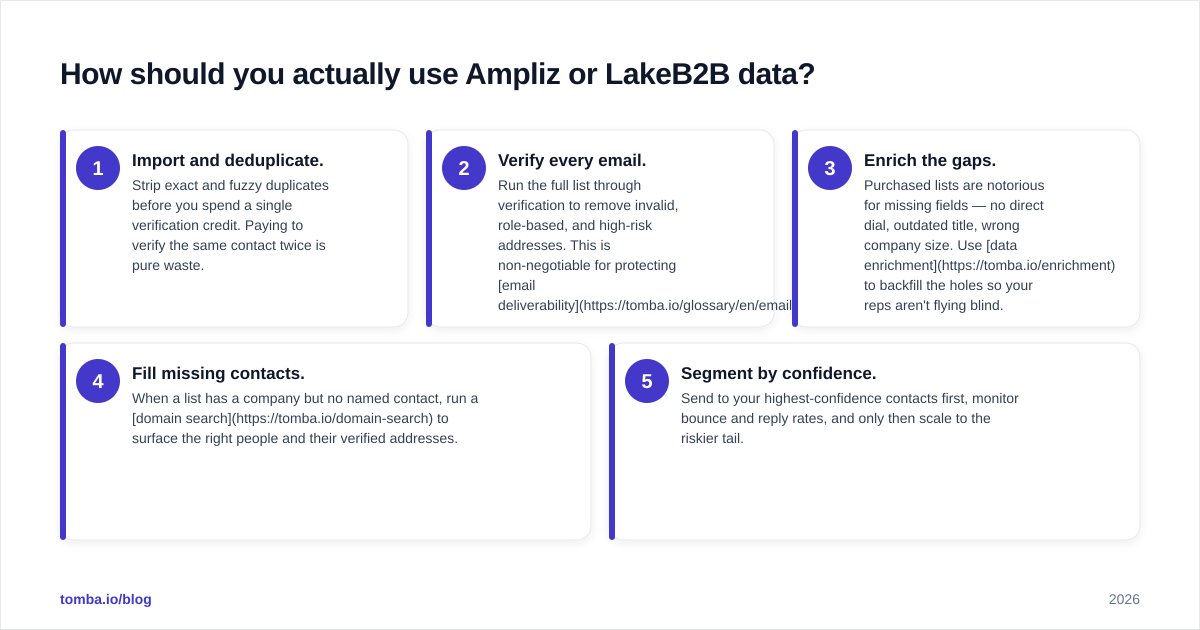
How should you actually use Ampliz or LakeB2B data?#
Buy the list, then earn the accuracy. Here is the workflow that turns either vendor's export into a clean, sendable file.
- Import and deduplicate. Strip exact and fuzzy duplicates before you spend a single verification credit. Paying to verify the same contact twice is pure waste.
- Verify every email. Run the full list through verification to remove invalid, role-based, and high-risk addresses. This is non-negotiable for protecting email deliverability.
- Enrich the gaps. Purchased lists are notorious for missing fields — no direct dial, outdated title, wrong company size. Use data enrichment to backfill the holes so your reps aren't flying blind.
- Fill missing contacts. When a list has a company but no named contact, run a domain search to surface the right people and their verified addresses.
- Segment by confidence. Send to your highest-confidence contacts first, monitor bounce and reply rates, and only then scale to the riskier tail.
This pipeline treats Ampliz or LakeB2B as the raw material and your verification stack as the refinery. The vendor gets you 70% of the way; the last 30% — the part that actually determines whether you hit the inbox — is yours to own.
Ampliz vs LakeB2B: the verdict#
- Choose Ampliz if you sell into healthcare or APAC, want platform plus API access, and run a repeatable outbound motion that pulls fresh data continuously.
- Choose LakeB2B if you need a one-time, hand-built list for a niche segment and would rather brief a data team than operate a tool yourself.
- Choose neither alone. Whichever you pick, the record quality you actually send to is a function of your verification, not their accuracy badge.
Both vendors are legitimate. The mistake is treating either as a finished product. Data decays the moment it is captured, and the only defense is re-verification at the point of use.
Close the accuracy gap with Tomba#
Whichever provider you buy from, the records still need to be proven before they earn a spot in your sequence. That is the job Tomba Email Finder is built for — find and confirm professional email addresses by domain, name, or company, then verify them so you only send to addresses that actually resolve. Start on the free tier (25 searches/mo), and when a purchased Ampliz or LakeB2B list lands in your CRM, run it through Tomba first. Clean data in, replies out.
// get started
Find, verify and enrich your first contacts today
Start on the free plan with 25 searches a month, then scale when your team is ready.
Free plan · No credit card required · GDPR & CCPA
// about the author