Ampliz vs LeadIQ 2026: B2B Data, Pricing & Accuracy Compared
Ampliz leans on healthcare and APAC firmographics; LeadIQ wins on workflow speed and CRM capture. Here is which B2B data tool fits your pipeline in 2026 — and where both leave gaps.
Choosing between Ampliz and LeadIQ usually comes down to one question: do you need depth in a specific market or speed inside your CRM? Both are B2B sales intelligence platforms, but they were built for different jobs, and picking the wrong one quietly taxes every rep on your team.
This breakdown compares Ampliz and LeadIQ across data coverage, accuracy, pricing, and day-to-day workflow — then shows where a dedicated finder-and-verifier stack outperforms both for raw contact data.
TL;DR — Ampliz vs LeadIQ at a glance#
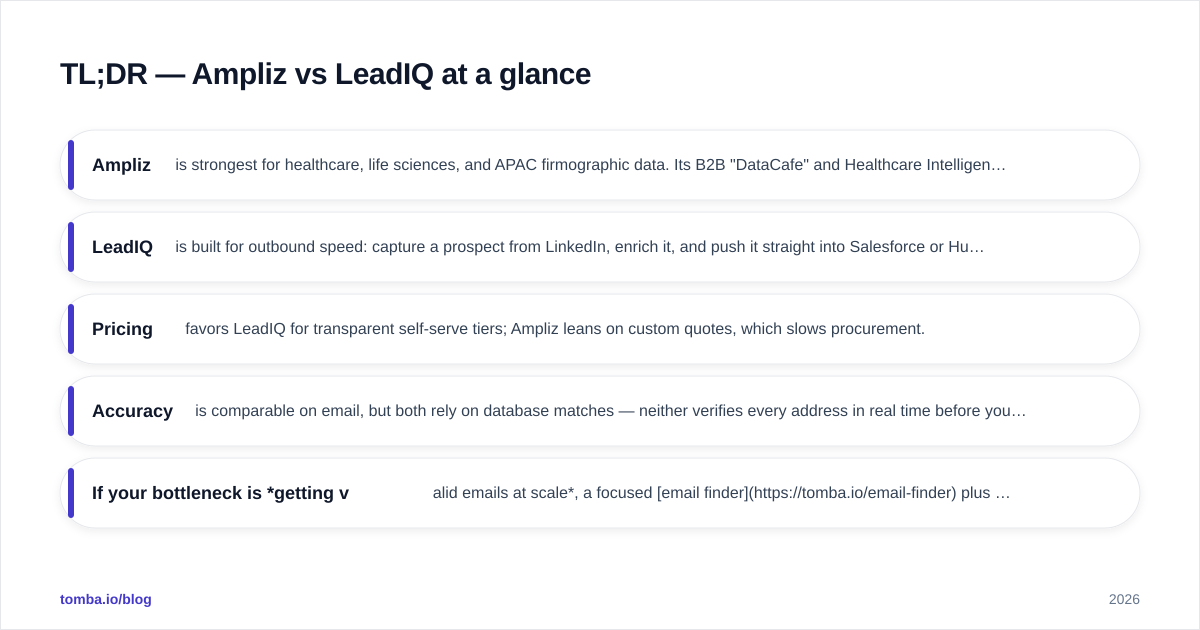
- Ampliz is strongest for healthcare, life sciences, and APAC firmographic data. Its B2B "DataCafe" and Healthcare Intelligence products go deep on niche segments most databases ignore.
- LeadIQ is built for outbound speed: capture a prospect from LinkedIn, enrich it, and push it straight into Salesforce or HubSpot with sequence-ready fields.
- Pricing favors LeadIQ for transparent self-serve tiers; Ampliz leans on custom quotes, which slows procurement.
- Accuracy is comparable on email, but both rely on database matches — neither verifies every address in real time before you send.
- If your bottleneck is getting valid emails at scale, a focused email finder plus an email verifier often beats paying platform pricing for data you only partly use.

What is Ampliz and who is it for?#
Ampliz is a B2B data and sales intelligence platform with two flagship products: B2B DataCafe (general firmographic and contact data) and Healthcare Intelligence (physician, hospital, and life-sciences records). The healthcare side is the differentiator — it includes NPI numbers, specialties, and facility-level detail that horizontal databases rarely carry.
Ampliz fits teams that:
- Sell into healthcare, pharma, or medical devices and need provider-level targeting.
- Run account-based motions in APAC and the Middle East, where Ampliz has stronger coverage than most US-first vendors.
- Want a custom data list built and delivered rather than a self-serve prospecting tool.
The trade-off: Ampliz is more of a data provider than a workflow tool. You get records, but the in-CRM capture-and-sequence loop that outbound reps live in is thinner.
What is LeadIQ and who is it for?#
LeadIQ is a prospecting and contact-capture platform aimed squarely at outbound SDR teams. Its core loop is a browser extension: you open a LinkedIn profile, LeadIQ surfaces the work email and phone, and one click pushes a structured contact into Salesforce, HubSpot, Outreach, or Salesloft — already mapped to the right fields.
LeadIQ fits teams that:
- Prospect heavily on LinkedIn and want zero copy-paste into the CRM.
- Care about sequence-ready data hygiene (deduping, enrichment on capture, tracking job changes).
- Want predictable, published pricing instead of a sales call for every seat.
LeadIQ also leans into AI messaging with its "Scribe" feature, generating personalized opening lines from a prospect's profile. That is genuinely useful, though you should still review every line before it goes out.
Ampliz vs LeadIQ: full comparison table#
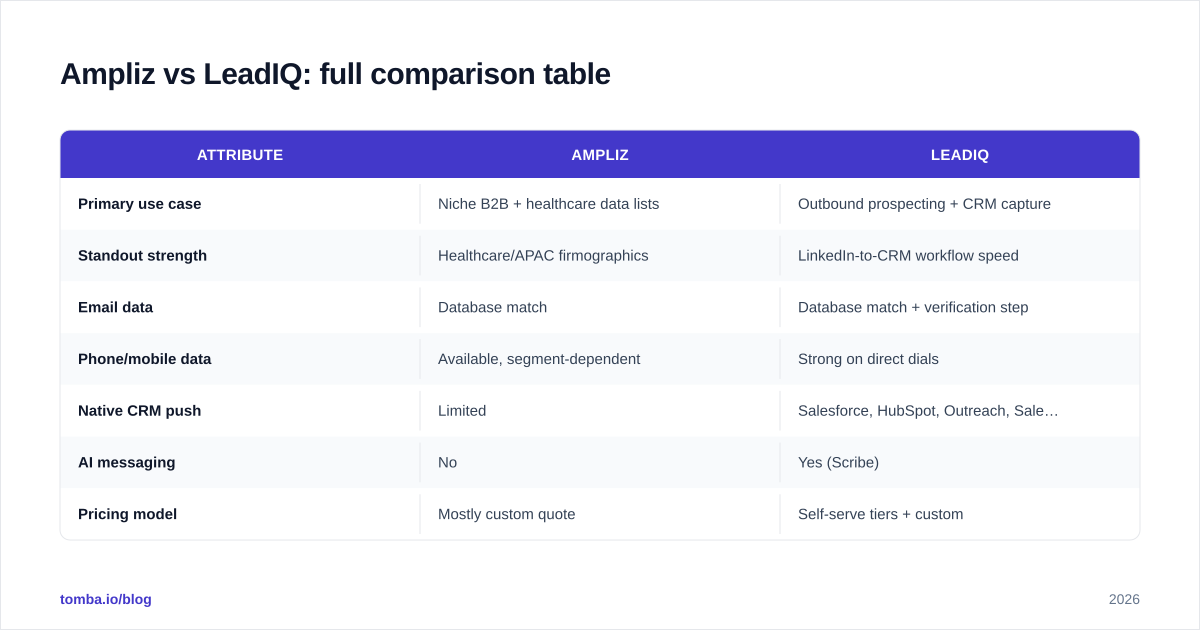
Here is the side-by-side. Treat vendor-published accuracy numbers as directional — independent results vary by industry and region.
| Attribute | Ampliz | LeadIQ |
|---|---|---|
| Primary use case | Niche B2B + healthcare data lists | Outbound prospecting + CRM capture |
| Standout strength | Healthcare/APAC firmographics | LinkedIn-to-CRM workflow speed |
| Email data | Database match | Database match + verification step |
| Phone/mobile data | Available, segment-dependent | Strong on direct dials |
| Native CRM push | Limited | Salesforce, HubSpot, Outreach, Salesloft |
| AI messaging | No | Yes (Scribe) |
| Pricing model | Mostly custom quote | Self-serve tiers + custom |
| Free option | Limited trial | Free plan (capped credits) |
| Best for | ABM into healthcare/APAC | SDR teams running LinkedIn outbound |
You can sanity-check both against peer reviews on G2's Ampliz listing and G2's LeadIQ listing — pay attention to comments about data freshness and refund/credit policies, which is where most complaints cluster for tools in this category.
Is Ampliz or LeadIQ more accurate?#
Neither has a decisive, universal accuracy edge — it depends on your segment. Ampliz tends to win inside healthcare and APAC because its records there are built and maintained deliberately. LeadIQ tends to win on North American direct dials and standard SaaS-buyer titles because that is where its capture volume concentrates.
The bigger issue is shared: both are database-match tools. When you pull a contact, you are trusting that the stored email was correct the day it was collected. People change jobs, companies rebrand domains, and catch-all servers mask whether a mailbox even exists. Without a verification pass, you inherit whatever decay has accumulated.
That decay is why deliverability-minded teams separate two jobs that platforms blur together:
- Finding the most likely email for a person at a domain.
- Verifying that the specific mailbox accepts mail before it enters a sequence.
A dedicated email verifier handles step two with SMTP and catch-all checks, so a stale Ampliz or LeadIQ record gets caught before it dents your sender reputation rather than after.
How do Ampliz and LeadIQ pricing compare in 2026?#
LeadIQ is the easier tool to buy. It publishes self-serve tiers, offers a free plan with capped credits, and scales by seats and verified-credit volume — so you can estimate spend before talking to sales. Ampliz, by contrast, routes most buyers through a custom quote, especially for healthcare datasets. That is fine for a planned ABM build but frustrating when you just want to test coverage this week.
A few pricing realities to budget for with either tool:
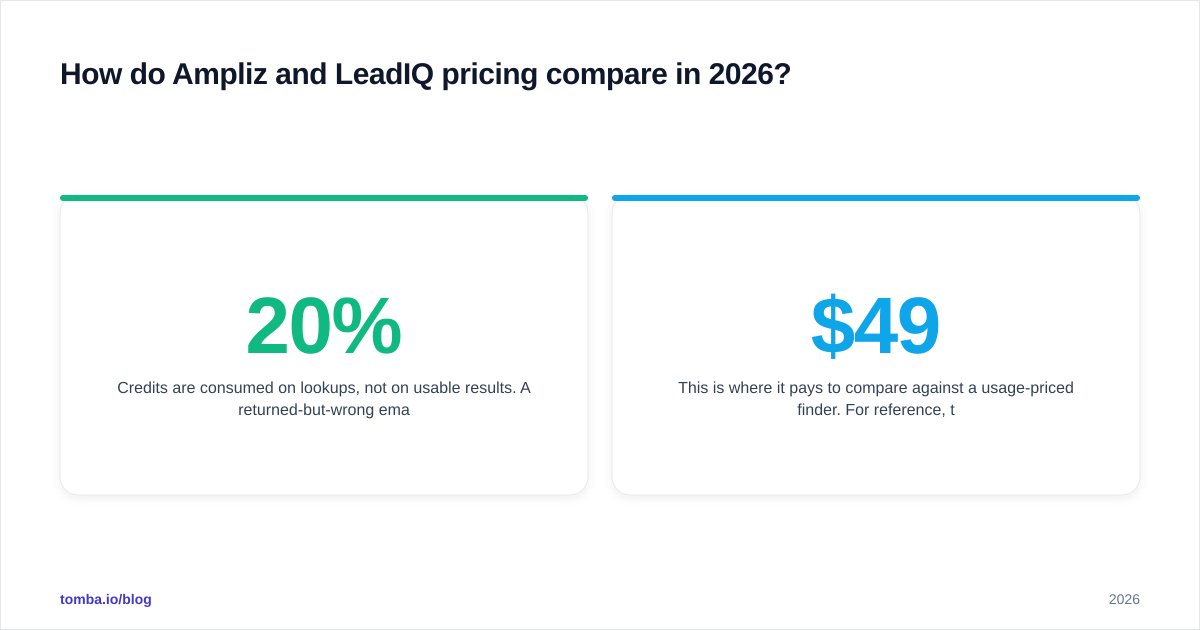
- Credits are consumed on lookups, not on usable results. A returned-but-wrong email still costs you. Build a 10–20% waste buffer into volume math.
- Seat-based plus credit-based billing means a 5-rep team can outgrow a "starter" tier fast.
- Annual commitments unlock the headline rates; monthly is materially more expensive.
This is where it pays to compare against a usage-priced finder. For reference, transparent Tomba pricing runs a Free tier (25 searches/mo), Starter at $49/mo, Growth at $99/mo, and Pro at $249/mo — useful as a benchmark even if you stay on a platform, because it tells you what raw find-and-verify should cost before workflow features are bundled on top.
Which tool fits your workflow?#
Match the tool to your actual motion, not to the longer feature list.
Choose Ampliz if...#
- Healthcare, pharma, or life sciences is your core ICP.
- You sell into APAC or the Middle East and US-first databases keep coming up thin.
- You want a curated, delivered list more than a self-serve prospecting extension.
- Procurement can tolerate a custom-quote cycle.
Choose LeadIQ if...#
- Your SDRs prospect primarily on LinkedIn.
- One-click capture into Salesforce/HubSpot would remove real daily friction.
- You want published pricing and a free tier to pilot.
- AI-assisted first lines fit your outbound playbook.
Consider a finder-plus-verifier stack if...#
- Your main pain is valid emails at volume, not data browsing.
- You enrich from a CRM, a scrape, or a list and need a domain search or data enrichment layer that plugs in via API.
- You want to stop paying platform pricing for features your reps never open.
If LeadIQ is on your shortlist mostly for the data, it is worth pricing a focused LeadIQ alternative that charges for finds and verifications instead of a full prospecting suite.
What do Ampliz and LeadIQ miss?#
Both platforms are good at their core job and incomplete at the edges. Three gaps show up repeatedly in real deployments:
1. Real-time verification at send time. A record that was valid at capture can be dead by the time it reaches a sequence three weeks later. Re-verifying right before send — not at import — is what actually protects deliverability.
2. Catch-all ambiguity. Many corporate domains accept all mail at the server, so a standard check returns "unknown." Neither tool fully resolves this; a dedicated catch-all verifier applies deeper logic to classify those addresses instead of letting reps gamble on them.
3. Coverage holes outside each tool's sweet spot. Ampliz outside healthcare/APAC and LeadIQ outside its LinkedIn-heavy core both thin out. Teams selling broadly often end up running a second source anyway — which is an argument for an API-first finder you can call to fill gaps rather than buying a third full platform.
For the deliverability mechanics behind all of this, the email deliverability and sender reputation glossary entries are a quick primer worth sending to new reps.
How should you test Ampliz vs LeadIQ before buying?#
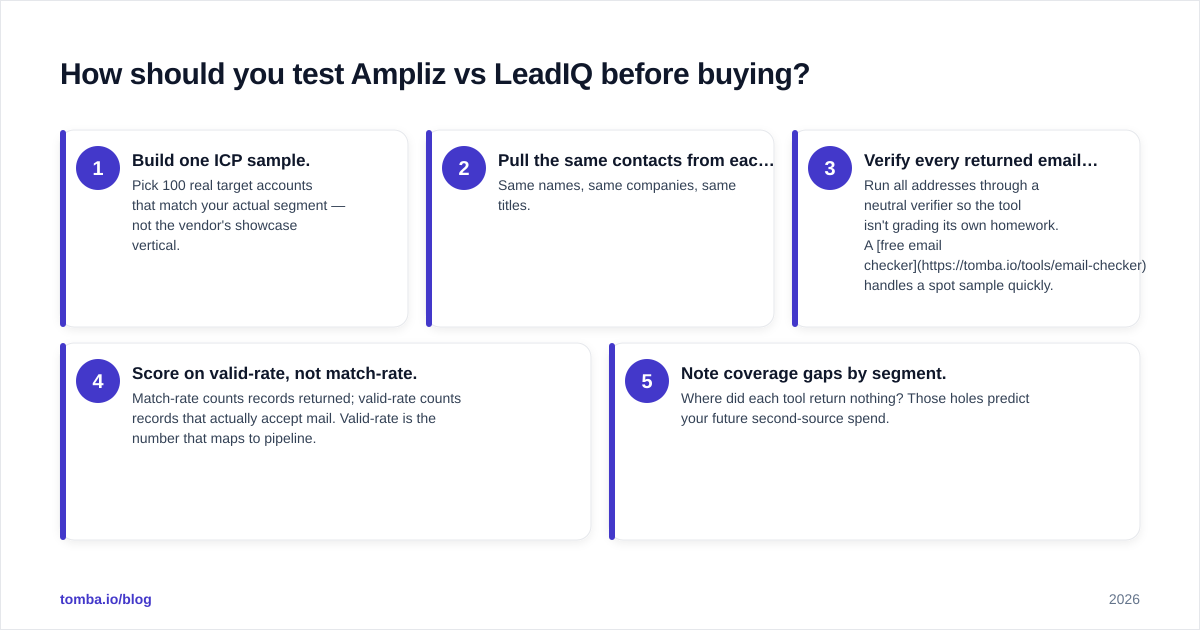
Run a controlled bake-off instead of trusting demos. A clean test takes an afternoon:
- Build one ICP sample. Pick 100 real target accounts that match your actual segment — not the vendor's showcase vertical.
- Pull the same contacts from each tool. Same names, same companies, same titles.
- Verify every returned email independently. Run all addresses through a neutral verifier so the tool isn't grading its own homework. A free email checker handles a spot sample quickly.
- Score on valid-rate, not match-rate. Match-rate counts records returned; valid-rate counts records that actually accept mail. Valid-rate is the number that maps to pipeline.
- Note coverage gaps by segment. Where did each tool return nothing? Those holes predict your future second-source spend.
Whichever wins, keep a verification step in the pipeline permanently. The tool that "wins" the bake-off today will still decay over the next quarter — verification is what keeps the win durable.
Verdict: Ampliz vs LeadIQ#
Pick LeadIQ for outbound speed, pick Ampliz for niche depth — and add verification to whichever you choose. LeadIQ is the better daily driver for LinkedIn-first SDR teams that want capture-to-CRM in one click and transparent pricing. Ampliz is the better choice when healthcare, life sciences, or APAC coverage is non-negotiable and you value a curated dataset over a self-serve tool.
Neither, on its own, guarantees that the email in front of your rep is deliverable today. That is the layer to own deliberately.
If your real constraint is finding and confirming valid B2B emails at scale — without paying full-suite pricing for features you won't use — start with the Tomba Email Finder. Find professional addresses by domain, name, or company, verify them before they hit a sequence, and call it from your CRM or scripts via the Tomba API. Run it on your own ICP sample alongside Ampliz and LeadIQ, score on valid-rate, and let the deliverable numbers pick the winner.
// get started
Find, verify and enrich your first contacts today
Start on the free plan with 25 searches a month, then scale when your team is ready.
Free plan · No credit card required · GDPR & CCPA
// about the author