Ampliz vs Leadsforge 2026: Which B2B Data Tool Wins?
Ampliz leans on healthcare and APAC intelligence; Leadsforge sells AI list-building speed. Here's how the two B2B data tools compare on accuracy, coverage, pricing, and fit — plus where a dedicated email finder beats both.
Choosing between Ampliz and Leadsforge usually comes down to one question: do you need deep, vertical-specific intelligence, or fast, conversational list-building? They are not the same kind of tool, and picking the wrong one wastes both budget and pipeline.
This guide breaks down where each platform actually wins, what you pay, how accurate the data tends to be, and when neither is the right call.
TL;DR — Ampliz vs Leadsforge in 30 seconds#
- Ampliz is a B2B data intelligence platform with unusually strong healthcare (HCP/HCO) coverage and solid APAC reach. Best for healthcare, life-sciences, and account-based teams that need firmographic and intent depth.
- Leadsforge is an AI-first, prompt-driven list builder. You describe your ideal customer in plain language and it returns a contact list fast. Best for SMB sales and founders who want speed over granularity.
- Pricing models differ: Ampliz is quote-and-credit heavy and enterprise-leaning; Leadsforge targets lower entry points with subscription list credits.
- Accuracy varies by region and role. Both struggle with verification at scale, which is where a dedicated email verifier earns its keep.
- If your real job is finding and verifying business emails, a focused tool like the Tomba Email Finder often beats a broad database on cost-per-valid-contact.
What is Ampliz?#
Ampliz is a B2B data and sales intelligence platform. Think of it as a specialized library rather than a general search engine: its shelves are stocked deepest in healthcare and Asia-Pacific markets, where generic providers tend to thin out.
The platform offers firmographic data, contact records, healthcare provider (HCP) and organization (HCO) intelligence, and intent signals. Sales and marketing teams use it for account targeting, territory planning, and building lists segmented by specialty, NPI-style attributes, or region. You can read more about how vendors source records on Ampliz's own site at ampliz.com.
Where Ampliz shines is vertical depth. If you sell medical devices, pharma services, or anything that requires reaching specific clinician roles, the granularity is hard to match with a horizontal database. The trade-off is that this depth comes with enterprise-style pricing and a heavier onboarding motion.
What is Leadsforge?#
Leadsforge is an AI-powered lead generation tool built around natural-language list building. Instead of clicking through filter menus, you type something like "marketing directors at Series B SaaS companies in the US" and the tool assembles a contact list for you.
That conversational layer is the selling point. It lowers the learning curve dramatically — a founder with no ops background can build a usable list in minutes. Leadsforge focuses on speed-to-list and a friendly entry price, positioning itself for SMBs, agencies, and early-stage outbound teams.
The trade-off mirrors Ampliz's in reverse: you gain speed and simplicity but lose the surgical filtering and vertical specialization. AI interpretation of your prompt is only as good as the underlying data it queries, and verification is not always baked in.
How do Ampliz and Leadsforge compare head-to-head?#
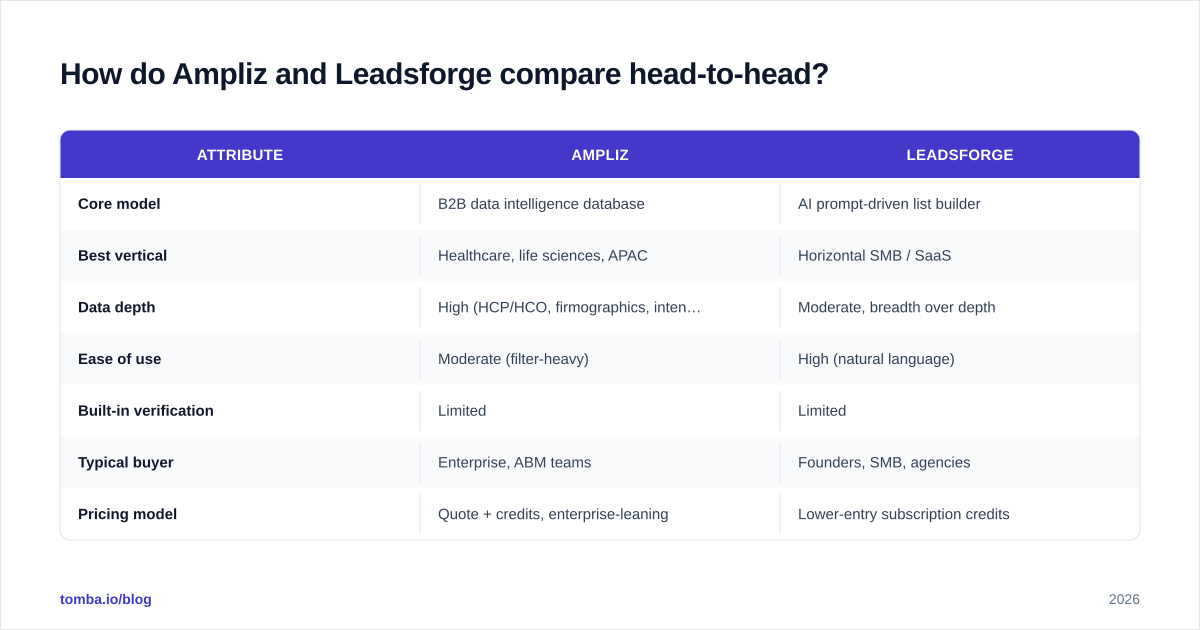
Here is the side-by-side on the attributes that actually move a buying decision.
| Attribute | Ampliz | Leadsforge |
|---|---|---|
| Core model | B2B data intelligence database | AI prompt-driven list builder |
| Best vertical | Healthcare, life sciences, APAC | Horizontal SMB / SaaS |
| Data depth | High (HCP/HCO, firmographics, intent) | Moderate, breadth over depth |
| Ease of use | Moderate (filter-heavy) | High (natural language) |
| Built-in verification | Limited | Limited |
| Typical buyer | Enterprise, ABM teams | Founders, SMB, agencies |
| Pricing model | Quote + credits, enterprise-leaning | Lower-entry subscription credits |
| Learning curve | Steeper | Minimal |
The pattern is clear: Ampliz trades simplicity for depth, and Leadsforge trades depth for speed. Neither is "better" in the abstract — they serve different buyers.
Use the framework above as a quick gut check. If your X-axis need (vertical depth) is high and you have budget, Ampliz. If your Y-axis need (speed and simplicity) dominates and budget is tight, Leadsforge. If you land in the middle — you mostly need accurate, verified emails at a predictable cost — a dedicated finder is usually the smarter spend.
Which has more accurate data?#
Accuracy is the metric that quietly decides ROI, because every bounced email and wrong-number dial costs sender reputation and rep time.
Ampliz tends to be more accurate inside its strongholds — healthcare contacts and APAC firmographics — because the data is curated for those segments. Outside those lanes, the freshness advantage narrows. Leadsforge's accuracy depends heavily on how it interprets your prompt and which sources it queries; broad horizontal coverage means more variance role-to-role and region-to-region.
The honest reality for both: no B2B database is verified the moment you export it. Records decay roughly 2-3% per month as people change jobs. That is why mature teams treat any database export as a candidate list, then run it through verification before it touches a sequence. Protecting your sender reputation is non-negotiable for email deliverability.

This is the gap neither platform fully closes. A purpose-built verification layer catches catch-all domains, role-based aliases, and dead inboxes that a list builder happily exports as "valid."
How does pricing compare?#
Pricing is where the two diverge most sharply, and where buyer expectations get set.
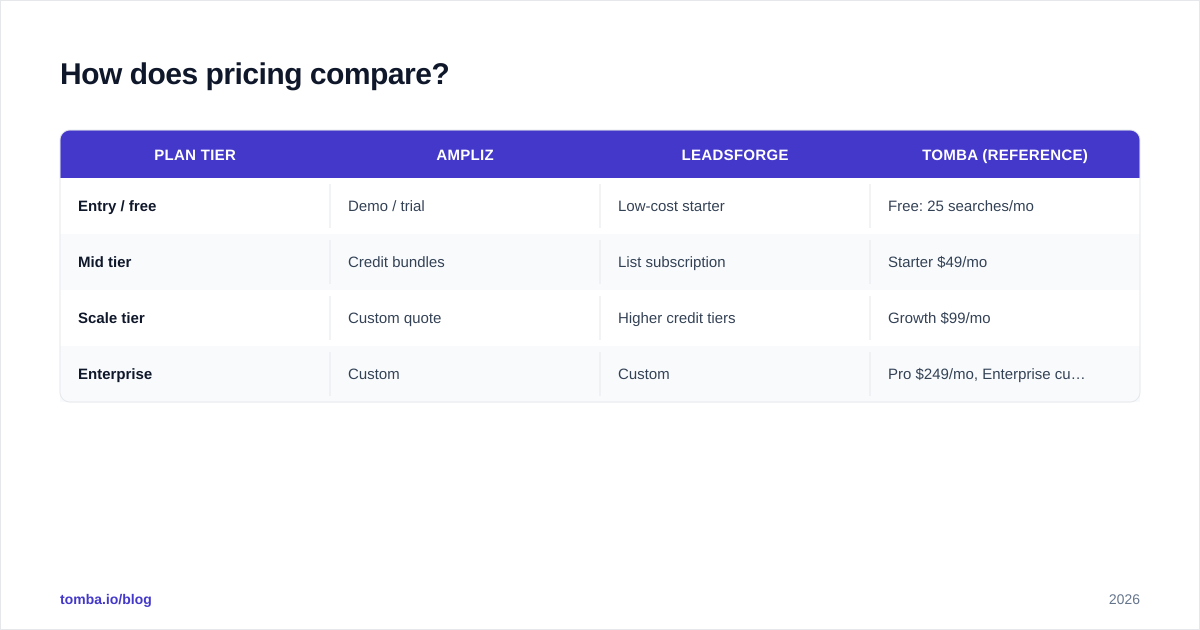
Ampliz leans enterprise. Pricing is typically quote-based with credit bundles, and the real cost scales with the depth and volume of records you pull. For a healthcare team running ABM, that cost is justified. For a five-person SaaS startup, it is overkill.
Leadsforge deliberately undercuts that with lower entry points and subscription-style list credits, making it accessible to solo founders and small teams. The catch is that cheaper credits do not equal cheaper valid contacts if a chunk of the list bounces.
When you evaluate either, calculate cost-per-valid-contact, not cost-per-record. A $0.10 record that bounces 30% of the time is more expensive than a $0.15 record that's verified. For comparison, you can see transparent, published Tomba pricing rather than chasing a quote.
| Plan tier | Ampliz | Leadsforge | Tomba (reference) |
|---|---|---|---|
| Entry / free | Demo / trial | Low-cost starter | Free: 25 searches/mo |
| Mid tier | Credit bundles | List subscription | Starter $49/mo |
| Scale tier | Custom quote | Higher credit tiers | Growth $99/mo |
| Enterprise | Custom | Custom | Pro $249/mo, Enterprise custom |
When should you choose Ampliz?#
Choose Ampliz when vertical depth is the whole point. Specifically:
- You sell into healthcare, pharma, or life sciences and need clinician-level targeting.
- You run account-based marketing and want intent signals layered onto firmographics.
- You target APAC markets where horizontal databases go thin.
- You have enterprise budget and an ops team that can work filter-heavy tools.
If two or more of those describe you, Ampliz's premium is defensible. You are paying for data you genuinely cannot reconstruct cheaply elsewhere.
When should you choose Leadsforge?#
Choose Leadsforge when speed and simplicity beat surgical precision:
- You are a founder or small team doing your own prospecting.
- You want a list today, without learning a filter taxonomy.
- You sell horizontally into SMB or SaaS where broad coverage is fine.
- Budget is tight and you would rather iterate fast than pay enterprise rates.
The natural-language interface is a genuine productivity unlock for non-technical users. Just pair it with verification so the speed doesn't cost you deliverability.
Is there a better-value alternative to both?#
For many teams, yes — if your actual job is finding and verifying business emails at a predictable cost, a focused email-finding platform beats a broad database on cost-per-valid-contact.
This is the lane where Tomba fits. Instead of paying enterprise rates for healthcare depth you don't need, or accepting list variance for speed, you get a finder-plus-verifier built for exactly that workflow:
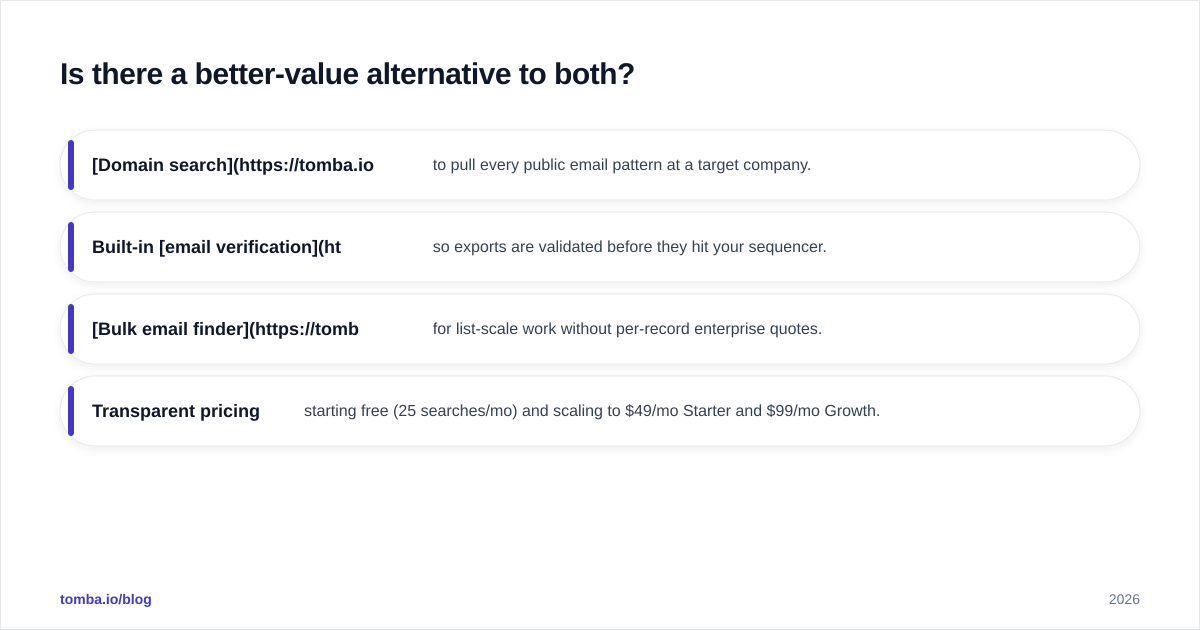
- Domain search to pull every public email pattern at a target company.
- Built-in email verification so exports are validated before they hit your sequencer.
- Bulk email finder for list-scale work without per-record enterprise quotes.
- Transparent pricing starting free (25 searches/mo) and scaling to $49/mo Starter and $99/mo Growth.
It is not a replacement for Ampliz's healthcare intelligence or Leadsforge's prompt magic in every scenario. But for the common case — "I need accurate, verified emails for my outreach without a sales call" — it is usually the better-value pick.

How do you actually decide?#
Run this quick test before you buy either:
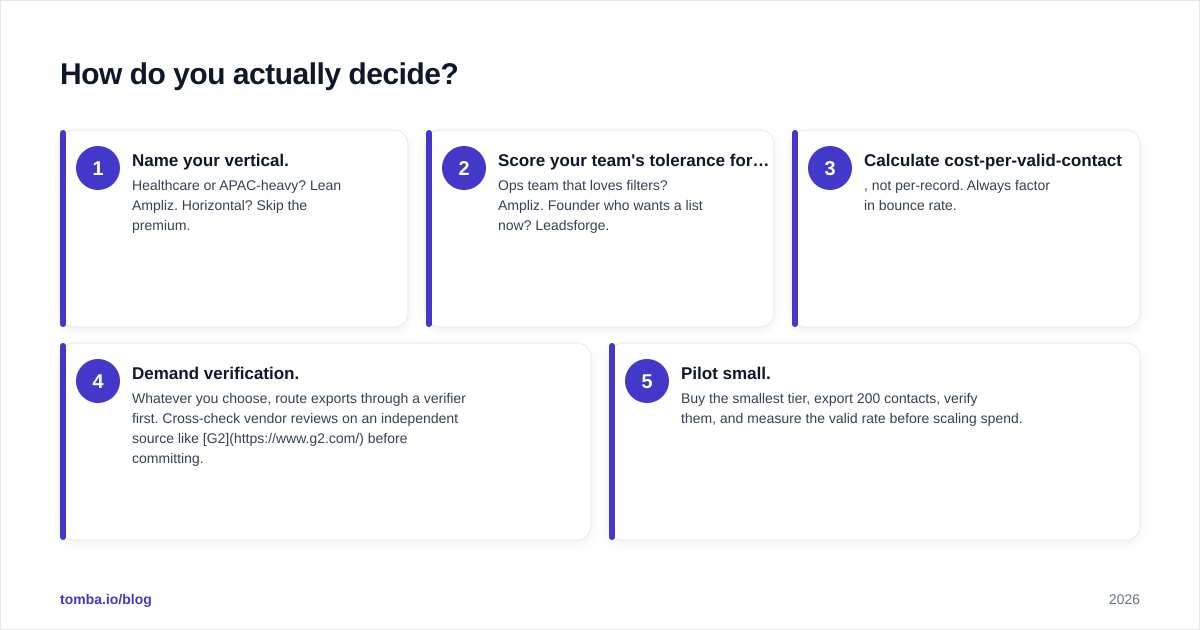
- Name your vertical. Healthcare or APAC-heavy? Lean Ampliz. Horizontal? Skip the premium.
- Score your team's tolerance for complexity. Ops team that loves filters? Ampliz. Founder who wants a list now? Leadsforge.
- Calculate cost-per-valid-contact, not per-record. Always factor in bounce rate.
- Demand verification. Whatever you choose, route exports through a verifier first. Cross-check vendor reviews on an independent source like G2 before committing.
- Pilot small. Buy the smallest tier, export 200 contacts, verify them, and measure the valid rate before scaling spend.
Most teams overspend by buying for the demo rather than for the steady-state workflow. The cheapest path to pipeline is accurate, verified contacts — not the deepest database or the slickest AI prompt.
The bottom line#
Ampliz and Leadsforge solve different problems. Ampliz is vertical depth for enterprise and healthcare; Leadsforge is speed-to-list for SMBs and founders. Match the tool to your vertical, your team's complexity tolerance, and — above all — your true cost-per-valid-contact.
If your core need is simply finding and verifying real business emails without an enterprise contract or list-quality roulette, start with the Tomba Email Finder. Spin up the free tier, run a real export through verification, and let the valid-contact rate make the decision for you. That single number tells you more than any feature comparison ever will.
Ready to find emails that actually work?
Join 150,000+ professionals who stopped guessing and started sending. Free credits on signup — no credit card required.
Get the Tomba newsletter
Practical outbound tactics and product updates — once every two weeks.
About the author