Ampliz vs Leadsrush 2026: B2B Data & Email Finder Compared
Ampliz vs Leadsrush in 2026: a neutral breakdown of data accuracy, pricing, coverage, and which B2B contact tool actually fits your outbound motion.
Choosing between Ampliz and Leadsrush usually comes down to one question: do you need deep, vertical-specific intelligence, or fast, broad contact discovery at a low price? This guide compares both tools on data accuracy, coverage, pricing, and workflow fit — and shows where a dedicated email finder beats either one.
TL;DR#
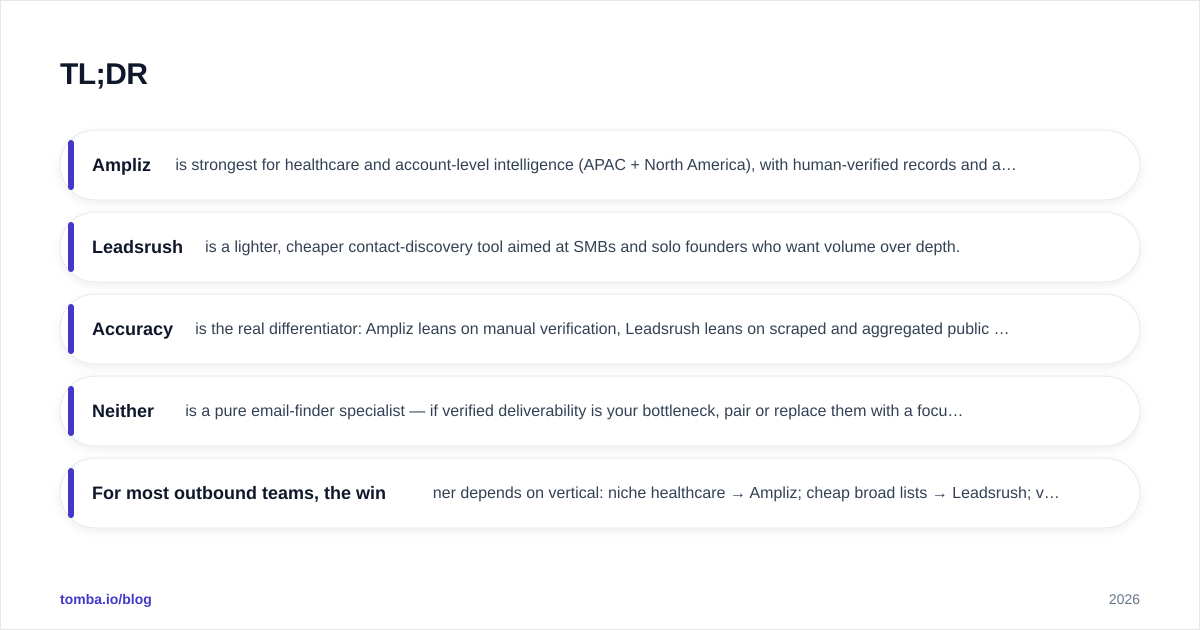
- Ampliz is strongest for healthcare and account-level intelligence (APAC + North America), with human-verified records and a higher price floor.
- Leadsrush is a lighter, cheaper contact-discovery tool aimed at SMBs and solo founders who want volume over depth.
- Accuracy is the real differentiator: Ampliz leans on manual verification, Leadsrush leans on scraped and aggregated public data.
- Neither is a pure email-finder specialist — if verified deliverability is your bottleneck, pair or replace them with a focused email finder.
- For most outbound teams, the winner depends on vertical: niche healthcare → Ampliz; cheap broad lists → Leadsrush; verified email-first outreach → a specialist.
What are Ampliz and Leadsrush?#
Ampliz is a B2B data intelligence platform best known for its healthcare database (the "Ampliz People Finder" and "Healthcare Intelligence" products). It sells account and contact data enriched with firmographics, technographics, and — in healthcare — provider-level attributes like NPI numbers, specialties, and hospital affiliations. Its sweet spot is teams selling into medical, pharma, and enterprise accounts across APAC and North America.
Leadsrush is a lead-generation tool positioned for speed and affordability. It focuses on pulling business contacts (emails, company info, social profiles) from public sources and aggregated directories, then exporting them into lists you can drop into a cold-email or CRM workflow. It targets freelancers, agencies, and small sales teams who care more about cost-per-lead than enterprise-grade enrichment.
The two overlap on the surface — both hand you B2B contacts — but they're built for different buyers. Ampliz optimizes for depth and compliance; Leadsrush optimizes for breadth and price.
How do Ampliz and Leadsrush compare at a glance?#
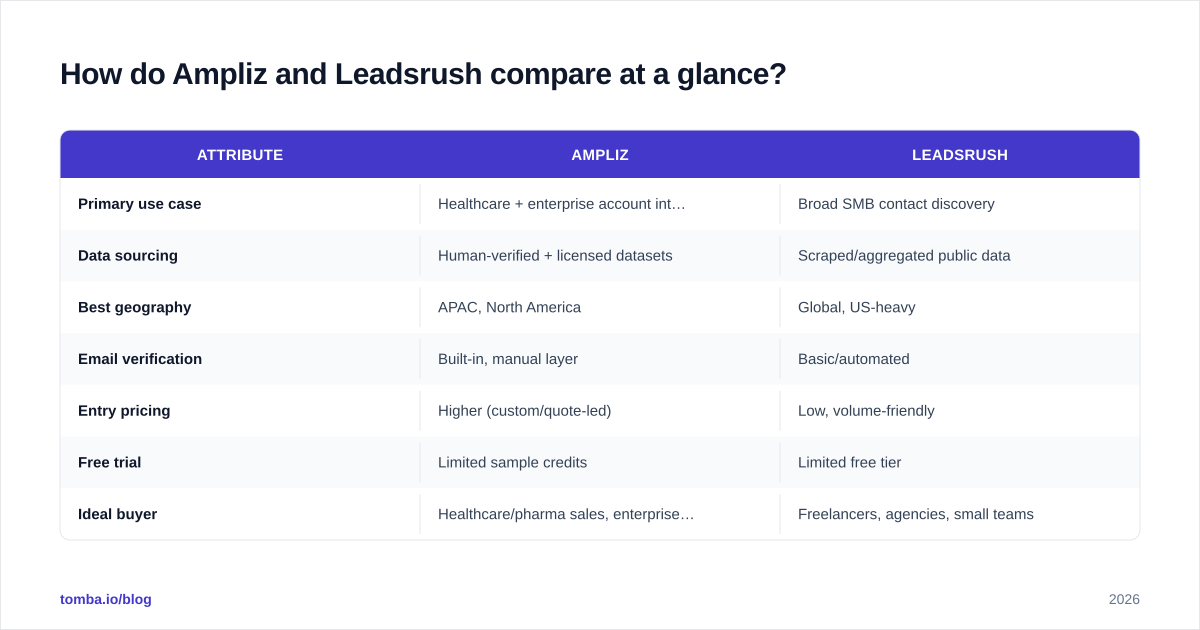
Here's the side-by-side before we go deeper. Treat the pricing as indicative — both vendors quote custom and seat-based plans, so confirm current numbers on their sites.
| Attribute | Ampliz | Leadsrush |
|---|---|---|
| Primary use case | Healthcare + enterprise account intelligence | Broad SMB contact discovery |
| Data sourcing | Human-verified + licensed datasets | Scraped/aggregated public data |
| Best geography | APAC, North America | Global, US-heavy |
| Email verification | Built-in, manual layer | Basic/automated |
| Entry pricing | Higher (custom/quote-led) | Low, volume-friendly |
| Free trial | Limited sample credits | Limited free tier |
| Ideal buyer | Healthcare/pharma sales, enterprise SDRs | Freelancers, agencies, small teams |
| API access | Yes | Limited |
If your motion is "I need 50 verified decision-makers at hospital systems in Singapore," Ampliz is the obvious starting point. If it's "I need 5,000 generic SMB contacts this week without blowing my budget," Leadsrush is closer to your lane.
Which has better data accuracy?#
Ampliz wins on verified accuracy; Leadsrush wins on raw volume. That tradeoff is the heart of the decision.
Ampliz invests in a manual verification layer, especially in healthcare where a wrong NPI or specialty makes a record useless. That human-in-the-loop step costs money and slows refresh cycles, but it's why enterprise and regulated-industry teams tolerate the higher price. Aggregated tools like Leadsrush refresh faster and cover more names, but scraped data decays quickly — people change jobs, emails bounce, and titles go stale.

The practical issue with either tool is the last mile: even an accurate-looking email can be a catch-all, a role address, or long-dead. That's why accuracy-obsessed teams run every list through a dedicated email verifier before a single send. A platform's "verified" badge and a real-time SMTP check are not the same thing, and your bounce rate will tell you which one you trusted.
A quick test before you commit to either vendor: pull 100 sample records for your exact ICP, then independently verify them. Measure the genuine valid rate, not the vendor's marketing claim. Accuracy on US tech contacts says nothing about accuracy on, say, German manufacturing or APAC healthcare.
How do Ampliz and Leadsrush price their plans?#
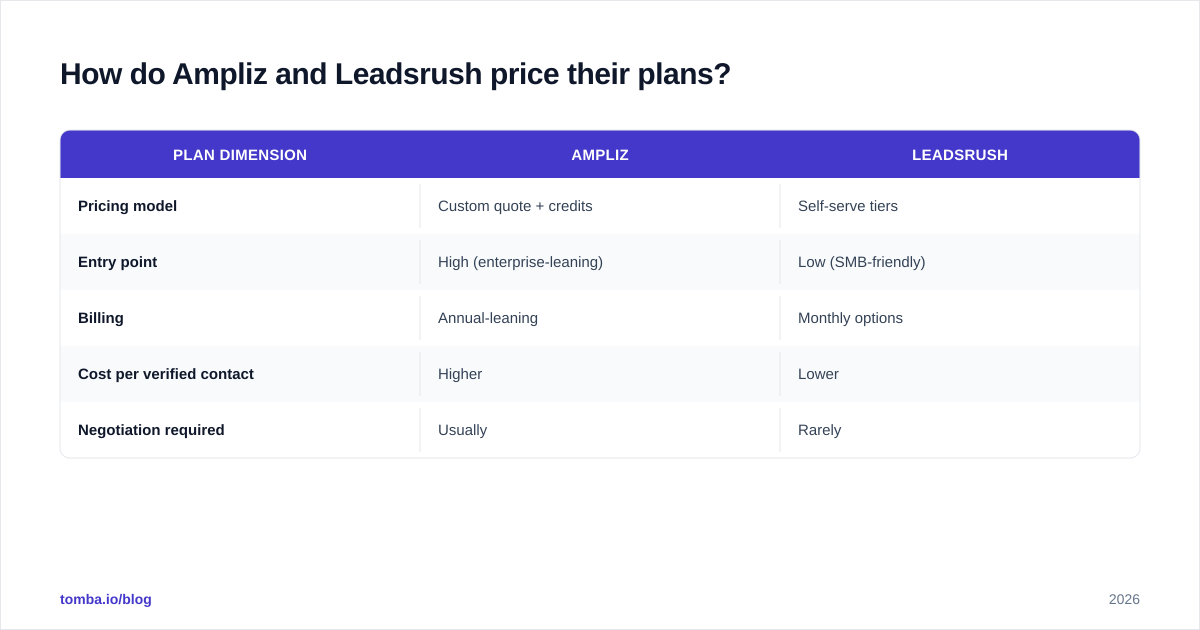
Pricing is where the two diverge most sharply.
Ampliz is quote-led and seat-based, with credit bundles for data downloads. You're paying for verified, niche records, so the effective cost-per-contact is higher — but in healthcare a single closed deal can justify the entire annual contract. Expect a sales conversation rather than a self-serve checkout.
Leadsrush is self-serve and volume-friendly, with low entry tiers designed to get freelancers and small agencies started fast. The cost-per-contact is low, which is exactly the point — but you're trading verification depth for that price.
| Plan dimension | Ampliz | Leadsrush |
|---|---|---|
| Pricing model | Custom quote + credits | Self-serve tiers |
| Entry point | High (enterprise-leaning) | Low (SMB-friendly) |
| Billing | Annual-leaning | Monthly options |
| Cost per verified contact | Higher | Lower |
| Negotiation required | Usually | Rarely |
A useful reference point: a dedicated email-finder like Tomba starts free (25 searches/month) and scales through a $49/mo Starter, $99/mo Growth, and $249/mo Pro tier — see the full Tomba pricing breakdown. That gives you a transparent, per-search benchmark to judge whether either platform's cost-per-contact is actually reasonable for your volume.

Is Ampliz better than Leadsrush?#
Neither is universally "better" — they win in different conditions. Use this decision logic:
Choose Ampliz if:
- You sell into healthcare, pharma, or regulated enterprise accounts.
- You need provider-level attributes (NPI, specialty, hospital affiliation).
- APAC or North American coverage is critical.
- Compliance and verified sourcing matter more than price.
Choose Leadsrush if:
- You're a freelancer, agency, or small team watching every dollar.
- You need broad SMB coverage fast and can tolerate higher bounce rates.
- Your outreach is high-volume and forgiving of data decay.
- You don't need vertical-specific enrichment.
Choose a dedicated email finder if:
- Your real bottleneck is finding and verifying the right email, not buying a database.
- You want pay-as-you-go transparency instead of enterprise contracts.
- You need to enrich names you already have (from LinkedIn, events, or inbound).
Where do both tools fall short?#
Both Ampliz and Leadsrush are databases first. That design has two consequences worth naming.
First, you're limited to who's already in their index. If your target contact isn't in the dataset — common for newer companies, smaller markets, or recently-promoted buyers — you're stuck. A search-driven domain search approach works differently: you give it a company domain and it discovers emails and patterns on demand, rather than depending on a pre-built record existing.
Second, bulk lists go stale between refreshes. Buying 5,000 contacts today means a chunk are wrong within 90 days. Teams that live on outbound usually adopt a hybrid model: a database for discovery, plus a real-time finder-and-verifier for the contacts that actually matter this quarter. Running a bulk email finder over your shortlist, then verifying before send, keeps deliverability healthy without paying enterprise database prices for names you'll never email.
There's also the deliverability angle neither tool fully owns. Even perfect data fails if your sending domain has a poor reputation. Before scaling any list from either vendor, it's worth understanding email deliverability fundamentals — warmup, SPF/DKIM, and bounce thresholds — because the cleanest database in the world won't save a burned domain.
How accurate is the underlying email data, really?#
This is the question that decides your bounce rate, so it deserves its own section.
Ampliz's manual layer means healthcare emails tend to verify well, but coverage thins out fast outside its core verticals. Leadsrush's aggregated approach means you'll get more emails, but a meaningful share will be catch-all addresses or role accounts (info@, sales@) that hurt reply rates and inbox placement.

The catch-all problem is especially sneaky. A catch-all domain accepts mail to any address, so a basic verifier marks it "valid" when it may not be. That's why teams serious about deliverability use a dedicated catch-all verifier rather than trusting a green checkmark. If 30% of your "valid" list is actually catch-all guesses, your sender reputation pays the price — and no database refund covers that.
Independent review sites are your friend here. Cross-check both vendors' current ratings on G2 and Capterra for unfiltered accuracy and support feedback before you sign anything. Marketing pages claim 95%+ accuracy; real users tell you the truth about coverage gaps in your specific market.
What about workflow and integrations?#
For day-to-day usability, look at how each tool reaches your CRM and sequencer.
Ampliz offers API access and enterprise integrations suited to RevOps teams building data pipelines — it expects to be part of a larger stack. Leadsrush is more export-and-go: pull a CSV, drop it into your tool of choice. Neither is a full outbound platform, so you'll still need a sequencer and a verification step on top.
If you're assembling a stack rather than buying one monolith, a finder with a clean email finder API, spreadsheet add-ons, and CRM connectors slots in alongside either database — handling the real-time discovery and verification that the bulk databases don't do well. The pattern that works in 2026: database for total addressable market, finder + verifier for the contacts you actually touch.
Ampliz vs Leadsrush vs a dedicated finder#
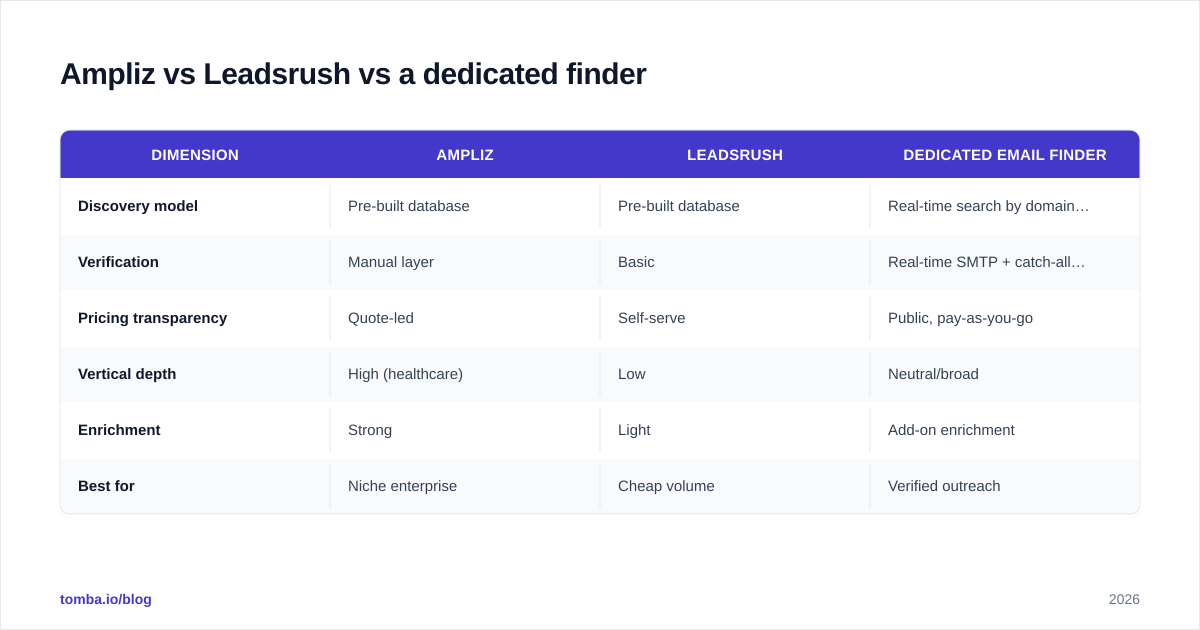
To put the choice in context, here's how a specialist email finder compares against both databases on the dimensions that drive outbound results.
| Dimension | Ampliz | Leadsrush | Dedicated email finder |
|---|---|---|---|
| Discovery model | Pre-built database | Pre-built database | Real-time search by domain/name |
| Verification | Manual layer | Basic | Real-time SMTP + catch-all checks |
| Pricing transparency | Quote-led | Self-serve | Public, pay-as-you-go |
| Vertical depth | High (healthcare) | Low | Neutral/broad |
| Enrichment | Strong | Light | Add-on enrichment |
| Best for | Niche enterprise | Cheap volume | Verified outreach |
The honest takeaway: these aren't always either/or. Plenty of teams keep a vertical database and a finder, using each for what it's best at. What you should not do is rely on a single bulk export and skip verification — that's the fastest way to a spam folder.
Final verdict: which should you pick?#
Pick Ampliz if you sell into healthcare or enterprise accounts in APAC/North America and need verified, attribute-rich records — and you can absorb the higher, quote-led pricing. Pick Leadsrush if you're a small team or agency that needs broad, cheap SMB contacts and can handle higher bounce rates with disciplined verification. Pick a dedicated finder if your actual bottleneck is finding and verifying the right email at the right moment, with transparent pricing and no enterprise contract.
Whichever database you choose, the verification step is non-negotiable. The cleanest outbound stacks in 2026 treat data discovery and email verification as two separate jobs — and do both well.
Ready to stop guessing at email accuracy? Tomba's Email Finder discovers professional emails by domain, name, or company in real time, then verifies them before they ever hit your sequencer — so you protect your sender reputation instead of repairing it. Start free with 25 searches a month, scale to Starter at $49/mo, and benchmark your current database vendor against transparent, pay-as-you-go accuracy. Pair it with the email verifier to catch the catch-alls Ampliz and Leadsrush miss, and send to lists you can actually trust.
Ready to find emails that actually work?
Join 150,000+ professionals who stopped guessing and started sending. Free credits on signup — no credit card required.
Get the Tomba newsletter
Practical outbound tactics and product updates — once every two weeks.
About the author