Ampliz vs SphereScout 2026: B2B Data Tools Compared
Ampliz and SphereScout both promise accurate B2B contact data — but they target different buyers. Here's an honest 2026 breakdown of pricing, coverage, and accuracy to help you pick.
The Ampliz vs SphereScout choice comes down to one question. Do you need deep healthcare and APAC intelligence? Or do you want broad, affordable contact discovery you can run at scale? This Ampliz vs SphereScout guide compares both tools on what moves pipeline: data accuracy, coverage, pricing, and workflow fit. It also shows where a leaner alternative beats both.
TL;DR#
- Ampliz is a B2B intelligence platform. It is strong in healthcare data and APAC coverage. It fits teams that sell into hospitals, clinics, and niche verticals where data depth matters more than raw volume.
- SphereScout is a lighter, prospecting-first contact tool. It focuses on quick lookups and list building for SMB and mid-market sales teams.
- On accuracy and verification, neither tool is bulletproof. Both rely on database matches that decay. So you should always re-verify before you send.
- Pricing favors SphereScout for small teams. Ampliz gets expensive fast once you need premium healthcare datasets.
- Maybe your core need is just finding and verifying work emails by name or domain. If so, a focused tool like Tomba Email Finder often delivers a better cost per valid contact than either platform.
What is Ampliz?#
Ampliz is a B2B data intelligence platform. It is best known for its healthcare database: physician contacts, NPI numbers, hospital firmographics, and decision-maker maps across the medical industry. It also offers a general "global B2B" dataset. Its Asia-Pacific coverage is strong, which most North American tools handle poorly.
The product is built for account-based selling. You get firmographic filters: industry, revenue, headcount, and tech used. You also get contact data like title, email, and phone, plus intent-style signals. Sales teams use it to build targeted account lists, not to spray and pray.
The trade-off: depth comes at a price. Ampliz is priced like an enterprise data subscription. The best datasets, such as verified healthcare contacts, sit behind higher tiers. To judge any vendor's claims, it helps to know how providers source and refresh records. See Tomba's data sources page for a useful frame.
What is SphereScout?#
SphereScout is a prospecting-first contact discovery tool. Ampliz leans into account intelligence and vertical depth. SphereScout instead aims for speed and simplicity. You search a company or person, get contact details, and push them into your outreach.
It targets SMB and mid-market reps. They want an easy way to build prospect lists without learning a complex platform. The feature set is narrower, with fewer filters and lighter intent data. But the learning curve is shorter and the entry price is lower.
So SphereScout fits well if you run high-volume outbound and need contacts fast. It fits poorly if you sell into a regulated vertical where data provenance and compliance matter.
Ampliz vs SphereScout: how do they compare on features?#
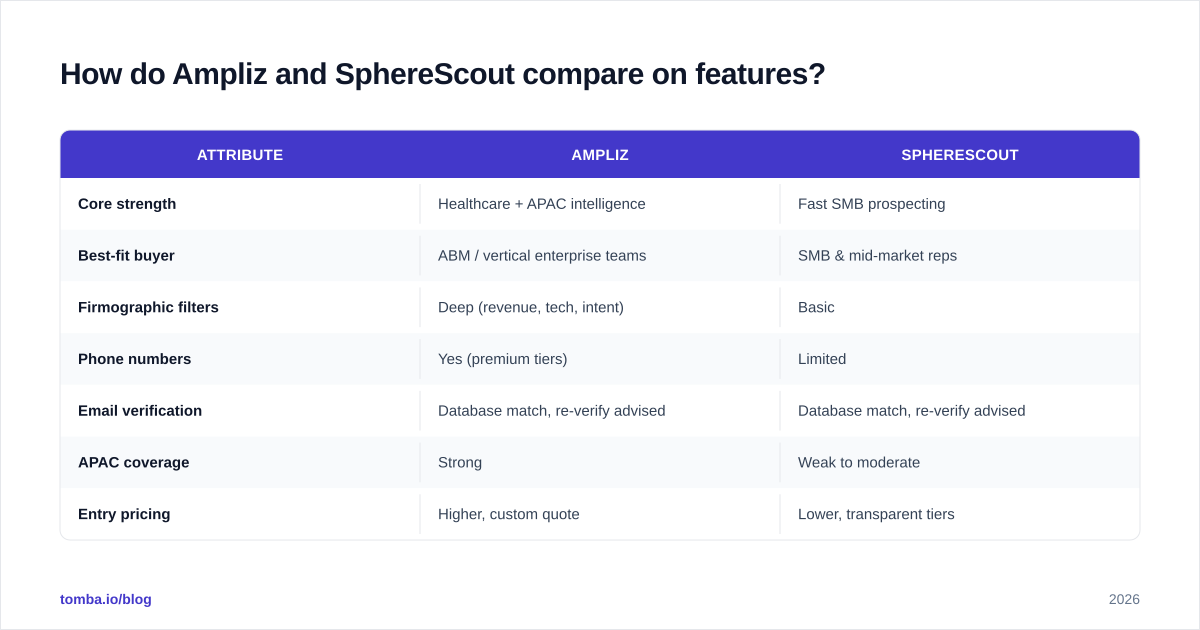
Here is the head-to-head on the factors that decide most purchases. The prices below are rough. Both vendors quote custom enterprise pricing, so treat the tiers as directional, not exact.
| Attribute | Ampliz | SphereScout |
|---|---|---|
| Core strength | Healthcare + APAC intelligence | Fast SMB prospecting |
| Best-fit buyer | ABM / vertical enterprise teams | SMB & mid-market reps |
| Firmographic filters | Deep (revenue, tech, intent) | Basic |
| Phone numbers | Yes (premium tiers) | Limited |
| Email verification | Database match, re-verify advised | Database match, re-verify advised |
| APAC coverage | Strong | Weak to moderate |
| Entry pricing | Higher, custom quote | Lower, transparent tiers |
| Learning curve | Steeper | Shallow |
| API access | Yes | Limited |
The pattern is clear. Ampliz wins on depth and vertical focus. SphereScout wins on speed, simplicity, and entry cost. Neither is "better" on its own. They serve different jobs.

Which tool has better data accuracy?#
Neither tool publishes an audited accuracy figure you should trust at face value. That is the most important thing to grasp before you buy.
All database-driven tools, including Ampliz and SphereScout, work the same way. They store a set of records and return the best match for your query. The problem is that B2B contact data decays fast. Most estimates put email and job-title decay at 20–30% per year. People change roles, companies rebrand, and domains move. A record that was 98% accurate when scraped can be stale six months later.
Ampliz tends to do better in its specialty of healthcare and APAC. It refreshes those datasets more often and ties records to stable IDs like NPI numbers. SphereScout's coverage is broader but shallower. That usually means more catch-all and role-based addresses slip through.
The takeaway: always re-verify before you send, whichever platform you choose. Run new addresses through a dedicated email verifier. Use a catch-all verifier for domains that return unclear SMTP responses. Sending to unverified lists is the fastest way to hurt your sender reputation and land in spam.

To see how independent reviewers rate these tools, browse the G2 B2B data category. Look at recency and review volume, not just the star average.
How do Ampliz and SphereScout price?#
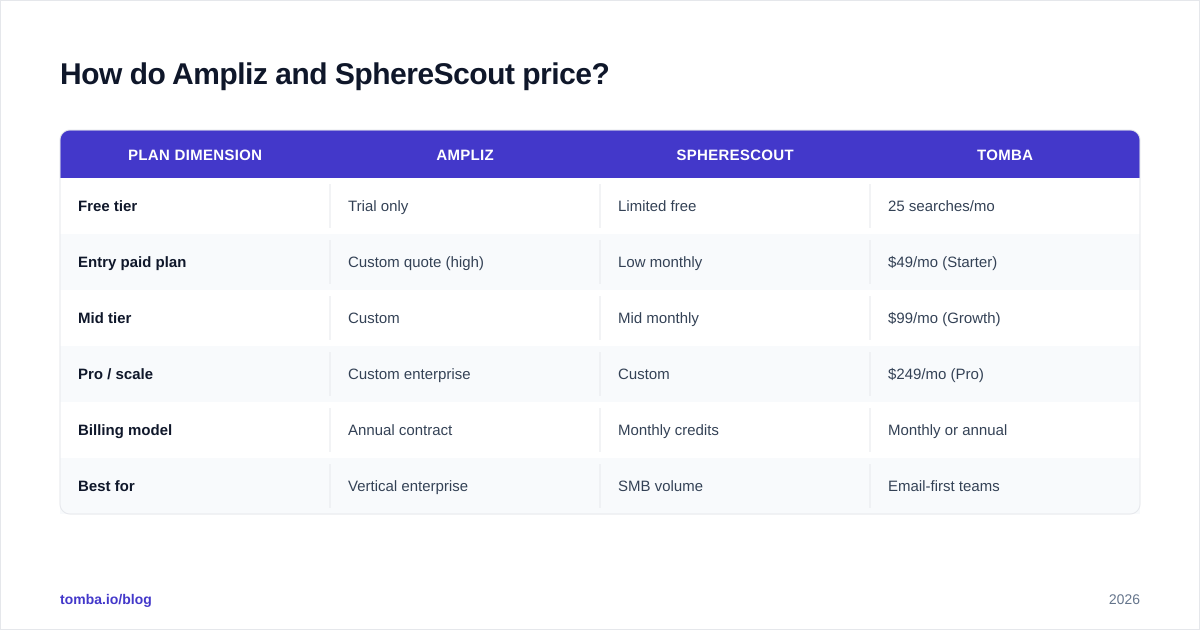
Pricing is where the two differ most. It is also where buyer regret usually starts.
Ampliz uses an enterprise sales motion. There is a free trial to test match quality. But real usage needs a custom annual contract. Premium datasets, like verified healthcare contacts, direct dials, and intent signals, sit behind higher tiers. Expect to negotiate. Expect a high per-contact cost if you only need part of the database.
SphereScout offers clearer, lower entry tiers for individual reps and small teams. You pay monthly, get a credit allotment, and top up as needed. The cost per lookup is lower, but so is the depth. You pay for volume, not for vertical intelligence.
| Plan dimension | Ampliz | SphereScout | Tomba |
|---|---|---|---|
| Free tier | Trial only | Limited free | 25 searches/mo |
| Entry paid plan | Custom quote (high) | Low monthly | $49/mo (Starter) |
| Mid tier | Custom | Mid monthly | $99/mo (Growth) |
| Pro / scale | Custom enterprise | Custom | $249/mo (Pro) |
| Billing model | Annual contract | Monthly credits | Monthly or annual |
| Best for | Vertical enterprise | SMB volume | Email-first teams |
If cost is the deciding factor, compare both against the published Tomba pricing before you sign anything annual. The hidden cost in enterprise data contracts is paying for coverage you never use.
When should you choose Ampliz over SphereScout?#
Choose Ampliz when:
- You sell into healthcare. Its physician and hospital data is genuinely different, and NPI-linked records reduce guesswork.
- You target the APAC region, where most US-built tools have thin coverage.
- You run account-based marketing and need deep firmographic and intent filters to build precise target lists.
- You have the budget for an annual enterprise contract and the volume to justify it.
Choose SphereScout when:
- You're an SMB or mid-market rep who wants fast, simple contact lookups.
- Your sales motion is high-volume outbound and you value speed over vertical depth.
- You want a low monthly entry cost without a long negotiation or annual lock-in.
- You don't need regulated-vertical data provenance.
A simple rule: if data depth in one vertical is your bottleneck, lean Ampliz. If access speed and cost is your bottleneck, lean SphereScout. If your real bottleneck is just finding and verifying emails reliably, neither full platform may be the right spend. That brings us to the alternative.
Is there a better alternative to both?#
For many teams, yes. This is true if your real job is to "find a verified work email for this person at this company," not to "license a vertical intelligence database."
Heavy platforms like Ampliz are overkill when you already know your target accounts and just need contact details. Lighter tools like SphereScout can leave you re-verifying everything anyway. A focused email-finding stack often delivers a better cost per valid contact:
- Domain search to pull every public email pattern for a target company in one query.
- Email finder to resolve a specific person's address from name + domain, with a confidence score attached.
- Bulk email finder to process an imported account list in one pass instead of one lookup at a time.
- Data enrichment to append titles, companies, and social profiles to records you already have.
This modular approach means you pay for the capability you need, not a broad database subscription. It also fits existing workflows. Most teams run it through the Tomba API, a Chrome extension, or inside Google Sheets.
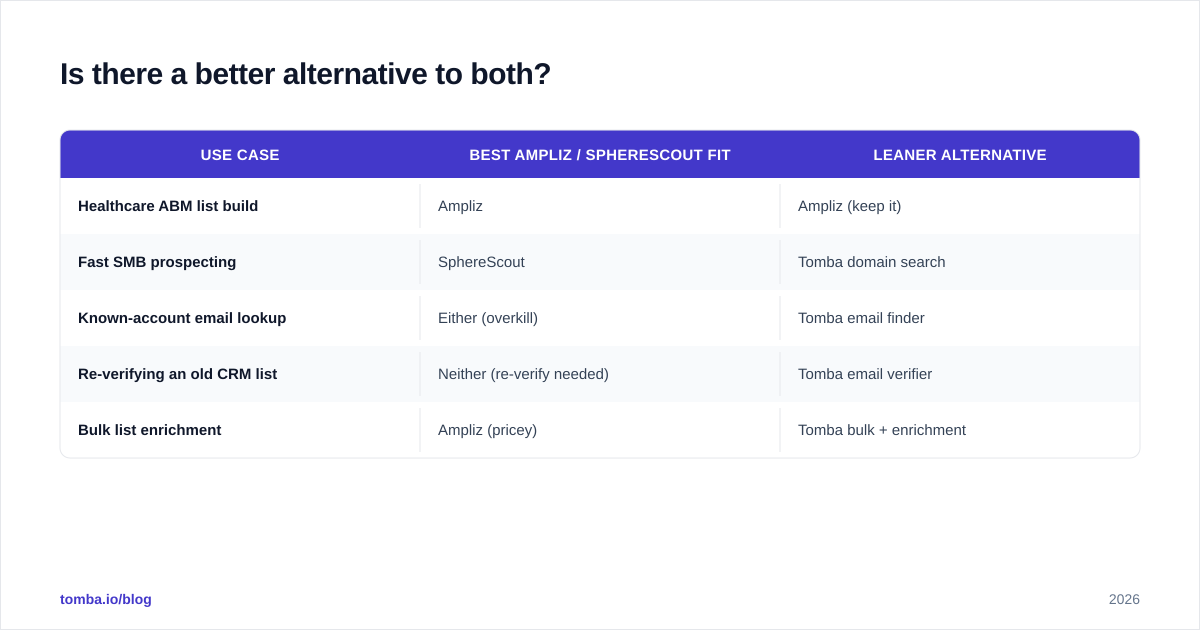
| Use case | Best Ampliz / SphereScout fit | Leaner alternative |
|---|---|---|
| Healthcare ABM list build | Ampliz | Ampliz (keep it) |
| Fast SMB prospecting | SphereScout | Tomba domain search |
| Known-account email lookup | Either (overkill) | Tomba email finder |
| Re-verifying an old CRM list | Neither (re-verify needed) | Tomba email verifier |
| Bulk list enrichment | Ampliz (pricey) | Tomba bulk + enrichment |
The honest answer: keep Ampliz if healthcare or APAC depth is your edge. Otherwise, a verification-first workflow usually wins on both accuracy and cost.
How do you evaluate any B2B data tool before buying?#
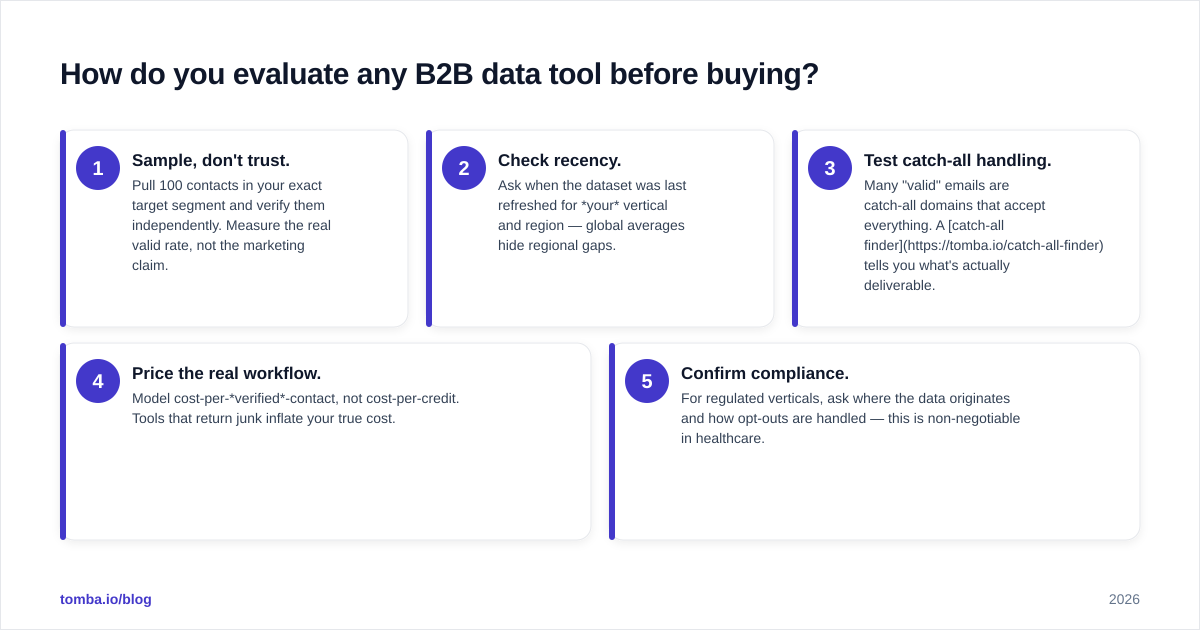
Run the same five-step test on Ampliz, SphereScout, or any vendor:
- Sample, don't trust. Pull 100 contacts in your exact target segment and verify them independently. Measure the real valid rate, not the marketing claim.
- Check recency. Ask when the dataset was last refreshed for your vertical and region. Global averages hide regional gaps.
- Test catch-all handling. Many "valid" emails are catch-all domains that accept everything. A catch-all finder tells you what's actually deliverable.
- Price the real workflow. Model cost-per-verified-contact, not cost-per-credit. Tools that return junk inflate your true cost.
- Confirm compliance. For regulated verticals, ask where the data comes from and how opt-outs are handled. This is non-negotiable in healthcare.
Tools come and go. A disciplined evaluation process protects you from a bad annual contract every time. For more on how data quality affects deliverability, see Tomba's primer on email deliverability.
The bottom line#
The Ampliz vs SphereScout verdict: they solve different problems. Ampliz is the specialist. Buy it for healthcare and APAC depth and account-based precision, and accept the enterprise price. SphereScout is the generalist. Buy it for fast, affordable SMB prospecting, and accept thinner data. Both make you re-verify before you send, because all database-driven tools decay.
Maybe your real need is just finding and confirming work email addresses without a heavy data subscription. If so, start with the Tomba Email Finder. Find emails by name, company, or domain with built-in confidence scoring. Verify them in the same workflow. Scale up to a full platform only once you have proven you need the depth. Try it free with 25 searches a month. Move to the $49/mo Starter plan when your pipeline demands more, with no annual lock-in.
Ready to find emails that actually work?
Join 150,000+ professionals who stopped guessing and started sending. Free credits on signup — no credit card required.
Get the Tomba newsletter
Practical outbound tactics and product updates — once every two weeks.
About the author