Annual Contract Value vs ARR: The 2026 SaaS Metrics Guide
ACV and ARR sound interchangeable, but mixing them up distorts forecasts, comp plans, and board decks. Here's how the two metrics differ and when to use each.
You can close the same deal twice in a board deck and report two completely different numbers — one called ACV, one called ARR — and both can be technically correct. That is exactly why finance, sales, and RevOps teams keep talking past each other. Annual contract value vs ARR is not a trivia question; it decides how you forecast, how you pay reps, and how investors read your growth.
This guide breaks down both metrics with plain formulas, a side-by-side comparison, and concrete rules for when each one belongs in the conversation.
TL;DR#
- ACV (Annual Contract Value) measures the average yearly value of a single contract, usually excluding one-time fees. It is a per-deal lens.
- ARR (Annual Recurring Revenue) measures the total recurring revenue your whole book of business generates in a year. It is a company-wide lens.
- They answer different questions: ACV tells you "how big is a typical deal?"; ARR tells you "how big is the business?"
- Multi-year contracts and one-time fees are where most teams miscalculate both numbers.
- Use ACV for sales targets, pricing, and segmentation; use ARR for valuation, board reporting, and growth tracking.
What is annual contract value (ACV)?#
Annual contract value is the average annualized revenue from a customer contract, normalized to a single year and typically stripped of one-time charges like setup or onboarding fees.
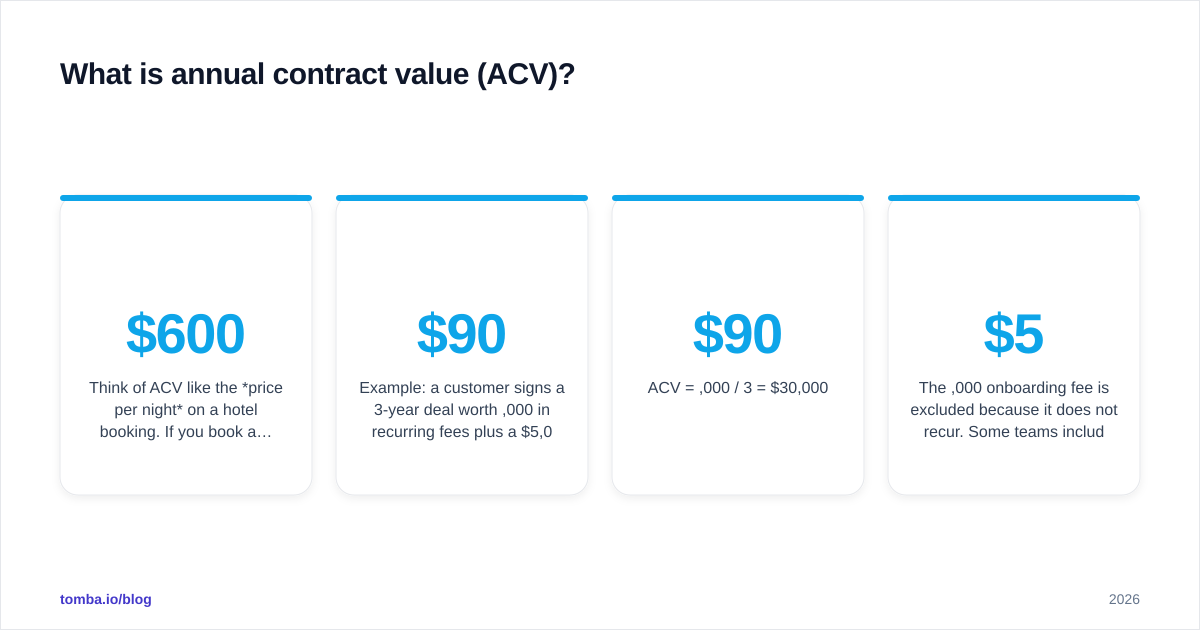
Think of ACV like the price per night on a hotel booking. If you book a 3-night stay for $600, the per-night rate is $200 — even though you paid $600 total. ACV does the same thing to a multi-year contract: it spreads the recurring value across the years so you can compare a one-year deal and a three-year deal on equal footing.
The basic formula:
ACV = Total recurring contract value / Contract term in yearsExample: a customer signs a 3-year deal worth $90,000 in recurring fees plus a $5,000 one-time onboarding charge.
ACV = $90,000 / 3 = $30,000The $5,000 onboarding fee is excluded because it does not recur. Some teams include one-time fees in a "blended ACV," but the cleaner, more common practice is to keep ACV recurring-only so it stays comparable across deals.
ACV shines at the deal level. It powers quota setting, win/loss analysis, pricing experiments, and segmentation — "are our enterprise reps actually landing bigger contracts than mid-market?" If you want context on how this rolls into broader pipeline health, our primer on revenue operations connects the dots.
What is annual recurring revenue (ARR)?#
Annual recurring revenue is the total predictable, recurring revenue your business expects to collect over a 12-month period from all active subscriptions combined.
If ACV is the price per night for one booking, ARR is the total annual revenue of the entire hotel — every room, every guest, summed up. It is a snapshot of the whole recurring engine.
The basic formula:
ARR = Sum of all annualized recurring revenue from active subscriptionsA common shortcut for monthly subscription businesses:
ARR = MRR x 12Example: you have 200 customers each paying $1,000/month in recurring subscription fees.
MRR = 200 x $1,000 = $200,000
ARR = $200,000 x 12 = $2,400,000
ARR is the number investors and boards care about because it reflects scale and momentum. It feeds valuation multiples, net revenue retention math, and growth-rate reporting. Crucially, ARR only counts recurring revenue — services, one-time fees, and usage overages that aren't contractually predictable should be excluded or tracked separately.
Annual contract value vs ARR: what's the real difference?#
The cleanest way to hold both in your head: ACV is per-contract and ARR is portfolio-wide. One zooms in on a deal; the other zooms out to the company.
Here is the side-by-side.
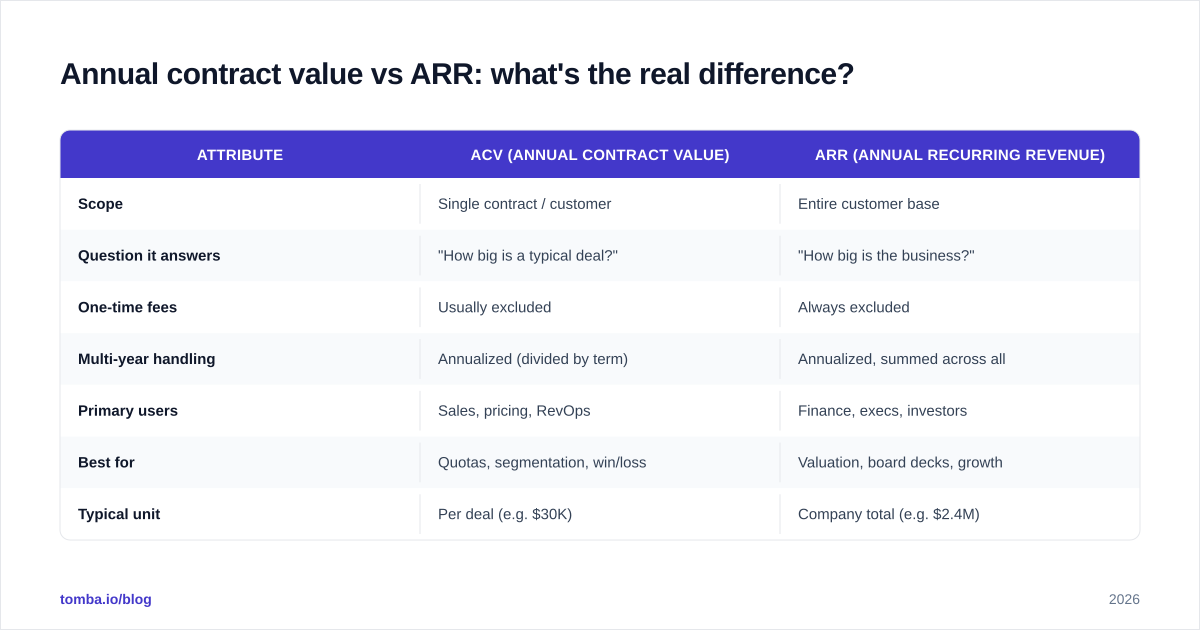
| Attribute | ACV (Annual Contract Value) | ARR (Annual Recurring Revenue) |
|---|---|---|
| Scope | Single contract / customer | Entire customer base |
| Question it answers | "How big is a typical deal?" | "How big is the business?" |
| One-time fees | Usually excluded | Always excluded |
| Multi-year handling | Annualized (divided by term) | Annualized, summed across all |
| Primary users | Sales, pricing, RevOps | Finance, execs, investors |
| Best for | Quotas, segmentation, win/loss | Valuation, board decks, growth |
| Typical unit | Per deal (e.g. $30K) | Company total (e.g. $2.4M) |
| Volatility | Varies deal to deal | Smooth, trend-friendly |
Notice they are not competing metrics — they are different magnifications of the same revenue. You need both. A business with a high ARR but a shrinking ACV might be winning lots of small logos while losing its ability to land large ones. A high ACV with flat ARR could mean a few whales are masking weak overall growth.

How do multi-year contracts break these metrics?#
Multi-year deals are where most ACV and ARR mistakes happen, because the total contract value (TCV) is tempting to report as if it were annual.
Total Contract Value (TCV) is the entire lifetime value of a contract, including one-time fees:
TCV = (Recurring value x term) + one-time feesFor our earlier 3-year, $90,000 + $5,000 deal:
TCV = $90,000 + $5,000 = $95,000
ACV = $90,000 / 3 = $30,000
ARR contribution = $30,000 (the annualized recurring slice)
The trap: reporting $95,000 as "annual" value inflates every downstream number. A rep who closes this should be credited $30,000 in ACV, the contract represents $30,000 of ARR while active, and the $95,000 is only relevant for cash-flow and TCV discussions.
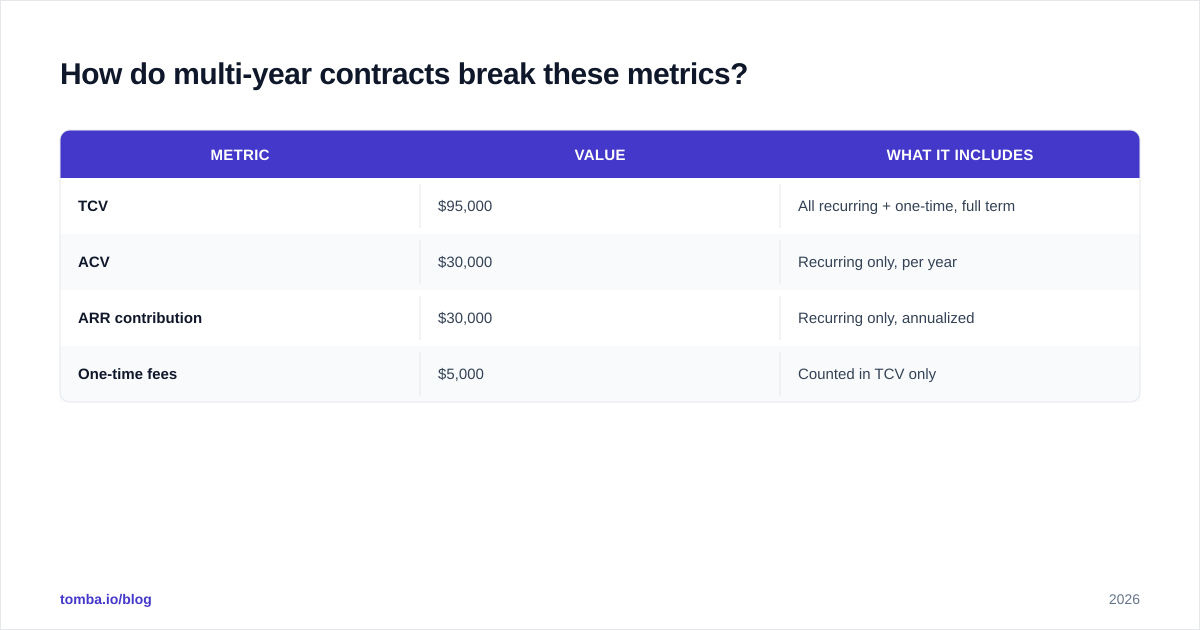
Here's how the same deal looks through each lens:
| Metric | Value | What it includes |
|---|---|---|
| TCV | $95,000 | All recurring + one-time, full term |
| ACV | $30,000 | Recurring only, per year |
| ARR contribution | $30,000 | Recurring only, annualized |
| One-time fees | $5,000 | Counted in TCV only |
When teams blur these, forecasts drift, comp disputes erupt, and board numbers stop reconciling. Pick one definition for each metric, document it, and enforce it across your revenue operations stack.
When should you use ACV vs ARR?#
Conclusion first: use ACV for anything sales- and deal-shaped, and ARR for anything company- and investor-shaped.
Use ACV when you are:
- Setting rep quotas and territories
- Comparing deal sizes across segments (SMB vs enterprise)
- Running pricing or packaging experiments
- Analyzing win rates by contract size — pair it with your win rate tracking
- Forecasting new-business bookings
Use ARR when you are:
- Reporting to the board or investors
- Calculating company valuation and growth rate
- Measuring net revenue retention and churn impact
- Modeling runway and burn multiples
- Benchmarking against peers on platforms like G2 or in HubSpot's SaaS metrics resources
A practical workflow most efficient GTM teams follow: reps and managers live in ACV day-to-day, RevOps rolls those contracts up into ARR weekly, and finance reconciles ARR to recognized revenue monthly. Vendors like HubSpot and Salesforce bake both views into their reporting objects precisely because the two audiences never go away.
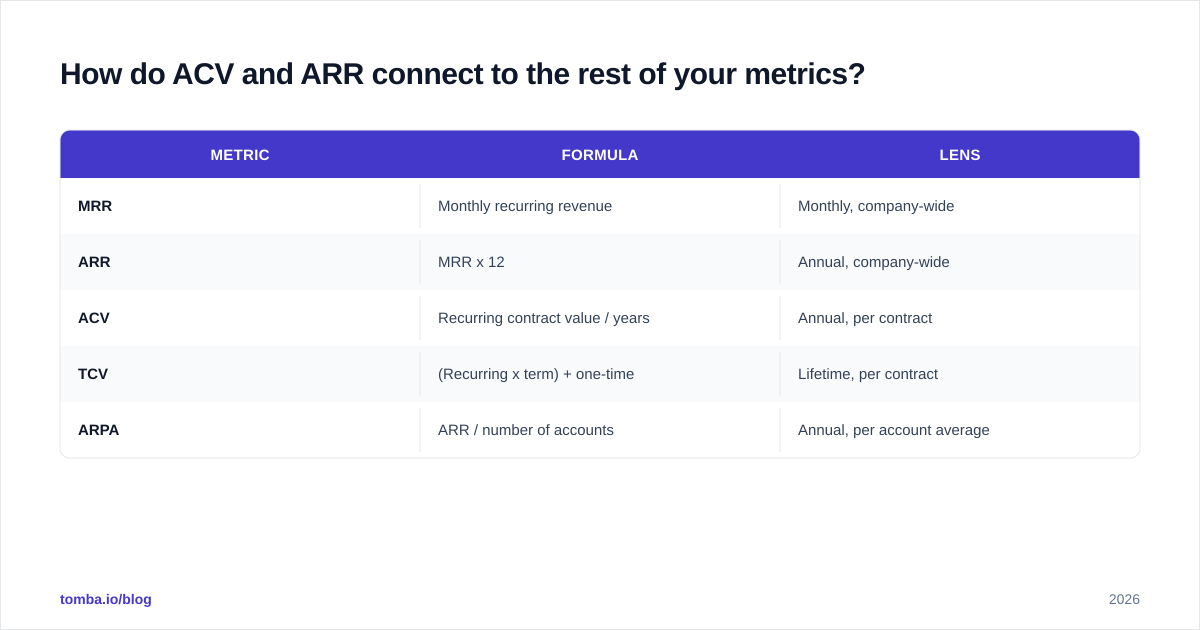
How do ACV and ARR connect to the rest of your metrics?#
ACV and ARR don't live alone. They sit inside a small family of recurring-revenue metrics that constantly reference each other.
| Metric | Formula | Lens |
|---|---|---|
| MRR | Monthly recurring revenue | Monthly, company-wide |
| ARR | MRR x 12 | Annual, company-wide |
| ACV | Recurring contract value / years | Annual, per contract |
| TCV | (Recurring x term) + one-time | Lifetime, per contract |
| ARPA | ARR / number of accounts | Annual, per account average |
ARPA (average revenue per account) is the bridge people forget: it is ARR divided across accounts, so it behaves like a portfolio-level cousin of ACV. If your ACV on new deals is climbing but ARPA across the whole base is flat, your older cohort is dragging — a signal to revisit expansion and retention motions before they hit ARR.
The discipline that makes all of this trustworthy is clean data. If your CRM is full of duplicate accounts, stale contacts, or contracts attributed to the wrong logo, every metric above inherits the mess. Keeping account records accurate and de-duplicated — and enriching them with verified firmographic and contact data — is the unglamorous foundation under every ARR chart. Reliable data enrichment keeps the account layer honest so your ACV and ARR rollups actually reconcile.
What are the most common ACV and ARR mistakes?#
Even experienced teams trip on the same handful of errors. Watch for these:
- Counting one-time fees in ARR. Onboarding, training, and implementation fees are not recurring. Including them inflates ARR and overstates growth.
- Reporting TCV as ACV. A 3-year, $90K deal is $30K of ACV, not $90K. This is the single most common quota and board-deck distortion.
- Ignoring downgrades and churn in ARR. ARR is a net number once you account for contraction and lost logos. New bookings alone aren't ARR growth.
- Mixing definitions across teams. If sales counts ACV one way and finance another, your numbers will never reconcile. Document one definition each.
- Forgetting discounts and credits. Promotional pricing and credits reduce the recurring value — both ACV and ARR should reflect the net contracted amount.
- Letting dirty CRM data corrupt rollups. Duplicate or misattributed accounts double-count revenue. Periodic data enrichment and de-duplication fix this at the source.
Avoiding these isn't about clever math — it's about agreeing on definitions once and enforcing them everywhere. When everyone uses the same formulas, ACV and ARR become a shared language instead of a recurring argument.
Frequently asked questions#
Is ACV the same as ARR for a one-year, single-customer contract? For a single one-year contract with no one-time fees, that contract's ACV equals its ARR contribution. But ARR is the sum across all customers, so at the company level they diverge the moment you have more than one account.
Should ACV include one-time fees? The cleaner standard is no — keep ACV recurring-only so deals stay comparable. One-time fees belong in TCV. If you do blend them, label it explicitly as "blended ACV" so no one confuses it with the recurring figure.
Which metric do investors care about most? ARR. It reflects the scale and predictability of the whole business and drives valuation multiples. ACV is more of an internal sales and pricing tool, though investors may ask about ACV trends to gauge whether you're moving upmarket.
Can ARR go down? Yes. ARR is net of churn, downgrades, and non-renewals. A quarter of strong new bookings can still produce flat or declining ARR if contraction outpaces it — which is exactly why net revenue retention matters.
Putting it to work#
ACV and ARR are not rivals — they are two magnifications of the same recurring revenue. ACV keeps your sales motion honest at the deal level; ARR keeps your story honest at the company level. The teams that win are the ones who define each metric once, exclude one-time fees consistently, annualize multi-year contracts correctly, and keep their account data clean enough that the rollups actually reconcile.
That last point is where execution lives or dies. Accurate metrics start with accurate contacts and accounts. If your pipeline is built on guessed emails and duplicate records, no formula will save your forecast. Tomba's Email Finder helps you build that clean foundation — verified, deduplicated contact data tied to the right companies — so the ACV and ARR numbers you report to your board are built on something real. Start free with 25 searches a month, and see full Tomba pricing when you're ready to scale.
Ready to find emails that actually work?
Join 150,000+ professionals who stopped guessing and started sending. Free credits on signup — no credit card required.
Get the Tomba newsletter
Practical outbound tactics and product updates — once every two weeks.
About the author