Annual Recurring Revenue (ARR): The 2026 SaaS Guide
What annual recurring revenue actually measures, how to calculate ARR correctly, and why most SaaS teams overstate it. A practical 2026 playbook with formulas, benchmarks, and a comparison table.
TL;DR
- Annual recurring revenue (ARR) is the normalized, predictable subscription revenue your business expects over a 12-month period — recurring contracts only, never one-time fees.
- The base formula is simple (
MRR × 12), but the number most teams report is inflated by counting bookings, professional services, or non-renewing deals. - Net ARR (new + expansion − contraction − churn) is the figure investors actually underwrite. Gross ARR alone hides a leaky bucket.
- Net Revenue Retention (NRR) above 100% means your existing customers grow ARR even if you sign zero new logos.
- Clean contact and account data is the unglamorous foundation of accurate ARR — bad records corrupt every downstream calculation.
What is annual recurring revenue?#
Annual recurring revenue is the predictable, contracted subscription revenue a company expects to collect over a single year. Think of ARR as the cruising altitude of a plane: it's the steady, repeatable number you'll hold at — not the one-time burst of fuel it took to get off the runway. That burst is your setup fees, onboarding charges, and one-off services. ARR ignores all of it.
The metric matters because subscription businesses are valued on durability, not on a good month. A $2M year built from one-time license sales is worth far less than a $2M year locked into annual contracts that renew. Boards, investors, and acquirers anchor on ARR precisely because it strips out noise and answers one question: if you signed nothing new tomorrow, how much revenue would still show up?
ARR only applies cleanly to businesses with annual or multi-year subscription terms. If you bill month-to-month, monthly recurring revenue (MRR) is the more honest primary metric, and ARR becomes a derived view.
How do you calculate ARR?#
The simplest version multiplies your monthly recurring revenue by twelve:
ARR = MRR × 12
If you run pure annual contracts, you can also sum the annualized value of every active subscription directly:
ARR = Σ (annual contract value of each active recurring subscription)
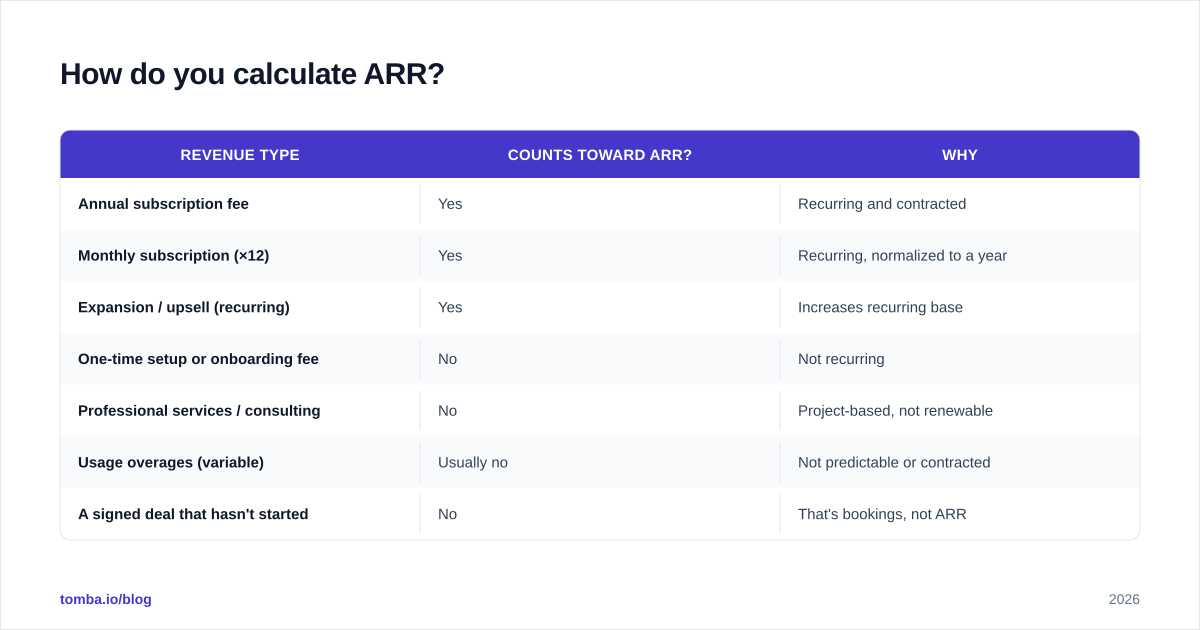
That's the easy part. The hard part is deciding what counts. Here is what belongs and what doesn't:
| Revenue type | Counts toward ARR? | Why |
|---|---|---|
| Annual subscription fee | Yes | Recurring and contracted |
| Monthly subscription (×12) | Yes | Recurring, normalized to a year |
| Expansion / upsell (recurring) | Yes | Increases recurring base |
| One-time setup or onboarding fee | No | Not recurring |
| Professional services / consulting | No | Project-based, not renewable |
| Usage overages (variable) | Usually no | Not predictable or contracted |
| A signed deal that hasn't started | No | That's bookings, not ARR |
The single most common mistake is folding bookings into ARR. A booking is a signed commitment; ARR is live, billing, recognized recurring revenue. A 3-year $300K deal is a $300K booking but only $100K of ARR. Mixing the two inflates your number and sets up an ugly correction later.
What is the difference between gross and net ARR?#
Gross ARR is the total recurring revenue from all active customers. Net ARR adjusts that total for everything that moved during the period — and it's the number that tells the truth.
Net New ARR = New ARR + Expansion ARR − Contraction ARR − Churned ARR
Picture a bucket. New logos and upsells pour water in. Downgrades and cancellations leak water out. Gross ARR measures only the inflow and quietly ignores the leak. Net ARR measures the actual water level. A company can post impressive new-business numbers and still shrink if churn and contraction are draining faster than sales can fill.
The four components every revenue team should track separately:
- New ARR — recurring revenue from brand-new customers
- Expansion ARR — upsells, cross-sells, and seat growth from existing customers
- Contraction ARR — downgrades and reduced seats from existing customers
- Churned ARR — recurring revenue lost to cancellations
Reporting only gross ARR is the metric equivalent of weighing yourself with your coat on. It's technically a number; it just isn't the one that matters.
What is a good ARR growth rate and NRR benchmark?#
The benchmark depends on stage, but two numbers dominate board conversations: ARR growth rate and Net Revenue Retention.
Net Revenue Retention measures how recurring revenue from your existing customer base changes over a year, including expansion, contraction, and churn — but excluding new logos.
NRR = (Starting ARR + Expansion − Contraction − Churn) / Starting ARR
An NRR above 100% is the holy grail: it means your current customers spend more each year even if you acquire nobody new. According to widely cited SaaS benchmarks compiled by firms like OpenView and Bessemer, best-in-class B2B SaaS companies post NRR between 110% and 130%.
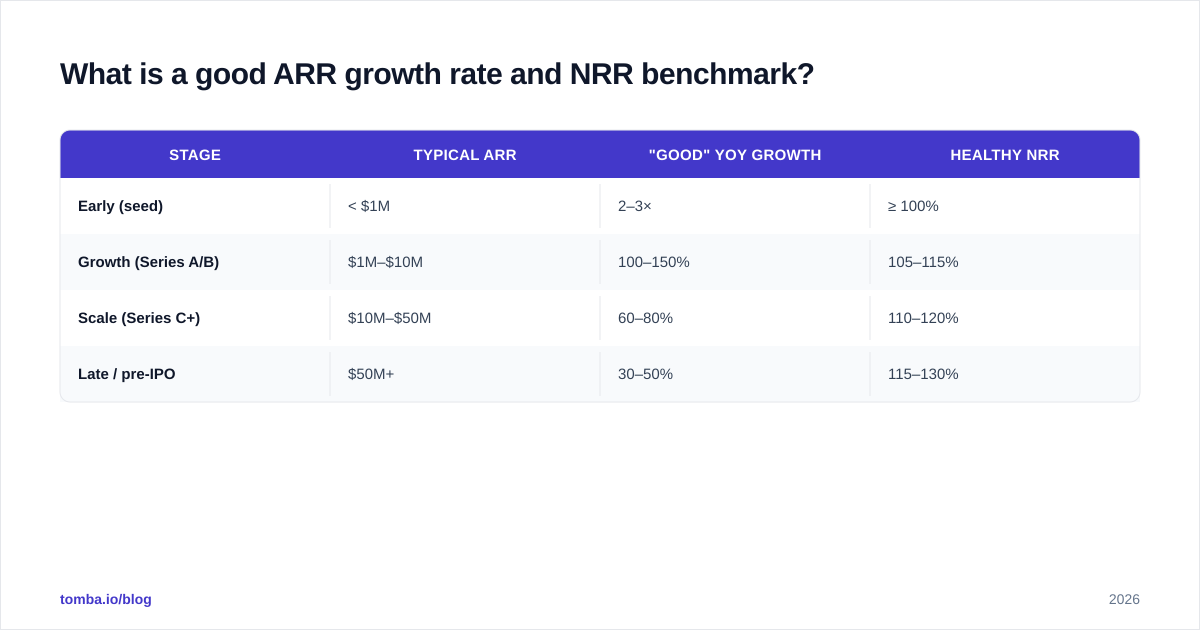
Here is a rough orientation by company stage. Treat these as directional, not gospel:
| Stage | Typical ARR | "Good" YoY growth | Healthy NRR |
|---|---|---|---|
| Early (seed) | < $1M | 2–3× | ≥ 100% |
| Growth (Series A/B) | $1M–$10M | 100–150% | 105–115% |
| Scale (Series C+) | $10M–$50M | 60–80% | 110–120% |
| Late / pre-IPO | $50M+ | 30–50% | 115–130% |
The pattern is clear: growth rates compress as ARR grows (the law of large numbers is undefeated), but retention should hold or improve. A scaling company with declining NRR is a warning sign no amount of new-logo velocity fully offsets.
How does ARR connect to sales pipeline and forecasting?#
ARR is a lagging indicator; your pipeline is the leading one. The bridge between them is conversion math, and that's where clean data and a disciplined sales process and pipeline earn their keep.
To forecast net new ARR for a quarter, you work backwards from the target:
- Start with the net new ARR goal.
- Divide by average deal ARR to get deals needed.
- Divide by win rate to get qualified opportunities needed.
- Divide by opportunity-to-qualified conversion to get the top-of-funnel volume needed.
Every step in that chain depends on accurate inputs. If your CRM is full of duplicate accounts, dead contacts, or wrong company sizes, your average deal value and win rate are fiction — and a forecast built on fiction is just an expensive guess.
This is the unglamorous truth behind ARR accuracy: it starts with the contact record. Reaching the right decision-maker with a verified email, enriching an account with correct firmographics, and deduplicating your list all directly improve the conversion rates that drive your ARR forecast. Tools like the Tomba Email Finder and data enrichment feed clean inputs into the top of that funnel, while a solid email verifier keeps bounce rates from quietly torching your outbound efficiency.
What are the most common ARR mistakes?#
Most ARR errors aren't fraud — they're sloppy definitions and optimistic rounding. Watch for these:
- Counting bookings as ARR. The deal is signed but not live. It's a commitment, not recognized recurring revenue.
- Including one-time fees. Setup, training, and professional services are real money but not recurring. They don't belong in ARR.
- Ignoring churn timing. Customers who've given notice but haven't lapsed yet are often still counted. They're already gone in spirit.
- Counting usage overages as recurring. Variable consumption isn't predictable. If it isn't contracted, it isn't ARR.
- Annualizing a discounted first month. A promotional rate multiplied by 12 overstates the steady-state value.
- Double-counting expansion. Mixing the upsell into both new ARR and expansion ARR inflates the total.
A useful self-check: if you wouldn't bet your renewal forecast on a line item, it probably shouldn't be in ARR.
How do you grow ARR sustainably?#
There are only three levers, and the order you pull them matters:
1. Acquire new customers (New ARR). The most expensive lever. Necessary, but the hardest to scale efficiently because customer acquisition cost rises as you exhaust your best-fit market. Efficient acquisition depends on precise targeting — knowing exactly which accounts fit and reaching the right buyer there.
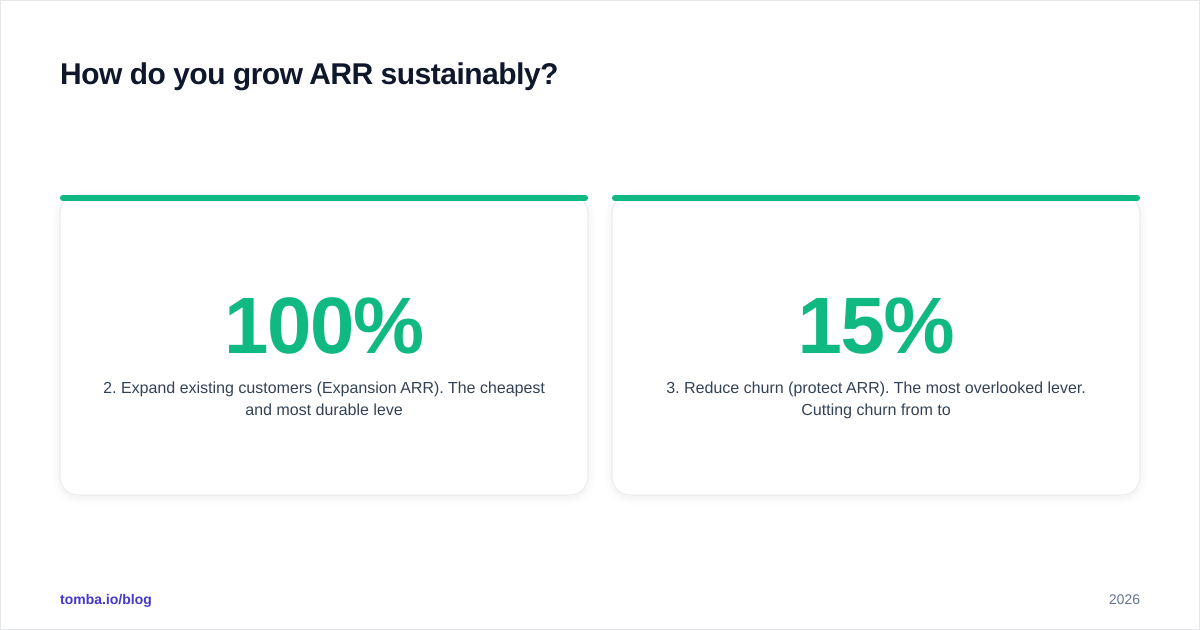
2. Expand existing customers (Expansion ARR). The cheapest and most durable lever. Selling more seats, tiers, or modules to happy customers carries near-zero acquisition cost and is the engine behind NRR over 100%. This is where most efficient SaaS growth actually comes from.
3. Reduce churn (protect ARR). The most overlooked lever. Cutting churn from 15% to 10% can do more for net ARR than a quarter of heroic new-logo selling. Retention compounds; acquisition resets every period.
The practical implication: a healthy ARR engine invests in customer success and product stickiness, not just sales headcount. Founders love the new-logo dopamine hit, but the math rewards the boring work of keeping and expanding the customers you already have. For teams running outbound to feed lever one, pairing accurate prospecting data with disciplined follow-up is what keeps acquisition cost from eating your ARR gains alive — start with verified emails so your best reps spend time selling, not chasing bounced messages.
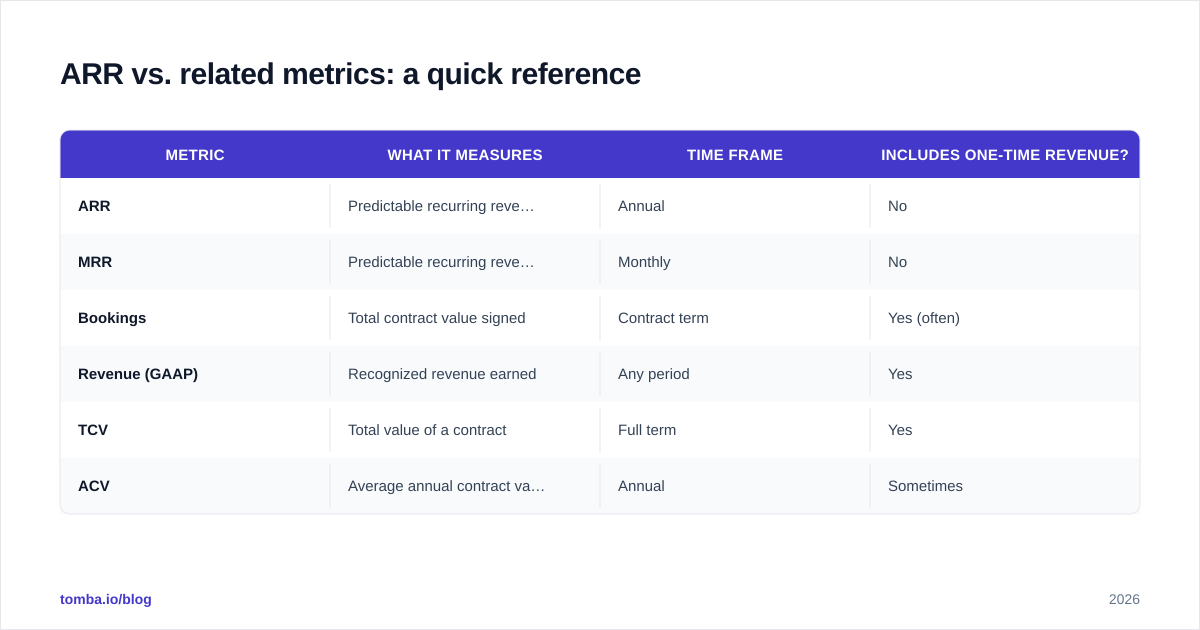
ARR vs. related metrics: a quick reference#
ARR doesn't live alone. Here's how it relates to the metrics it's most often confused with:
| Metric | What it measures | Time frame | Includes one-time revenue? |
|---|---|---|---|
| ARR | Predictable recurring revenue | Annual | No |
| MRR | Predictable recurring revenue | Monthly | No |
| Bookings | Total contract value signed | Contract term | Yes (often) |
| Revenue (GAAP) | Recognized revenue earned | Any period | Yes |
| TCV | Total value of a contract | Full term | Yes |
| ACV | Average annual contract value | Annual | Sometimes |
The trap is treating these as interchangeable. Bookings and TCV measure commitment. GAAP revenue measures what's been earned. ARR measures durable, repeatable subscription value. Different audiences need different numbers, and presenting one when someone expects another is how credibility evaporates in a board meeting.
Why does data quality decide ARR accuracy?#
Your ARR is only as trustworthy as the records underneath it. Every calculation — new, expansion, contraction, churn — rolls up from individual account and contact data. When those records are duplicated, stale, or wrong, the aggregate is wrong too, and nobody notices until renewal season exposes the gap.
This is the quiet through-line of revenue operations. Accurate firmographics tell you which accounts have expansion headroom. Verified contacts let you actually reach the buyer who controls the renewal. Deduplicated lists stop you from counting the same logo twice. The most sophisticated ARR dashboard in the world is worthless if it's aggregating garbage. Industry analysts at Gartner have long flagged poor CRM data hygiene as a leading cause of inaccurate revenue forecasting — the model is rarely the problem; the inputs are.
If you're building or cleaning the data layer that feeds your ARR motion, start at the source: find and verify the right contacts, enrich your accounts, and keep your CRM free of duplicates. The Tomba Email Finder helps you reach verified decision-makers by domain, name, or company, so the pipeline feeding your annual recurring revenue is built on real, reachable people — not guesses. Pair it with bulk verification and enrichment, and the number your board lives by finally reflects reality. See Tomba pricing to match a plan to your outbound volume.
Ready to find emails that actually work?
Join 150,000+ professionals who stopped guessing and started sending. Free credits on signup — no credit card required.
Get the Tomba newsletter
Practical outbound tactics and product updates — once every two weeks.
About the author